
The world price of a commodity will settle at the level where
a. supply and demand are equal within each country.
b. the excess demand of the importing country is equal to the excess supply of the
exporting country.
c. the excess demand in the exporting country is equal to the excess demand in the
importing country.
d. there is no excess demand in the exporting country.
A rise in price will always result in an increase in the total amount consumers spend on
a product.
a. True
b. False
If DI falls by $100 billion, and C falls by $90 billion, the slope of the consumption is
a. −0.45.
b. 0.45.
c. −0.90.

d. 0.90.
e. 0.50.
Excess capacity and inefficiency result under monopolistic competition.
a. True
b. False
Assume that the banking system has $200 billion in reserves. There are no excess
reserves in the system. If the reserve requirement is decreased from 10 percent to 8
percent, what will happen to the level of excess reserves in the system?
a. There will be a deficiency of $40 billion in reserves.
b. There will be a deficiency of $20 billion in reserves.
c. There will be $20 billion in excess reserves.
d. There will be $40 billion in excess reserves.

Banks try to keep their excess reserves at a maximum in order to maximize profits.
a. True
b. False
The concept of equity pertains to the fairness of a tax.
a. True
b. False
Poverty is a mainstream event experienced by a majority of Americans.
a. True
b. False

A firm’s total revenue is simply the price of its product multiplied by the quantity sold.
a. True
b. False
One effect of market intervention is resource misallocation.
a. True
b. False
How do critics of stabilization policy view the “political business cycle”?
a. They suggest shorter election cycles would improve stabilization.
b. They believe that politicians cause economic instability, due mainly to the election
schedule.
c. They believe that the Fed can resist political pressure and stabilize the economy.

d. They believe that politicians do not know enough economics in order to stabilize the
economy.
Property taxes are the main source of funding for public schools.
a. True
b. False
If the objective of economic policy is to decrease the amount of pollution by an industry
in the long run, the
a. most effective policy action would be a subsidy to firms for the reduction of
emissions.
b. most effective policy action would be a tax on polluting firms.
c. appropriate course of action for government is to do nothing.
d. appropriate course of action for government is to increase R&D outlays to develop
technology to remove the emissions from the environment.

What happens typically to a budget deficit during a recession?
a. It increases because of tax changes.
b. It decreases because of spending decreases.
c. It decreases automatically.
d. It increases automatically.
Why does an increase in the price level tend to cause the consumption function to shift
downward?
a. An increase in the price level decreases disposable income.
b. An increase in the price level increases the demand for fixed money assets.
c. An increase in the price level decreases the value of fixed money assets.
d. An increase in the price level decreases saving and increases debt.

Purchasing power parity explains how exchange rates cause price differences between
two countries.
a. True
b. False
An expansionary monetary policy will
a. increase imports.
b. decrease exports.
c. increase a current account deficit.
d. decrease a capital account surplus.
The excess capacity theorem implies that
a. consumers would be better off if some monopolistically competitive firms left their
markets.
b. consumers would be better off with more standardization of products.
c. monopolistic competition benefits society by eliminating excess capacity in
production.
d. monopolistic competition wastes some of society’s resources but the elimination of
this waste does not necessarily benefit consumers.
The argument that the minimum wage law has significantly increased teenage
unemployment is not supported by recent statistical analysis.
a. True
b. False
From the late 1960s to the late 1980s, SAT scores in the United States
a. help explain the productivity increases.
b. rose consistently throughout the period.
c. declined throughout the period.
d. indicated improving workforce quality.

Of all the payments made to factors of production in the United States in 2013, ____
received the lowest share.
a. land rents
b. labor
c. interest payments
d. corporate profits
Imports are a leakage in the sense that
a. the international financial system is unstable.
b. consumers buy foreign output of goods and services.
c. foreigners earn less than U.S. workers.
d. a trade deficit increases aggregate demand.
Which of the following is the term used to describe a failing bank selling off a
substantial amount of assets in a short time period in order to remain solvent?
a. fire sale

b. short sale
c. long sale
d. liquidity sale
Marginal social cost is defined as marginal private cost
a. plus opportunity cost.
b. plus marginal opportunity cost.
c. minus incidental cost.
d. plus incidental cost.
Figure 11-6
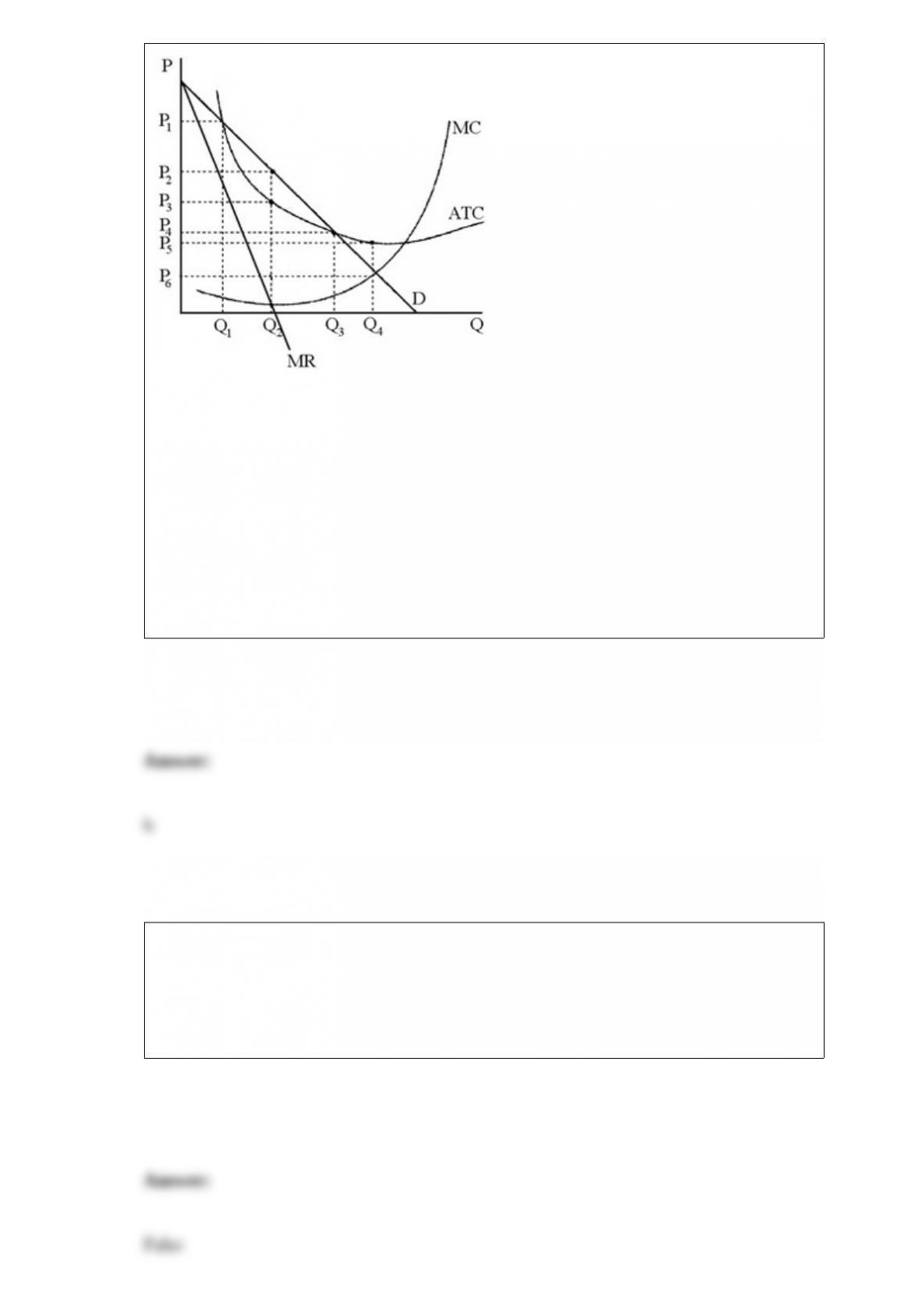
The profit-maximizing monopolist in Figure 11-6 will sell its output at
a. P1.
b. P2.
c. P3.
d. P4.
The federal government of the United States relies heavily on value-added taxes.
a. True
b. False
The occurrence of bank failures in the United States
a. ended after 1933 and the creation of the FDIC.
b. increased dramatically during the Clinton administration.
c. reappeared in intensity in the late 1990s and early 2000s.
d. reappeared in the 1980s and early 1990s and again in 2006.
Prices influence the distribution of income by making the distribution fairer.
a. True
b. False
Regulations that strictly limit pollution
a. provide firms no incentives to reduce pollution once a standard is met.
b. provide incentives for firms to discover loopholes in the regulations.
c. tend to be economically inefficient ways to reduce pollution.
d. All of the above are true.

In terms of the price-real GDP diagram, a given expansion of the money supply will
have a greater effect on prices the
a. steeper the aggregate supply curve.
b. flatter the aggregate supply curve.
c. higher the initial price level.
d. lower the initial price level.
Table 22-4
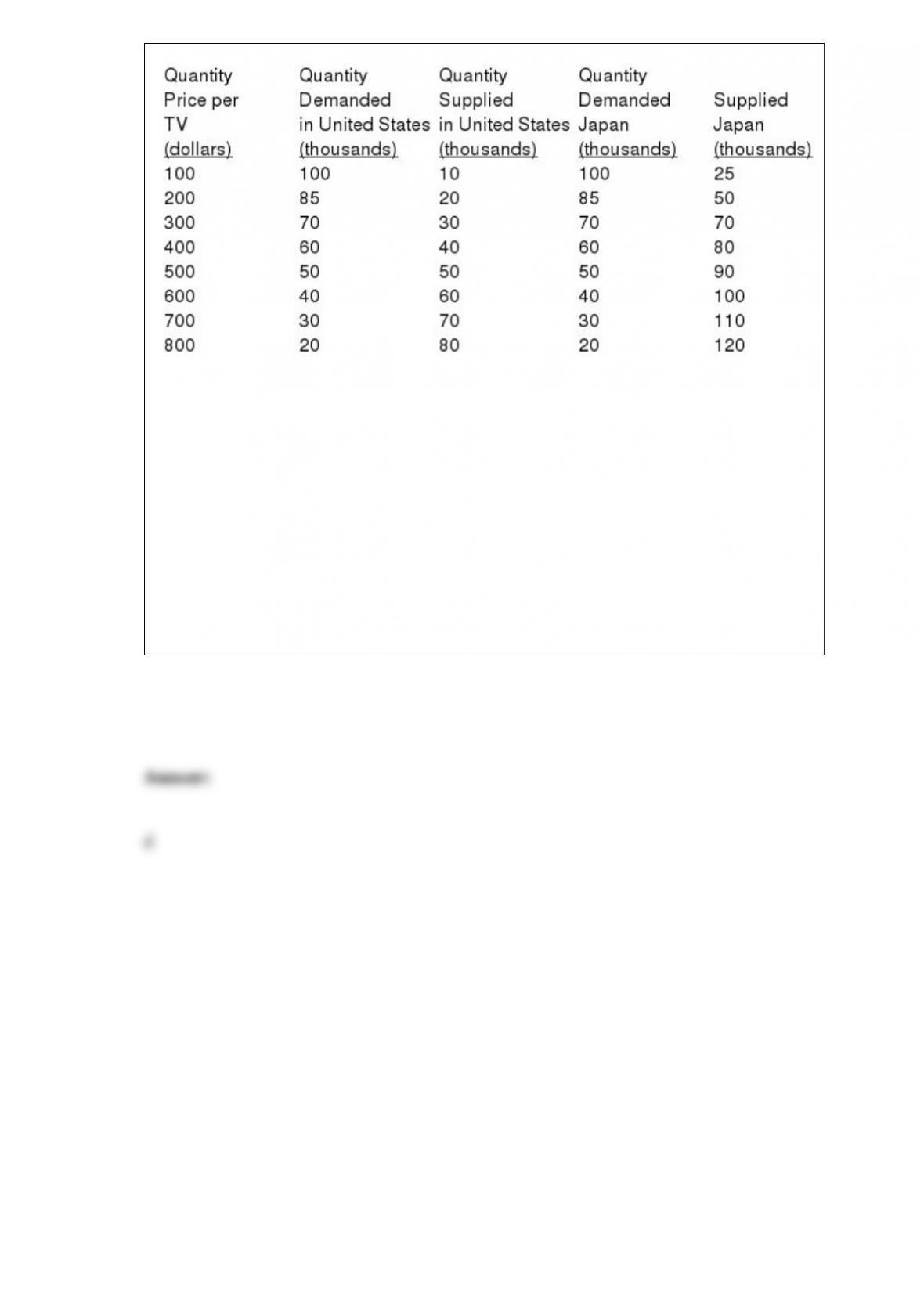
Table 22-4 presents the demand and supply schedules for television sets in Japan and
the United States. If the United States and Japan decide to trade with each other, what
will happen to the output of television sets in Japan?
a. TV production in Japan will fall by 10,000 units.
b. TV production in Japan will fall by 20,000 units.
c. TV production in Japan will fall by 30,000 units.
d. TV production in Japan will increase by 10,000 units.