
Which of the following was an argument in favor of using discretionary fiscal policy in
fighting the Great Recession?
A) Monetary policy could not be effective, since interest rates were near zero.
B) If taxes were increased, the budget could be balanced.
C) If government spending decreased, the budget surplus would increase.
D) The lags associated with monetary policy would be destabilizing.
Since the Federal Reserve has the power to determine the supply of money, the money
supply curve in the liquidity preference model is a(n):
A) horizontal line.
B) vertical line.
C) upward-sloping line.
D) upward-sloping, then vertical line when Congressional rules change the Federal
Reserve’s powers.
Productivity is declining when:
A) the number of hours worked exceeds the number of workers.
B) population growth exceeds real GDP growth.
C) the ratio of adult civilians employed outside the home rises.
D) real GDP growth exceeds the population growth.
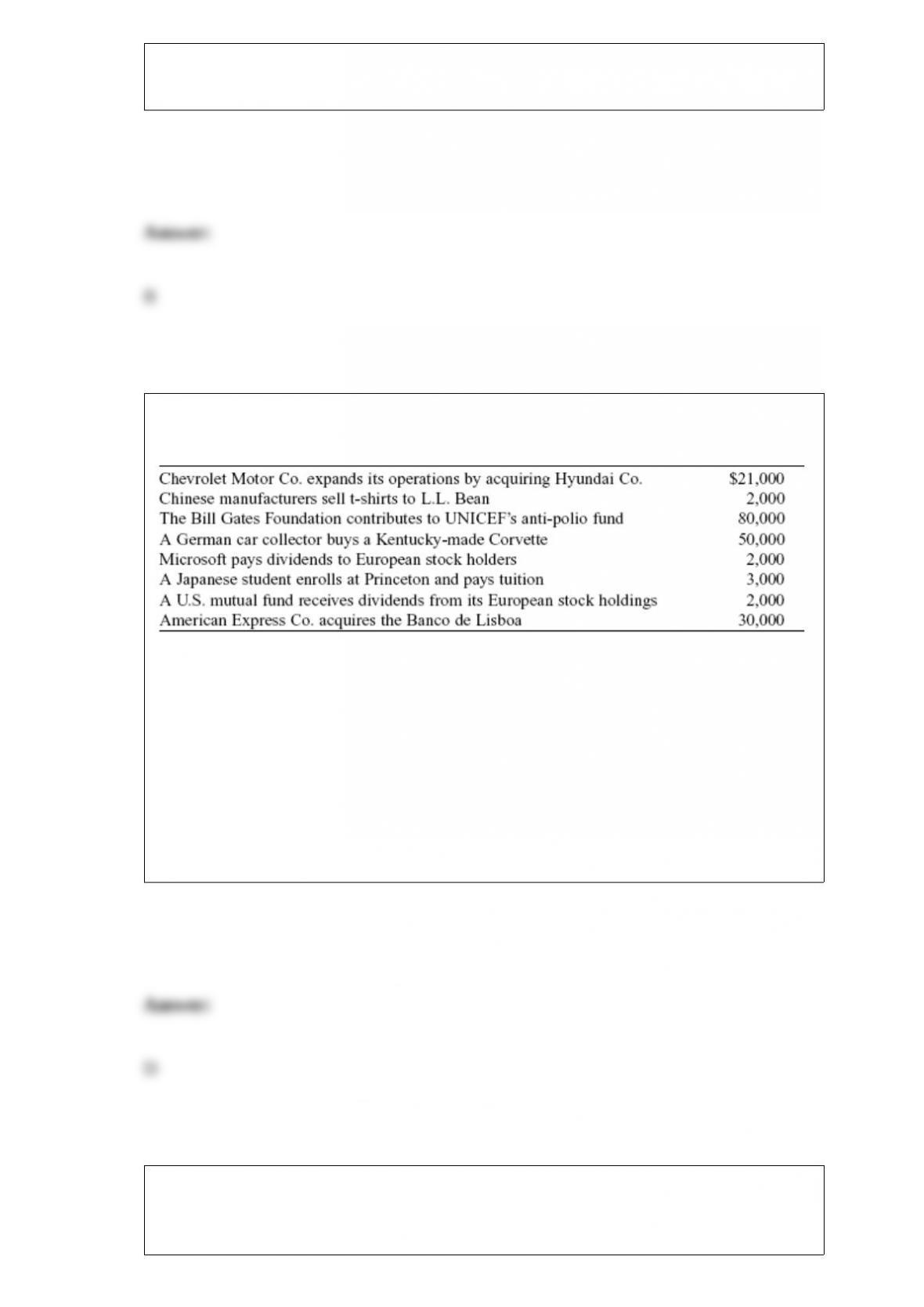
Table: International Transactions
Look at the table International Transactions. The balance on current account is:
A) $29,000.
B) $22,000.
C) “$8,000.
D) “$29,000.
Scenario: Linear Production Possibility Frontier
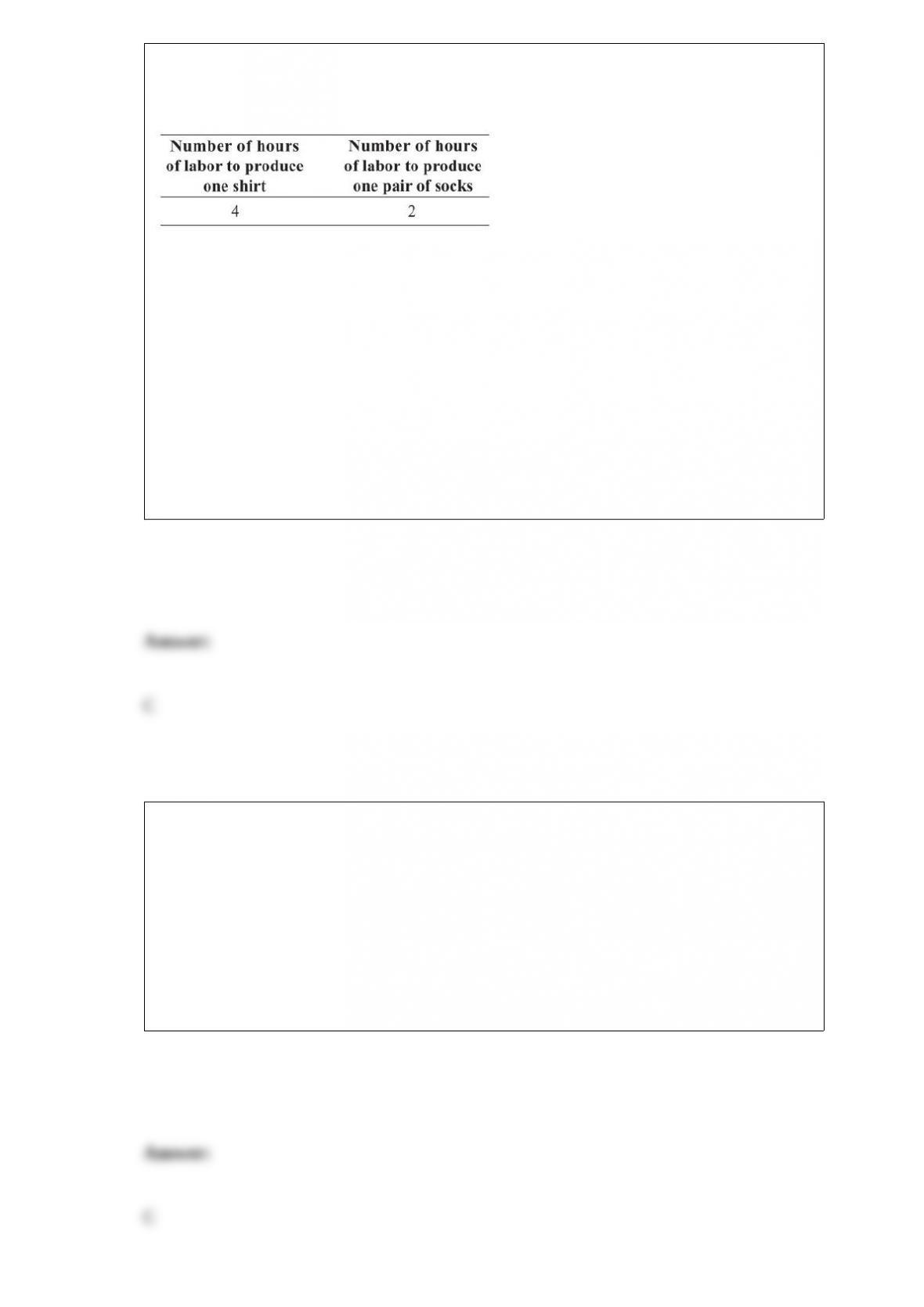
Largetown has a linear production possibility frontier, and it produces socks and shirts
with 80 hours of labor. The table shows the number of hours of labor necessary to
produce one pair of socks or one shirt.
Look at the scenario Linear Production Possibility Frontier. If Largetown’s labor
resource decreases by 40 hours, the opportunity cost of producing shirts:
A) increases.
B) decreases.
C) does not change.
D) may or may not change depending upon the number of pairs of socks it wishes to
produce.
Which of the following will NOT cause an increase in the supply of good X?
A) an improvement in the technology used to produce good X
B) a decrease in the price of good Y, a substitute in production
C) an increase in the price of inputs used to produce good X
D) a decrease in the price of inputs used to produce good X

High-fructose corn syrup, which is derived from corn, is an important ingredient in the
production of many soft drinks. If the price of corn increases, one would expect:
A) the supply curve for soft drinks to shift left.
B) the quantity supplied of soft drinks to increase.
C) the demand for soft drinks to increase.
D) the supply curve for soft drinks to shift right.
In the United States, investment spending accounts for approximately _____ of GDP.
A) 6%
B) 16%
C) 24%
D) 33%
An unplanned fall in inventories leads to:
A) prices falling.
B) production falling.

C) production increasing.
D) interest rates increasing.
Scenario: Income”Expenditure Equilibrium
Real GDP is $8,000, autonomous consumption is $500, and planned investment
spending is $200. The marginal propensity to consume is 0.8.
Look at the scenario Income”Expenditure Equilibrium. How much is unplanned
inventory investment?
A) $1,100
B) “$900
C) $900
D) 0
If Jim’s income is $80,000 and the price level is 4, then Jim’s real income is:
A) $20,000.
B) $320,000.
C) $84,000.
D) $80,000.

In the long run, as the economy self-corrects, an increase in aggregate demand will
cause the price level to _____ and potential output to _____.
A) rise; increase
B) fall; decrease
C) rise; remain stable
D) fall; remain stable
If the money supply grows by 4% and the real money supply is $100 billion, real
seignorage is:
A) $4 billion.
B) $25 billion.
C) $400 billion.
D) $2.5 trillion.

The merchandise trade balance:
A) is the difference between sales of assets to foreigners and purchases of assets by
foreigners.
B) is the difference between a country’s exports and imports of goods.
C) includes the value of services traded.
D) is not part of the current account.
Expansionary monetary policy may increase consumer spending.
A) True
B) False
The real business cycle theorists say that changes in total factor productivity are totally
the result of:
A) depressions.
B) shifts in aggregate supply.
C) shifts in aggregate demand.
D) uneven technological progress.

The circular-flow diagram illustrates all of the following in the U.S. economy EXCEPT:
A) growing income inequality.
B) flows of money.
C) flows of goods and services.
D) the purchase and sale of factors of production.
A current account surplus is generally a result of:
A) imports exceeding exports.
B) sales of stock in U.S. companies to citizens of foreign countries.
C) a large influx of foreign investment income.
D) exports exceeding imports.

The aggregate demand curve:
A) slopes downward.
B) slopes upward.
C) is horizontal at potential output.
D) is vertical at potential output.
A change in taxes shifts the aggregate demand curve by _____ than a change in
government spending for goods and services and has a _____ effect on real GDP.
A) more; smaller
B) more; larger
C) less; smaller
D) less; larger
All of the following are financial assets EXCEPT:
A) bonds.

B) stocks.
C) bank deposits.
D) gold coins.
A country with a fixed exchange rate regime:
A) tends to increase uncertainty regarding the value of its currency.
B) allows countries to use both fiscal and monetary policies to stabilize their economy.
C) reduces a country’s bias toward inflationary policies.
D) reduces the amount of foreign currency a country must hold.
The biggest global environment issue is:
A) the impact of fossil-fuel consumption on the world’s climate.
B) the availability of coal.
C) how to determine who has the property rights to wind power.
D) how to extract oil from Canadian tar sands.
A mutual fund:
A) always includes a base year.
B) owns a diversified portfolio.
C) always earns a profit.
D) offers a lower rate of return for any given level of risk.
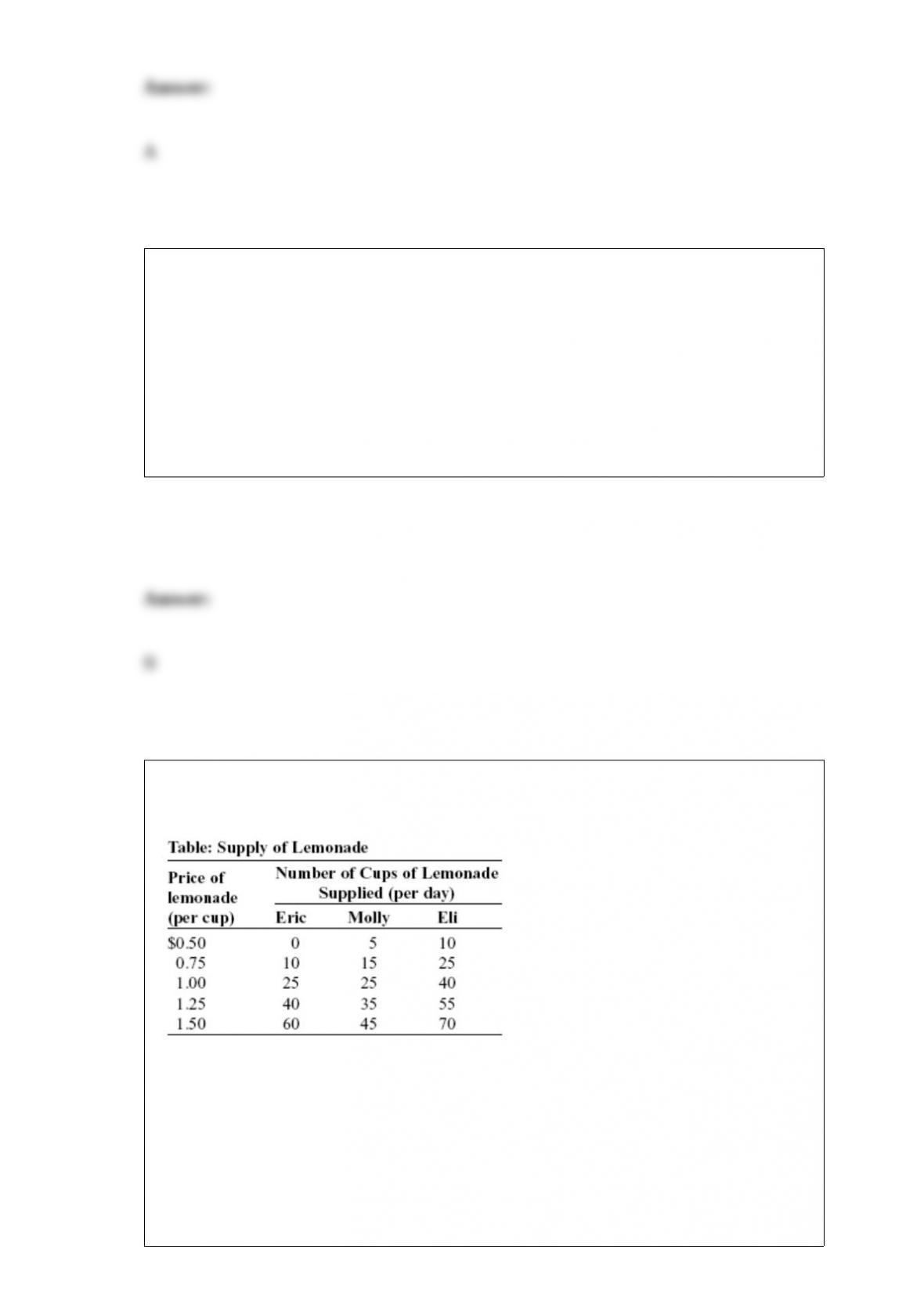
Look at the table Supply of Lemonade. When the price of lemonade is $1 per cup, the
quantity of lemonade supplied by Eli will be:
A) 40 cups.
B) 90 cups.
C) 10 cups.
D) 25 cups.
In 1989 Congress increased oversight of S&Ls and allowed two government agencies,
Fannie Mae and Freddie Mac, to take over much of the home mortgage lending
previously done by the thrifts.
A) True
B) False
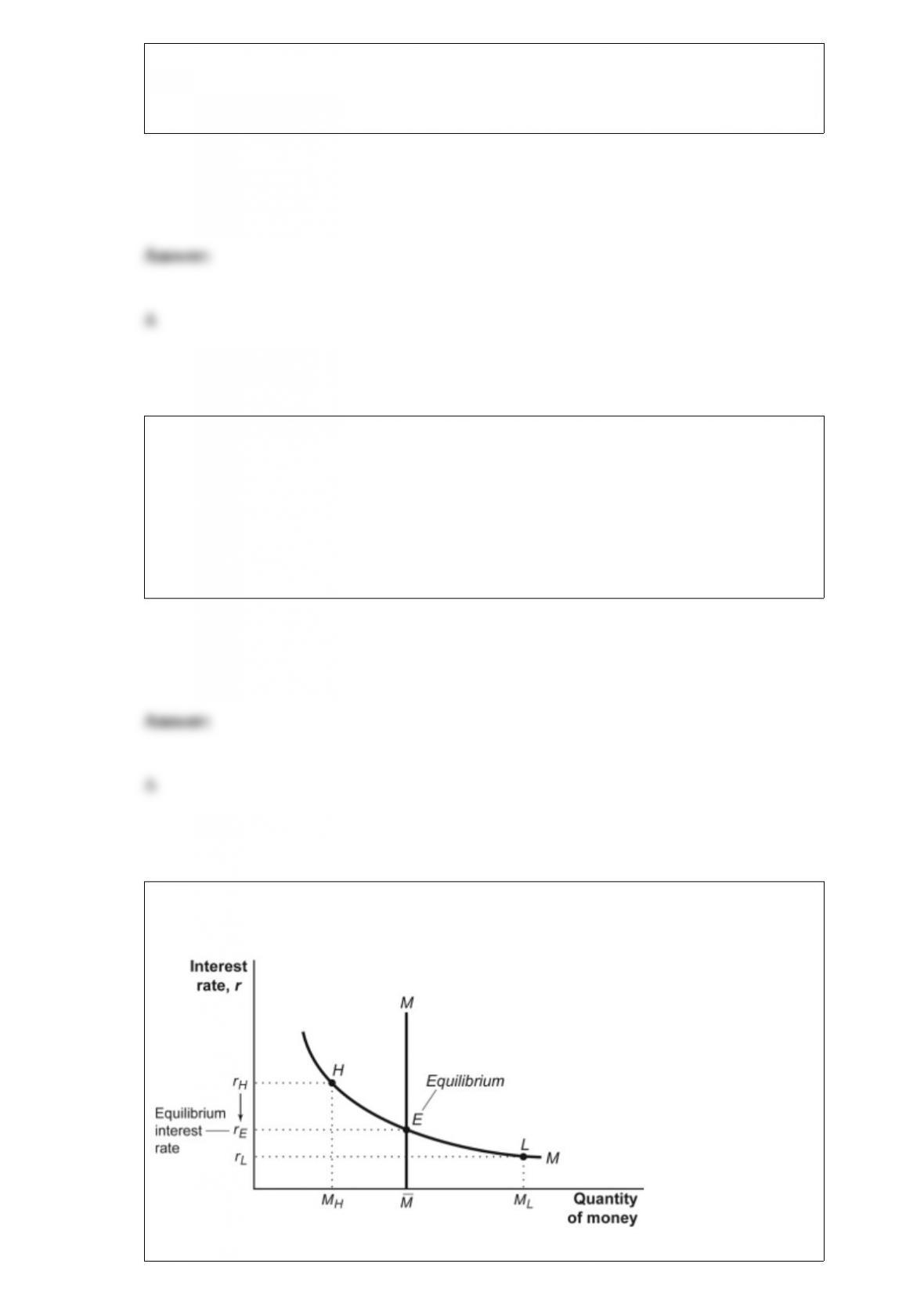
Figure: Money Market I
Look at the figure Money Market I. If the money market is initially in equilibrium at

point Eand the central bank sells Treasury bills, then the interest rate will:
A) move toward point H.
B) move toward point L.
C) remain at point E.
D) shift rightward.
The theory of monetary neutrality means that monetary policy is completely irrelevant.
A) True
B) False
A shift to the left of the demand for loanable funds could be caused by:
A) more business investment spending financed through borrowing.
B) less business investment spending financed through borrowing.
C) a loosening of requirements needed to borrow funds.
D) a more promising-looking economy.

Assume that the foreign exchange market is trading the domestic currency at a rate
(U.S. dollars per unit of the domestic currency) above the rate fixed by the government.
To maintain the fixed exchange rate, the government must:
A) decrease foreign exchange reserves.
B) lower the domestic interest rate.
C) facilitate the domestic purchase of foreign financial assets.
D) raise the domestic interest rate.
Many economists view resource scarcity as a:
A) major obstacle to long-run economic growth.
B) problem resolved fairly well by the market mechanism.
C) primary reason for poor countries’ lack of economic growth.
D) problem for wealthy countries but not for poorer countries.
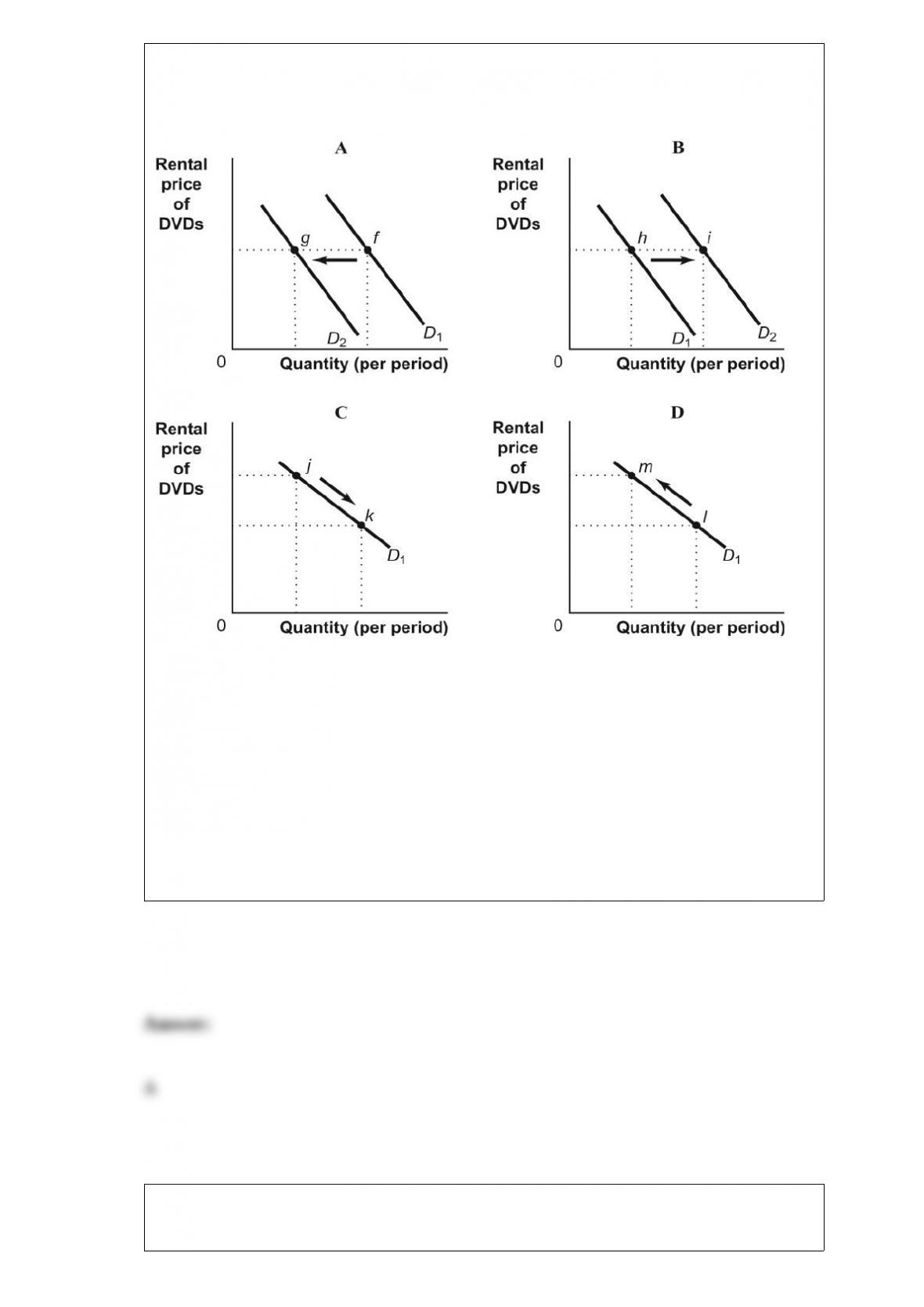
Figure: Demand for DVDs
Look at the figure Demand for DVDs. A decrease in the price of movie tickets (a
substitute) would result in a change illustrated by the move from:
A) f to g in panel A.
B) h to i in panel B.
C) j to k in panel C.
D) l to m in panel D.
Which of the following figures is used to measure changes in the prices that firms pay
for goods and services?

A) producer price index
B) consumer price index
C) GDP deflator
D) cost of living index