
Assume that seigniorage and the government’s primary deficit are both zero. If the real
interest rate is greater than the growth rate of real GDP, the debt-to-GDP ratio
A) will increase.
B) will decrease.
C) will either decrease or not change.
D) will either increase or not change.
Suppose you purchase a one-year bond that has a $450 coupon and a face value of
$5,000, and immediately after you purchase the bond, new bonds are issued that are
otherwise identical, except they have coupons of $375. If you sell your bond, you will
A) suffer a loss of $5.76.
B) suffer a loss of $412.84.
C) receive a gain of $69.77.
D) receive a gain of $418.60.
Gross domestic product is calculated as the sum of the
A) total quantity of final goods and services produced in the economy during a period
of time.

B) total quantity of goods and services produced in the economy.
C) total market value of goods and services produced in the economy.
D) total market value of final goods and services produced in the economy during a
period of time.
If the marginal product of labor is less than the nominal wage divided by the price of
output, a firm that wishes to maximize profits will
A) hire more labor.
B) lay off workers.
C) maintain its current level of workers.
D) raise the real wage.
On which of the following government spending projects would the crowding out effect
most likely be the greatest?
A) government spending on farm subsidies
B) government spending on improvements in infrastructure
C) government spending on research and development
D) government spending on education
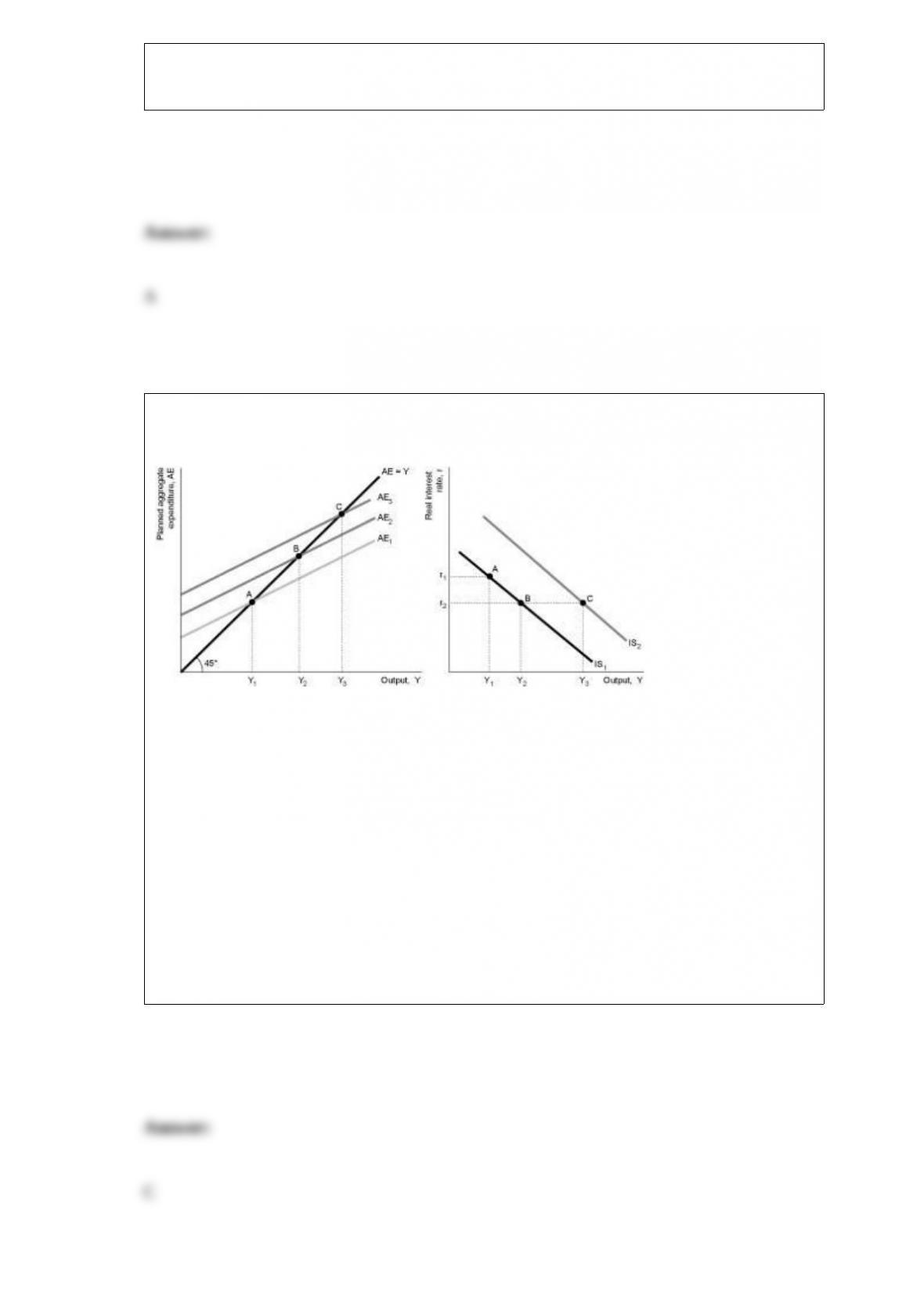
Figure 10.3
Panel (a) Panel (b)
Refer to Figure 10.3. An increase in the real interest rate, with no other changes that
affect aggregate expenditure, is best represented by ________ in panel (a) and
________ in panel (b).
A) a shift from AE2 to AE3; a shift from IS1 to IS2
B) a shift from AE3 to AE2; a shift from IS2 to IS1
C) a shift from AE2 to AE1; a movement from point B to point A
D) a shift from AE3 to AE1; a movement from point C to point A

From 2012 until 2087, the CBO projects that, as a percentage of GDP, government
revenues are expected to ________, government expenditure is expected to ________,
and the budget deficit is expected to ________.
A) increase; decrease; decrease
B) decrease; increase; increase
C) increase; increase; increase
D) increase; increase; decrease
The growth rate of real GDP per worker results from
A) convergence to the steady state and steady-state growth.
B) growth from total factor productivity minus depreciation.
C) growth from labor productivity and growth from the labor force.
D) growth from investment and growth from break-even investment.
Which of the following best represents the consumption function?
A) consumption = autonomous consumption + (the marginal propensity to consume ×
disposable income)

B) consumption = disposable income – (autonomous consumption / the marginal
propensity to consume)
C) consumption = disposable income × (1 / 1 – the marginal propensity to consume)
D) consumption = autonomous consumption + (the marginal propensity to consume ×
transfer payments) / disposable income
If potential GDP for the first quarter of 2013 = $75.8 billion, nominal GDP for the first
quarter of 2013 = $80.3 billion, and the GDP deflator = 109, then the output gap was
A) 2.8%.
B) 4.7%.
C) 5.6%.
D) 5.9%.
Figure 10.5
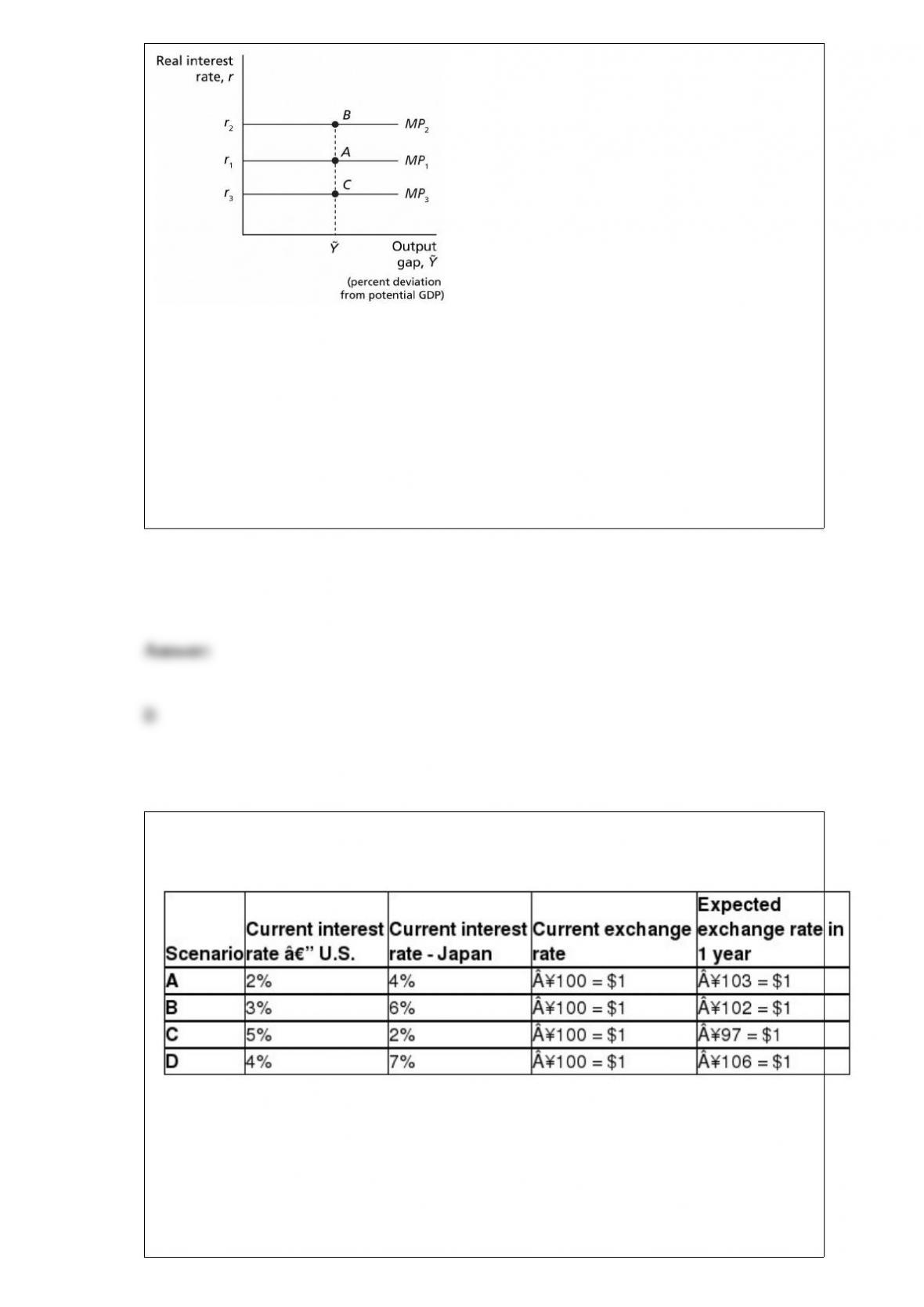
Refer to Figure 10.5. A shift from MP1 to MP2 will occur if
A) the Fed decreases its target for the short-term nominal interest rate.
B) the term structure effect increases.
C) the default-risk premium decreases.
D) the expected inflation rate increases.
Table 4.2
Suppose that you intend to invest $10,000 in one-year government bonds. You are
looking for the highest return on your investment and do not care whether you
invest in the United States or Japan, but as U.S. resident, you want your
investment return to be in U.S. dollars. The Table lists 4 scenarios, each showing
the current interest rate for one-year government bonds in the United States and
Japan, the current exchange rate between the dollar and the yen, and the expected
exchange rate in one year. Other than the interest rates, you assume the bonds

from each country to be identical.
Refer to Table 4.2. If you choose to invest in Japanese bonds, your investment return
from Scenario C will be
A) -3%.
B) -1%.
C) 2%.
D) 5%.
Suppose the federal budget surplus for the year was $350 billion and the economy was
in an economic expansion. If the economy had been at potential GDP, it is estimated
that tax revenue would have been $140 billion lower and government spending on
transfer payments would have been $50 billion higher. Using these estimates, the
cyclically adjusted budget
A) deficit was $440 billion.
B) deficit was $260 billion.
C) surplus was $160 billion.
D) surplus was $540 billion.
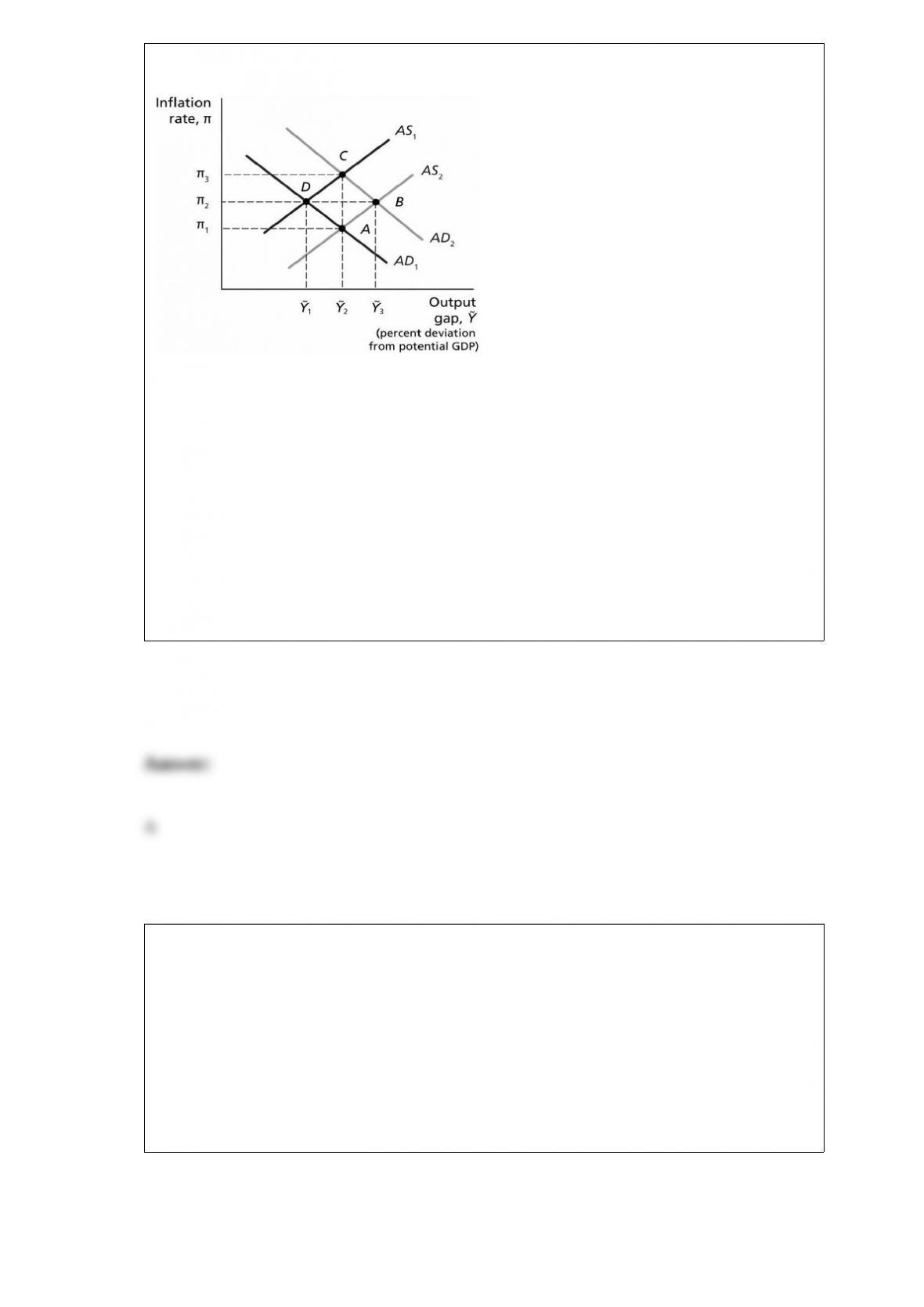
Figure 14.3
Refer to Figure 14.3. Suppose the economy is initially at long-run equilibrium and the
Fed increases the target inflation rate, and to hit this rate, it must reduce the real interest
rate. The economy then reaches a new, short-run equilibrium point. Assuming
expectations are adaptive, the next movement will result in real GDP
A) decreasing back to potential GDP.
B) increasing beyond potential GDP.
C) increasing back to potential GDP.
D) declining below potential GDP.
The price of one currency in terms of another country’s currency is known as the
A) nominal exchange rate.
B) real exchange rate.
C) relative inflation rate.
D) purchasing power parity rate.

Many economists believe the Fed was in large part responsible for bringing about the
Great Moderation, gaining more credibility as it transitioned away from ________ and
more towards ________.
A) fiscal policy; monetary policy
B) discretionary policy; a rules policy
C) monetary rules; discretionary rules
D) targeting inflation; targeting unemployment
One disadvantage of a fixed exchange rate system compared to a floating or managed
float exchange rate system is
A) it more difficult for central banks to control inflation.
B) it does not allow for government intervention.
C) it can worsen inflation if domestic prices of imports rise quickly.
D) it eliminates the possibility of depreciation during a recession.

All of the following are government purchases except
A) the salary paid to Senator John Cornyn of Texas.
B) the presidential pension paid to former President George H.W. Bush.
C) the purchase of a new office building for the CIA.
D) the purchase of new radar tracking equipment for the Navy.
The federal government debt refers to
A) the accumulation of past budget deficits.
B) government spending plus transfer payments minus tax revenues.
C) tax revenues minus government spending and transfer payments.
D) the total value of U.S. Treasury bonds outstanding.
If the economy is initially in short-run equilibrium and then experiences a positive
demand shock, real GDP will ________ relative to potential GDP and the real interest
rate will ________.
A) increase; increase

B) increase; decrease
C) decrease; increase
D) decrease; decrease
Under a fixed exchange rate system, central banks ________ meet the demand for their
domestic currency and ________ meet the demand for foreign currencies.
A) can always; can always
B) can always; are limited in their ability to
C) are limited in their ability to; are limited in their ability to
D) are limited in their ability to; can never
Which of the following is an example of a fiscal policy?
A) The federal government increases income tax rates on people earning more than
$250,000.
B) The Federal Reserve takes action to greatly decrease the money supply.
C) The Federal Reserve increases interest rates.

D) Businesses begin to export and import more products and services.
An economy accumulates capital when
A) its capital-labor ratio increases.
B) it increases the number of workers.
C) GDP per capita increases.
D) labor productivity declines.
By the time the German hyperinflation following World War I ended in November
1923, the price level in Germany was ________ times higher than at the beginning of
the hyperinflation.
A) 1,000
B) 1 million
C) 250 million
D) 50 billion

If households spend $0.40 of each additional dollar of increased income, the
expenditure multiplier will be
A) 1.67
B) 2.5
C) 4
D) 6
As the capital-labor ratio increases, break-even investment
A) increases at a decreasing rate.
B) increases at an increasing rate.
C) increases at a constant rate.
D) remains unchanged.
From 1980 through 2010, the debt-to-GDP ratio in the United States
A) is considered high by U.S. historical standards.
B) has more than quadrupled.
C) has slowly declined.
D) has remained about average compared to countries in the OECD.
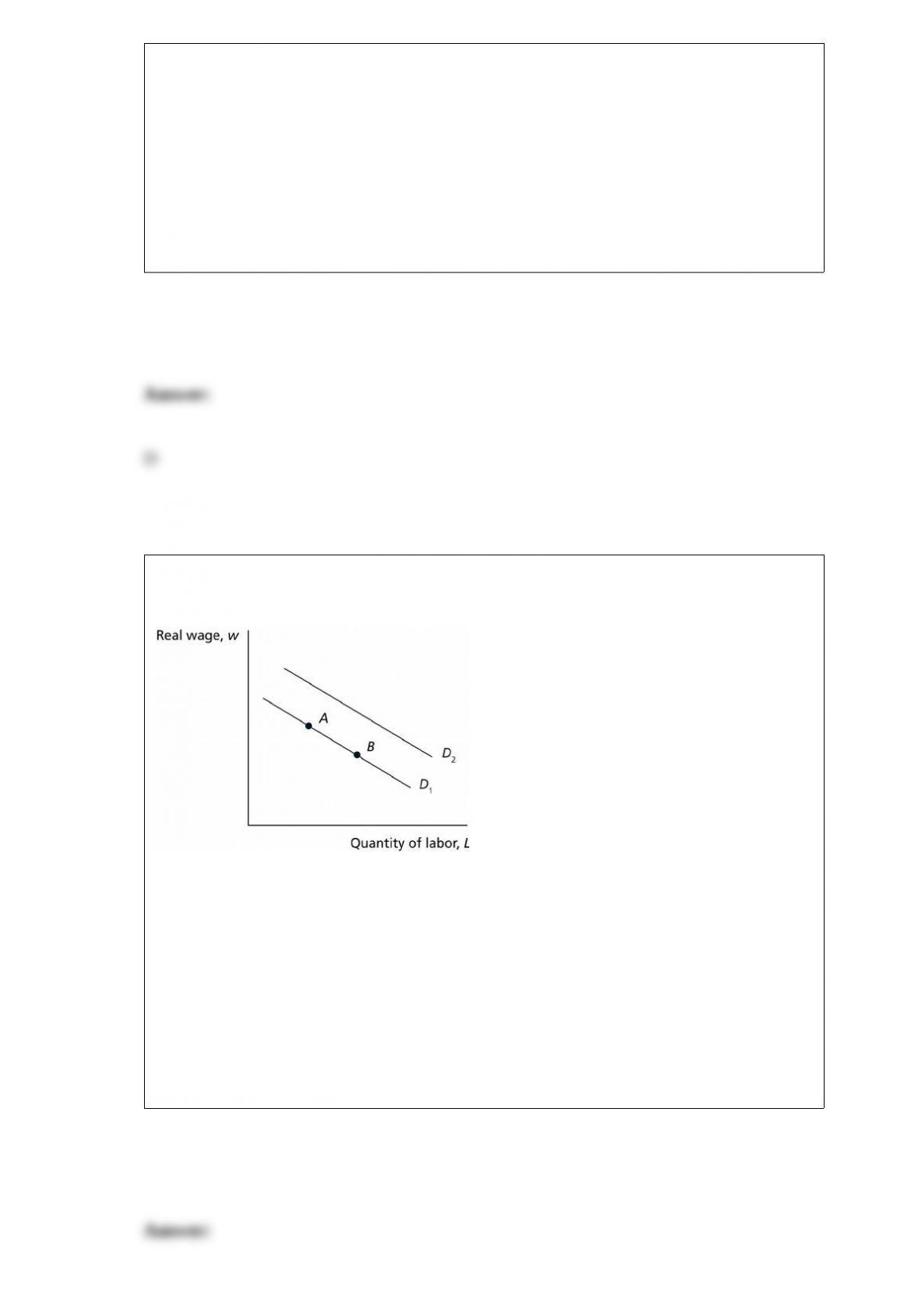
Figure 8.1
Refer to Figure 8.1. Holding other variables constant, a decrease in the capital stock
will result in a
A) shift from curve D1 to curve D2.
B) shift from curve D2 to curve D1.
C) movement from point A to point B.
D) movement from point B to point A.
Because labor unions contribute to keeping real wages ________ their equilibrium
levels, higher unionization rates will tend to contribute to ________ unemployment
rates.
A) above; higher
B) above; lower
C) below; higher
D) below; lower
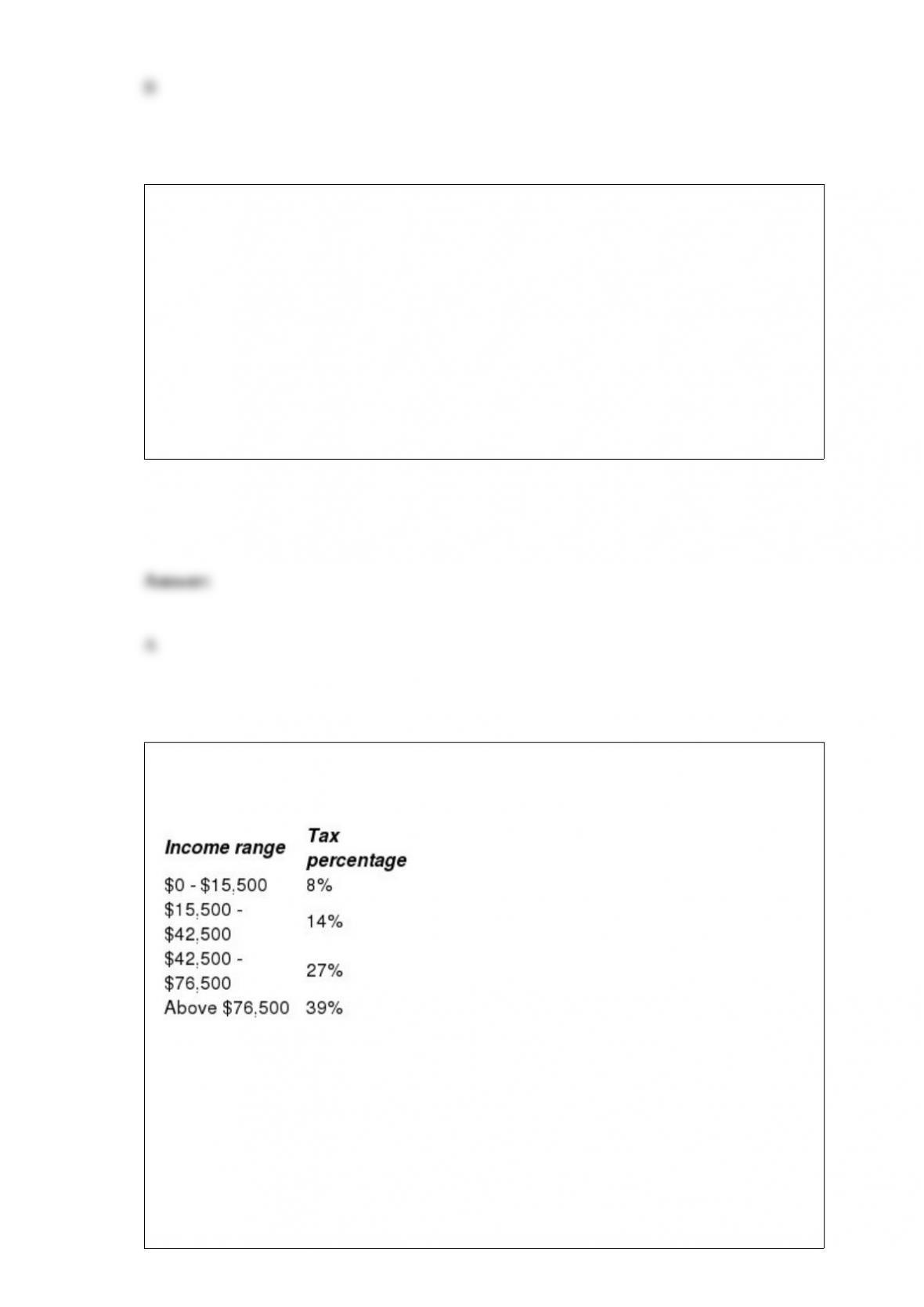
Table 7.2
Tax brackets for a single person, 2013
Refer to Table 7.2. Assume Darryl earned $47,500 in 2013.
a. How much would Darryl pay in taxes?
b. Suppose that inflation in 2013 was 7%, and Darryl received a 3% raise in 2013. What
happens to Darryl’s nominal income, and what happens to his real income?
c. What happens to Darryl’s tax payment once he receives the raise? Has his real tax
payment increased, decreased, or stayed the same?
Other things equal, the higher the interest rate paid on term deposits, the ________
funds that are available in banks’ reserve accounts and the ________ the potential for
expanding the money supply.
A) more; greater
B) more; lower
C) fewer; greater
D) fewer; lower

Money’s most narrow definition is based on its function as a
A) medium of exchange.
B) store of value.
C) standard of deferred payment.
D) unit of account.
An agreement among countries about how relative currency values should be
determined is known as
A) an exchange rate system.
B) an international currency market.
C) a free-trade arrangement.
D) a parity intervention.
One disadvantage of a floating exchange rate system compared to a fixed or managed
float exchange rate system is
A) it does not allow the exchange rate to reflect demand and supply in the market.
B) it is difficult to maintain.

C) it can worsen inflation if domestic prices of imports rise quickly.
D) it eliminates the possibility of depreciation during a recession.