
Suppose that in a market for used cars, there are good used cars and bad used cars
(lemons). Consumers are willing to pay as much as $6,000 for a good used car but only
$1,000 for a lemon. Sellers of good used cars value their cars at $5,000 each and sellers
of lemons value their cars at $800 each. Buyers cannot tell if a used car is reliable or is
a lemon. Based on this information, what is the likely outcome in the market for used
cars?
A) Both good used cars and lemons will sell for $4,500 each.
B) Only lemons will sell, for $800 each.
C) Both good used cars and lemons will sell for $1,000 each.
D) Most used cars offered for sale will be lemons.
Which of the following reforms could potentially reduce spending on health care
without reducing the effectiveness of health care received?
A) nationalize health care so that all health services are government funded and
operated
B) give every citizen a fixed amount of money that can only be spent on health care
services
C) reimburse consumers for preventive health care expenditures so as to avoid costly
emergency medical treatments in the future
D) standardize the tax treatment of employer-based health insurance benefits and
private spending on health care

If Japanese workers are more productive than French workers then trade between Japan
and France
A) can take place only if France has an absolute advantage in producing a good or
service Japanese buyers want.
B) cannot take place because Japanese goods and services will be less expensive than
French goods and services.
C) cannot take place until French workers become more productive.
D) will take place so long as each country has a comparative advantage in a good or
service that buyers in the other country want.
Suppose your grandfather earned a salary of $12,000 in 1964. If the CPI is 31 in 1964
and 219 in 2013, then the value of your grandfather’s salary in 2013 dollars is
approximately
A) $84,775.
B) $63,830.
C) $37,200.
D) $26,280.
In an open economy, the government purchases multiplier will be
A) larger as the marginal propensity to import increases.

B) smaller as the marginal propensity to import increases.
C) larger as the marginal propensity to tax increases.
D) smaller as the marginal propensity to consume increases.
Which of the following is a characteristic of a bond?
A) A bond represents a promise to repay a fixed amount of funds.
B) The face value or principal plus interest is repaid at a specified period of time.
C) The length of coupon payments is fixed by the stated maturity period.
D) All of these are characteristics of bonds.
In Singapore the government places a $5,000 tax on the buyers of new automobiles.
After the purchase of a new car, a buyer must pay the government $5,000. How would
the imposition of the tax on buyers be illustrated in a graph?
A) The tax will shift the demand curve to the right by $5,000.
B) The tax will shift the demand curve to the left by $5,000.
C) The tax will shift both the demand and supply curve to the right by $5,000.
D) The tax will shift the supply curve to the left by $5,000.

Jake sells Star Wars memorabilia on eBay. His annual revenue is $42,000 per year, the
explicit costs of his business are $10,000, and the opportunity costs of his business are
$18,000 per year. What is his economic profit?
A) $14,000
B) $24,000
C) $32,000
D) $34,000
Which of the following policies are designed specifically to directly promote
technological change in an economy?
A) government subsidization of research and development
B) tax incentives to promote investment in 401K plans
C) laws to strengthen property rights
D) a vaccination program to combat infectious diseases
Which of the following does not hold true for a perfectly competitive firm in long-run
equilibrium?
A) Its economic profit will be zero.
B) It will minimize average total cost.
C) It will charge a price equal to marginal cost.
D) Marginal cost will be minimized.
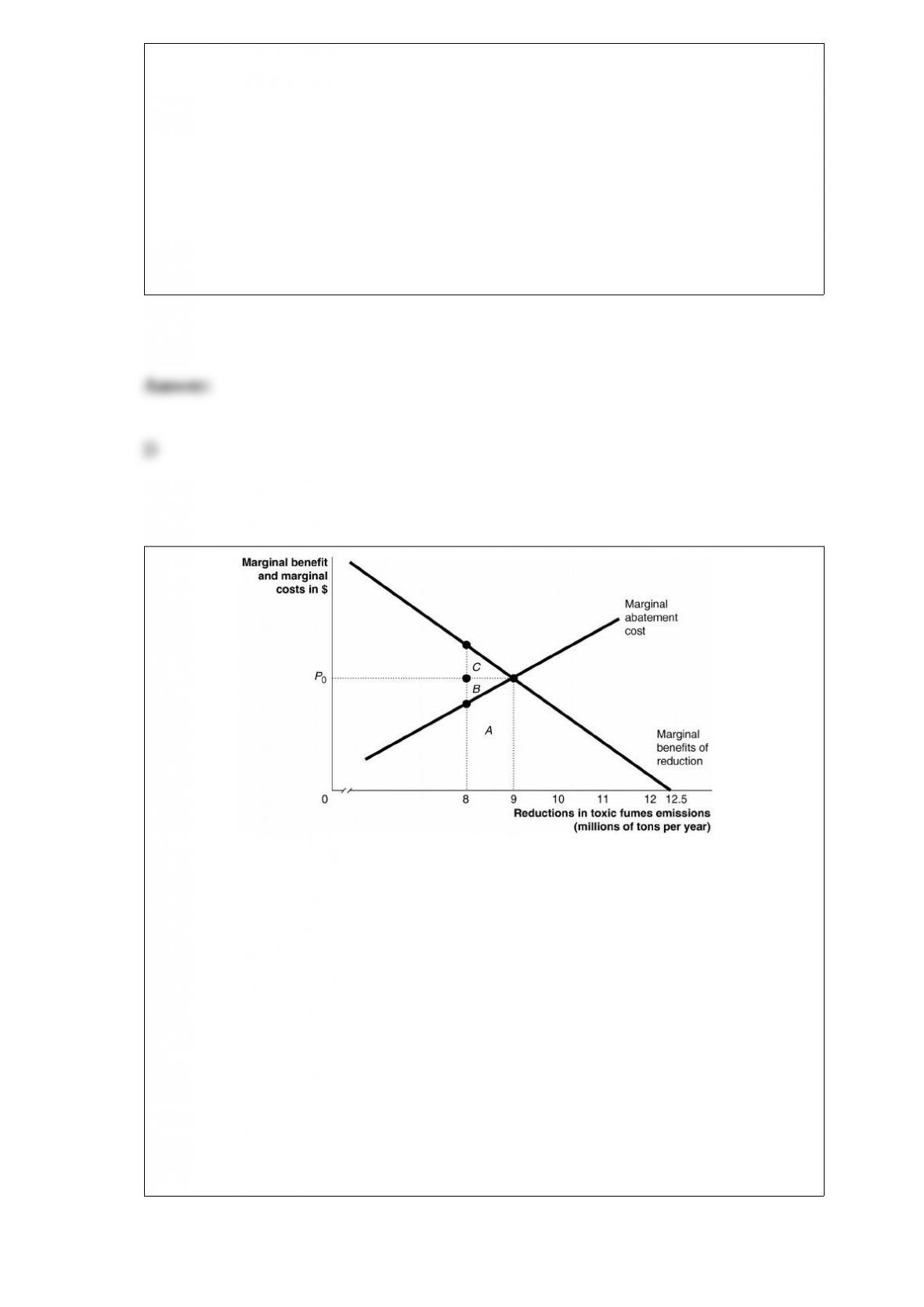
Figure 5-8 Consider a
chemical plant that discharges toxic fumes over a nearby community. To reduce the
emissions of toxic fumes the firm can install pollution abatement devices. Figure 5-8
shows the marginal benefit and the marginal cost from reducing the toxic fumes
emissions.
Suppose the emissions reduction target is currently established at 8 million tons. What
is the area that represents the cost of eliminating an additional 1 million tons?
A) A
B) B + C
C) A + B
D) A + B + C

In August 2008, Ethan Nicholas developed the iShoot application for the apple iPhone
3G, and within five months had earned $800,000 from this program. By May 2009,
Nicholas had dropped the price from $4.99 to $1.99 in an attempt to maintain sales.
This example indicates that in a competitive market,
A) earning an economic profit in the long run is extremely easy.
B) earning an economic profit in the long run is extremely difficult.
C) it is impossible to earn an economic profit in either the short run or the long run.
D) economic profits are only earned in the long run.
The current account includes records of a country’s
A) net exports.
B) net investment income.
C) net transfers.
D) All of the above are included in an economy’s current account.

When lumber from Brazilian forests is used by a U.S.-owned company to produce
furniture in Canada, the value of the furniture produced will be counted as a final good
in
A) U.S. GDP.
B) Canada’s GDP.
C) Brazil’s GDP.
D) Brazil’s GNP.
Suppose your expenses for this term are as follows: tuition: $12,000, room and board:
$6,500, books and other educational supplies: $1,500. Further, during the term, you can
only work part-time and earn $3,500 instead of your full-time salary of $14,000. What
is the opportunity cost of going to college this term, assuming that your room and board
expenses would be the same even if you did not go to college?
A) $13,500
B) $20,000
C) $24,000
D) $30,500
________ and ________ are the largest sources of revenue collected by the federal
government.
A) Individual income taxes; corporate income taxes

B) Individual income taxes; social insurance taxes
C) Corporate income taxes; excise and other taxes
D) Excise and other taxes; individual income taxes