
1) an example of a public good is cable television.
2) a decrease in supply of x increases the equilibrium price of x, which reduces the
demand for x and automatically returns the price of x to its initial level.
3) business income will decrease in the nation from which workers emigrate.
4) Given supply, the more inelastic the demand for a product, the larger the portion of
an excise tax that is shifted to consumers.
5) because of health insurance, resources are underallocated to the health care industry.
6) Venture capital is another name for retained earnings.
7) Energy demand is relatively stable over the course of a day.
8) when a consumer is maximizing total utility, he or she cannot increase total utility by
reallocating expenditures among different products.

9) The basic function of profits and losses is to allocate society’s scarce resources to
their highest valued uses.
10) The M2 money supply may be larger or smaller than the M1 money supply
depending on the size of small time deposit balances and Money Market Mutual Fund
balances held by individuals.
11) u.s. immigrants (legal and illegal combined) have lower prison rates than the
native-born population.
12) a cross elasticity of demand coefficient of +2.5 indicates that the two products are
substitutes.
13) all of the following are designed to reduce health care expenses for consumers
except:
a.hmos.
b.ppos.
c.the drg payment system.
d.the fee-for-service system.
14)

Refer to the above information. The marginal resource (labor) cost of the third worker
is:
A.$15.
B.$25.
C.$35.
D.$45.
15) if a regulatory commission imposes upon a nondiscriminating natural monopoly a
price that is equal to marginal cost and below average total cost at the resulting output,
then:
a.the firm will realize an economic profit.
b.the firm will earn only a normal profit.
c.allocative efficiency will be worsened.
d.the firm must be subsidized or it will go bankrupt.
16) Which of the following would we expect to have the highest poverty rate?
A.white households headed by males
B.elderly white households
C.white households headed by females
D.African-American households headed by females
17) Which of the following Gini ratios indicates the lowest degree of income
inequality?
A.0.71
B.0.55
C.0.31
D.0.45

18) the economic perspective refers to:
a.macroeconomic phenomena, but not microeconomic phenomena.
b.microeconomic phenomena, but not macroeconomic phenomena.
c.the making of purposeful decisions in a context of marginal costs and marginal
benefits.
d.unlimited resources in a context of limited economic wants.
19) the vertical distance between the total cost and the total variable cost curves differs
by an amount which:
a.initially increases, but then decreases, as output increases.
b.is constant as output changes.
c.decreases as output increases.
d.increases as output increases.
20) Which of the following would cause the present optimal extraction level of a
non-renewable resource to rise?
A.A decrease in the price of the resource.
B.An increase in the extraction cost of the resource.
C.A decrease in the user cost of the resource.
D.A decrease in interest rates.
21)
refer to the above diagram for athletic shoes. the optimal output of shoes is:
a.q1.
b.q2.
c.q3.
d.greater than q3.
22) The two main characteristics of a public good are:
A.production at constant marginal cost and rising demand.
B.nonexcludability and production at rising marginal cost.
C.nonrivalry and nonexcludability.
D.nonrivalry and large negative externalities.
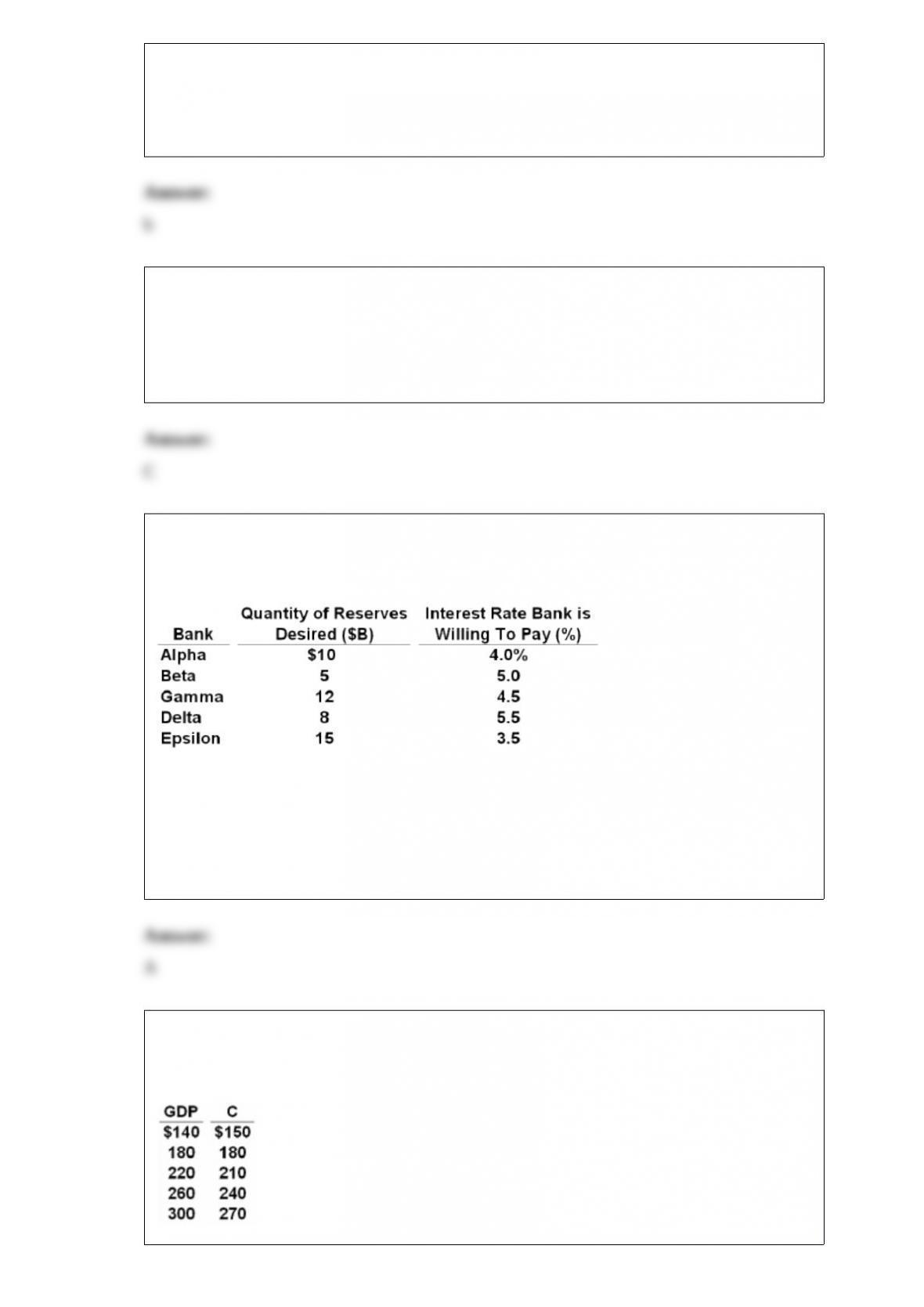
23) The following information: The Fed is going to auction $30 billion in reserves using
the term auction facility. It receives the following bids:
Refer to the above information. Which of the following banks will not borrow reserves
as a result of this auction?
A.Epsilon only.
B.Beta and Delta.
C.Gamma and Epsilon.
D.All of the banks will be allowed to borrow at least a portion of their desired reserves.
24) The following schedule contains data for a private closed economy. All figures are
in billions. Use these data in answering the next question(s).

Refer to the above data. If gross investment is $10 at all levels of GDP, the equilibrium
GDP will be:
A.$300.
B.$260.
C.$220.
D.$180.
25) If the dollar appreciates relative to foreign currencies, we would expect:
A.the multiplier to decrease.
B.a country’s exports and imports to both fall.
C.a country’s net exports to rise.
D.a country’s net exports to fall.
26) Technological advance is shown as a(n):
A.movement from a point inside a production possibilities curve to a point on the curve.
B.movement along a production possibilities curve.
C.outward shift of a production possibilities curve.
D.inward shift of a production possibilities curve.
27) A large hospital in a relatively small city finds that, if its demand for nurses
increases, the wages of nurses will rise. We can say that the hospital:
A.is a monopsonist.
B.faces a perfectly elastic supply of nurses.
C.is functioning in a perfectly competitive labor market.
D.will confront a surplus of nurses.
28) Which item below will affect the U.S. balance on goods and services, but not affect
its balance of trade in goods?
A.an increase in U.S. goods exports
B.a decrease in U.S. exports of services
C.an increase in foreign purchases of U.S. assets
D.an increase in net transfers
29) There must always be a balance of a nation’s:
A.goods exports and gold imports.
B.total international payments.
C.imports and exports of goods and services.
D.net transfers and net investment income.
30) How does speculation in currencies affect the value of a nations currency?
31) Does it matter whether capital and labor are substitutes or complements when
figuring out what will happen to the demand for labor if the price of capital increases?
Explain.
32) What happens to inventories when prices are sticky and there is a demand shock?
Explain.
33) If the public debt is a debt that we owe to ourselves, then there are obviously no
problems connected with such a debt. Critically evaluate.
34) When economists refer to labor, what type of workers are they referring to?
35) How would a purely competitive industry adjust and restore allocative efficiency
when there is an increase in the demand for a product?