In output markets, the elasticity of supply tends to be
A) negative.
B) zero.
C) positive.
D) decreasing at an increasing rate.
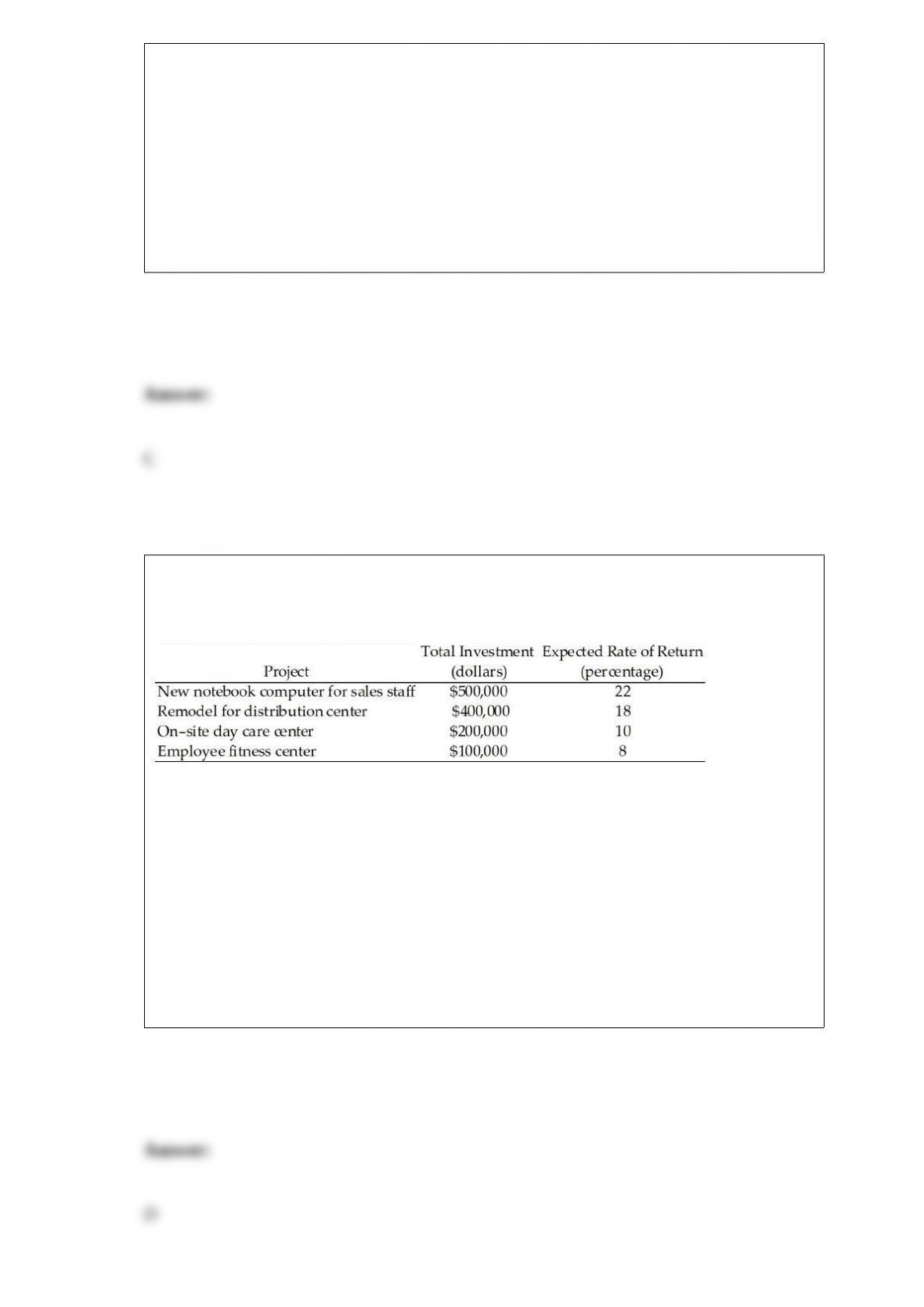
Table 11.1
Refer to Table 11.1. If the interest rate is 9%, Nashbar Bicycle’s total investment would
be
A) $200,000.
B) $300,000.
C) $900,000.
D) $1,100,000.

Monopolistically competitive firms can use product differentiation to do which of the
following?
A) guarantee long-run profitability
B) block entry of all other firms
C) provide consumers with commitment devices
D) gain complete control over the price of their product
Thomas Hobbes argued for a tax on consumption instead of on income because
A) the standard of living depends not on income, but on how much income is spent.
B) consumption is the best indication of ability to pay.
C) a tax on income discourages saving by taxing savings twice.
D) a tax on consumption raises more revenue than a tax on income.
The total amount of satisfaction yielded by the consumption of a good or service is
called
A) total utility.
B) total demand.
C) market equilibrium.
D) maximized behavior.
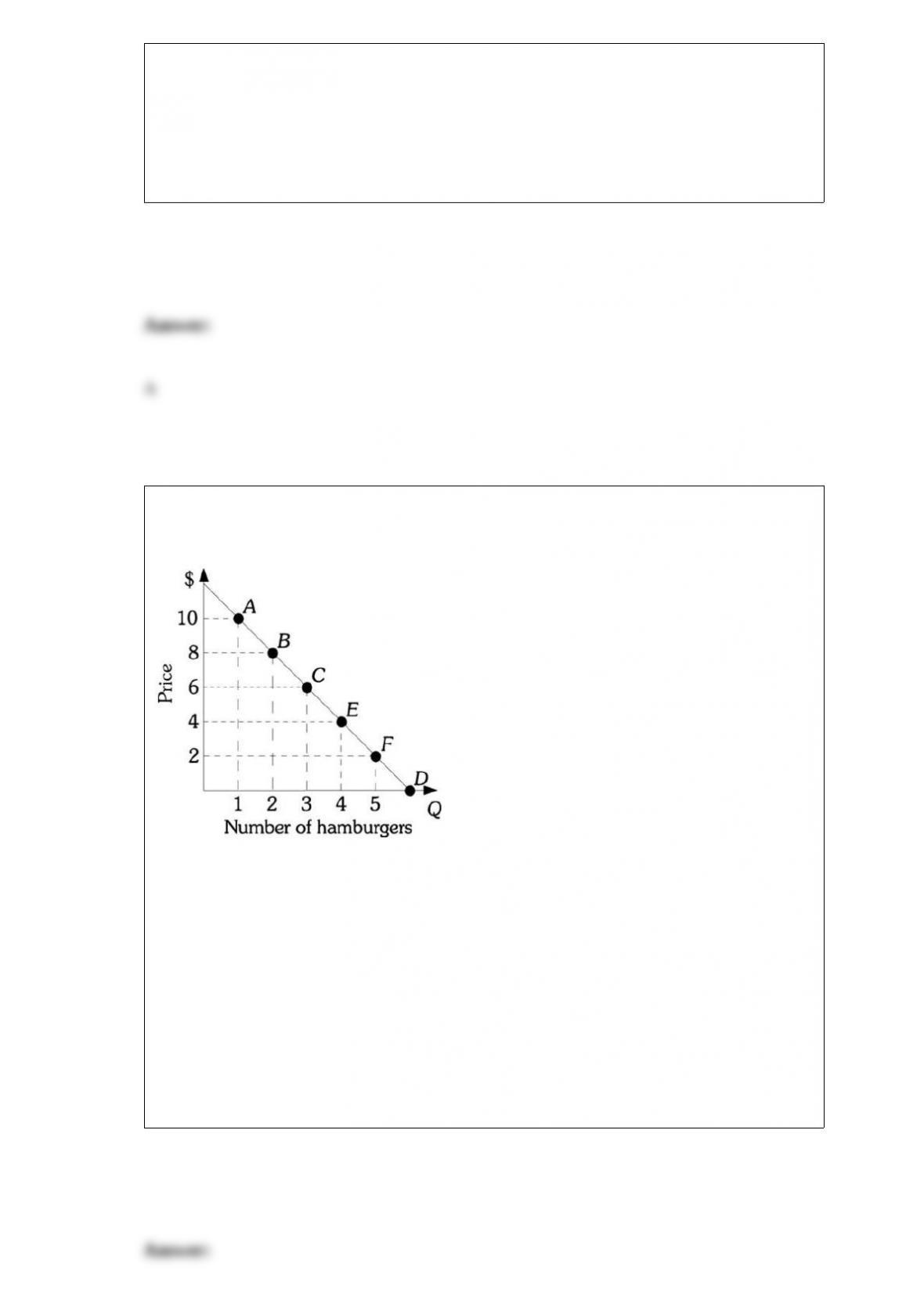
Figure 5.2
Refer to Figure 5.2. At Point C the price elasticity of demand is -1. Along line segment
________ of the demand curve, the demand is inelastic.
A) AC
B) BE
C) CF
D) AF

An example of tangible capital is
A) a restaurant’s unsold, unopened cans of soda.
B) an idea for a new business.
C) the goodwill a firm has established through advertising.
D) knowledge of how to program a computer.
Investors put up $104,000 to construct a building and purchase all equipment for a new
restaurant. The investors expect to earn a minimum return of 10 percent on their
investment. The restaurant is open 52 weeks per year and serves 900 meals per week.
The fixed costs are spread over the 52 weeks (i.e. prorated weekly). Included in the
fixed costs is the 10% return to the investors and $2,000 in other fixed costs. Variable
costs include $2,000 in weekly wages, and $600 per week in materials, electricity, etc.
The restaurant charges $6 on average per meal.
Weekly total revenue is
A) $1,600.
B) $2,000.
C) $3,600.
D) $5,400.

A ________ income tax means that those with a higher income pay the same percentage
of their income in taxes as low-income people.
A) regressive
B) progressive
C) proportional
D) consumption-based
Related to the Economics in Practice on page 69: Consumption of coffee has been on
the rise in China. Since tea and coffee are generally considered ________, an increase
in the price of coffee should ________ the demand for tea, ceteris paribus.
A) substitutes; increase
B) substitutes; decrease
C) complements; increase
D) complements; decrease
A firm earns a profit if
A) total revenue exceeds the total cost of production.
B) total revenue equals total fixed costs.
C) price is less than the total cost of production.
D) price equals marginal cost.
A monopolist will not produce if
A) marginal revenue is declining.
B) marginal revenue is zero.
C) marginal revenue is negative.
D) All of the above are correct.
A monopolistic industry has
A) many differentiated products and easy entry.
B) a homogeneous product and easy entry.
C) a single, unique product and blocked entry.

D) either a standardized product or differentiated products.
A scientist wants to understand the relationship between automobile emissions and the
level of global warming. The scientist collects data on the volume of automobile
emissions and the levels of global warming over time. The scientist concludes that a 1%
increase in automobile emissions causes a 0.0003% increase in average global
temperatures. From this information he concludes that the automobile emissions are
harmful to the environment and should be reduced to stop the increase in global
temperatures.
A graph of the volume of automobile emissions on one axis and the level of average
global temperatures on the other axis is an example of
A) an economic model.
B) an economic theory.
C) a variable theory.
D) inductive reasoning.
When Frank’s income rises from $29,000 to $34,000 per year, he increases his
purchases of tomatoes from 20 pounds to 28 pounds per year. What is Frank’s income
elasticity of demand for tomatoes? (Use the midpoint formula.) According to Frank, are
tomatoes an inferior or normal good?
You own the Star Wars six DVD set. The opportunity cost of watching these DVDs for
the second time
A) is zero.
B) is one-half the cost of the DVDs, as this is the second time you have watched it.
C) is the value of the alternative use of the time you spend watching the DVDs.
D) cannot be calculated.
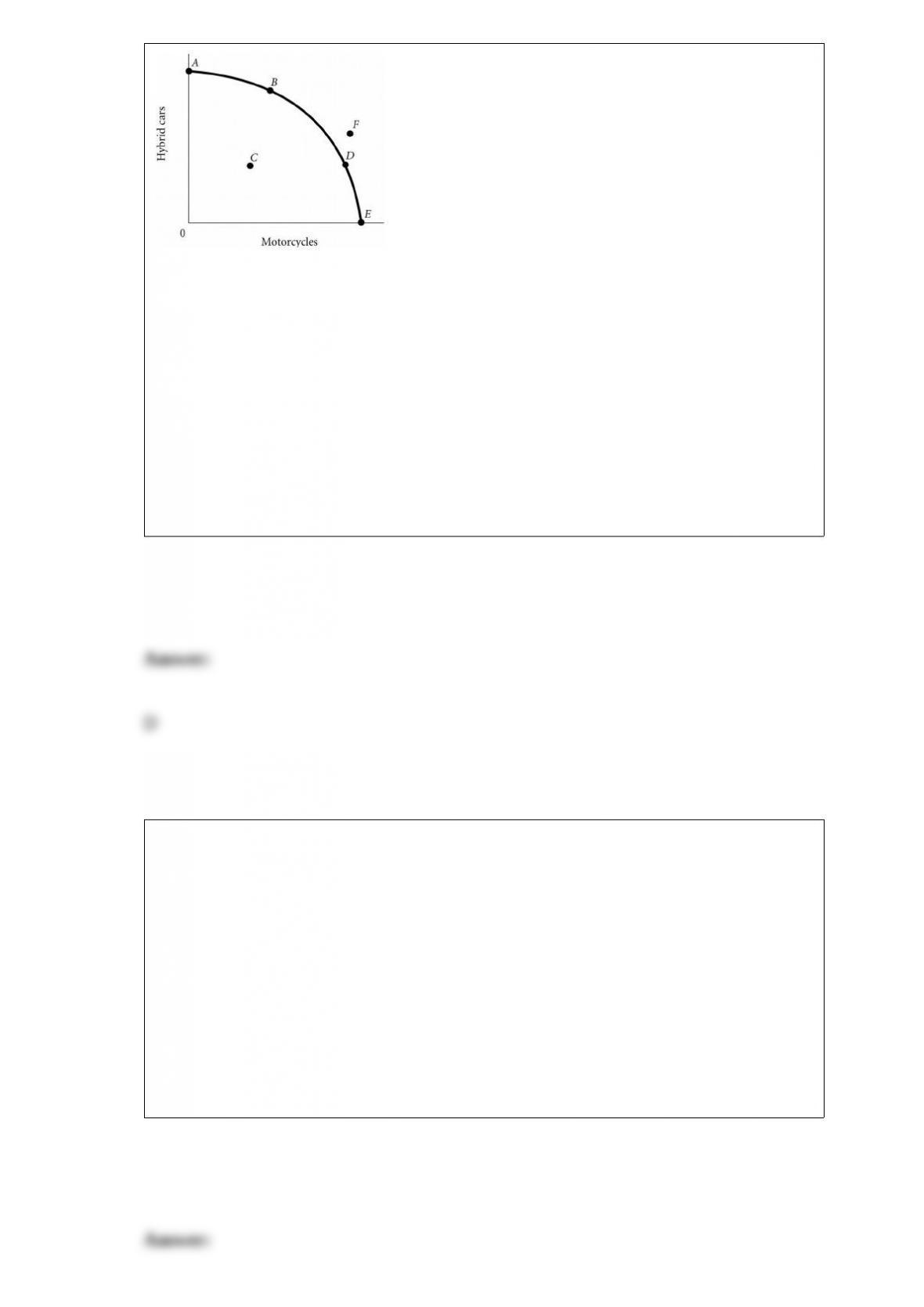
Figure 2.4
According to Figure 2.4, which point cannot be produced with the current state of
technology?
A) A
B) B
C) C
D) F
An oligopoly with a dominant price leader will produce an output level that is
________ than the output level that would prevail if the industry were competitive and
sells it at a price that is ________ than the price that would prevail if the industry were
competitive.
A) higher; higher
B) higher; lower
C) lower; lower
D) lower; higher

Bonita’s Braidworks hires workers to braid hair. The store sells the service for $25 per
customer. The marginal revenue product of this store’s fifth worker is $50. The marginal
product of the fifth worker is
A) 5 braided customers.
B) 2 braided customers.
C) 25 braided customers.
D) indeterminate from this information.
There are 10,000 families in a neighborhood that are affected by noise pollution from a
local factory. The noise could be reduced if the company spent $5,000 on technological
improvements. The company agrees to make these improvements if the affected
families contribute the $5,000. Since there are so many families they fail to come to a
resolution to which they will all agree. This outcome is an example of the
A) free rider problem.
B) drop-in-the-bucket problem.
C) Coase theorem.
D) collective action problem (that arises when there are too many parties involved).
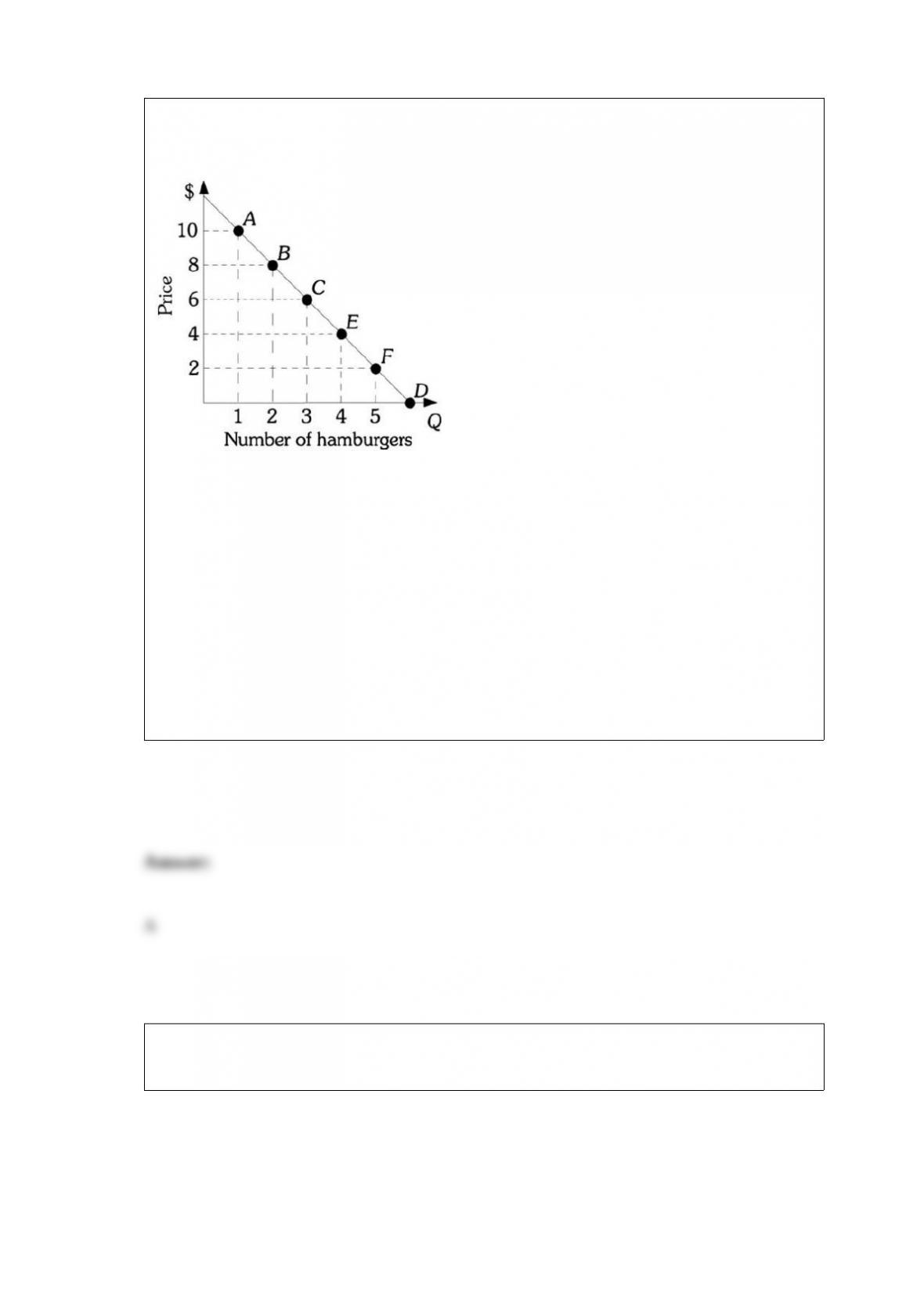
Figure 5.2
Refer to Figure 5.2. At Point C the price elasticity of demand is -1. Along line segment
AB of the demand curve, the demand is
A) elastic.
B) unit elastic.
C) inelastic.
D) either elastic or inelastic, depending on whether price increases or decreases.
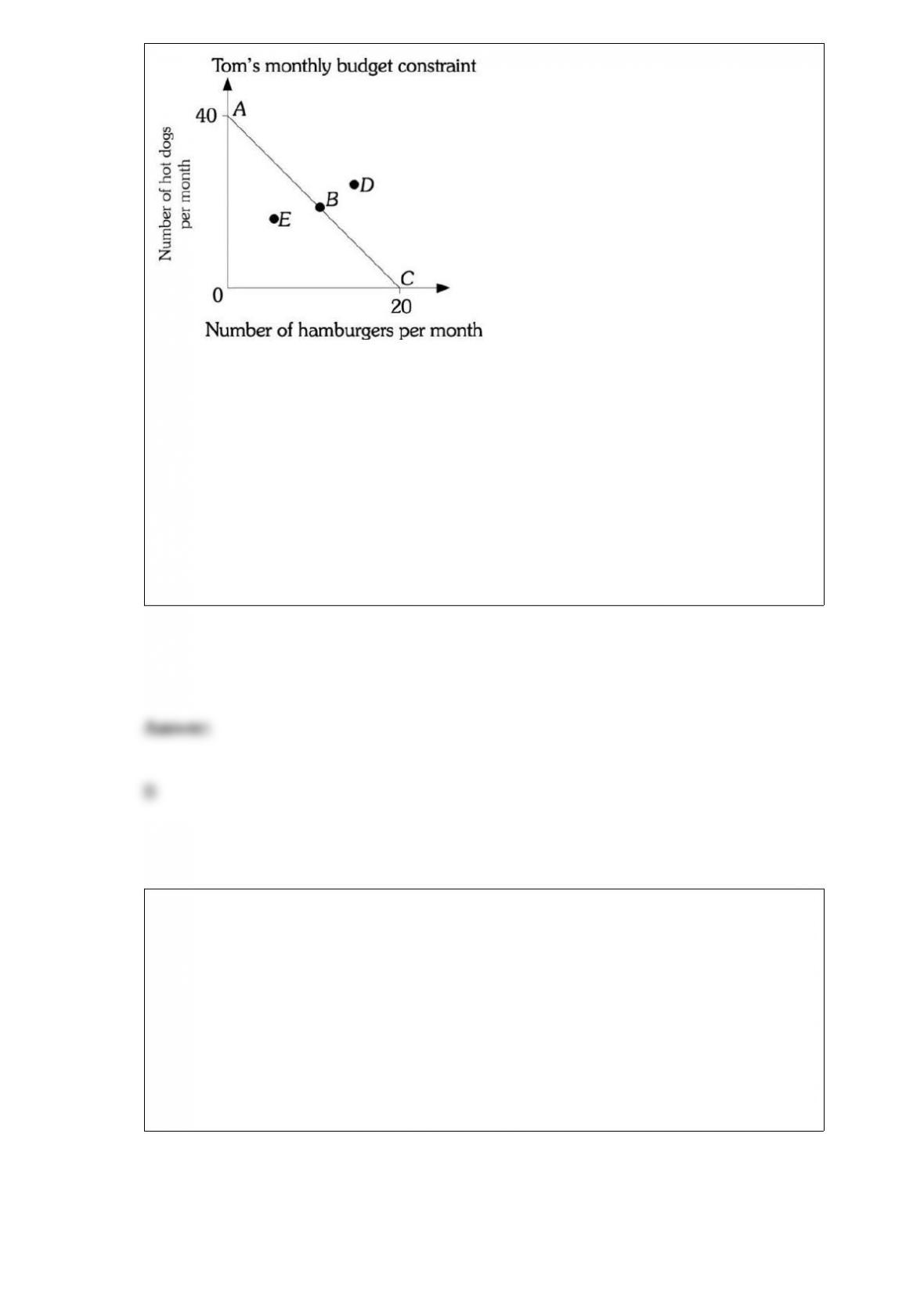
Figure 6.1
Refer to Figure 6.1. Along budget constraint AC, the opportunity cost of one hot dog
A) is 1/4 of a hamburger.
B) is 1/2 of a hamburger.
C) is 2 hamburgers.
D) changes as you move down along the budget constraint.
In perfect competition, the condition that ensures that the right things are produced is
A) MUX = PX.
B) P = MC.
C) P = ATC.
D) MRPL = ATC.
An example of a price ceiling would be the government setting the price of sugar
A) above the equilibrium market price.
B) at the equilibrium market price.
C) below the equilibrium market price.
D) none of the above
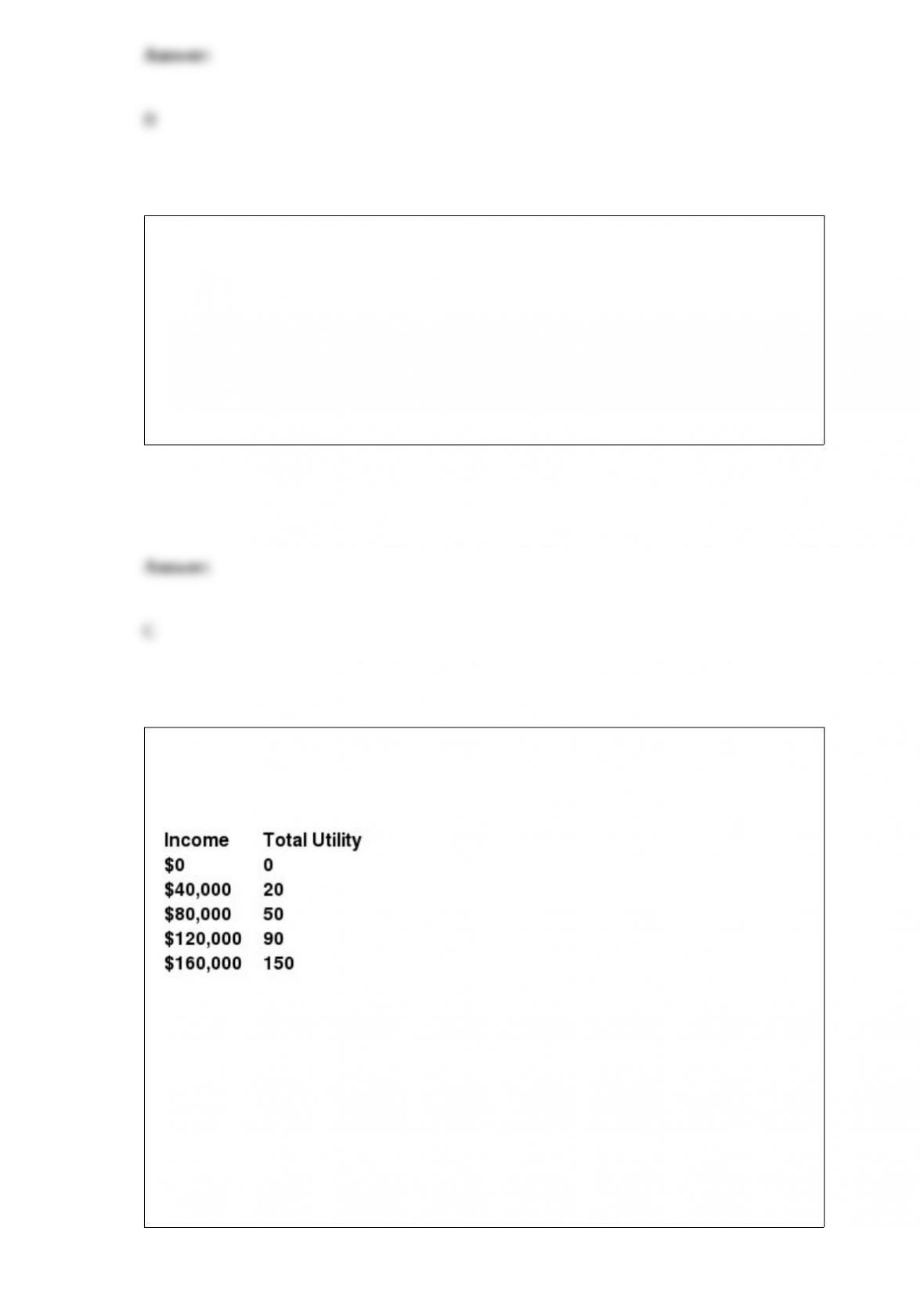
The table shows the relationship between income and utility for Isabel.
Table 17.3
Refer to Table 17.3. From the table, we can see that Isabel is
A) risk averse.
B) risk loving.
C) risk neutral.
D) We cannot determine Isabel’s attitude toward risk from the table.

Investors put up $52,000 to construct a building and purchase all equipment for a new
restaurant. The investors expect to earn a minimum return of 10 percent on their
investment. The restaurant is open 52 weeks per year and serves 900 meals per week.
The fixed costs are spread over the 52 weeks (i.e. prorated weekly). Included in the
fixed costs is the 10% return to the investors and $1,000 per week in other fixed costs.
Variable costs include $1,000 in weekly wages and $600 per week for materials,
electricity, etc. The restaurant charges $3 on average per meal.
Weekly total revenue is
A) $1,600.
B) $2,000.
C) $2,700.
D) $3,600.
An economist wants to understand the relationship between minimum wages and the
level of teenage unemployment. The economist collects data on the values of the
minimum wage and the levels of teenage unemployment over time. The economist
concludes that a 1% increase in minimum wage causes a 0.2% increase in teenage
unemployment. From this information he concludes that the minimum wage is harmful
to teenagers and should be reduced or eliminated to increase employment among
teenagers.
The statement that a 1% increase in the minimum wage causes a 0.2% increase in
teenage unemployment is an example of

A) the fallacy of composition.
B) normative economics.
C) positive economics.
D) Ockham’s razor.
Production inefficiency occurs
A) only when an economy produces underneath its production possibility frontier.
B) only when an economy produces at the wrong point on the production possibility
frontier.
C) either when an economy produces underneath the production possibility frontier or
when the economy is producing the wrong combination of goods on the production
possibility frontier.
D) only when the economy produces outside the production possibility frontier.
Related to the Economics in Practice on page 722: By 2001, the majority of the fishing
fleet in the Indian state of Kerala had mobile phones. As a result of the introduction of
mobile phone service to this fishing industry, profits ________ and consumer prices
________.

A) rose; fell
B) fell; rose
C) rose; rose
D) fell; fell
A distribution of goods between person A and person B is ________ if person A can be
made worse off only if person B is
A) inefficient; made better off.
B) efficient; made no better or no worse off.
C) efficient; made better off.
D) efficient; made worse off.
The ________ broadly a market is defined; the more difficult it becomes to find
________.
A) more; substitutes
B) more; complements
C) less; substitutes
D) less; goods independent of each other
Related to theEconomics in Practice on page 309: The FCC and the DOJ ruled that the
merger between AT&T and T-Mobile
A) could proceed.
B) could not proceed.
C) could only proceed if AT&T sold its Verizon subsidiary.
D) could not proceed unless T-Mobile halted its merger plans with MetroPCS.
If banks pay deposit insurance premiums to the Federal Deposit Insurance Corporation
that are less than the amount that they would have to pay if the insurance were privately
provided what kind of behavioral problem might this cause on the part of banks?
The price of cabbage rises from $0.20 per pound to $0.30 per pound. The quantity of
cabbage demanded falls from 800 pounds per week to 600 pounds per week. Use the
midpoint formula to calculate the price elasticity of demand for cabbage. Is the demand
elastic, inelastic, or unit elastic?
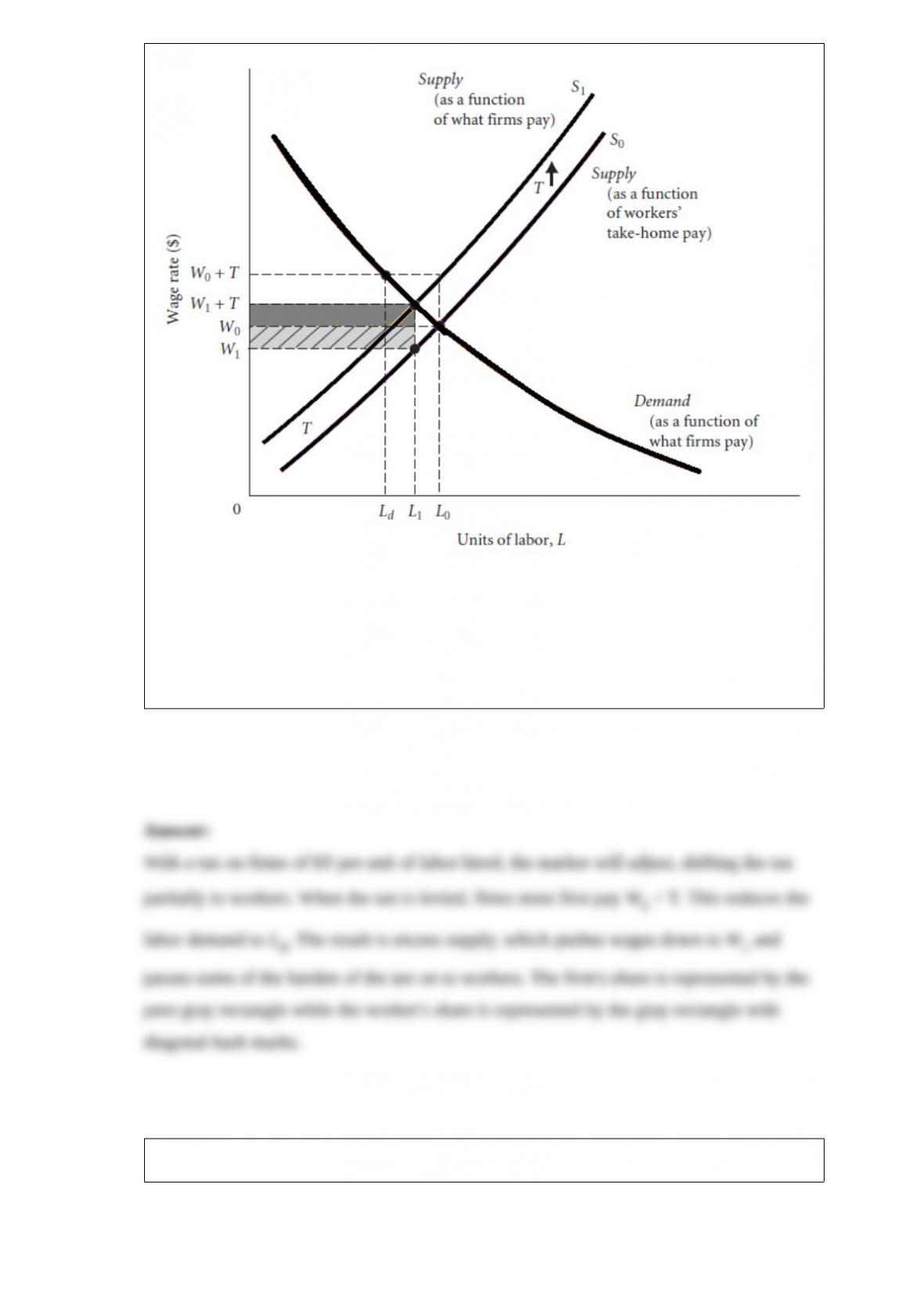
Figure 19.1
Use Figure 19.1 to answer the following question. Assume the labor market is initially
in equilibrium at a wage rate of W0 and employment level of L0. Explain the effects on
the labor market and indicate the burden the tax between the worker and the firm.
What are food stamps?
The Gini coefficient is really a point estimate of equality at a certain time period. Why
is this a limiting factor when it comes to examining issues of equality over a lifetime?
What is NAFTA?
The following table shows output per hour for Martha and Stewart who make gift
baskets and potholders:
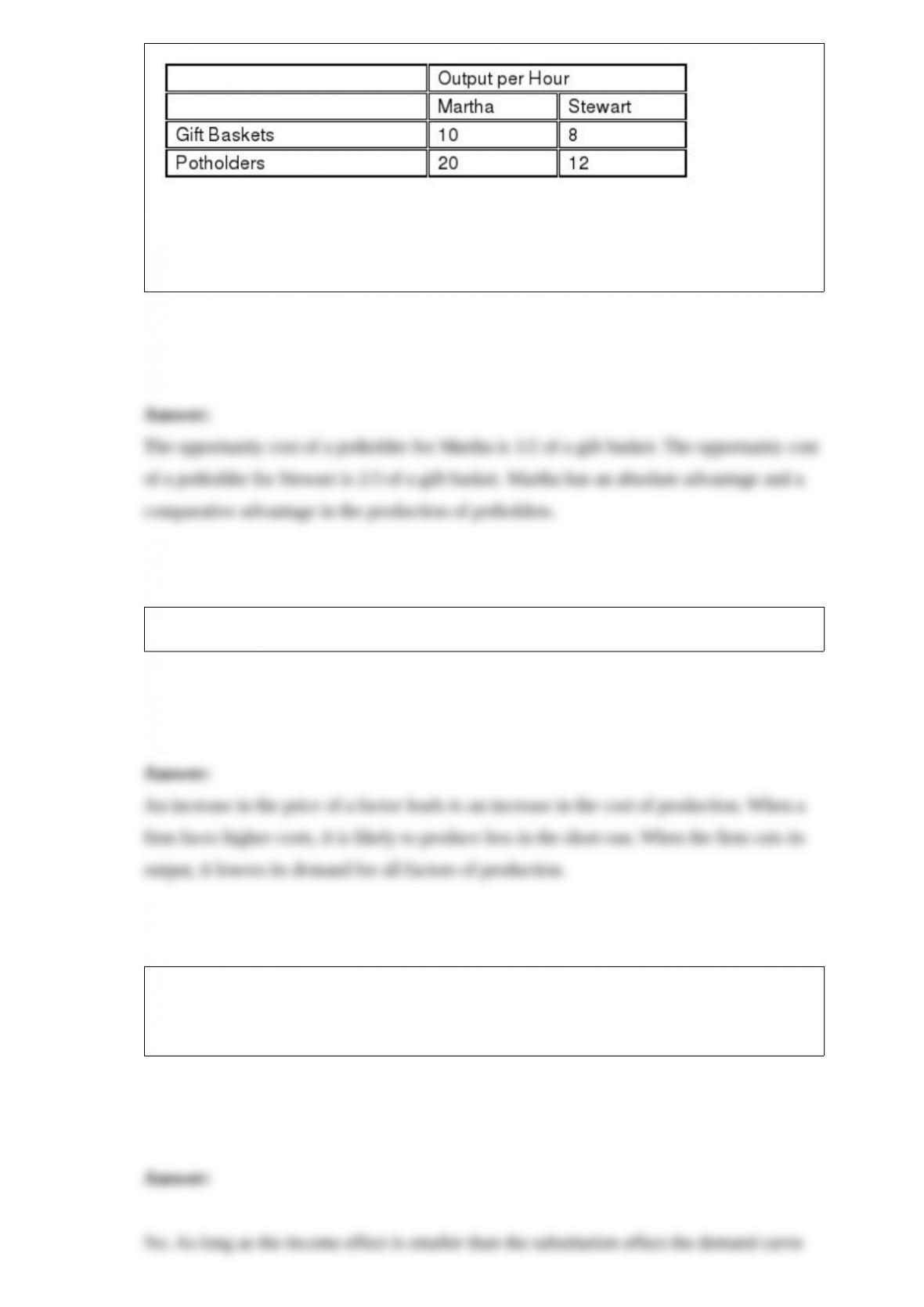
What is the opportunity cost of a potholder for Martha? What is the opportunity cost of
a potholder for Stewart? Who has an absolute advantage in producing potholders? Who
has a comparative advantage in producing potholders?
Explain the output effect of a factor price increase.
For a normal good, the income and substitution effect work in the same direction. For
an inferior good, the income and substitution effects work in opposite directions. Does
this imply that the demand curve for an inferior good is upward sloping? Explain.
List four government expenditure programs designed to redistribute income.
Use a supply and demand graph to explain why the rent on land is demand determined.
What is the most an individual would be willing to pay on January 1st for a bond that
promises to pay $500 at the end of the year for the next three years if the market rate of
interest is 5 percent? Explain.
A company will shut down in the short run if it cannot cover its __________ and will
exit the industry in the long run if it cannot cover its __________.
What does marginal cost measure?
Explain why privatization can help the economy become more efficient.
A government wants to build a hydroelectric dam to reduce flooding in a region and
provide electricity to its people. What type of investment is this? In order to make a
decision about whether or not to make the investment, how should the government
evaluate this project?
Suppose that you have saved $100. You can spend it today or you can put it in your
savings account for a year and earn 5% interest. What is the opportunity cost of
spending the money today?