
Corn flakes are
A) a rival good because many firms produce them.
B) a rival good because if another person wants some corn flakes society has to use
additional resources to produce corn flakes for that person.
C) a non-rival good because there are only a few firms in the industry.
D) a non-rival good because even if another person wants some corn flakes so many
corn flakes are produced that no additional resources are used to satisfy this new
customer’s needs.
E) a public good.
Which of the following is NOT regarded as a source of inefficiency in monopolistic
competition?
A) The fact that price exceeds marginal cost
B) Excess capacity
C) Product diversity
D) The fact that long-run average cost is not minimized
E) all of the above

Labor is typically assumed to be the only variable input in very short-run production
systems, and the number of variable inputs increases as we lengthen our planning
horizon from short run to long run. What happens to the labor demand curve as we
move from short run to long run?
A) Demand curve becomes less elastic
B) Demand curve elasticity does not change
C) Demand curve becomes more elastic
D) Demand curve becomes upward sloping
Under the kinked demand model, suppose the firm’s demand curve shifts rightward but
the price at which the kink occurs remains the same. In this case, the firm:
A) does not change its output.
B) increases output.
C) decreases output.
D) We do not have enough information to answer this question.
Credit histories allow firms to
A) identify high-risk borrowers, so they can be eliminated and interest rates kept down

for others.
B) increase the number of credit cards issued, and interest rates go up as a result.
C) increase the number of credit cards issued, and interest rates go down as a result.
D) lower the number of credit cards issued, and interest rates go up as a result.
E) increase market power in the credit card industry, raising interest rates.
What type of good is clean air?
A) Rival and exclusive
B) Nonrival and exclusive
C) Rival and nonexclusive
D) Nonrival and nonexclusive
As an economy recovers from a recession, the observed level of labor productivity
tends to decline. Why?
A) The total product remains the same during the recovery, but the number of workers
declines.
B) The total product increases during the recovery, but the number of workers declines.

C) The marginal product of labor declines as new workers enter the expanding work
force.
D) The marginal product of labor increases at a slower rate than the decline in
employment.
An association of businesses that are jointly owned and operated by members for
mutual benefit is a:
A) condominium.
B) corporation.
C) cooperative.
D) joint tenancy.
A lighthouse is a public good
A) because it doesn’t cost any more to light the way for 105 ships than it does to light
the way for 104 ships, but for no other reason.
B) because there is no way to prevent those who haven’t contributed to the lighthouse
from seeing better because of it, but for no other reason.
C) because the government produces it, and for no other reason.

D) for the reasons in A and B together.
E) for the reasons in A, B, and C together.
Cartels can more easily detect cheating by cartel members if the products sold by each
member are largely homogeneous. As product quality varies, the observed prices
charged by cartel members may be due to differences in the products, or they may be
due to cheating. Which of the following goods would more difficult to monitor for
potential cheating?
A) Aluminum ingots
B) Industrial concrete
C) Steel beams
D) Luxury yachts
Consider the following information:
StowUrStuff Storage is located slightly below sea level in a coastal town. It could build
and maintain a flood control system around its property at an annual cost of $1000, and
if it did so, the probability of a flood’s doing $1,000,000 in damage during the year
would be .005. With no flood control system, the probability of such a flood would be .
01.

If there is no flood insurance and the flood control system is in place, the expected loss
from a flood is
A) $5,000.
B) $10,000.
C) $100,000.
D) $200,000.
E) $1,000,000.
If indifference curves are concave to the origin, which assumption on preferences is
violated?
A) Diminishing marginal rates of substitution
B) Transitivity of preferences
C) More is preferred to less
D) Completeness
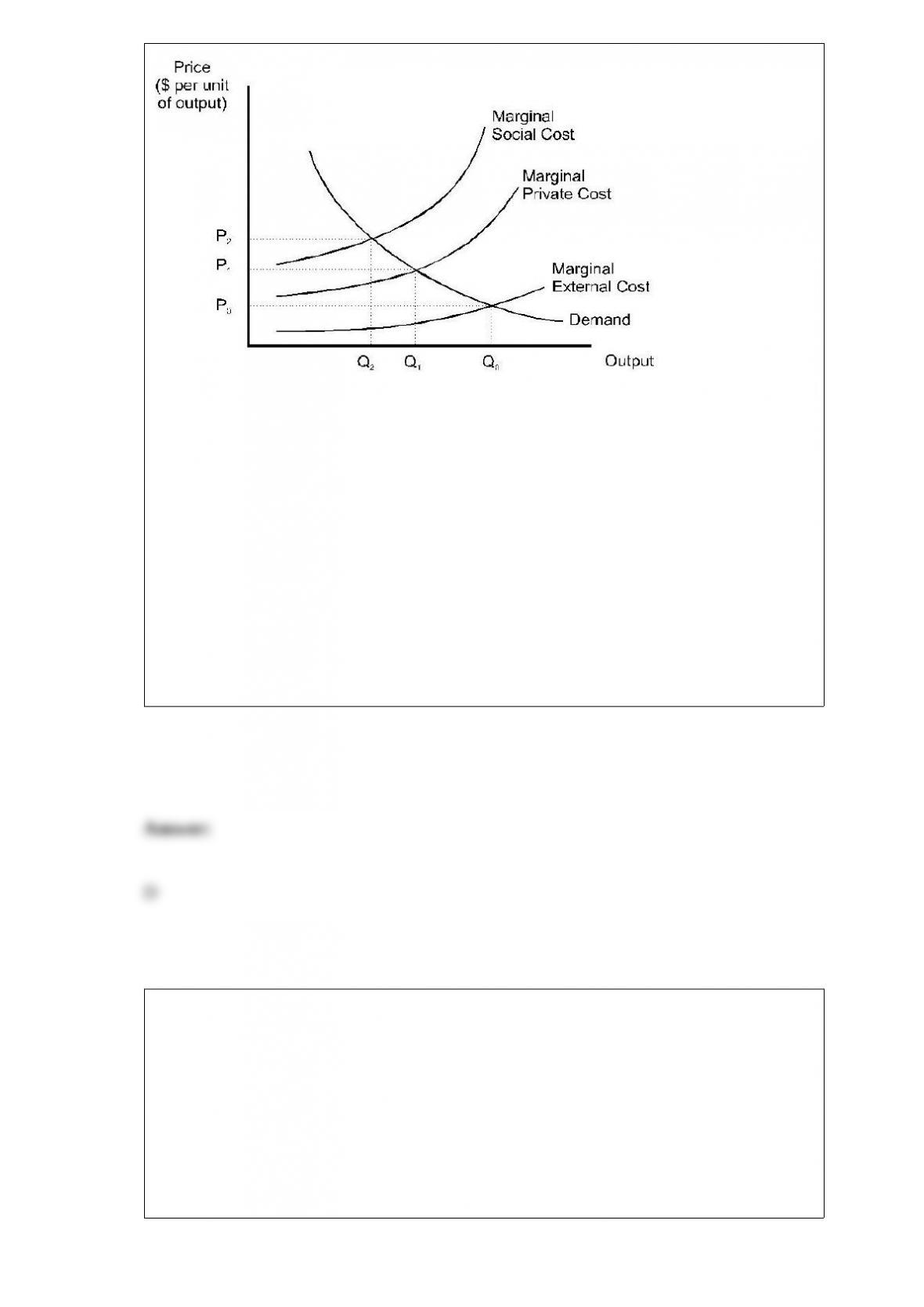
Figure 18.1
All producers in the corbomite industry dump wastes in the river in the production of
their output.
Given the information in Figure 18.1, the efficient output in the corbomite industry is:
A)
B) Q0.
C) Q1.
D) Q2.
Which of the following can be thought of as a barrier to entry?
A) scale economies.
B) patents.
C) strategic actions by incumbent firms.
D) all of the above

Scenario 4.1:
Daniel derives utility from only two goods, cake (Qc) and donuts (Qd). The marginal
utility that Daniel receives from cake (MUc) and donuts (MUd) are given as follows:
MUc = Qd
MUd = Qc
Daniel has an income of $240 and the price of cake (Pc) and donuts (Pd) are both
$3.See Scenario 4.1. Holding Daniel’s income and Pd constant at $240 and $3
respectively, what is Daniel’s demand curve for cake?
A) Qc = 240 – Pc
B) Qc = 240/Pc
C) Qc = 120/Pc
D) Qc = 240/(3 + Pc)
E) none of the above
A price taker is
A) a firm that accepts different prices from different customers.

B) a consumer who accepts different prices from different firms.
C) a perfectly competitive firm.
D) a firm that cannot influence the market price.
E) both C and D
The object of diversification is
A) to reduce risk and fluctuations in income.
B) to reduce risk, but not to reduce fluctuations in income.
C) to reduce fluctuations in income, but not to reduce risk.
D) neither to reduce risk, nor to reduce fluctuations in income.
Scenario 13.9
Consider the following game:
Two firms are situated next to a lake, and it costs each firm $1,500 per period to use
filters that avoid polluting the lake. However, each firm must use the lake’s water in
production, so it is also costly to have a polluted lake. The cost to each firm of dealing
with water from a polluted lake is $1,000 times the number of polluting firms.

What is true about dominant strategies in the game in Scenario 13.9?
A) “Pollute” is a dominant strategy for both firms.
B) “Pollute” is a dominant strategy for Lago only.
C) “Don’t Pollute” is a dominant strategy for both firms.
D) “Don’t Pollute” is a dominant strategy for Lago only.
E) There are no dominant strategies.
Scenario 14.3:
Suppose that a firm’s demand curve for its product is as follows:
Output Price of the Good
25 9
40 8
54 7
67 6
79 5
90 4
Also suppose that labor is the only variable input of production, and that the total
product of labor is:
Amount of Total Output
Labor

2 25
3 40
4 54
5 67
6 79
7 90
Refer to Scenario 14.3. What is the marginal profit from hiring the third unit of labor?
A) 30
B) 65
C) 85
D) 225
E) none of the above
Scenario 3:
Sam and Sally are the only consumers in an economy where tee shirts and candy are the
only commodities that are consumed. The marginal utility schedule for each appears
below.
Sam tee shirts MU(tee shirts) Candy MU(Candy)
1 10 1 6
2 9 2 5
3 8 3 4
4 7 4 5

5 6 5 4
Sally tee shirts MU(tee shirts) Candy MU(Candy)
1 24 1 12
2 19 2 9
3 18 3 8
4 14 4 7
5 10 5 3
There are 7 candies and 7 tee shirts total in the economy.
Consider the case when the goods are redistributed such that Sam has 4 tee shirts and 4
candies. Sally has 3 tee shirts and 3 candies.
What is the relative price of tee shirts to candy?
A) $2.25
B) $2
C) $1.40
D) The relative price will be between $2.25 and $1.40.
E) It is impossible to determine.
The contract curve in an Edgeworth Box diagram illustrates
A) the only efficient allocation of goods among individuals.
B) all possible efficient allocations of goods among individuals.
C) all equitable distributions of goods among individuals.
D) the only equitable distribution of goods among individuals.

Common property resources like fish stocks in open waters tend to be over-utilized
because:
A) the marginal social cost is less than the private marginal cost.
B) the marginal social cost is always equal to the private marginal cost.
C) the marginal social cost is greater than the private marginal cost.
D) none of the above
In recent years, the world demand curve for copper shifted rightward due to continued
economic growth in China and other emerging economies. Also, the costs of extracting
the copper increased due to higher energy prices. As a result, we observed:
A) higher equilibrium copper prices and unambiguously lower quantities.
B) higher equilibrium copper prices and unambiguously higher quantities.
C) higher equilibrium copper prices and either higher or lower quantities.
D) lower equilibrium copper prices and either higher or lower quantities.

When a moral hazard problem exists for automobile driving, the marginal cost of
driving
A) is lowered, and the amount of driving done is raised above the efficient level.
B) is lowered, and the amount of driving done is lowered below the efficient level.
C) is raised, and the amount of driving done is raised above the efficient level.
D) is raised, and the amount of driving done is lowered below the efficient level.
E) is raised above the efficient level, but market forces keep the total amount of driving
is kept at the efficient level.
Bette’s Breakfast, a perfectly competitive eatery, sells its “Breakfast Special” (the only
item on the menu) for $5.00. The costs of waiters, cooks, power, food etc. average out
to $3.95 per meal; the costs of the lease, insurance and other such expenses average out
to $1.25 per meal. Bette should
A) close her doors immediately.
B) continue producing in the short and long run.
C) continue producing in the short run, but plan to go out of business in the long run.
D) raise her prices above the perfectly competitive level.
E) lower her output.

An individual with a constant marginal utility of income will be
A) risk averse.
B) risk neutral.
C) risk loving.
D) insufficient information for a decision
What happens to an incumbent firm’s demand curve in monopolistic competition as
new firms enter?
A) It shifts right.
B) It shifts left.
C) It becomes horizontal.
D) New entrants will not affect an incumbent firm’s demand curve.

Compared to the equilibrium price and quantity sold in a competitive market, a
monopolist will charge a ________ price and sell a ________ quantity.
A) higher; larger
B) lower; larger
C) higher; smaller
D) lower; smaller
E) none of these
Use the following two statements in answering this question:
I. For all Giffen goods the substitution effect is larger than the income effect.
II. For all inferior goods the substitution effect is larger than the income effect.
A) I and II are true.
B) I is true, and II is false.
C) I is false, and II is true.
D) I and II are false.

If a monopolist sets her output such that marginal revenue, marginal cost and average
total cost are equal, economic profit must be:
A) negative.
B) positive.
C) zero.
D) indeterminate from the given information.
A Nash equilibrium occurs when
A) each firm is doing the best it can given its opponents’ actions.
B) each firm chooses the strategy that maximizes its minimum gain.
C) a player can choose a strategy that is optimal regardless of its rivals’ actions.
D) there is no dominant firm in a market.
Which of following is an example of a homogeneous product?
A) Gasoline
B) Copper

C) Personal computers
D) Winter parkas
E) both A and B
Suppose your neighbor likes to repair motorcycles in his front yard during evenings and
on weekends, and he earns $400 per week from this work. However, the sight of piles
of greasy motorcycle parts and the additional noise and traffic caused by his customers
reduces your value of living in this neighborhood by $500 per week. If your neighbor
has a right to operate this business, how can you achieve the efficient outcome?
A) You cannot afford to pay him enough money to stop working on motorcycles, and he
continues to operate the business.
B) You pay him some value between $0 and $100 to close his home business.
C) You pay him some value between $400 and $500 to close his home business.
D) You pay him at least $500 to close his home business.
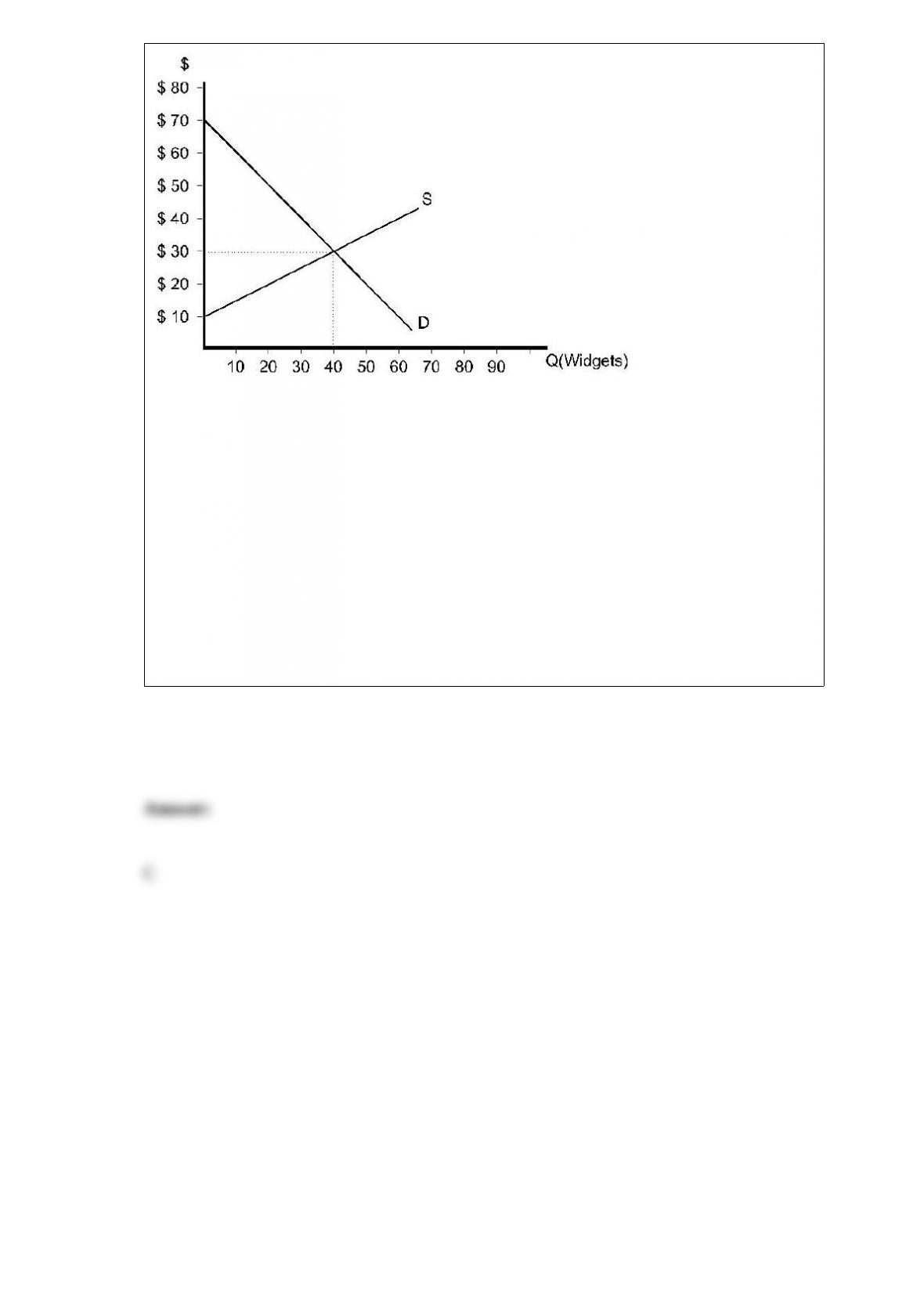
Figure 9.1
Refer to Figure 9.1. If the market is in equilibrium, total producer surplus is
A) $30.
B) $70.
C) $400.
D) $800.
E) $1200.