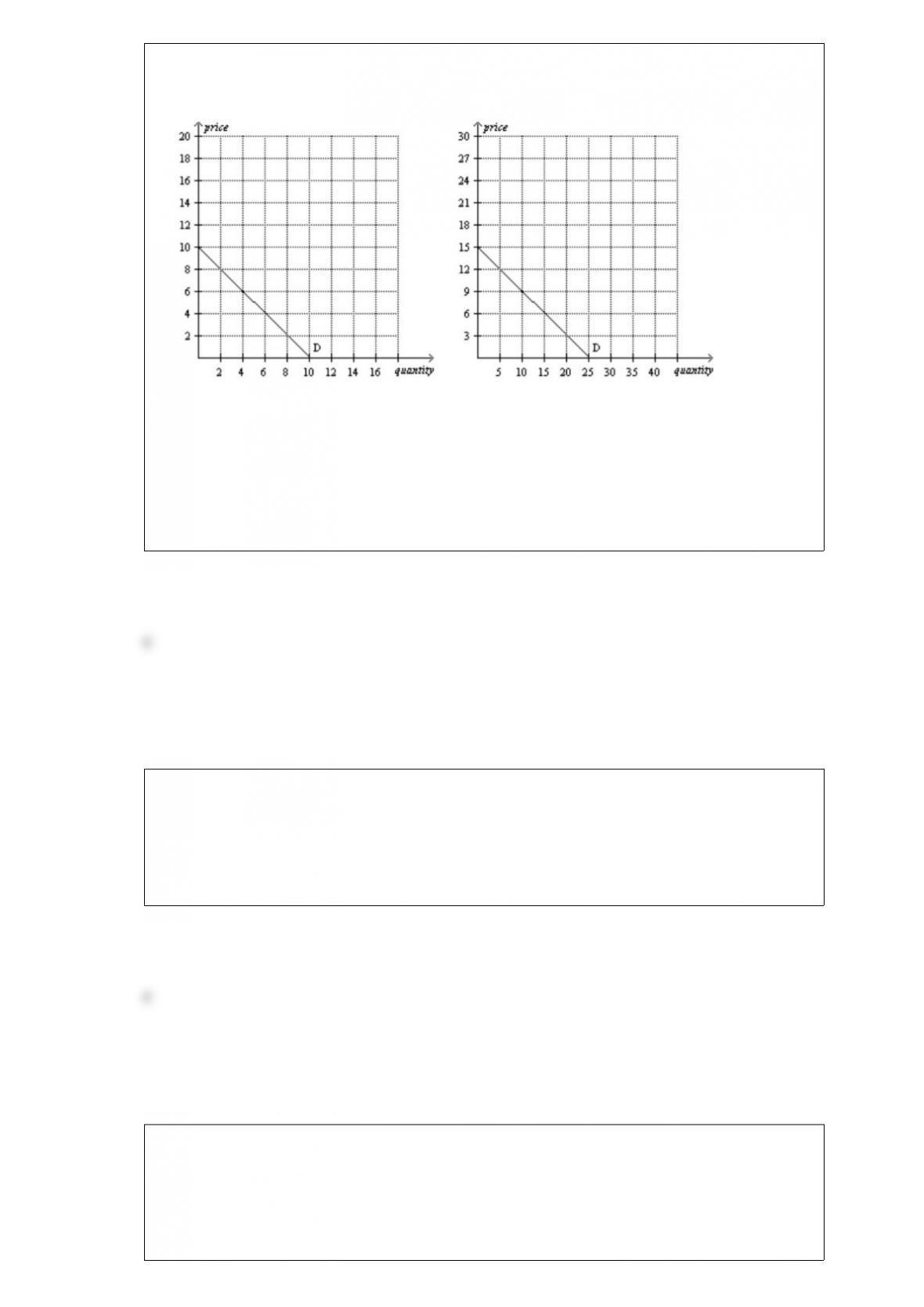
Figure 43
Consumer 1Consumer 2
Refer to Figure 43. If these are the only two consumers in the market, then the market
quantity demanded at a price of $10 is
a. 0 units.
b. 5 units.
c. 8.33 units.
d. 25 units.
Which of the following will cause an increase in producer surplus?
a. the imposition of a binding price ceiling in the market
b. buyers expect the price of the good to be lower next month
c. the price of a substitute increases
d. income increases and buyers consider the good to be inferior
In January the price of widgets was $1.00, and Wendy’s Widgets produced 80 widgets.
In February the price of widgets was $1.50, and Wendy’s Widgets produced 110
widgets. In March the price of widgets was $2.00, and Wendy’s Widgets produced 140
widgets. The price elasticity of supply of Wendy’s Widgets was about
a. 0.79 when the price increased from $1.00 to $1.50 and 0.84 when the price increased
from $1.50 to $2.00.
b. 1.27 when the price increased from $1.00 to $1.50 and 1.19 when the price increased
from $1.50 to $2.00.
c. 0.79 when the price increased from $1.00 to $1.50 and 1.19 when the price increased
from $1.50 to $2.00.
d. 1.27 when the price increased from $1.00 to $1.50 and 0.84 when the price increased
from $1.50 to $2.00.
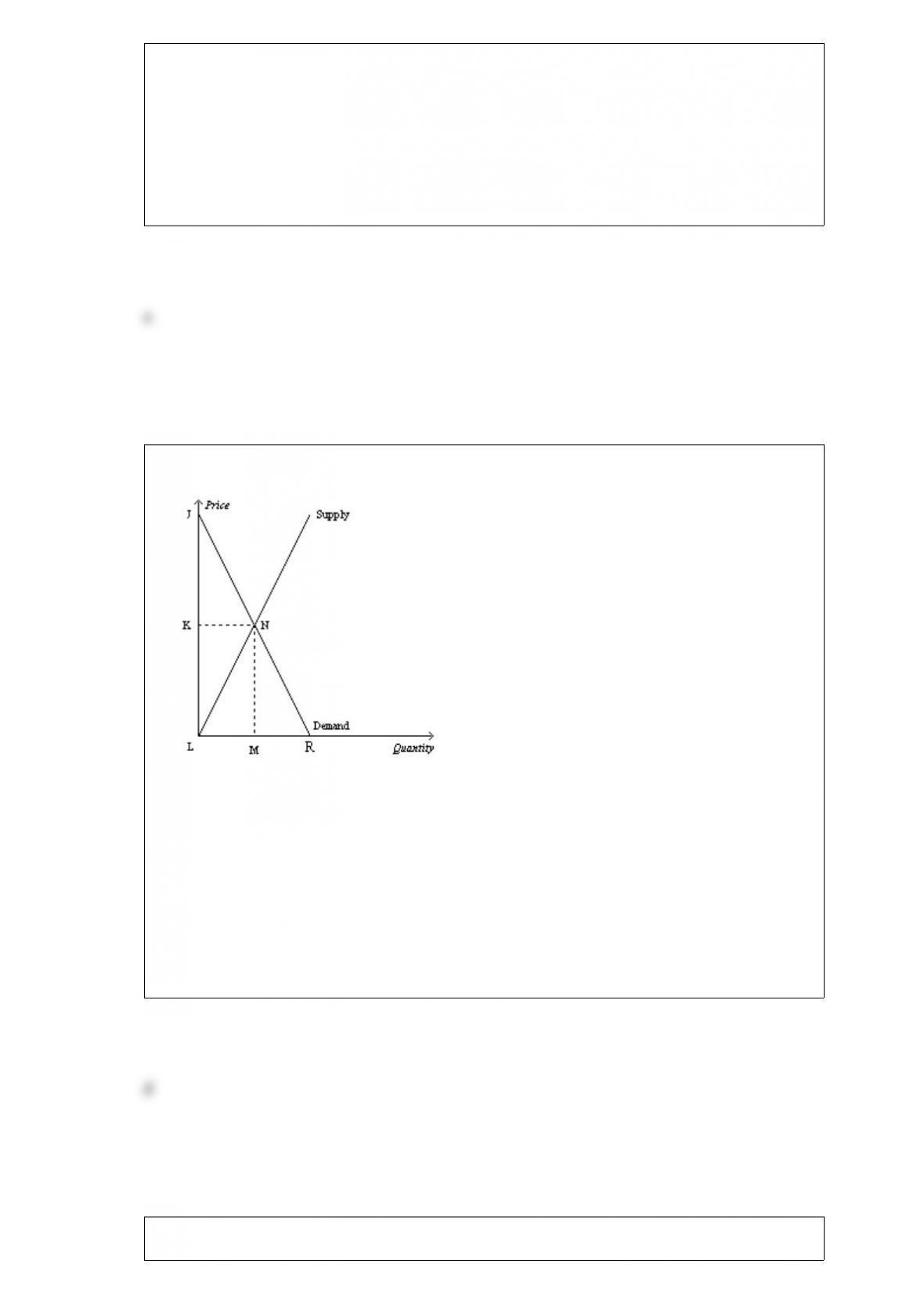
Figure 720
Refer to Figure 720. For quantities greater than M, the value to the marginal buyer is
a. greater than the cost to the marginal seller, so increasing the quantity increases total
surplus.
b. less than the cost to the marginal seller, so increasing the quantity increases total
surplus.
c. greater than the cost to the marginal seller, so decreasing the quantity increases total
surplus.
d. less than the cost to the marginal seller, so decreasing the quantity increases total
surplus.
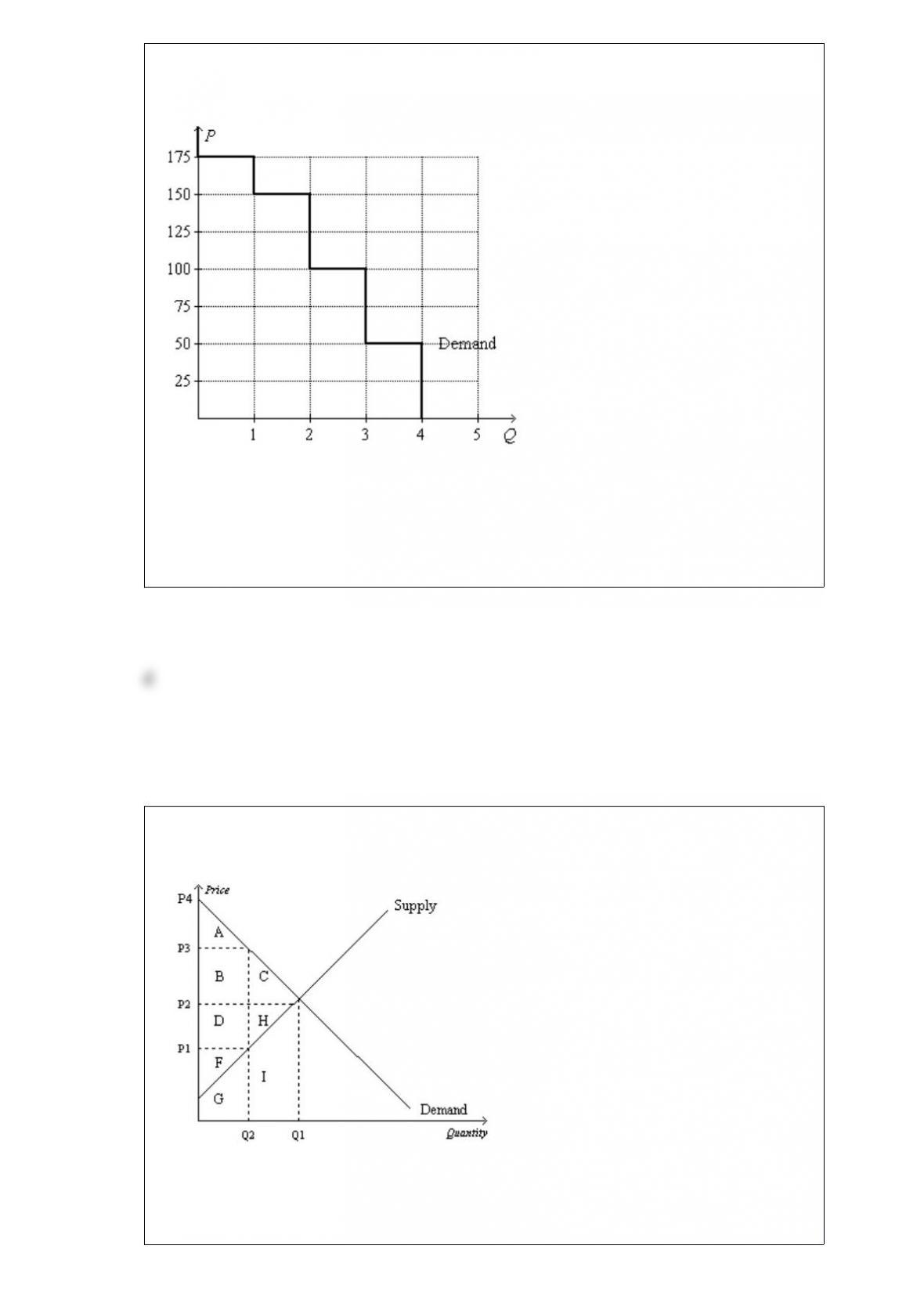
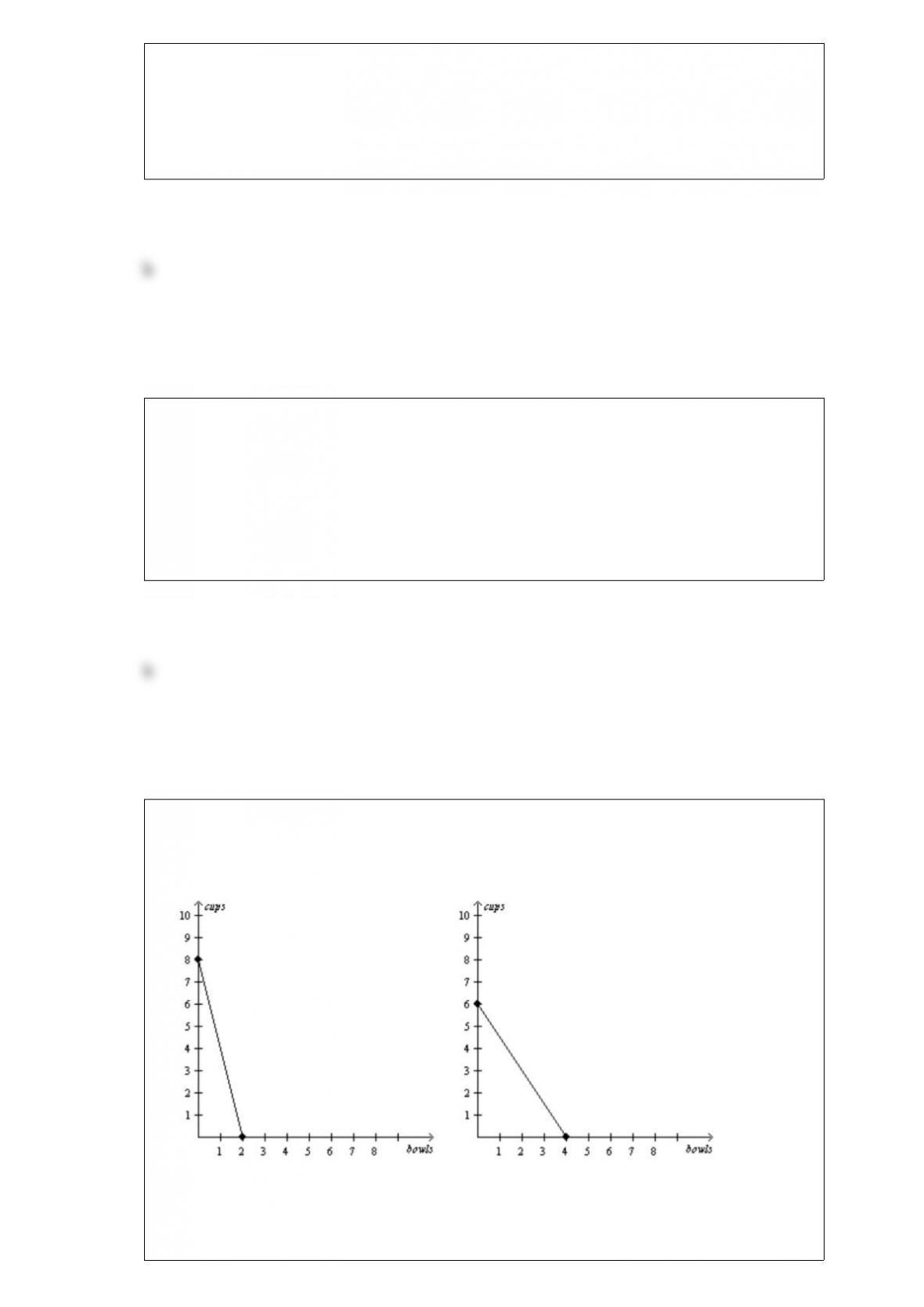
Figure 72
Refer to Figure 72. If the price of the good is $100, then consumer surplus amounts to
a. $50.
b. $75.
c. $100.
d. $125.
Figure 85
Suppose that the government imposes a tax of P3 P1.
Refer to Figure 85. Consumer surplus before the tax was levied is represented by area
a. A.
b. A+B+C.

c. D+H+F.
d. F.
Some, but not all, government economists are employed within the administrative
branch of government. Which of the following government agencies employs
economists outside of the administrative branch?
a. the Department of Labor
b. the Department of the Treasury
c. the Congressional Budget Office
d. the Council of Economic Advisers
When a country allows trade and becomes an importer of jet skis,
a. domestic producers of jet skis are worse off, domestic consumers of jet skis are better
off, and the economic wellbeing of the country rises.
b. domestic producers of jet skis are worse off, domestic consumers of jet skis are better
off, and the economic wellbeing of the country falls.
c. domestic producers of jet skis are better off, domestic consumers of jet skis are worse
off, and the economic wellbeing of the country rises.
d. domestic producers of jet skis are better off, domestic consumers of jet skis are worse
off, and the economic wellbeing of the country falls.
The supply curve for portable charcoal grills shifts
a. only when production technology changes.
b. when a determinant of the supply of portable charcoal grills other than the price of
portable charcoal grills changes.
c. when any determinant of the supply of portable charcoal grills changes.
d. only when the number of sellers of portable charcoal grills changes.
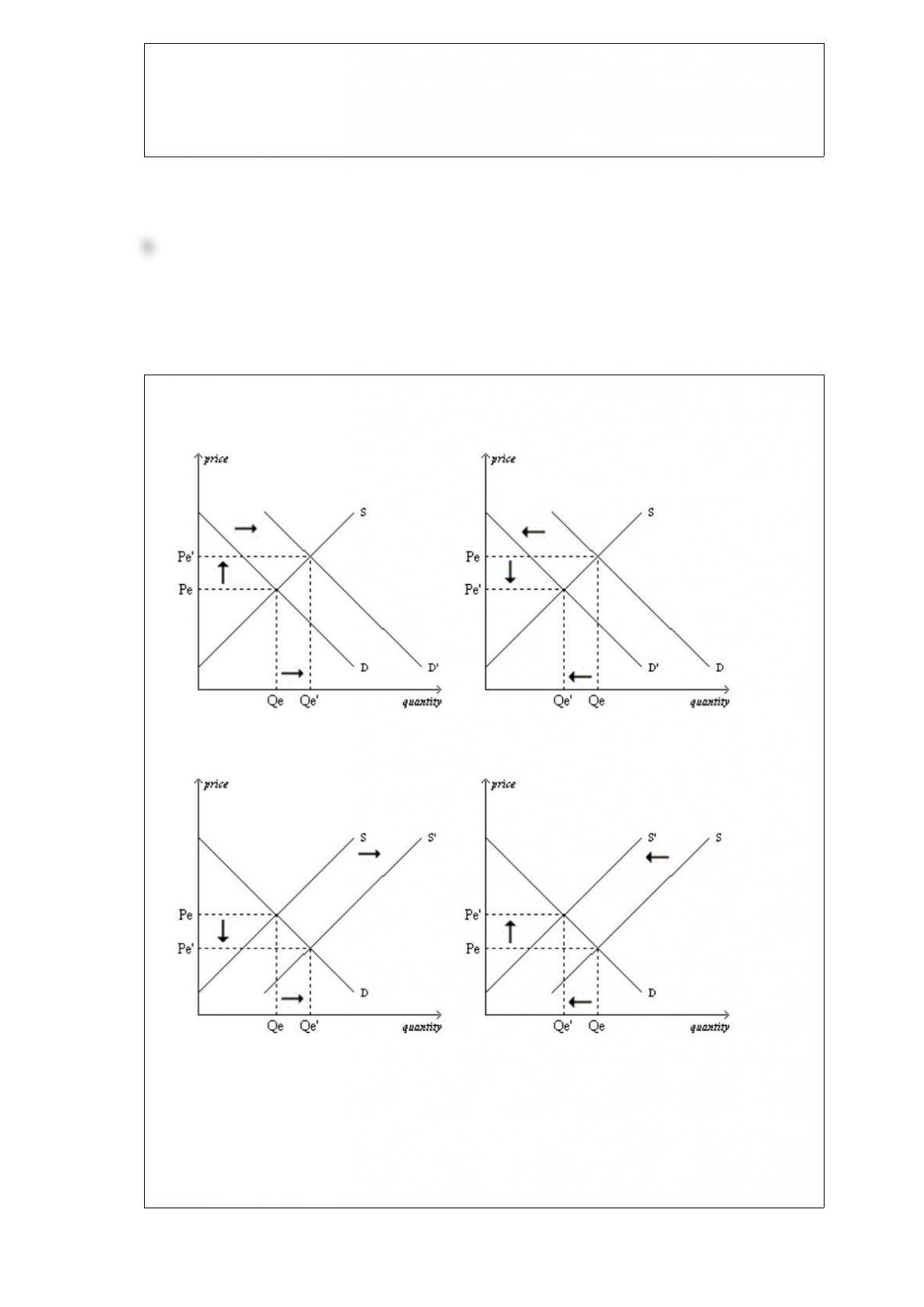
Figure 427
Panel (a)Panel (b)
Panel (c)Panel (d)
Refer to Figure 427. Which of the four panels illustrates a decrease in quantity
supplied?
a. Panel (a)
b. Panel (b)
c. Panel (c)
d. Panel (d)
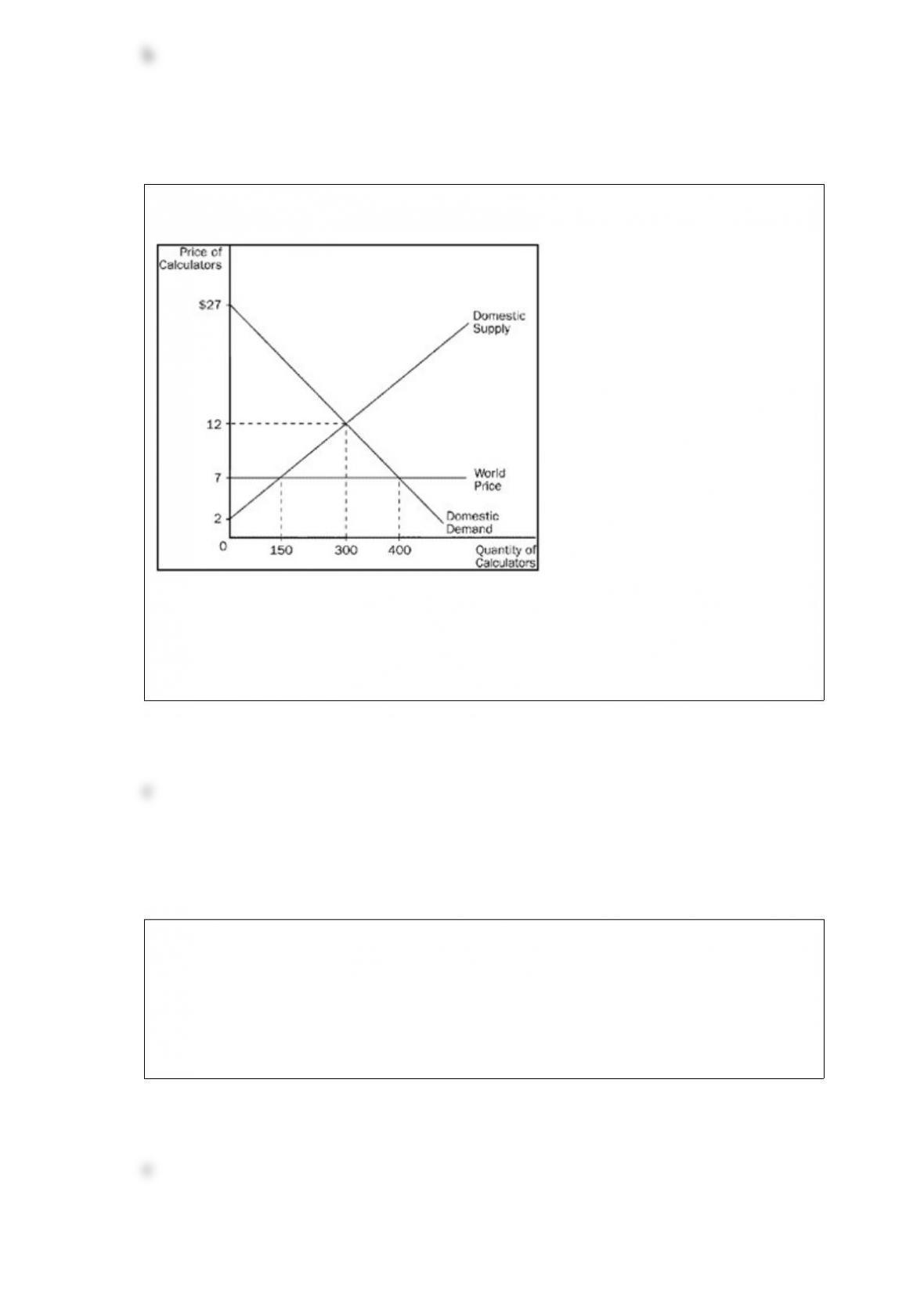
Figure 94. The domestic country is Nicaragua.
Refer to Figure 94. Consumer surplus in Nicaragua without trade is
a. $375.
b. $2,000.
c. $2,250.
d. $8,700.
Which of the following statements exemplifies a principle of individual
decisionmaking?
a. Trade can make everyone better off.
b. Governments can sometimes improve market outcomes.
c. The cost of something is what you give up to get it.
d. All of the above are correct.

Table 329
Juanita and Shantala run a business that programs and tests cellular phones. Assume
that Juanita and Shantala can switch between programming and testing cellular phones
at a constant rate. The following table applies.
Minutes Needed to Number of Cellular Phones Programmed or Tested in a 40Hour
Week
Program 1 Cellular PhoneTest 1 Cellular PhoneCellular Phones ProgrammedCellular
Phones Tested
Juanita ?21601200
Shantala104240600
Refer to Table 329. Juanita’s opportunity cost of programming one cellular phone is
testing
a. 7.5 cellular phones and Shantala’s opportunity cost of programming one cellular
phone is testing 5/2 cellular phones.
b. 2/15 cellular phones and Shantala’s opportunity cost of programming one cellular
phone is testing 5/2 cellular phones.
c. 7.5 cellular phones and Shantala’s opportunity cost of programming one cellular
phone is testing 2/5 cellular phones.
d. 2/15 cellular phones and Shantala’s opportunity cost of programming one cellular
phone is testing 2/5 cellular phones.
Most economists view the United States’ experience with trade as
a. one from which no firm conclusions about the virtues of free trade can be reached,
due to the relatively short history of international trade in the U.S.
b. one from which no firm conclusions about the virtues of free trade can be reached,
due to the lack of trade within the U.S. throughout most of the early history of the U.S.
c. an ongoing experiment that confirms the virtues of free trade.
d. an ongoing experiment that calls into serious question the notion that free trade
enhances the economic wellbeing of a nation.

Which of the following events is consistent with an increase in the deadweight loss of
the gasoline tax from $30 million to $120 million?
a. The tax on gasoline increases from $0.30 per gallon to $0.45 per gallon.
b. The tax on gasoline increases from $0.30 per gallon to $0.60 per gallon.
c. The tax on gasoline increases from $0.25 per gallon to $0.45 per gallon.
d. The tax on gasoline increases from $0.25 per gallon to $1.00 per gallon.
If Faith attends college, it will take her four years, during which time she will earn no
income. She will pay $50,000 for tuition, $12,000 for room and board, and $5,000 for
books. If she spends the four years working rather than attending college, she will pay
$18,000 for room and board, pay no intuition, and buy no books. Based on this
information, Faith’s economic cost of attending college would be $67,000 if, over the
four years, she could earn
a. $12,000 instead of attending college.
b. $14,000 instead of attending college.
c. $16,000 instead of attending college.
d. $18,000 instead of attending college.
Which famous economist developed the principle of comparative advantage as we
know it today?
a. Adam Smith
b. David Ricardo
c. John Maynard Keynes
d. Milton Friedman
The maximum price that a buyer will pay for a good is called
a. consumer surplus.
b. willingness to pay.
c. equilibrium.
d. efficiency.
Suppose the government has imposed a price floor on cellular phones. Which of the
following events could transform the price floor from one that is binding to one that is
not binding?
a. Cellular phones become less popular.
b. Traditional land line phones become more expensive.
c. The components used to produce cellular phones become less expensive.
d. Firms expect the price of cellular phones to fall in the future.
Figure 37
Bintu’s Production Possibilities FrontierJuba’s Production Possibilities Frontier
Refer to Figure 37. If Bintu and Juba each divides her time equally between making
bowls and making cups, then total production is
a. 2 bowls and 6 cups.

b. 3 bowls and 7 cups.
c. 4 bowls and 8 cups.
d. 6 bowls and 14 cups.
A simultaneous decrease in both the demand for MP3 players and the supply of MP3
players would imply that
a. both the value of MP3 players to consumers and the cost of producing MP3 players
has increased.
b. both the value of MP3 players to consumers and the cost of producing MP3 players
has decreased.
c. the value of MP3 players to consumers has decreased, and the cost of producing MP3
players has increased.
d. the value of MP3 players to consumers has increased, and the cost of producing MP3
players has decreased.
Table 411
PriceQuantity
DemandedQuantity
Supplied
$101060
$82045
$63030
$44015
$2500
Refer to Table 411. The equilibrium price and quantity, respectively, are
a. $2 and 50 units.
b. $6 and 30 units.
c. $6 and 60 units.
d. $12 and 30 units.

Trade between countries tends to
a. reduce both competition and specialization.
b. reduce competition and increase specialization.
c. increase competition and reduce specialization.
d. increase both competition and specialization.
In 1990, Congress passed a new luxury tax on items such as yachts, private airplanes,
furs, jewelry, and expensive cars. The goal of the tax was to
a. raise revenue from the wealthy.
b. prevent wealthy people from buying luxuries.
c. force producers of luxury goods to reduce employment.
d. limit exports of luxury goods to other countries.
Table 340
Hours Needed to Make 1Quantity Produced in 2400 Hours
BoatCarBoatCar
Germany40306080
Italy40506048
Refer to Table 340. Italy should specialize in the production of
a. boats and import cars.
b. cars and import boats.
c. both goods and import neither good.
d. neither good and import both goods.
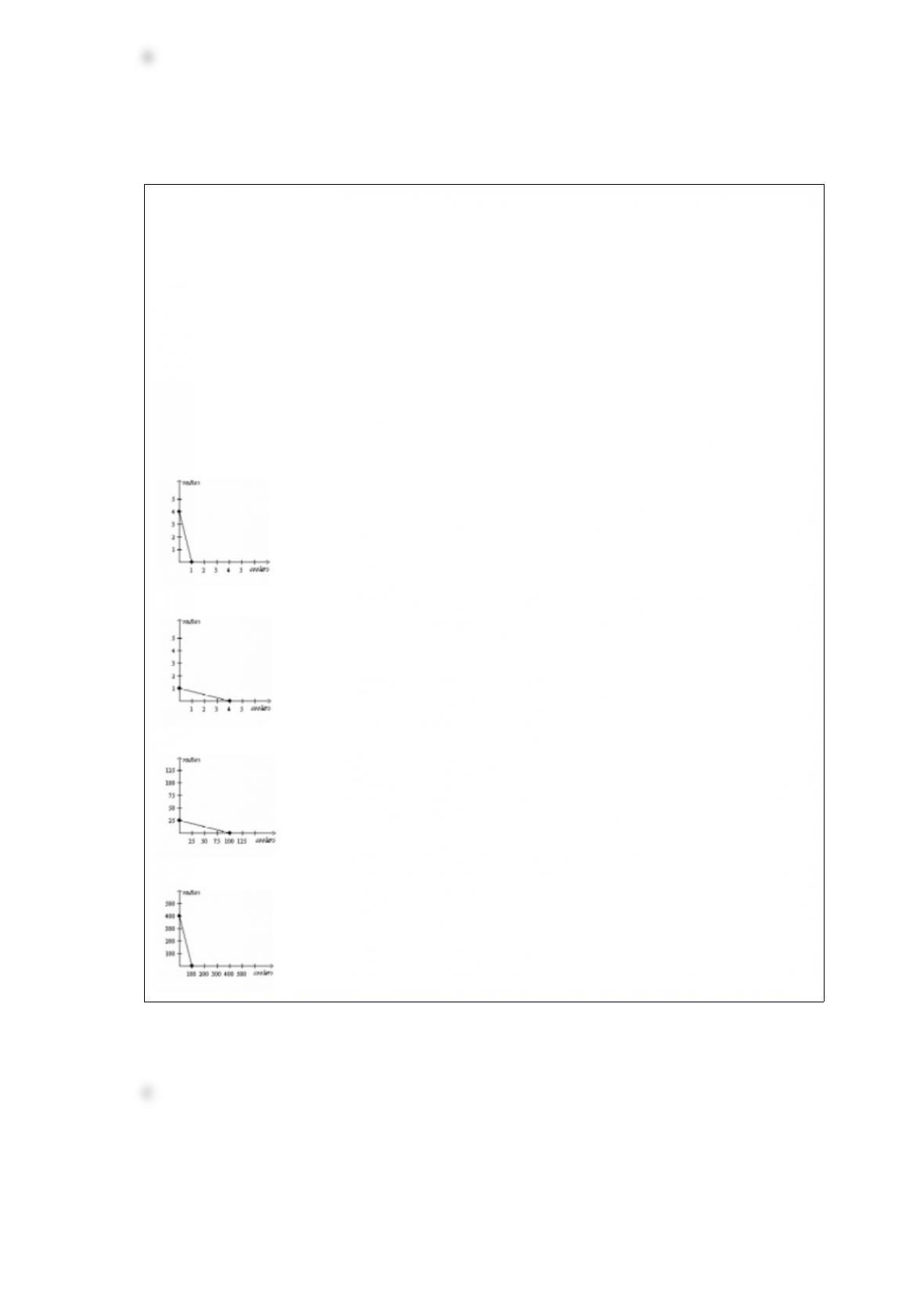
Table 35
Assume that Aruba and Iceland can switch between producing coolers and producing
radios at a constant rate.
Labor Hours
Needed to Make 1
CoolerRadio
Aruba25
Iceland14
Refer to Table 35. Which of the following represents Iceland’s production possibilities
frontier when 100 labor hours are available?
a.
b.
c.
d.
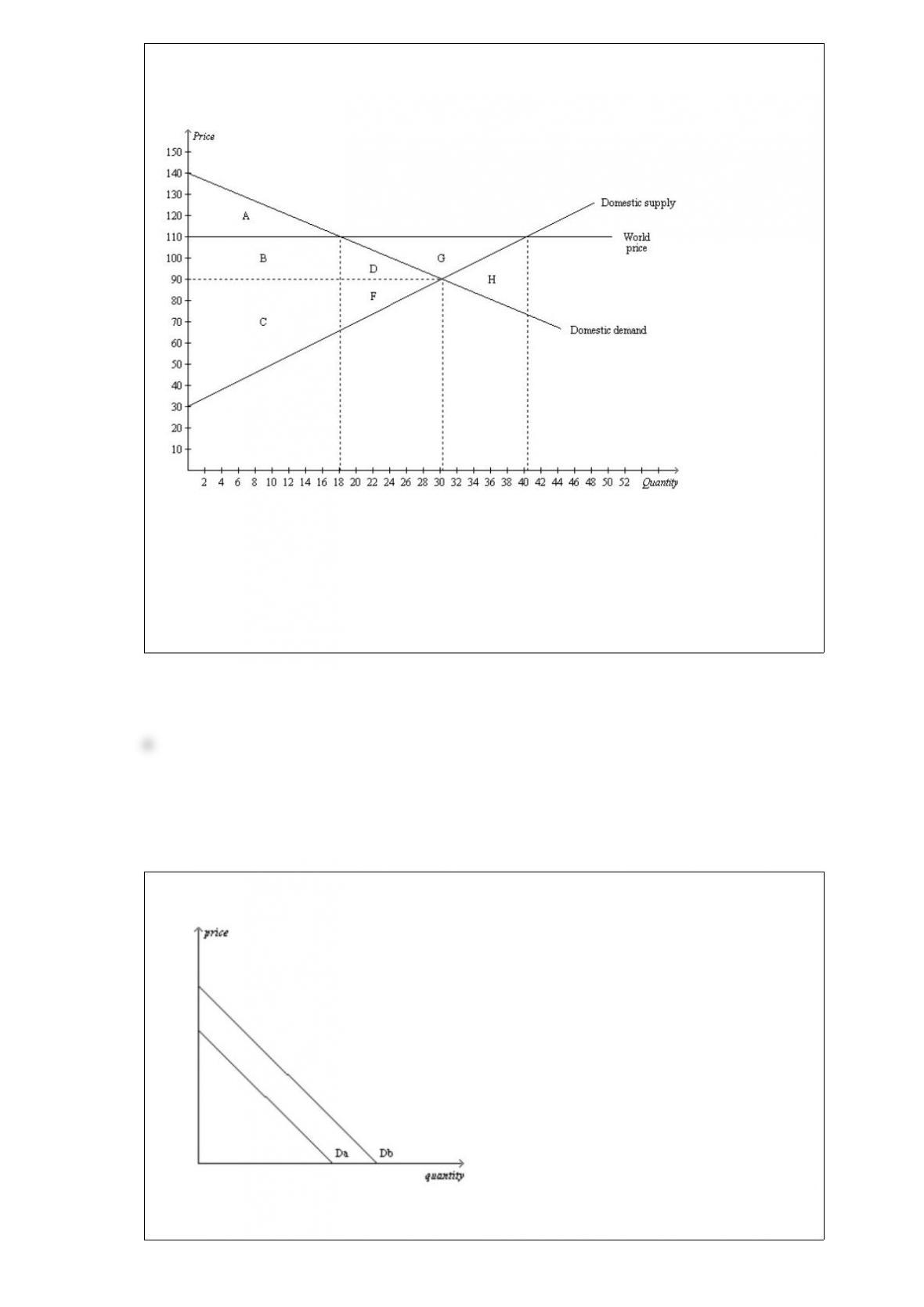
Figure 91
The figure illustrates the market for coffee in Guatemala.
Refer to Figure 91. From the figure it is apparent that
a. Guatemala will export coffee if trade is allowed.
b. Guatemala will import coffee if trade is allowed.
c. Guatemala has nothing to gain either by importing or exporting coffee.
d. the world price will fall if Guatemala begins to allow its citizens to trade with other
countries.
Figure 47
Refer to Figure 47. The movement from Da to Db could be caused by

a. a decrease in price.
b. a decrease in income, assuming the good is inferior.
c. buyers expecting the price of the good to fall in the near future.
d. an increase in the price of a complement.
If the Korean steel industry subsidizes the steel that it sells to the United States, the
a. United States should protect its domestic steel industry from this unfair competition.
b. harm done to U.S. steel producers from this unfair competition exceeds the gain to
U.S. consumers of cheap Korean steel.
c. harm done to U.S. steel producers is less than the benefit that accrues to U.S.
consumers of steel.
d. United States should subsidize the products it sells to Korea.
When a country allows trade and becomes an exporter of a good,
a. domestic producers become better off, and domestic consumers become worse off.
b. domestic producers become worse off, and domestic consumers become better off.
c. domestic producers become better off, but the effect on the wellbeing of domestic
consumers is ambiguous.
d. domestic consumers become worse off, but the effect on the wellbeing of domestic
producers is ambiguous.
Which of the following is not an example of a public policy?
a. rentcontrol laws
b. minimumwage laws
c. taxes
d. equilibrium laws
A rightward shift of a supply curve is called a(n)
a. increase in supply.
b. decrease in supply.
c. decrease in quantity supplied.
d. increase in quantity supplied.
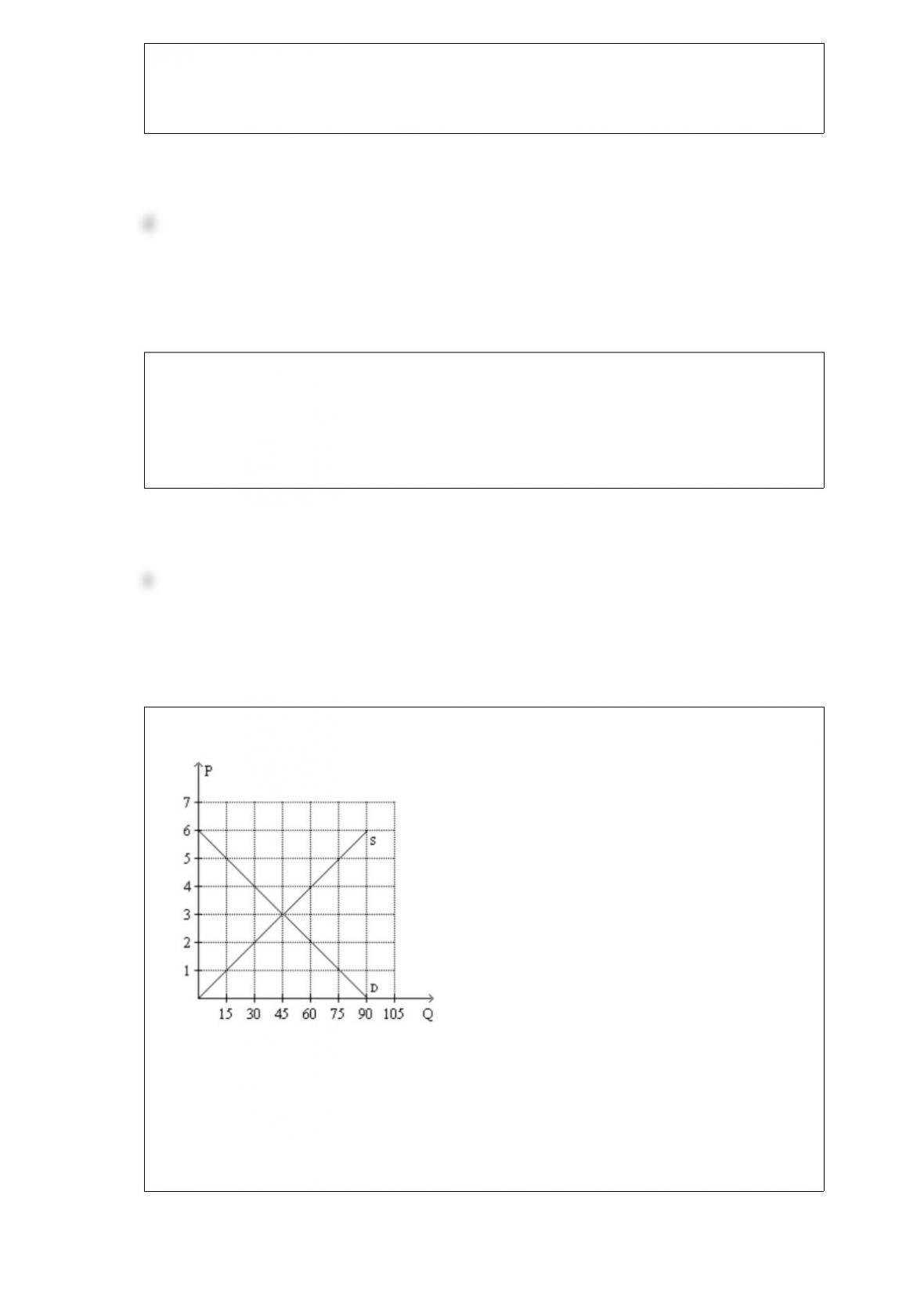
Figure 615
Refer to Figure 615. For a price ceiling to be binding in this market, it would have to
be set at
a. any price below $3.
b. a price between $2 and $3.
c. a price between $3 and $4.
d. any price above $3.

The minimum wage is an example of a
a. price ceiling.
b. price floor.
c. wage subsidy.
d. tax.
Table 328
Barb and Jim run a business that sets up and tests computers. Assume that Barb and Jim
can switch between setting up and testing computers at a constant rate. The following
table applies.
Minutes Needed to Number of Computers Set Up or Tested in a 40Hour Week
Set Up 1 ComputerTest 1 ComputerComputers Set UpComputers Tested
Barb48?5040
Jim30408060
Refer to Table 328. Jim has an absolute advantage in
a. both setting up and testing computers and a comparative advantage in setting up
computers.
b. both setting up and testing computers and a comparative advantage in testing
computers.
c. neither setting up nor testing computers and a comparative advantage in setting up
computers.
d. neither setting up nor testing computers and a comparative advantage in testing
computers.