
Suppose the same basket of goods costs $100 in the U.S. and 50 pounds in Britain.
According to purchasing power parity, if the two countries’ price levels do not change,
what will be the exchange rate?
a. 2 dollars/pound
b. 4 dollars/pound
c. 5 dollars/pound
d. 0.50 dollars/pound
e. 50 dollars/pound
What are the three important macroeconomic goals about which most economists, and
society at large, agree?
a. economic growth, full employment, and low interest rates
b. economic growth, full employment, and stable prices
c. economic growth, zero unemployment, and falling prices
d. economic growth, low unemployment, and a balanced budget
e. economic growth, a balanced budget, and balanced international trade
If the income elasticity of demand for a good is -2.5, then
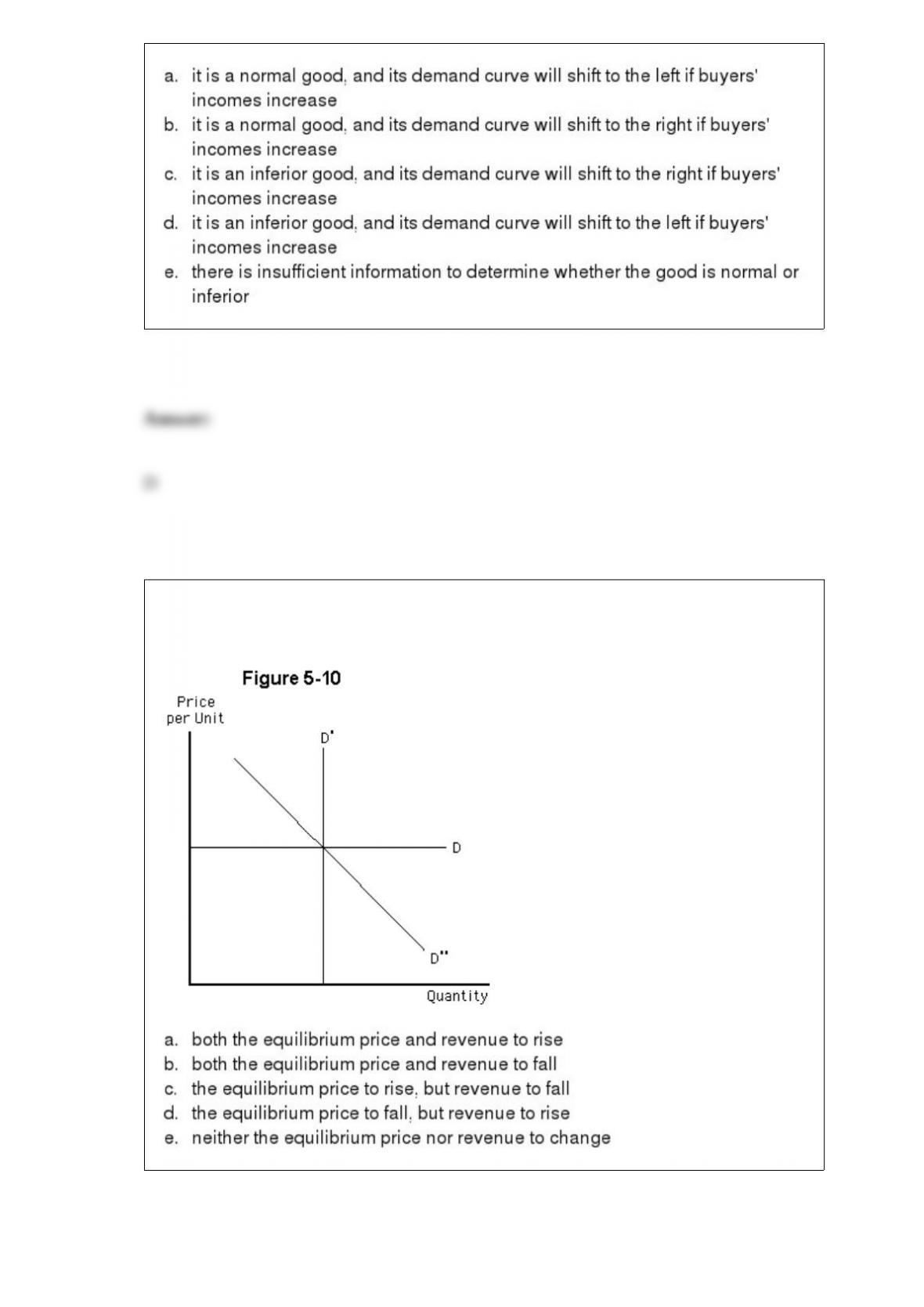
If demand for a good is represented by curve D’ in Figure 5-10, then a decrease in
supply of the good will cause

Which of the following is a common way of measuring the average standard of living?
a. The unemployment rate plus the inflation rate
b. Real GDP divided by the price level
c. The unemployment rate multiplied by the population
d. Real GDP divided by the population
e. Inflation rate divided by the population
Which of the following sequences results from a decrease in the price level?
a. the money demand curve shifts leftward, the interest rate decreases, investment
spending and autonomous consumption increase, the aggregate expenditure line shifts
upward, and there is a rightward movement along the aggregate demand curve.
b. the money demand curve shifts rightward, the interest rate increases, investment
spending and autonomous consumption increase, the aggregate expenditure line shifts
downward, and there is a rightward movement along the aggregate demand curve.
c. the money demand curve shifts leftward, the interest rate decreases, investment
spending and autonomous consumption increase, the aggregate expenditure line shifts
upward, and there is a leftward movement along the aggregate demand curve.
d. the money demand curve shifts rightward, the interest rate decreases, investment
spending and autonomous consumption increase, the aggregate expenditure line shifts
upward, and there is a movement upward along the aggregate demand curve.
e. the money demand curve shifts leftward, the interest rate increases, investment
spending and autonomous consumption increase, the aggregate expenditure line shifts
upward, and there is a leftward movement along the aggregate demand curve.

The supply curve for a particular bond is horizontal.
William quits his job where he earns an annual salary of $75,000 and opens a
management consulting business, charging an hourly rate of $120. He works out of his
home, converting a storeroom into an office. (Zoning restrictions prevent William from
renting out the room.) Start-up costs are financed by selling $15,000 worth of bonds he
inherited that were earning annual interest payments of $900. During his first year,
William incurs expenses for supplies and utilities that total $3,500. If William bills 500
hours of consulting time in the first year, he earns an economic profit equal to
What is the main reason why monetary policy has a stronger effect in an open economy
than in a closed economy?
a. Changes in the price level affect net exports.
b. Changes in the price level affect exchange rates.
c. Changes in exchange rates affect output.
d. Changes in the interest rate affect exchange rates which, in turn, affect net exports.
e. Changes in exchange rates affect the interest rate which, in turn, affects net exports.

An increase in human capital
a. is of secondary importance to economic growth compared to physical capital.
b. causes the production function to shift downward and become flatter.
c. causes the production function to shift upward.
d. causes the production function to shift downward.
e. can be separated from labor.
In a perfectly competitive labor market, the market labor supply curve
The demand curve facing the firm has been estimated as follows:
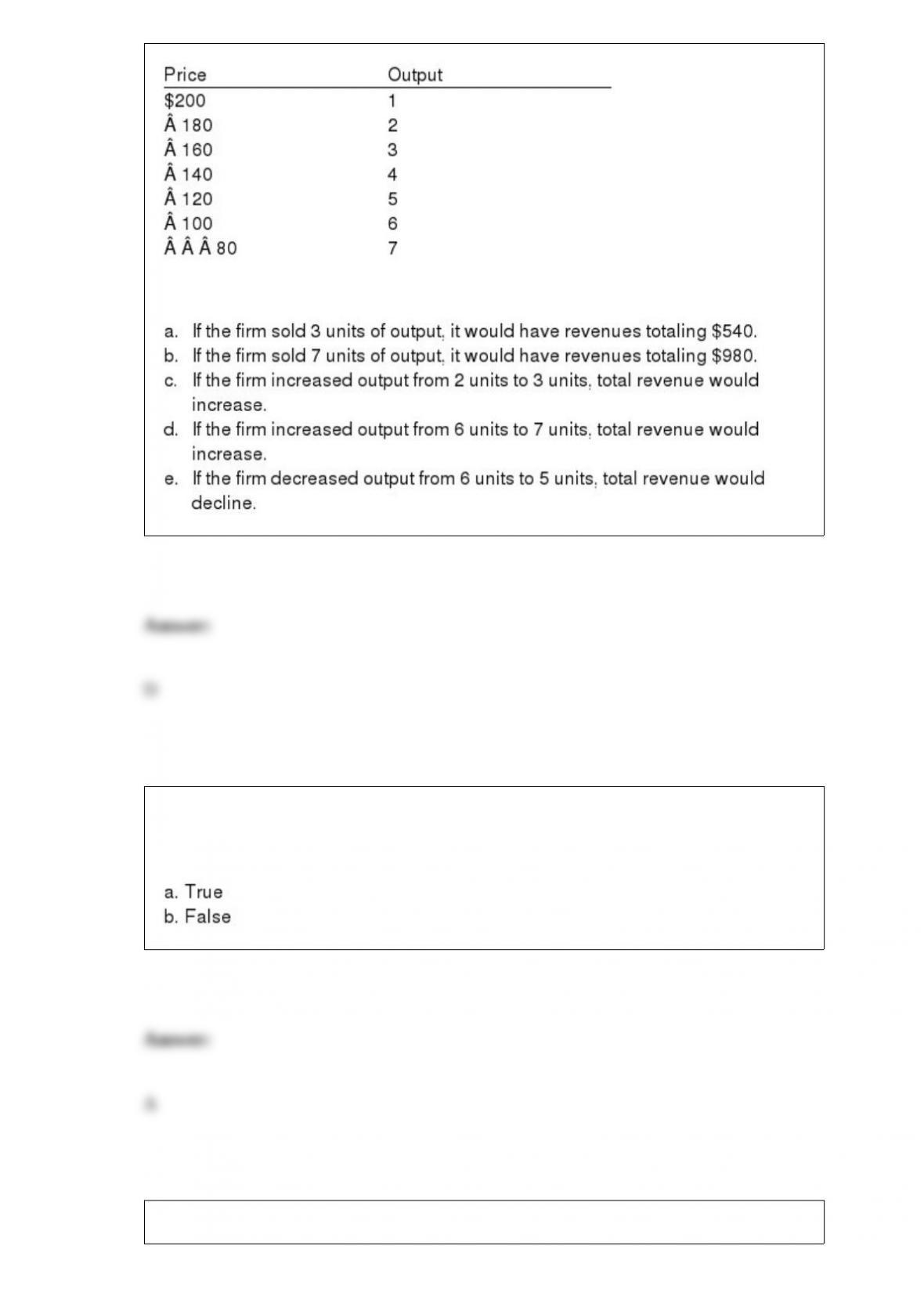
Which of the following statements about the firm’s total revenue is correct?
A major difference between monopolistic competition and perfect competition is the
degree of product differentiation. Pure competition has none and differentiation always
exists in monopolistic competition.
A price floor on corn would have the effect of