1) continued losses in an industry will cause some firms to reduce output or eventually
leave the industry.
2) the natural rate of unemployment in the united states is about 4 to 5 percent.
3) increases in household and business spending are a demand factor in economic
growth.
4)
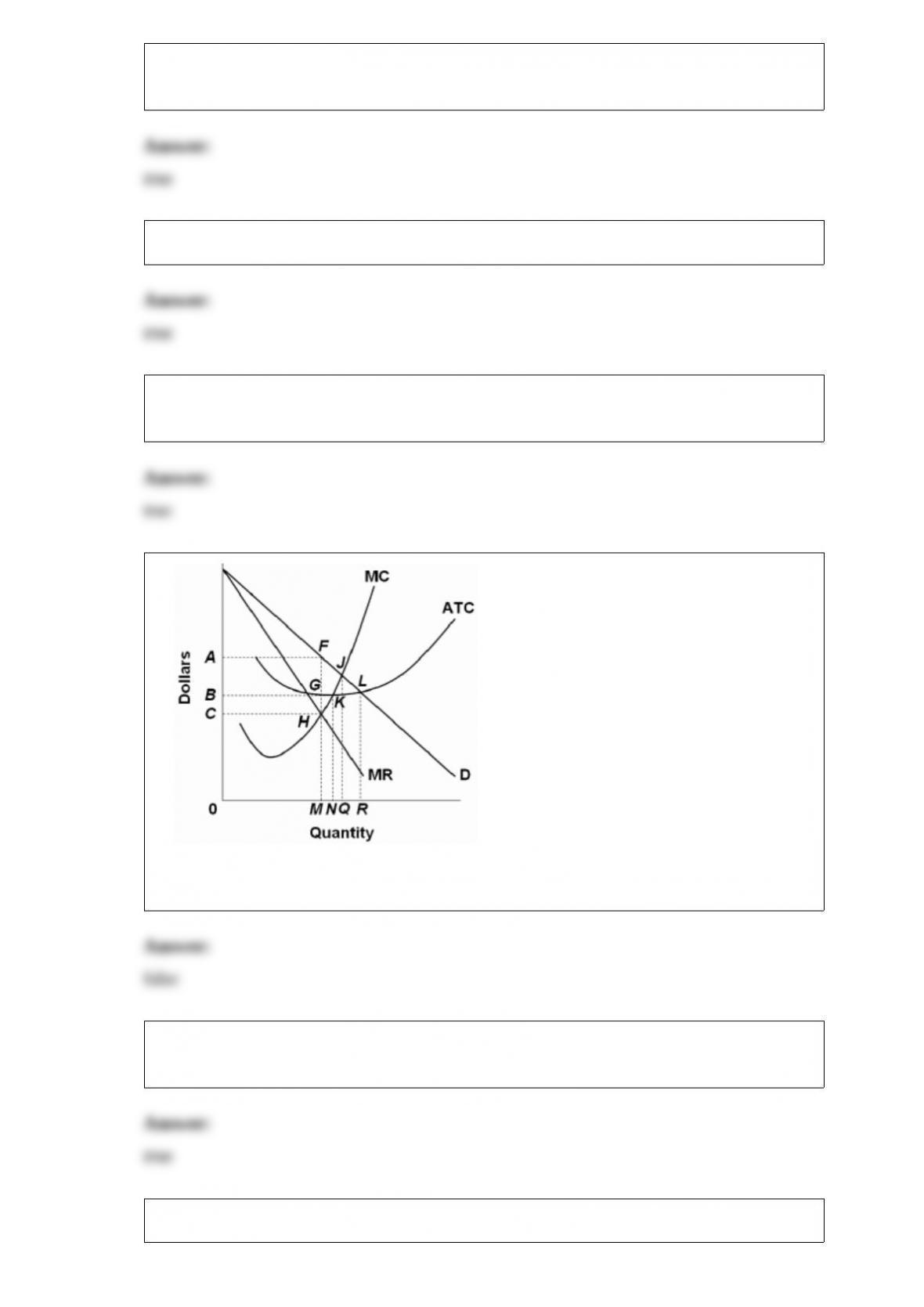
refer to the above diagram for a nondiscriminating monopolist. at output m total cost
will be 0chm.
5) the united states, japan, and the western european nations are the major international
traders in terms of overall volume.
6) price discrimination will result in consumers with more elastic demand purchasing
more of the good than when a single price is charged to all consumers in the market.
7)
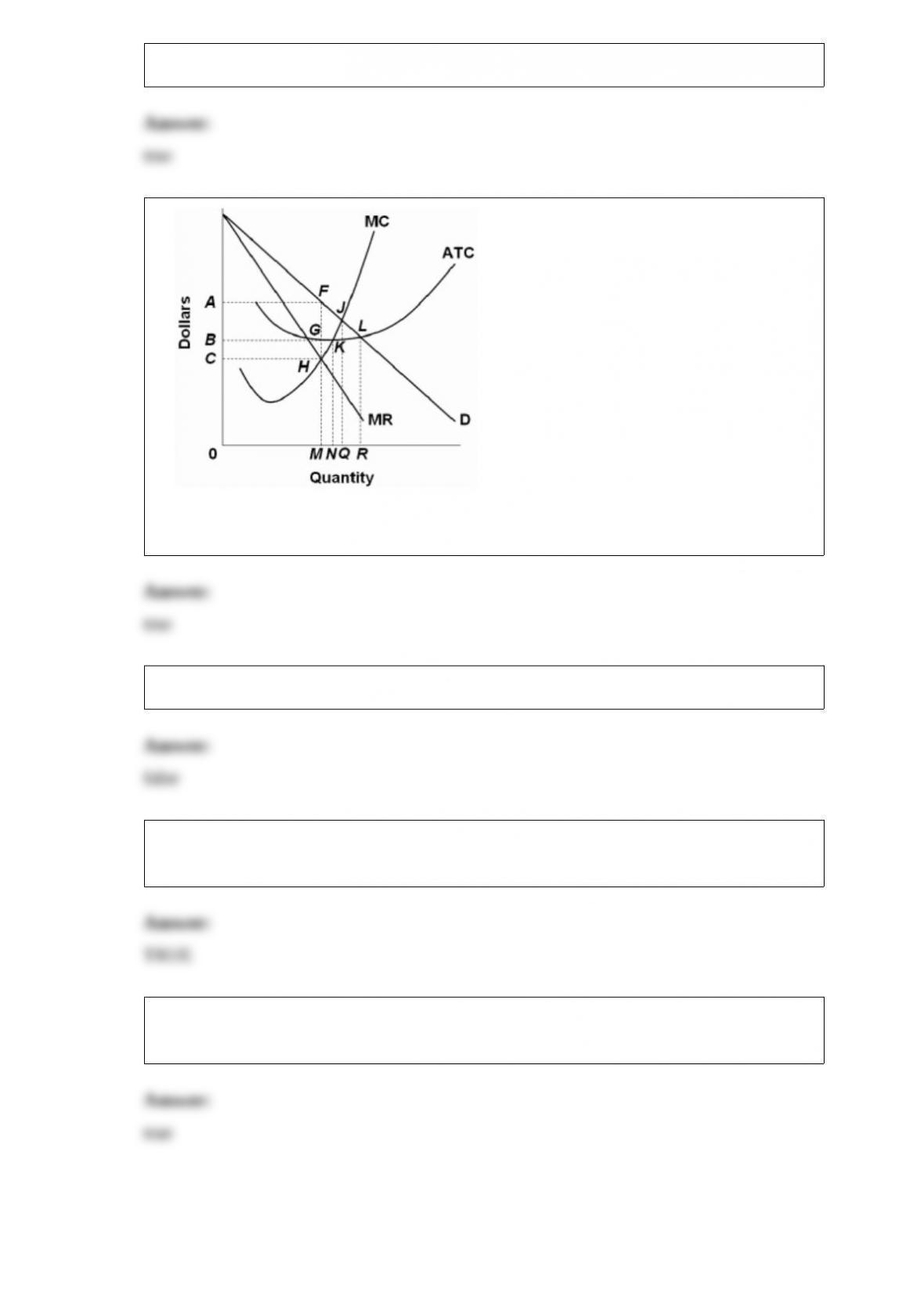
refer to the above diagram for a nondiscriminating monopolist. at output r economic
profits will be zero.
8) if the elasticity coefficient of supply is 0.7, supply is elastic.
9) An improvement in the technology of pollution control is likely to increase society’s
optimal amount of pollution abatement.
10) the greater the ease of shifting resources from product x to y in the production
process, the greater is the elasticity of supply of product y.
11)
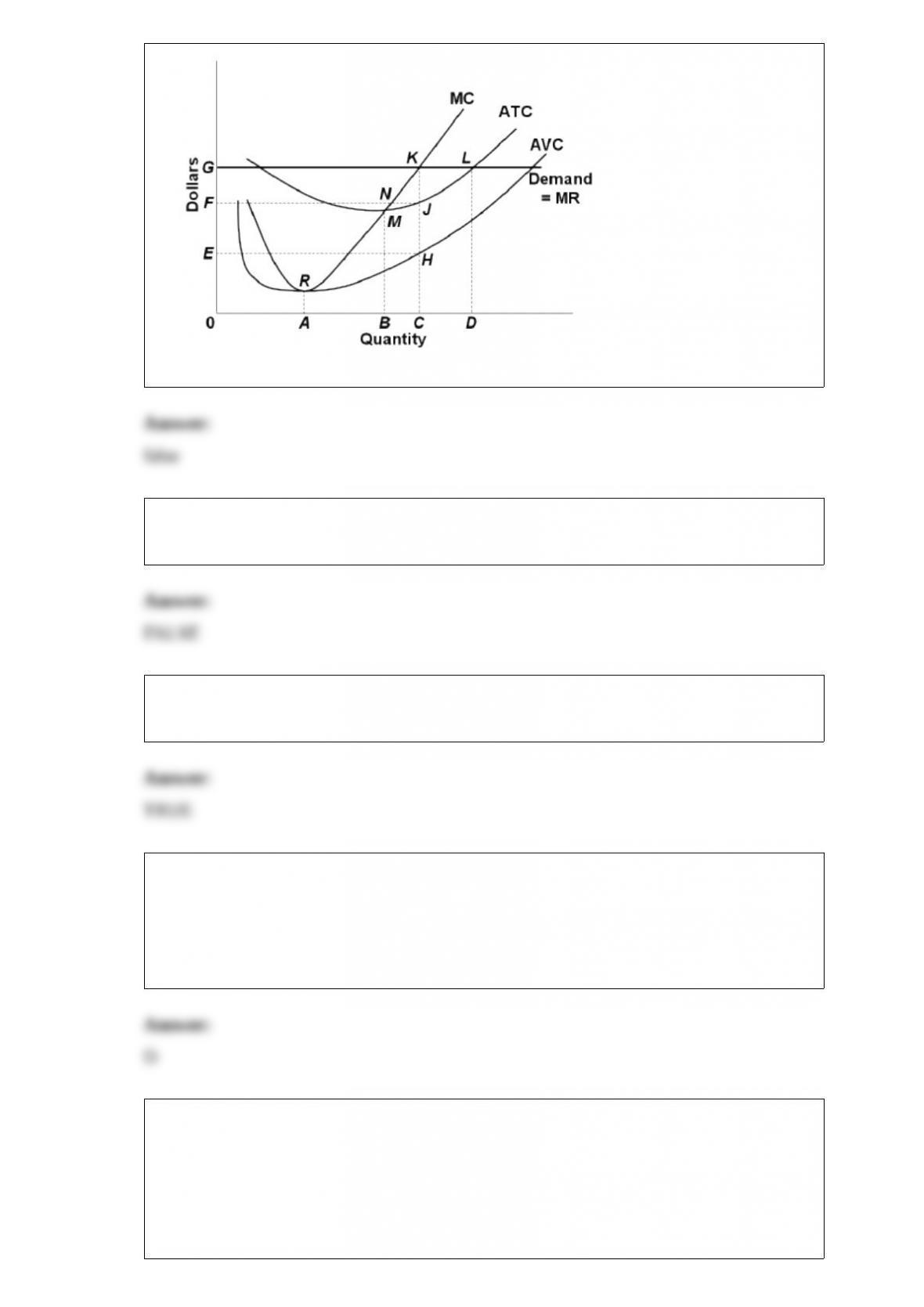
refer to the above diagram. at the profit-maximizing output total revenue will be 0gld.
12) Marginal resource (labor) cost will always exceed the wage rate when the employer
is selling its product in an imperfectly competitive market.
13) The total cost of extracting and selling a resource in a given year is the sum of the
extraction cost and user cost.
14) All of the following contribute to low investment spending in DVCs except:
A.low rates of saving.
B.inadequacy of public capital goods (infrastructure).
C.political instability.
D.expensive labor.
15) in which of the following market structures is there clear-cut mutual
interdependence with respect to price-output policies?
a.pure monopoly
b.oligopoly
c.monopolistic competition
d.pure competition

16) If Congress were to pass a law exempting interest on saving from taxation, the:
A.supply of loanable funds would decrease and the equilibrium interest rate rise.
B.supply of loanable funds would increase and the equilibrium interest rate fall.
C.demand for loanable funds would increase and the equilibrium interest rate rise.
D.equilibrium interest rate would be unaffected.
17) The elasticity of resource demand measures the:
A.responsiveness of workers to changes in wage rates.
B.responsiveness of producers to changes in resource prices.
C.ratio of marginal revenue product to resource price.
D.sensitivity of marginal revenue product to changes in product price.
18) the “after this, therefore because of this” fallacy states that:
a.positive statements are always followed by normative judgments.
b.positive statements can never be proven true or false.
c.if one acts on one’s expectations, those expectations will always be fulfilled.
d.cause and effect can be determined merely by observing the sequence of events.
19) Suppose the domestic price (no-international-trade price) of copper is $1.20 a
pound in the United States while the world price is $1.00 a pound. Assuming no
transportation costs, the United States will:
A.have a domestic surplus of copper.
B.export copper.
C.import copper.
D.neither export nor import copper.
20) In deriving the aggregate demand curve from the aggregate expenditures model we
note that:

A.the real-balances effect is irrelevant to both models.
B.a change in the price level will have no impact on the aggregate expenditures
schedule.
C.an increase (decrease) in the price levels shifts the aggregate expenditures schedule
upward (downward).
D.an increase (decrease) in the price level shifts the aggregate expenditures schedule
downward (upward).
21) Which of the following is not an example of a market imperfection that might
explain persistent wage differentials within an occupation?
A.geographic immobility of workers
B.discrimination
C.noncompeting groups
D.poor information about job opportunities and pay
22) which of the following statements is true about illegal immigration?
a.illegal immigrants are often willing to work for less pay, keeping costs and prices for
consumer goods and services lower.
b.illegal immigration can increase wages for u.s. workers who are complementary
inputs.
c.illegal immigration tends to reduce wages more for previous immigrants than for
native-born workers.
d.all of these.
23) Tying agreements:
A.are legal in the United States, even though they may reduce competition.
B.occur when the purchase of one product obligates the buyer to purchase other
products from the same seller.
C.refer to any long-term contract between a buyer and a seller.
D.were outlawed by the Celler-Kefauver Act.
24) The reserves of a commercial bank consist of:
A.the amount of money market funds it holds.
B.deposits at the Federal Reserve Bank and vault cash.
C.government securities that the bank holds.
D.the bank’s net worth.
25) national income accountants define investment to include:
a.any increase in business inventories.
b.the addition of cash to a savings account.
c.the purchase of common or preferred stock.
d.the purchase of any durable good, for example, an automobile or a refrigerator.
26) What rationale does rational expectations theory provide for the ineffectiveness of
discretionary policies?
27) Why does the private market succeed in meeting consumers demands while
majority voting in many cases fails to do the same?
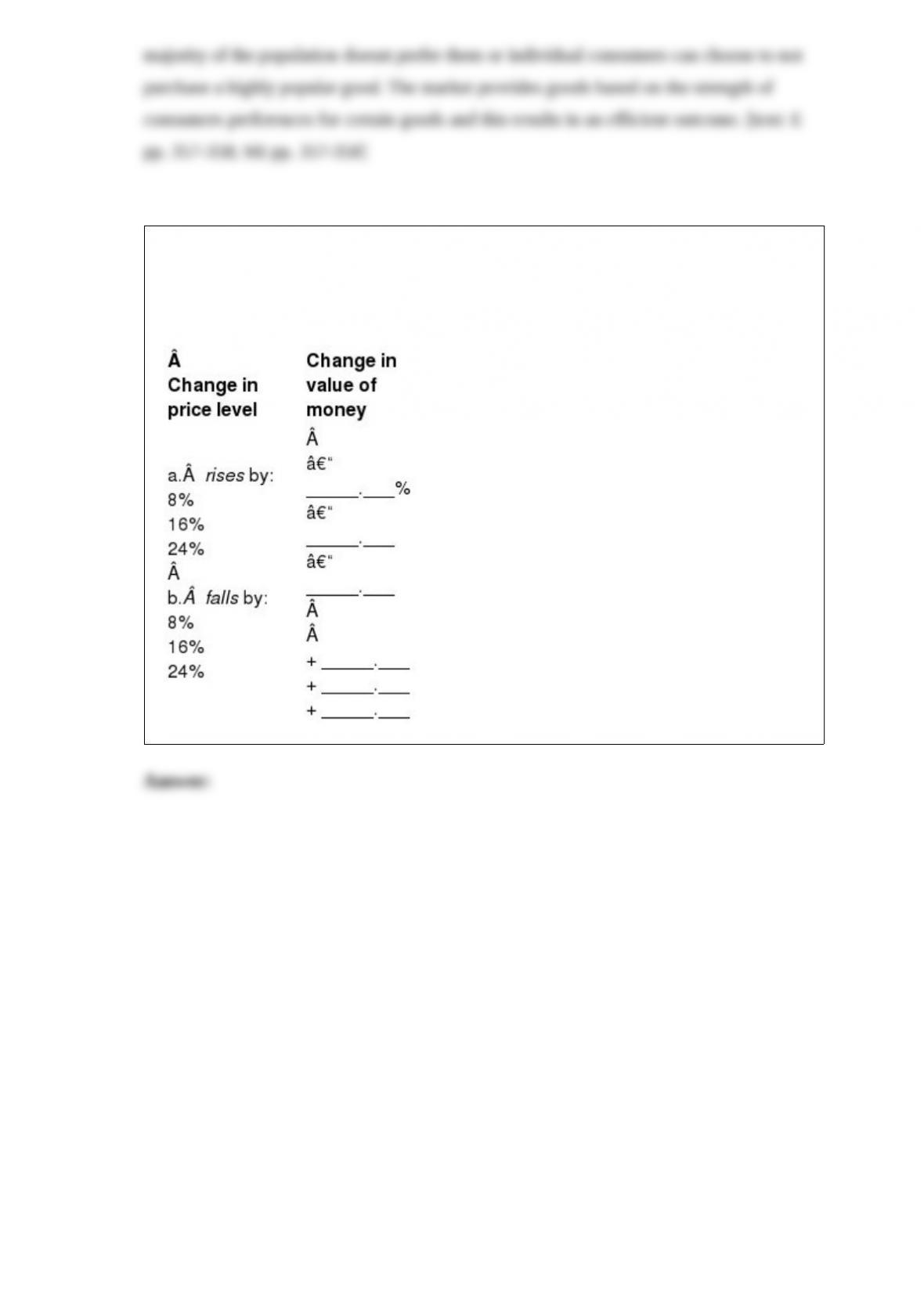
28) Complete the following table showing the relationship between a percentage change
in the price level and the percentage change in the value of money. Calculate the
percentage change in the value of money to one decimal place.
29) Explain the differences among the frictional, structural, and cyclical forms of
unemployment.
30) What resource problem is created by positive externalities and what methods are
suggested for dealing with this problem?
31) Describe a recent violation of the Wheeler-Lea Act of 1938.
32) (Consider This) Why is recent immigration a vital contributor to the American
economy?
33) Identify the two major ways economic growth is measured.
34) The following table shows the price of a specific stereo receiver for a five-year
period. Using year 3 as the base year, calculate the price index for each year.
35) How does investment in capital goods and infrastructure contribute to economic
growth?