When Jimmy produces one guitar his costs total $250. When he produces two guitars
his total costs are $400. This means that Jimmy’s marginal cost of producing the second
guitar is $200.
Active economic policies are more likely to destabilize the economy if the adjustment
process is quick enough.
If output of each good or service doubles and all prices remain the unchanged, nominal
GDP doubles.
The largest component of aggregate expenditure is consumption expenditure.
Recall Application 3, “The Effectiveness of Committees,” to answer the following
questions:
Outside time lags are delays in the economy’s response to stabilization policies.
Deposit insurance indirectly helped to create the savings and loan crisis in the United
States during the 1980s.
The Fed can directly control the federal funds rate.
We can infer from the application that the increase in living standards today may cause
a drop in living standards in the long run.

A White House proposal to lower business taxes by increasing tax deductions is an
example of
A) expansionary fiscal policy.
B) contractionary fiscal policy.
C) automatic stabilization.
D) progressive taxation.
Prior to the 1980s, which of the following assets did not pay interest?
A) checking accounts
B) time deposits
C) savings accounts
D) All of the above paid interest prior to the 1980s.
A student has a D grade average in her accounting course and a B grade average in her
economics course. She decides to study an extra hour for her accounting exam and one
less hour for her economics exam hoping to improve her accounting grade while not
hurting her economics grade. This is an example of:
A) thinking at the margin.
B) using assumptions to simplify.
C) ceteris paribus.
D) caveat emptor.
If the economy finds itself at a point where planned spending is equal to output, then we
will expect to see:
A) a decrease in inventories.
B) an increase in inventories.
C) a decrease in planned spending.
D) no change in inventories.
Table 5.4
Refer to Table 5.4. Assume that this economy produces only two goods: Good X and
Good Y. If year 1 is the base year, the value for this economy’s GDP Deflator in year 3

is:
A) 100.0.
B) 118.2.
C) 126.3.
D) 132.9.
Recall Application 2, “The Market for Meteorites,” to answer the following questions:
According to the Application, a chunk of space debris that enters our atmosphere and
survives an impact into the earth is called a:
A) meteor.
B) meteorite.
C) meteoroid.
D) All of the above are correct.
Recall Application 4, “Trade, Consumption and Inequality,” to answer the following
questions:
According to the application, examples of non-durable goods include:

A) toys.
B) cars.
C) massages.
D) televisions.
Let C = 70 + 0.75y and I = 40. Assume no government or foreign sectors. Investment
needs to increase by ________ to increase equilibrium output by a total of $600.
A) $30
B) $150
C) $560
D) $600
In theory, the price of a stock equals the:
A) present value of expected future dividend payments.
B) future value of expected future dividend payments.
C) future value of expected future profits of the firm.
D) present value of expected future sales of the firm.
The difference between exports and imports in GDP is called
A) net imports.
B) net exports.
C) import tariffs.
D) gross imports.
Stabilization policies are policies designed:
A) to close the trade deficit.
B) to raise or lower interest rates.
C) to move the economy closer to full employment.
D) to close the budget deficit.
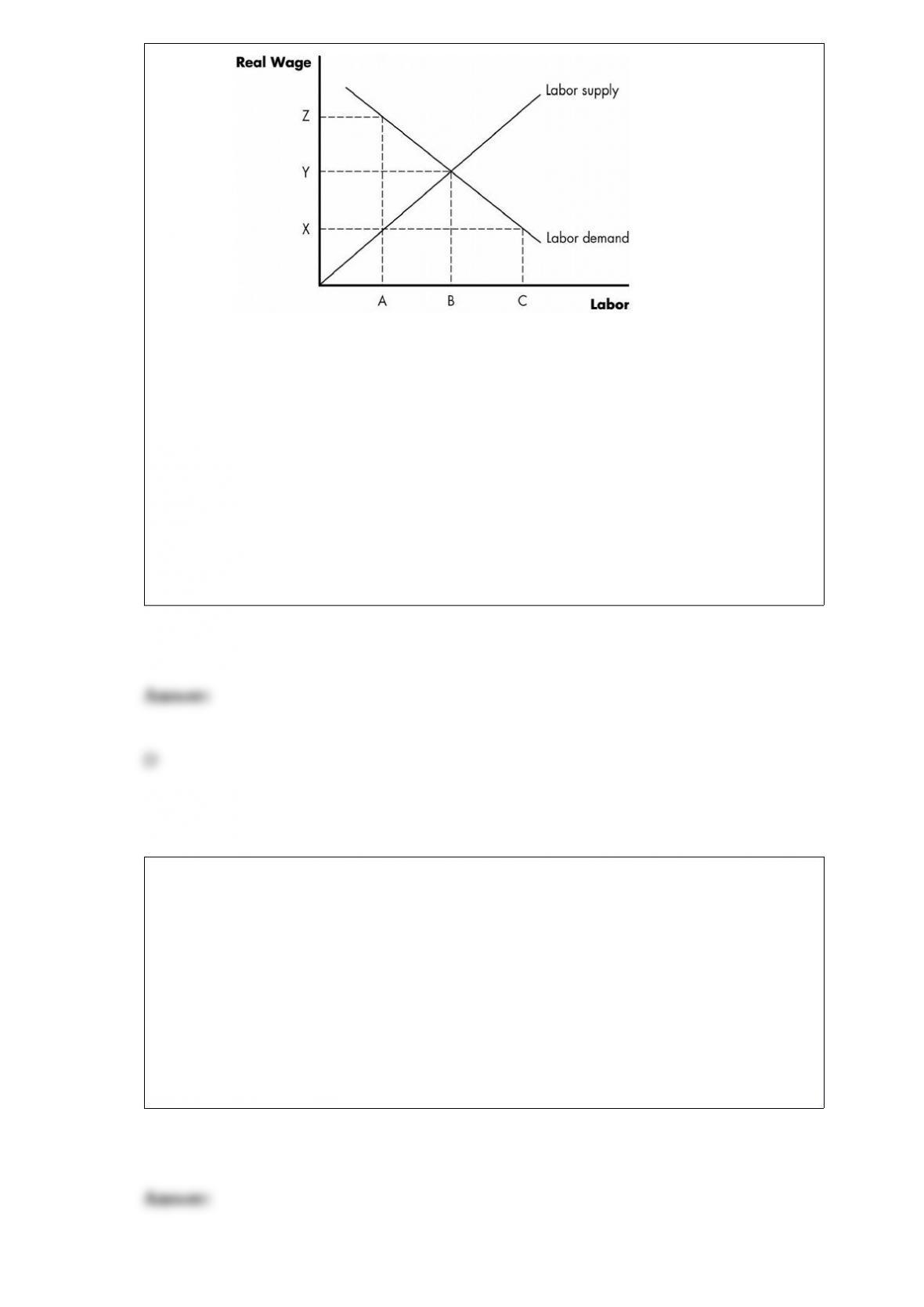
Figure 7.1
Refer to Figure 7.1 . Start from initial equilibrium. If firms reduce their capital stock,
the new real wage could be ________ and the new amount of labor employed could be
________.
A) Z; C
B) Y; C
C) X; C
D) X; A
The existence of automatic stabilizers causes:
A) the size of any budget deficit to increase as the economy enters a recession.
B) the size of any budget deficit to decrease as the economy enters a recession.
C) the effects of a given change in autonomous expenditures on output to be larger than
they would be if there were no automatic stabilizers.
D) no change in the size of the budget deficit as the economy enters a recession.
During the 1980s, firms from ________ were accused of dumping VCRs in Europe.
A) Taiwan
B) Japan
C) Mexico
D) Korea
If you want to have $50,000 in 5 years, how much would you need to put in your
savings account now if the savings account pays 3 percent interest?
What important roles do financial intermediaries play in the U.S. economy?
Producing more output in an existing production facility by increasing the number of
workers sharing the facility will bring into effect the principle of ________.
What were some of the events that occurred in the 21st century that contributed to the
dramatic rise in the budget deficit and in the government’s debt?
Why is GDP only an imperfect valid measure of the value of output produced by an
economy?
Define equilibrium as the term is used in macroeconomics.