
If expectations are formed rationally, wages and prices are completely flexible in the
short run and policy is correctly anticipated, increases in aggregate demand will
a. cause lower short-run price level increases than a Keynesian would expect.
b. cause higher short-run price level increases than a Keynesian would expect.
c. not impact the general price level.
d. produce both increases and decreases in the price level at different times.
If the Fed wants to increase the money supply through open market operations, it will
a. purchase government securities.
b. sell government securities.
c. first purchase, then sell, government securities.
d. lend more reserves to commercial banks.
Assume that Ms. Sawyer’s salary is $42,000, up from $40,000 last year, while the CPI is
157.5 this year, up from 150 last year. This means that Ms. Sawyer’s real income has
a. increased.
b. decreased.
c. stayed the same.

d. It depends on which year is the base year.
Which of the following factors can change continually in such a way as to bring about
continued increases in aggregate demand?
a. autonomous consumption
b. autonomous investment
c. government spending
d. the money supply
e. all of the above
Which of the following statements is true?
a. The main items that comprise indirect business taxes include excise taxes, income
taxes, and property taxes.
b. Capital consumption allowance is also known as depreciation.
c. A sales tax is an example of an indirect business tax.
d. b and c
e. a, b, and c

The law of comparative advantage can be used to explain why many couples divide up
their household duties along gender lines.
a. True
b. False
If the government sets out to make home buying easier for more people by forcing
lenders to accept ____________ down payments and ______________ interest rates,
the result will likely be a(n) _______________ in housing prices.
a. lower; lower; increase
b. higher; higher; increase
c. lower; higher; decrease
d. higher; lower; decrease

Real business cycle theory emphasizes that an adverse supply shock will shift the
LRAS curve leftward and cause a decline in Real GDP.
a. True
b. False
Which of the following statement is falsebased on information presented in the
textbook?
a. There is evidence of a shortage in the market for kidneys (for transplants).
b. The waiting list for transplanted kidneys is used as a non-price rationing device.
c. There is a price ceiling in the market for transplanted kidneys at a price of $0.
d. In the market for transplanted kidneys the legal price is the same as the equilibrium
price.
e. It is currently unlawful to buy or sell kidneys at any positive price.
Exhibit 16-2
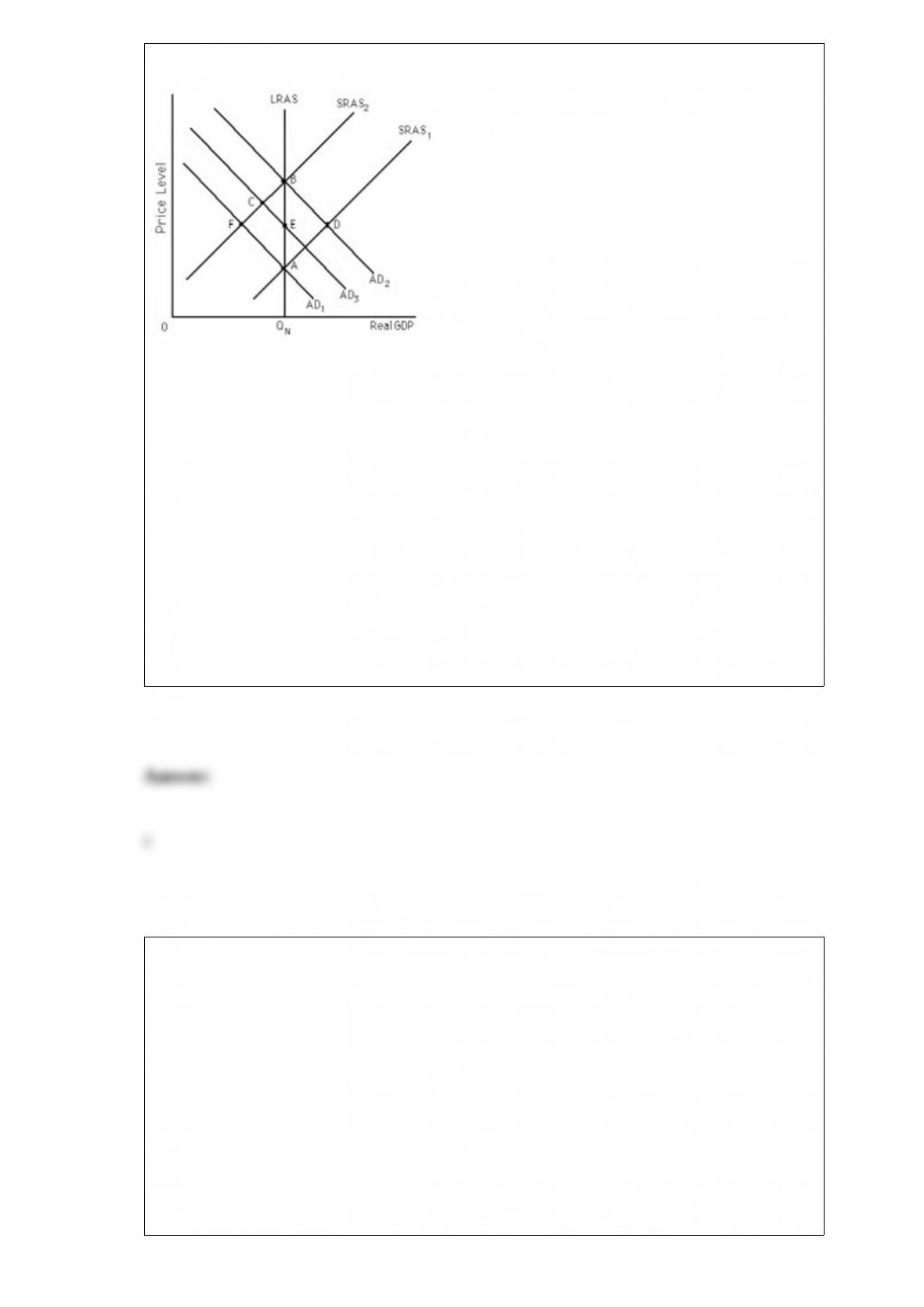
Suppose the economy starts out at point A. Next, the public anticipates that the Fed will
use expansionary monetary policy to shift the AD curve from AD1 to AD2. What
happens, instead, is that the Fed does not raise aggregate demand as much as the public
expects (bias upward).Instead the Fed pushes the AD curve from AD1 to AD3. As a
result, according to new classical theory in the short run the economy moves to point
a. A.
b. B.
c. C.
d. D.
If the economy is currently operating below its institutional production possibilities
frontier (institutional PPF), it is
a. in long-run equilibrium.
b. in a recessionary gap.
c. in an inflationary gap.
d. definitely not self-regulating.
e. b and d

Which set of changes is definitely predicted to raise the price level in the short run?
a. The money supply falls and wage rates rise.
b. The money supply falls and wage rates fall.
c. The money supply rises and wage rates fall.
d. Labor productivity rises and there is a beneficial supply shock.
e. The prices of nonlabor inputs rise and individuals expect higher (future) incomes.
When the dollar depreciates, this shifts the AD curve rightward and the SRAS curve
leftward, leading to a higher price level.
a. True
b. False

The change in the interest rate brought on by a change in Real GDP is referred to as the
__________ effect.
a. liquidity
b. expectations
c. income
d. nominal
Crowding out results when an increase in government spending leads to declines in
consumption, investment, and/or net exports.
a. True
b. False
Exhibit 39-9

Under a price support program, with the price support set at P1, consumers will end up
paying a price of
a. P1.
b. P2.
c. P3.
d. P4.
e. There is not enough information to answer the question.
New classical economists believe that monetary and fiscal policies are never effective.
a. True
b. False

Which of the following would definitely not be included in the measurement of GDP?
a. value of the services of a painter who paints your garage
b. value of the services of a person who mows his or her own lawn
c. value of the services of a maid who cleans your house
d. value of the services of a plumber who fixes your kitchen sink
One argument in favor of activist monetary policy is that the economy does not always
equilibrate quickly enough at Natural Real GDP.
a. True
b. False