
If a person’s income rises and they do not increase their consumption, we can conclude
that
a. the good is not inferior.
b. their income elasticity of demand is zero.
c. the good is not normal.
d. no conclusions can be made without knowing the person’s initial income and
consumption levels.
A defendant forced to pay punitive damages must pay the plaintiff
a. the exact amount of actual damage.
b. more than the amount of actual damage.
c. less than the amount of actual damage.
d. nothing.
Diminishing marginal returns to labor imply that
a. fixed costs will remain constant as the firm’s output increases.
b. the firm’s short-run marginal cost curve will be upward sloping.

c. the firm enjoys increasing returns to scale in the long run.
d. the firm will be unable to earn short-run economic profit.
Game Matrix III
The following questions refer to the game matrix below. Each firm has a choice of
advertising, Ads, or not advertising, No ad. The profits each gets depend upon which it
chooses.
Which of the following is a property of this game?
a. Both firms have dominant strategies.
b. There is no pure strategy Nash equilibrium.
c. There is a Nash equilibrium and it is Pareto optimal.
d. There is a Nash equilibrium and it is not Pareto optimal.
When the interest rate is 7.5%, what is the present value of a perpetuity paying $50 a
year forever?
a. $375.00.
b. $465.11.
c. $537.50.
d. $666.67.
Monopoly Supplier and Manufacturer
The following questions refer to the accompanying diagram, which shows a monopoly
leather supplier selling leather to a monopoly shoe manufacturer. The leather supplier
initially produces QM and charges the shoe manufacturer PM. Then the leather supplier
acquires the shoe manufacturer in a vertical merger.
After the merger, the leather supplier will
a. continue to produce QM.
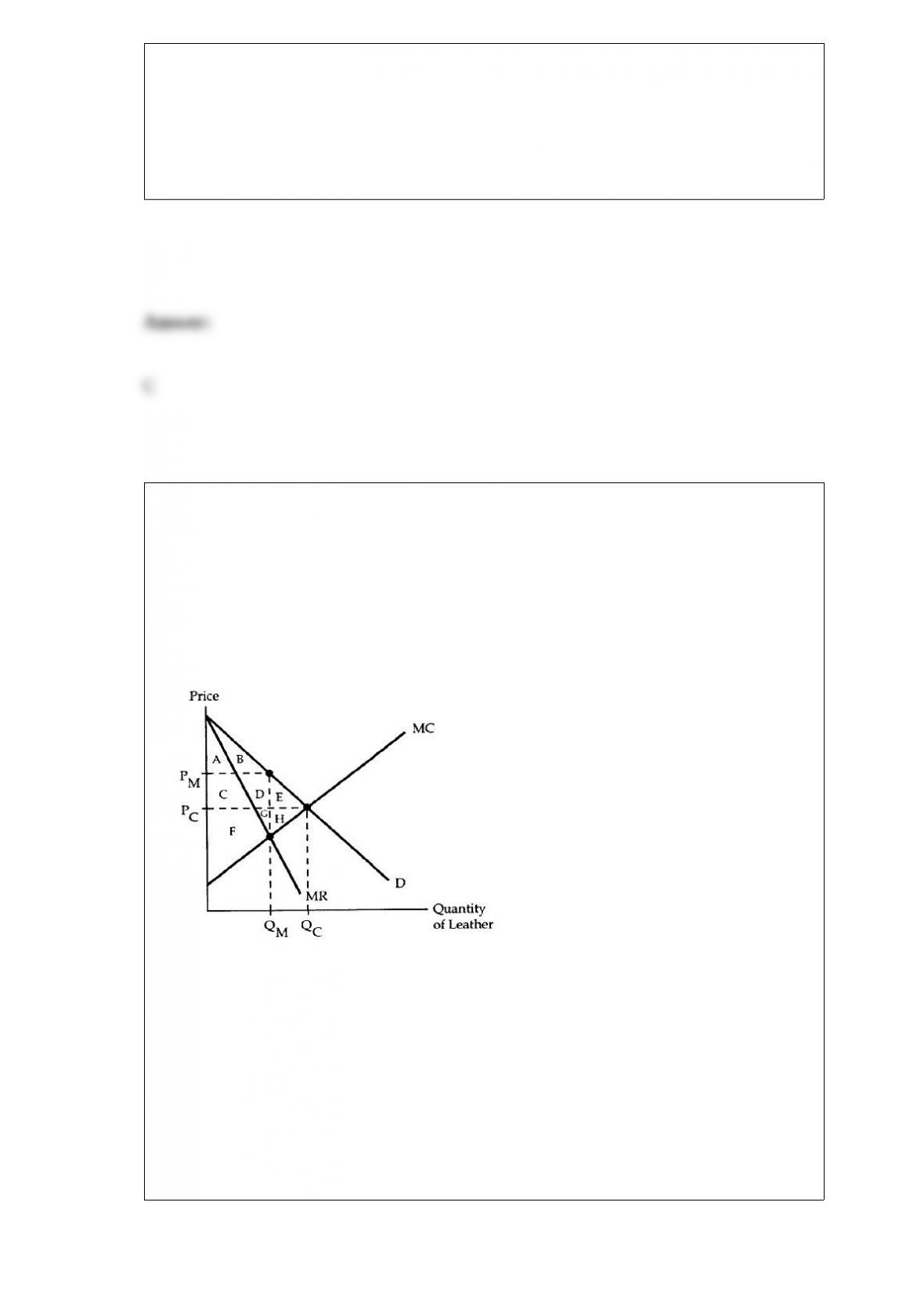
b. reduce its production from QM to force the shoe manufacturer to pay higher prices.
c. increase production to QC.
d. produce more than QM but less than QC.
Monopoly Supplier and Manufacturer
The following questions refer to the accompanying diagram, which shows a monopoly
leather supplier selling leather to a monopoly shoe manufacturer. The leather supplier
initially produces QM and charges the shoe manufacturer PM. Then the leather supplier
acquires the shoe manufacturer in a vertical merger.
The vertical merger causes social gain to
a. rise by area A + B.
b. rise by area E + H.
c. fall by area B + D + G.
d. remain equal to area A + B + C + D + F + G.

A speculative bubble causes
a. current prices to sink artificially low.
b. current prices to rise artificially high.
c. no current price changes, only possible future changes.
d. undervaluing of stock prices.
An increase in the marginal productivity of labor will tend to
a. shift the labor supply curve rightward if the change is temporary.
b. result in an increase in employment if the change is temporary.
c. result in an increase in employment if the change is permanent.
d. all of the above.

Suppose we observe that the price of gasoline has been rising, even though the quantity
of gasoline sold has been falling. We can conclude that
a. the law of supply does not hold for gasoline.
b. the law of demand does not hold for gasoline.
c. the demand for gasoline must have fallen.
d. the supply of gasoline must have fallen.
Whether or not people have identical tastes, the net value that the marginal user
receives from a common property is
a. positive.
b. zero.
c. negative.
d. uncertain.
Labor Demand and Labor Supply
The following questions refer to the accompanying diagram, which shows an industry’s
labor demand and labor supply. Labor and capital are the only factors used by the
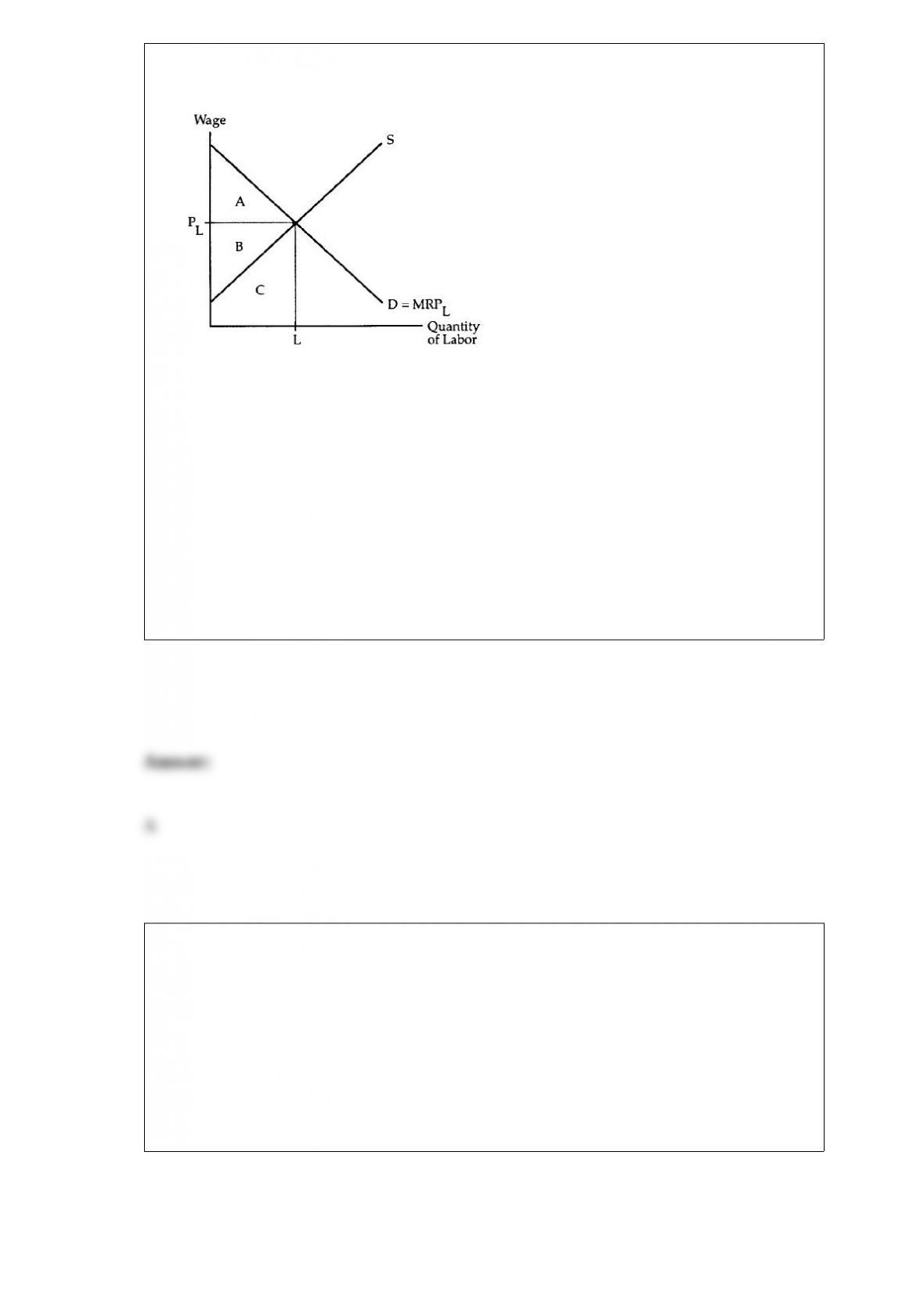
industry. The industry hires L units of labor at a wage of PL.
Suppose firms in the industry earn zero profit. The total rental payment made to the
industry’s capital is measured by
a. area A.
b. area B.
c. area A + B.
d. area B + C.
Free-riding is a problem associated with
a. nonrivalrous goods.
b. nonexclusive goods.
c. both nonrivalrous and nonexclusive goods.
d. neither nonrivalrous nor nonexclusive goods.

In the consumer-choice model, the economist examines how the consumer’s purchases
change when there is a change in prices or income. Which stage of economic analysis is
this procedure a part of?
a. Formulation.
b. Optimization.
c. Equilibrium.
d. Economic dynamics.
Under standard assumptions, which of the following is not a property of indifference
curves?
a. They are downward sloping and convex.
b. They fill the plane and never cross.
c. Their slope is equal, in magnitude, to the relative price of the goods.
d. Baskets on indifference curves further away from the origin provide more
satisfaction than those which are closer to the origin.

Suppose that in Paraguay, one of the poorest countries in the Americas, only two of the
goods that are produced can compete in world markets, tea and DVD players. Given
this success in exporting, Paraguay
a. should specialize only in DVD players since tea production is an old industry.
b. should specialize in the production of tea, since its people are probably too poor to
buy DVD players.
c. should stop exporting both goods and produce more food products for its people.
d. is better off producing both goods in which it has a comparative advantage, relative
to all other goods.
An economic analysis of “planned obsolescence” shows that
a. monopolies have an incentive to produce shorter-lived products, even when
longer-lived products can be produced at the same cost.
b. firms prefer to produce shorter-lived products, because these result in greater sales
and hence larger profits.
c. competitive firms are forced to produce the product with greatest longevity, but
monopolies can successfully use planned obsolescence.
d. firms will make a longer-lived product if the additional cost is less than the present
value of the benefits received by consumers.

A firm’s revenue minus its factor payments equals
a. zero.
b. the profits or losses earned by the firm.
c. the quasi-rents earned by the factors of production.
d. the firm’s total revenue.
Which of the following is a normative concept?
a. Nash equilibrium.
b. Stackelberg equilibrium.
c. Pareto optimality.
d. Nash equilibrium, Stackelberg equilibrium, and Pareto optimality are all normative
concepts.
In order to identify differences in preferences among various countries, one would look
for evidence that
a. indifference curves from different countries cross.

b. prices for goods differ among countries.
c. different market baskets are chosen among different nationalities.
d. higher income countries choose baskets with more of all goods.
The use of signals in a market economy
a. makes everyone better off, even those people who choose not to obtain the signal.
b. prevents the economy from reaching an equilibrium.
c. lowers efficiency because the signals waste resources.
d. is one way that the principal-agent problem can be avoided.
According to the law of demand, if other relevant factors remain unchanged, then a rise
in the price of a commodity will cause
a. a reduction in the equilibrium quantity.
b. excess supply.
c. suppliers to reduce their production in reaction to the lower demand.
d. a fall in the quantity demanded.

Before Walmart’s entry into the retail pharmacy business which drove down prices,
existing pharmacies
a. were operating efficiently, so this is an example of predatory pricing.
b. were colluding on price, so this is an example of a contestable market.
c. were not operating as efficiently as afterwards, so this is not a case of predatory
pricing.
d. did not advertise but were forced to do so by the new competition.
In the Bertrand model of oligopoly, each firm chooses its output assuming that its rivals
a. do not change their price.
b. do not change their output.
c. can enter and exit the industry costlessly.
d. use the tit-for-tat strategy.

Which of the following economic models is untestable?
a. Demand and supply model of a product market.
b. Monopoly model of market power.
c. Edgeworth box model of exchange.
d. Capital asset pricing model.
A system for studying strategic behavior in economics is called
a. decision science.
b. political economy.
c. game theory.
d. solution concepts.
If the income elasticity of demand for a good is zero, then

a. the goods inferior.
b. the good is normal.
c. the good violates the Law of Demand.
d. consumption of the good does not change as income changes.
Game Matrix V
The following questions refer to the game matrix below. Each firm has a choice of
saying Yes or NO. The profits each gets depend upon which it chooses.
If X = 15 and Y = 15, then
a. Player A has a dominant strategy, but Player B does not.
b. Player B has a dominant strategy, but Player A does not.
c. Both Players A and B have dominant strategies.
d. Neither Players have dominant strategies.

The theory of efficient markets suggests that the steep decline the value of stocks traded
on the NASDAQ was due to
a. a speculative bubble.
b. a response to new information about lower than previously expected profitability in
technology related firms which weigh heavily in the NASDAQ average.
c. a natural cycle in technology stock prices evidenced by charts of previous prices
trends.
d. moral hazard.
When the wage rate rises, a worker chooses to replace some leisure hours with work
hours, even if he would remain equally well off. This phenomenon is known as
a. compensating differential.
b. the income effect.
c. the substitution effect.
d. intertemporal substitution.
Assume investment is possible. Which of the following will decrease the supply of

current consumption?
a. Manna from heaven.
b. A plague that kills half of the economy’s laborers.
c. Increased productivity of capital.
d. A temporary rise in people’s wealth.
Any firm, competitive or not, desiring to maximize profits, will choose its quantity
according to the rule, produce that quantity at which
a. marginal revenue = price.
b. marginal revenue = marginal cost.
c. average variable cost is at its minimum.
d. marginal cost is at its minimum.
If the income elasticity of a good is negative, then
a. the good must be a Giffen good.
b. the substitution and income effects must be moving in the same direction.

c. the Engel curve for this good must be downward sloping.
d. the law of demand must be satisfied for this good.
The economic model of supply and demand is one that can be tested using data.
A merger between Gateway, a manufacturer of computers, and Logitech, a
manufacturer of components for computers, would be an example of horizontal
integration.
Suppose labor and capital are the only factors of production. Capital is fixed and has a
perfectly inelastic supply, so all income earned by capital is rent. A Japanese-owned
factory is built in the U.S. and employs only American workers. Let DUS represent the
demand for labor in American factories and DJ represent the demand for labor in the
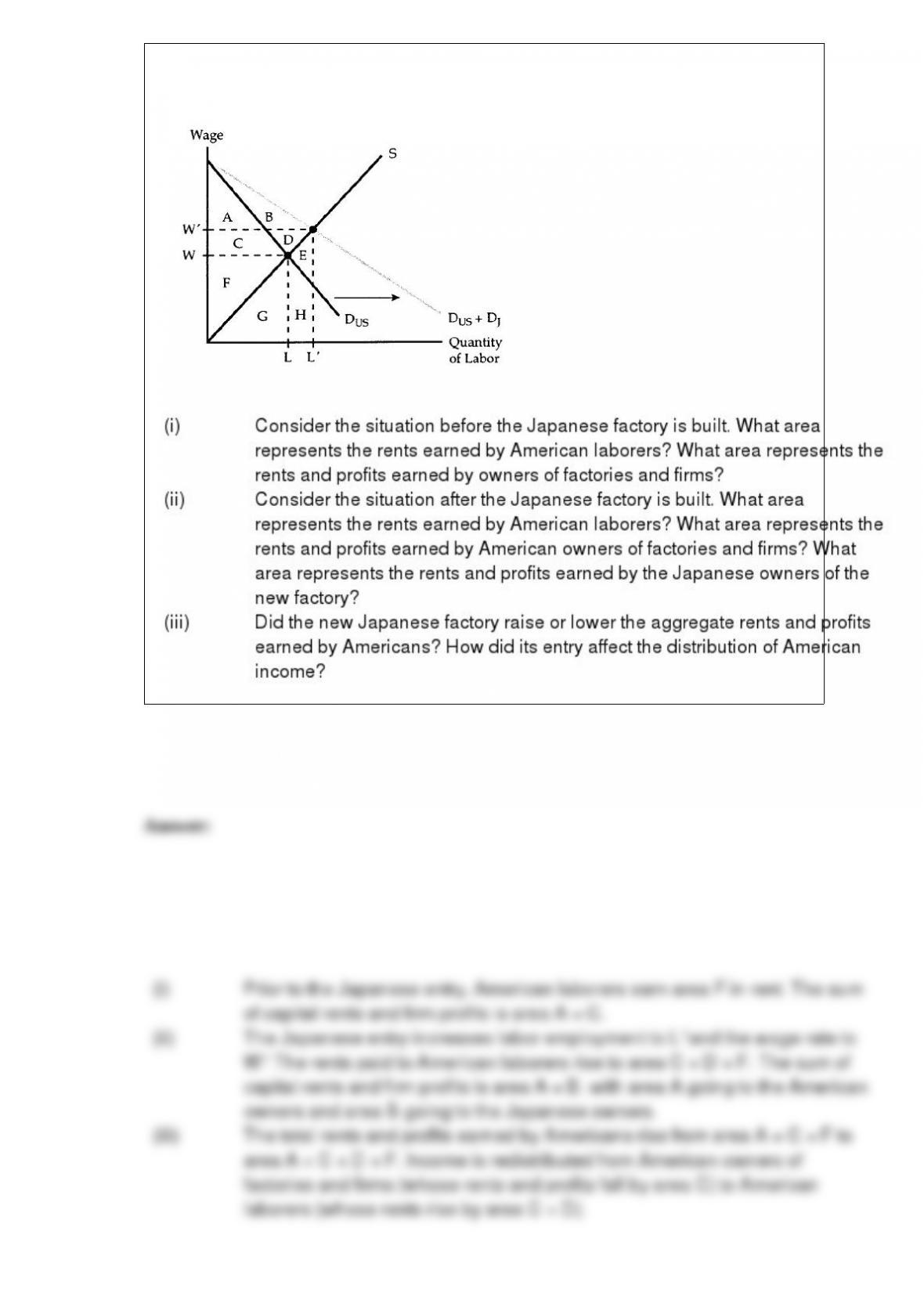
new Japanese factory. The effect of the new factory on the American labor market is
shown in the accompanying diagram.
If a natural monopoly charged the competitive price, it would earn a negative profit.
The tremendous growth of the American economy allows for greater consumption and
fewer hours worked by the average American employee than their counterparts in
European nations such as France and Britain.
Consider the following:
Each user of a common property imposes a negative externality on its other users.
There are an infinite number of choices faced by a consumer that are shown along an
indifference curve.
If the cross price elasticity of demand is negative, then the two goods under
consideration must be complements.

When the price of fabric falls, it does not benefit a clothing manufacturer to lower its
prices since that will only reduce its profit margin.
If the marginal value of beef is $8 per pound, then the consumer is willing to pay at
most $8 for an additional pound of beef.
A consumer can not consume a basket of goods that lies closer to the origin than their
budget line because they can not afford that basket.
Describe the three stages of economic analysis.
When labor is a regressive factor, a higher wage rate leads to a reduction in the firm’s
long-run total costs.
As defined by economists, the supply of corn refers to the number of bushels of corn
that farmers bring to the market.

On average over all goods, it has been found that as people become wealthier,
expenditures for higher quality grow more rapidly than expenditures for increased
quantity.