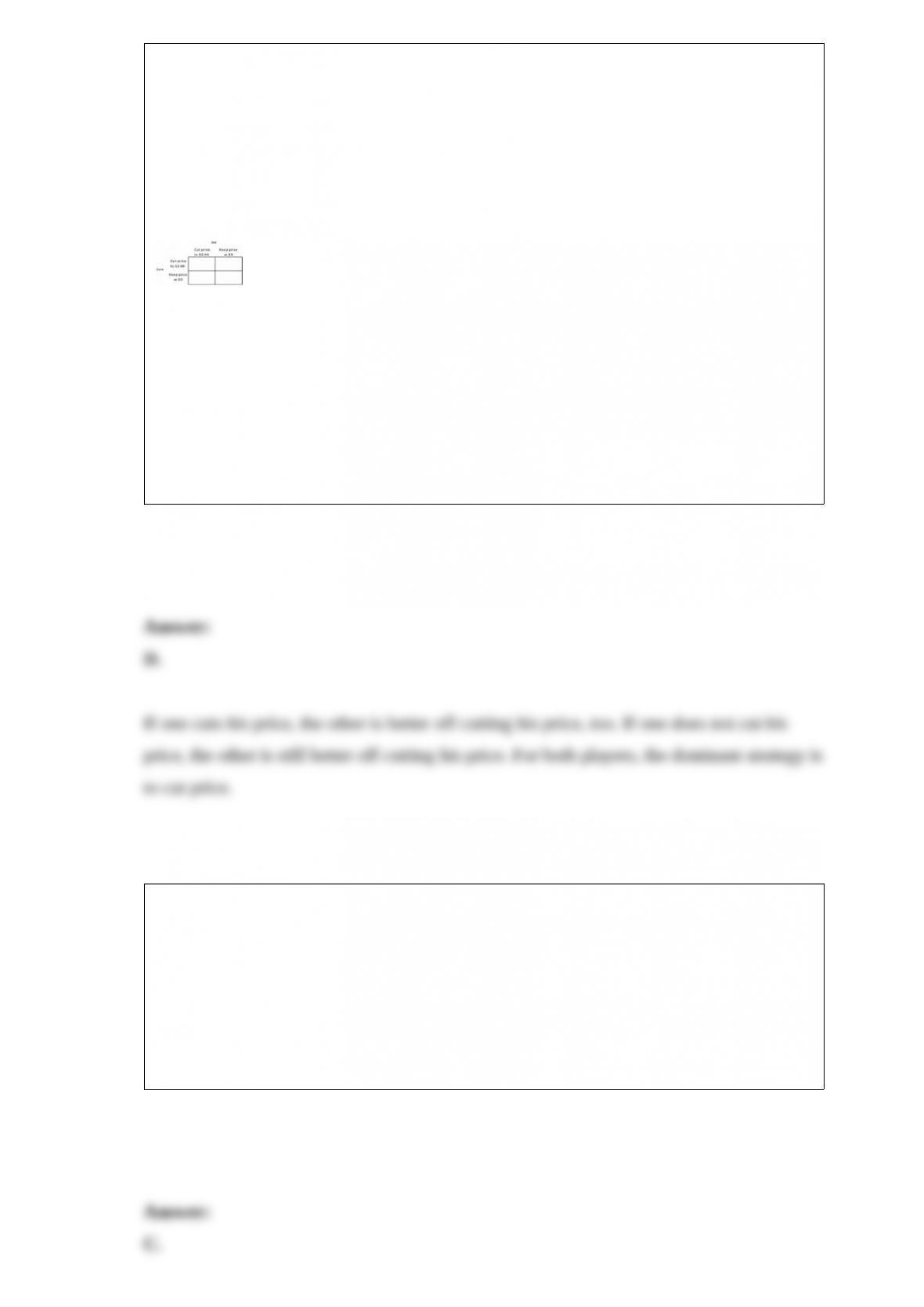
Joe is the owner of the 7-11 Mini Mart, Sam is the owner of the SuperAmerica Mini
Mart, and together they are the only two gas stations in town. Currently, they both
charge $3 per gallon, and each earns a profit of $1,000. If Joe cuts his price to $2.90 and
Sam continues to charge $3, then Joe’s profit will be $1,350, and Sam’s profit will be
$500. Similarly, if Sam cuts his price to $2.90 and Joe continues to charge $3, then
Sam’s profit will be $1,350, and Joe’s profit will be $500. If Sam and Joe both cut their
price to $2.90, then they will each earn a profit of $900. You may find it easier to
answer the following questions if you fill in the payoff matrix below.
For both Joe and Sam, ______ is a ______.
A. cutting the price to $2.90; dominated strategy
B. leaving the price at $3; Nash equilibrium
C. leaving the price at $3; dominant strategy
D. cutting the price to $2.90; dominant strategy
In the long run, output gaps are eliminated by:
A. reducing potential output.
B. increasing potential output.
C. price changes.
D. increased efficiency in labor markets.

You originally required a risk premium of 6 percent in addition to the rate of return on
safe assets before you would purchase shares of Techno Company stock. If you and
other investors reduce the risk premium you require to 4 percent, the price of Techno
Company stock will:
A. increase.
B. decrease.
C. equal the old risk premium plus the new risk premium.
D. equal the new risk premium plus the rate of return on safe assets.
A relative price is:
A. the rate of inflation.
B. a measure of overall prices at a particular point in time.
C. the percentage change in a price index such as the CPI.
D. the price of a specific good in comparison to the prices of other goods and services.
Over the period from 1870 to 2010, the growth of real GDP per capita tended to be
more rapid between _____, particularly for _____.
A. 1870-1950; Japan
B. 1870-1950; the United States
C. 1870-1950; Canada
D. 1950-2010; Japan
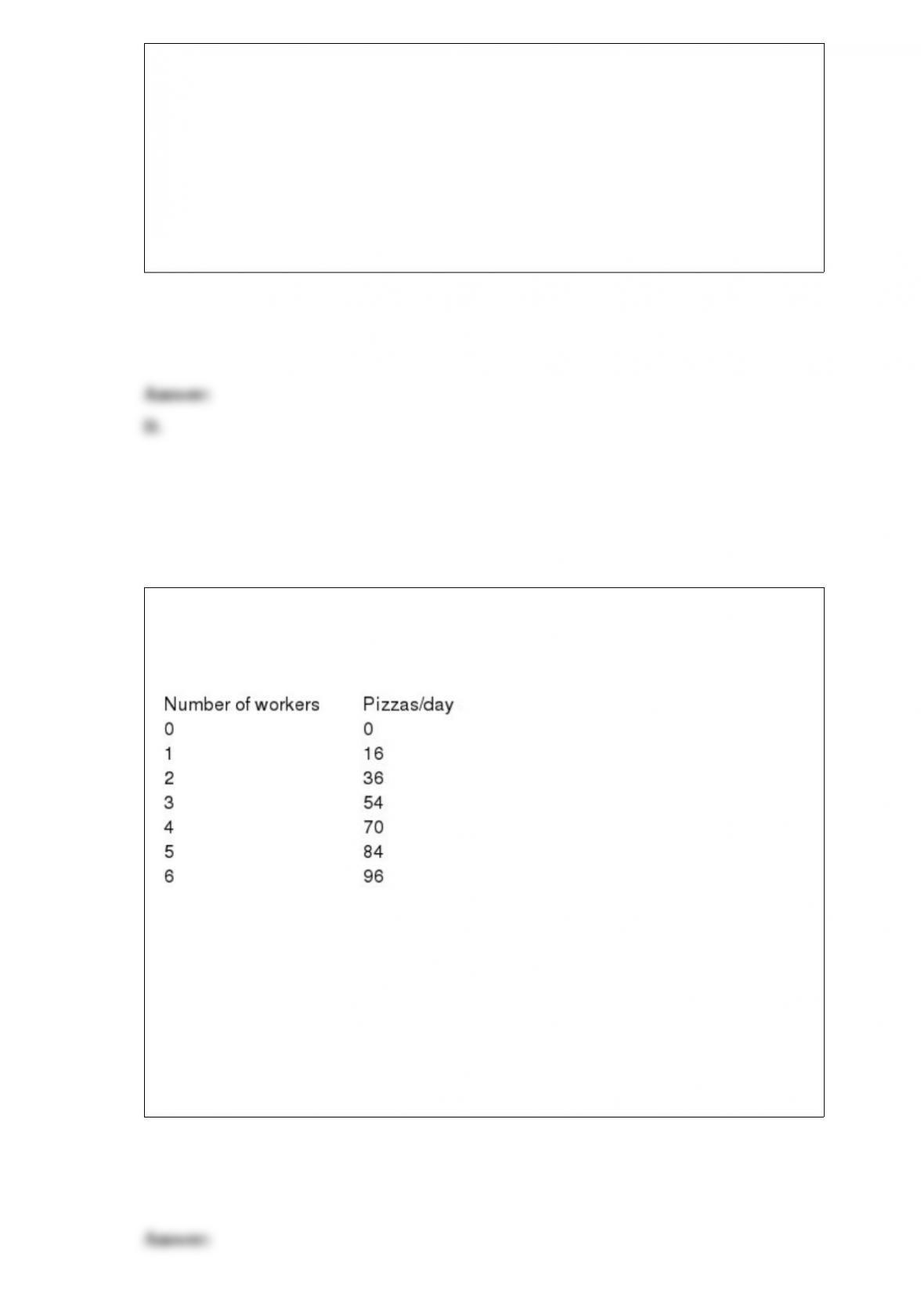
Gino’s Pizza shop hires workers in a competitive market to make pizza. The ingredients
required to make each pizza cost $5. Daily output at Gino’s Pizza varies with the
number of workers hired, as shown in the table below:
If the pizzas sell for $10 each, and the competitive market wage is $75 per day, Gino
will hire ______ workers and produce ______ pizzas per day.
A. 5; 84
B. 2; 36
C. 3; 54
D. 4; 70
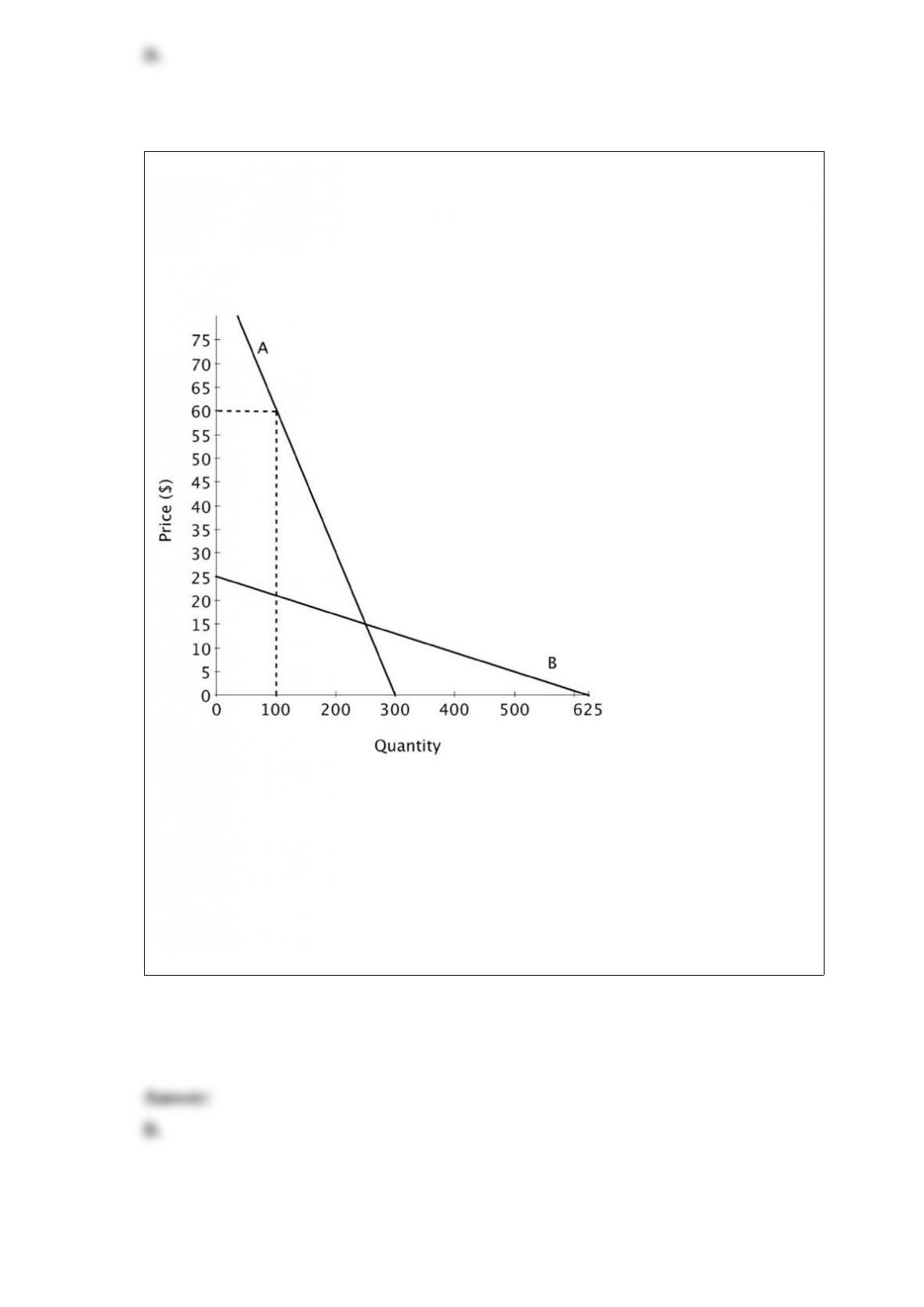
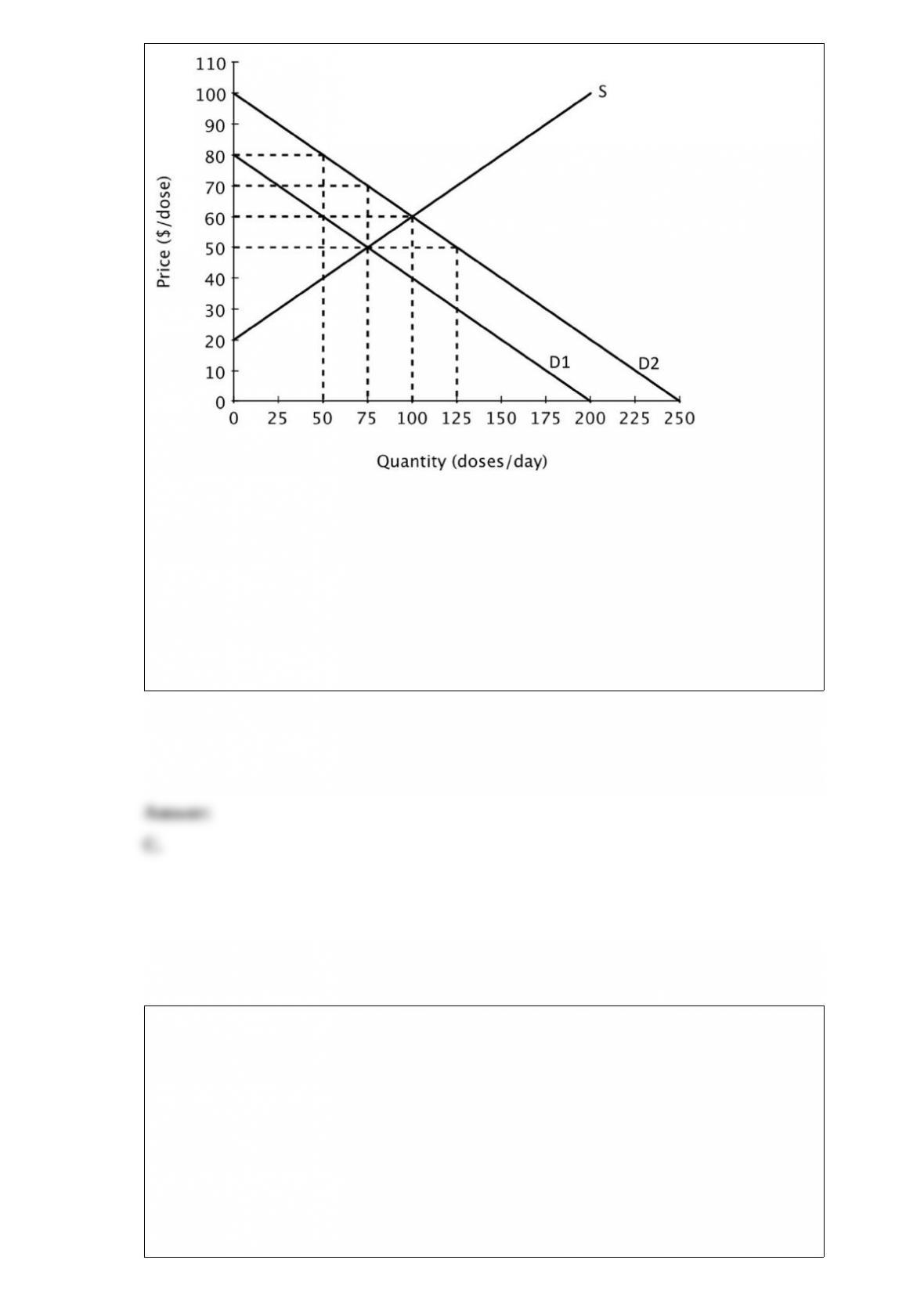
Suppose that a new drug has been approved to treat a life-threatening disease. The
demand for that drug is shown on the graph below. Prior to approval of this drug, the
only treatment for this condition was any one of several non-prescription, or
over-the-counter, pain relievers. The demand for one brand of the several
non-prescription pain relievers is also shown on the graph.
If the manufacturer of the new drug chose to increase its price from $70 to $75,
consumers would buy ______ doses, and have ______ total expenditures.
A. more; higher
B. fewer; lower
C. more; lower
D. fewer; higher
If a firm’s production process exhibits increasing returns to scale, then doubling all the
firm’s inputs will lead output to _____.
A. double
B. more than double
C. less than double
D. fall by one-half
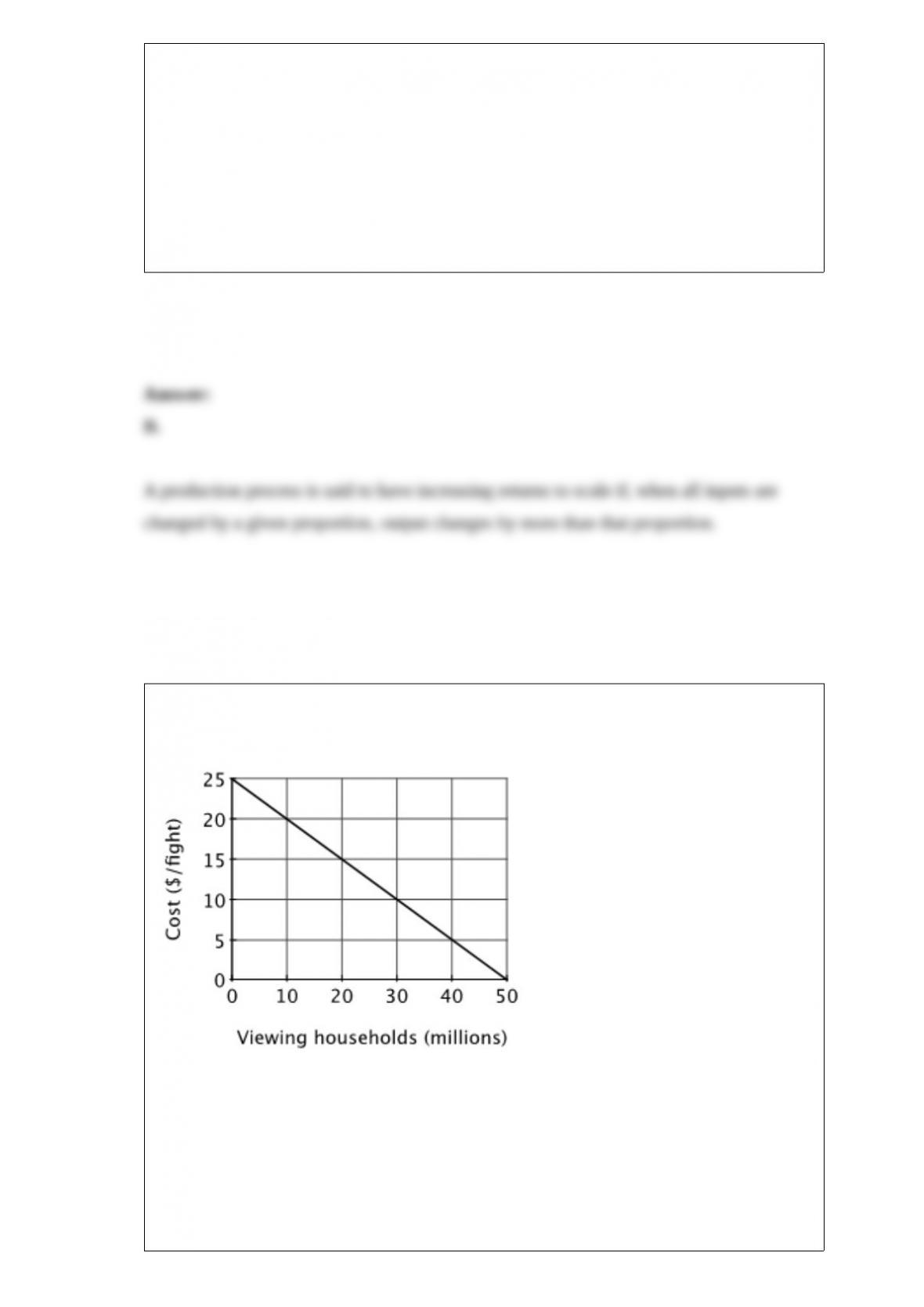
If a boxing fight is shown on pay-per-view television every Saturday at 4pm, the
demand curve for each fight is given below.
If there is a pay-per-view charge to watch a fight, the outcome is ______ because
______.
A. efficient; prices will allocate the program to those who value it the most
B. efficient; the marginal cost of an additional viewing household is zero
C. inefficient; the marginal cost of an additional viewing household is zero
D. inefficient; television stations would not always make a profit
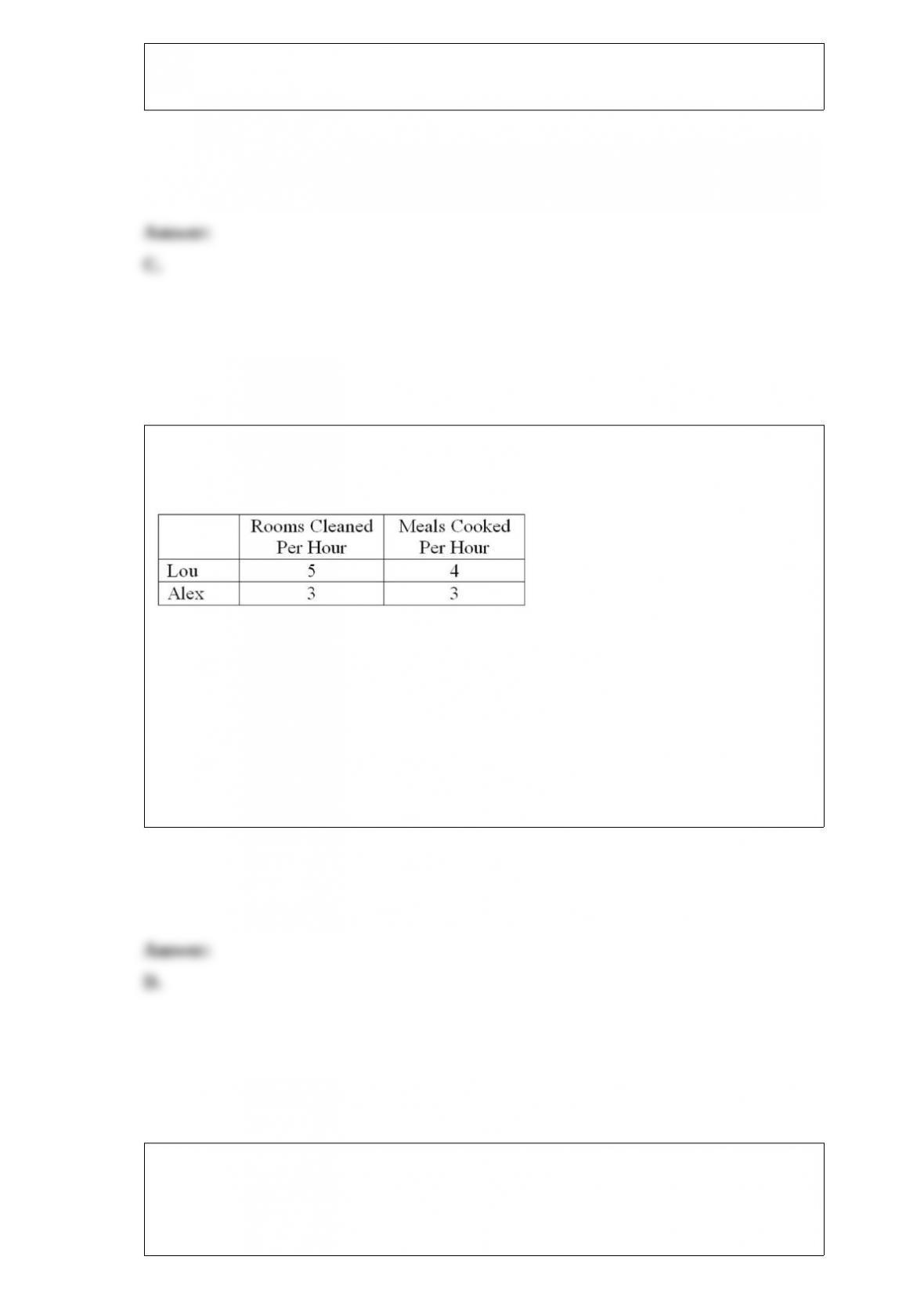
Lou and Alex live together and share household chores. They like to cook some meals
ahead of time and eat leftovers. The table below shows the number of rooms they can
each clean and the number of meals they can each cook in an hour.
If Alex and Lou work out an efficient arrangement for these two chores, then under that
arrangement:
A. Alex and Lou each would do half of the cooking and half of the cleaning.
B. Alex would do all of the cleaning, while Lou would do all the cooking.
C. Lou would do all of the cleaning and all of the cooking.
D. Lou would do all of the cleaning, while Alex would do all of the cooking.
Suppose that a vaccine is developed for a highly contagious strain of flu. The likelihood
that anyone will get this flu decreases as more people receive the vaccine. One of the
demand curves below represents the private demand for the vaccine and the other
represents the social demand for the vaccine.
At the private market equilibrium, the deadweight loss is ______ per day.
A. $0
B. $125
C. $250
D. $500
Large economies, such as the U.S. economy, should ______ adopt a flexible exchange
rate, because giving up the power to stabilize the domestic economy via monetary
policy _____.
A. almost never; comes with a high cost
B. almost never; is of little consequence
C. nearly always; comes with a high cost
D. nearly always; is of little consequence

As the real interest rate decreases, the quantity of saving supplied ______ and the
quantity of saving demanded ____.
A. increases; increases
B. increases; decreases
C. does not change; does not change
D. decreases; increases
When more firms enter an industry:
A. the amount produced by each of the new firms will be greater than the amount
produced by each of the original firms.
B. the industry supply curve will shift left.
C. the amount produced by each of the new firms will be less than the amount produced
by each of the original firms.
D. the industry supply curve will shift right.
For a given nominal interest rate, an unexpectedly high inflation rate ______ the real
interest rate.
A. increases
B. decreases
C. has no impact on
D. may either increase or decrease
From the point of view of a particular country, capital outflows are:
A. purchases of domestic goods or services by foreigners.
B. purchases of domestic assets by foreigners.
C. purchases of foreign goods or services by domestic households or firms.
D. purchases of foreign assets by domestic households or firms.

MegaCable and Acme are competing for an exclusive contract to provide the city of
Dustin with cable television for the next year. The firm that wins the contract will earn
an economic profit of $5 million. The contact will be awarded to the firm that spends
the most on lobbying. If both firms spend the same amount on lobbying, then the
winner will be determined by a coin flip, so each will have a 50 percent chance of
winning. Suppose MegaCable spends $2,000,002 on lobbying, and Acme spends
$2,000,001 on lobbying. In this case, MegaCable’s economic profit net of its lobbying
costs will be ______, and Acme’s economic profit net of its lobbying costs will be
______.
A. $5 million; 0
B. $2,999,998; -$2,000,001
C. $2.5 million; $2.5 million
D. $499,998; -$2,000,001
Since 1925, the longest expansion in the United States lasted:
A. 120 months.
B. 21 months.
C. 43 months.
D. 60 months.

The introduction of a new technology that raises the marginal product of new capital
will:
A. decrease real interest rates and increase the equilibrium quantity of saving supplied
and demanded.
B. decrease real interest rates and the equilibrium quantity of saving supplied and
demanded.
C. increase real interest rates and the equilibrium quantity of saving supplied and
demanded.
D. increase real interest rates and decrease the equilibrium quantity of saving supplied
and demanded.
The free-rider problem arises when people:
A. obtain a good for less than the market equilibrium price.
B. who do not pay for a good cannot be excluded from consuming it.
C. who do not pay for a good cannot consume it.
D. who pay for a good cannot consume it.
As the available technology improves, ______ shifts to the _____.
A. aggregate demand; left

B. aggregate demand; right
C. aggregate supply; left
D. aggregate supply; right
Shelly purchases a leather purse for $400. One can infer that:
A. she paid too much.
B. her reservation price was at least $400.
C. her reservation price was exactly $400.
D. her reservation price was less than $400.
Deposit insurance is a system in which the government guarantees that:
A. depositors will not lose any money even if their bank goes bankrupt.
B. people can have deposits at commercial banks.
C. commercial banks will not go bankrupt.
D. commercial banks will not lose any deposits.
Suppose Campus Books, a profit-maximizing firm, is the only supplier of the textbook
for a given class. The marginal cost of supplying each book is constant and equal to
$10, and Campus Books has no fixed costs. The table below shows the reservation
prices of the eight students enrolled in the class.
What price will Campus Books charge if it must charge a single price to all of its
customers?
A. $36
B. $18
C. $24
D. $10
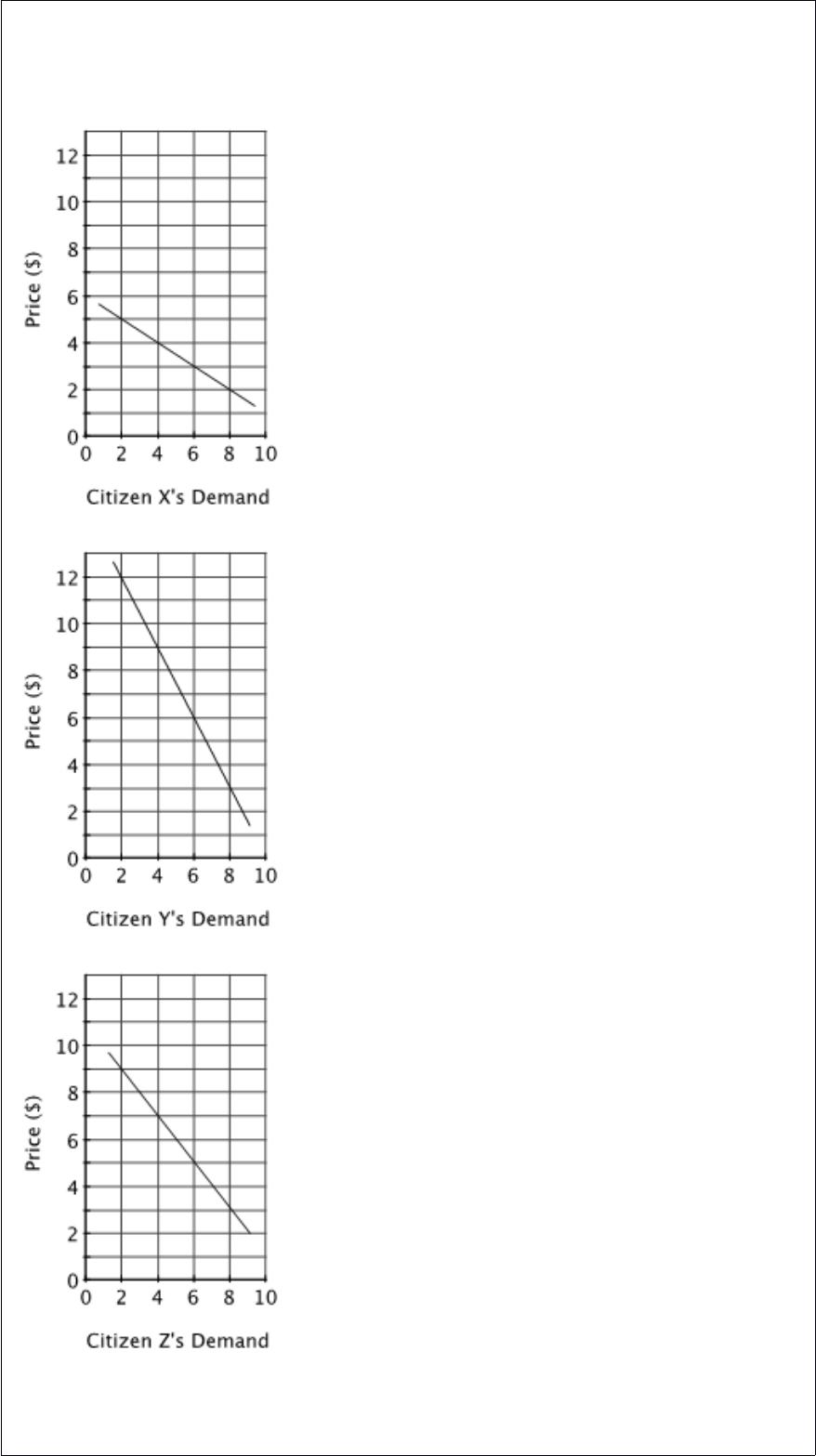
Consider a town with three residents. The residents’ demand curves for various acres of
a public park are shown below.
Suppose the town can purchase land for the park at a cost of $8 per acre. The optimal
park size would be ______ acres.
A. 2

B. 4
C. 6
D. 8
Which of the following directly follows from the No Cash on the Table Principle?
A. In a transaction, the parties will negotiate over prices until neither one earns any
surplus.
B. For a transaction to occur, the buyer’s reservation price must be greater than the
seller’s reservation price.
C. For a transaction to occur, the buyer’s reservation price must be less than the seller’s
reservation price.
D. Efficiency requires that the buyer’s surplus equal the seller’s surplus.
Curly just graduated from State U and has three job offers: teaching at a prestigious

private high school nine months a year with summers off, working forty hours a week at
a bank in a small city, and working more than sixty hours a week for a high-powered
investment firm in New York. Suppose all of the jobs paid exactly the same annual
salary, and that most people prefer leisure to work, all else equal. If that were the case:
A. there would be a shortage of teachers at the high school.
B. there would be a surplus workers at the investment firm.
C. there would be a surplus of teachers at the high school.
D. people would naturally sort themselves into the job that best suits their talents.
When calculating price elasticity of demand, if the percentage change in price is
negative, then the percentage change in quantity demanded is typically:
A. greater than one.
B. positive.
C. less than one.
D. negative.

In the short-run Keynesian model where the marginal propensity to consume is 0.75, to
offset a recessionary gap resulting from a $1 billion decrease in autonomous
consumption, taxes must be:
A. increased by $1 billion.
B. decreased by $1 billion.
C. increased by $1.33 billion.
D. decreased by $1.33 billion.
Imperfect price discrimination occurs when a monopolist:
A. charges a single price to all buyers.
B. price discriminates but some buyers pay less than their reservation price.
C. price discriminates but some buyers pay more than their reservation price.
D. charges all buyers exactly their reservation price.
In Econland autonomous consumption equals 700, the marginal propensity to consume
equals 0.80, net taxes are fixed at 50, planned investment is fixed at 100, government
purchases are fixed at 100, and net exports are fixed at 40. The vertical intercept of the
expenditure line is:
A. 890.
B. 900.
C. 940.
D. 990.
Economic growth can result from a(n):
A. increase in the amount of productive resources.
B. increase in number of the minimum wage jobs.
C. increase in the amount of consumer goods produced.
D. decrease in the number of workers available.
Paper Pushers Inc. hires workers in a competitive labor market. Apart from labor, the
company has no other variable inputs. The company’s hourly output varies with the
number of workers hired, as shown in the table below.
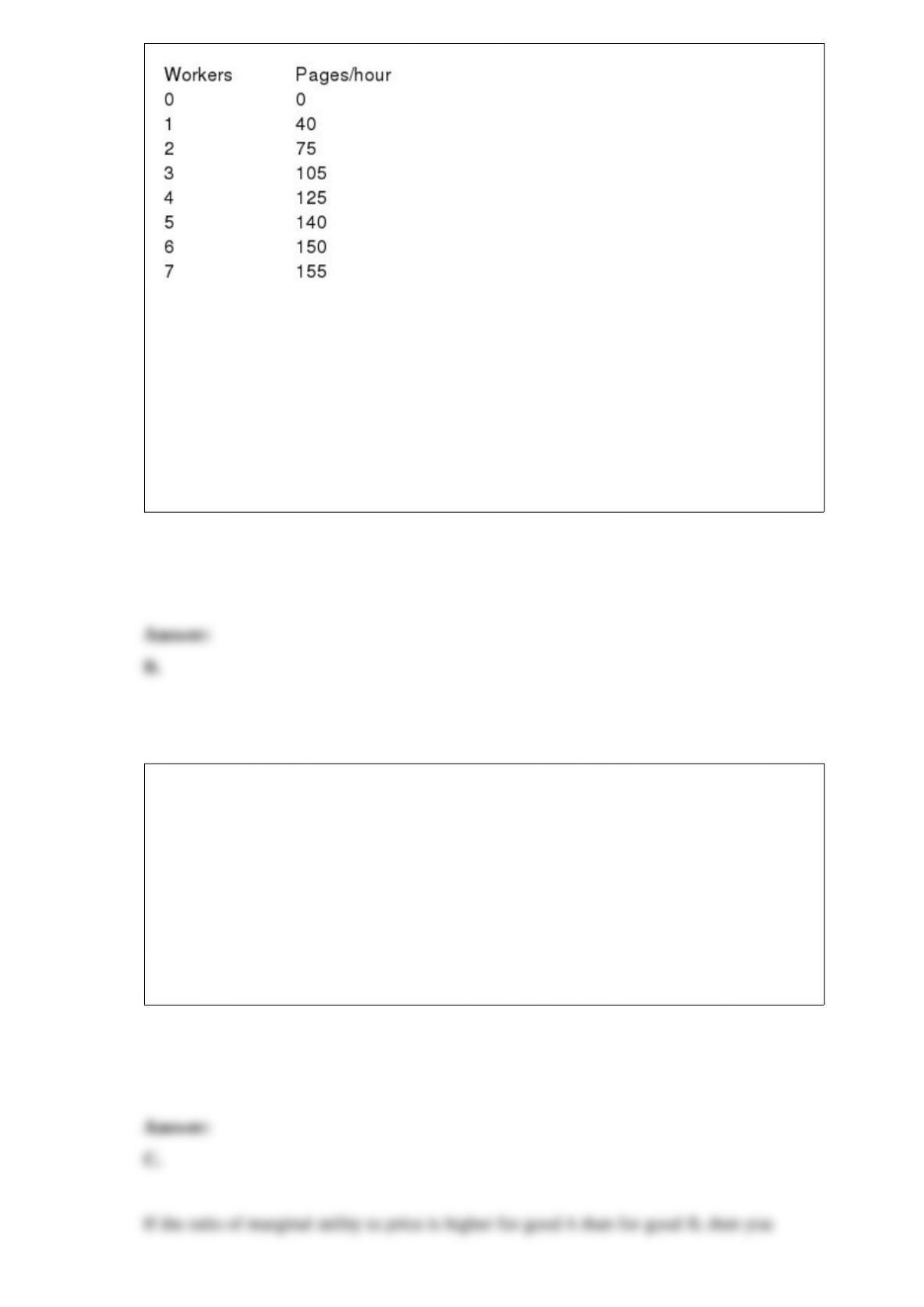
If the market price of each page is $5, the first worker’s VMP is ______ per hour, and
the third worker’sVMP is ______ per hour.
A. $20; $525
B. $200; $150
C. $200; $525
D. $20; $15
Suppose that at your current consumption of two goods, A and B, MUA/PA = 25 and
MUB/PB = 20. In order to maximize, your utility you should:
A. leave your spending unchanged.
B. purchase less of A and more of B.
C. purchase more of A and less of B.
D. purchase less of A and B.