1) Infrastructure is best illustrated by:
A.farm equipment.
B.school buildings and highways.
C.machinery and equipment for the production of consumer goods.
D.government tax revenues.
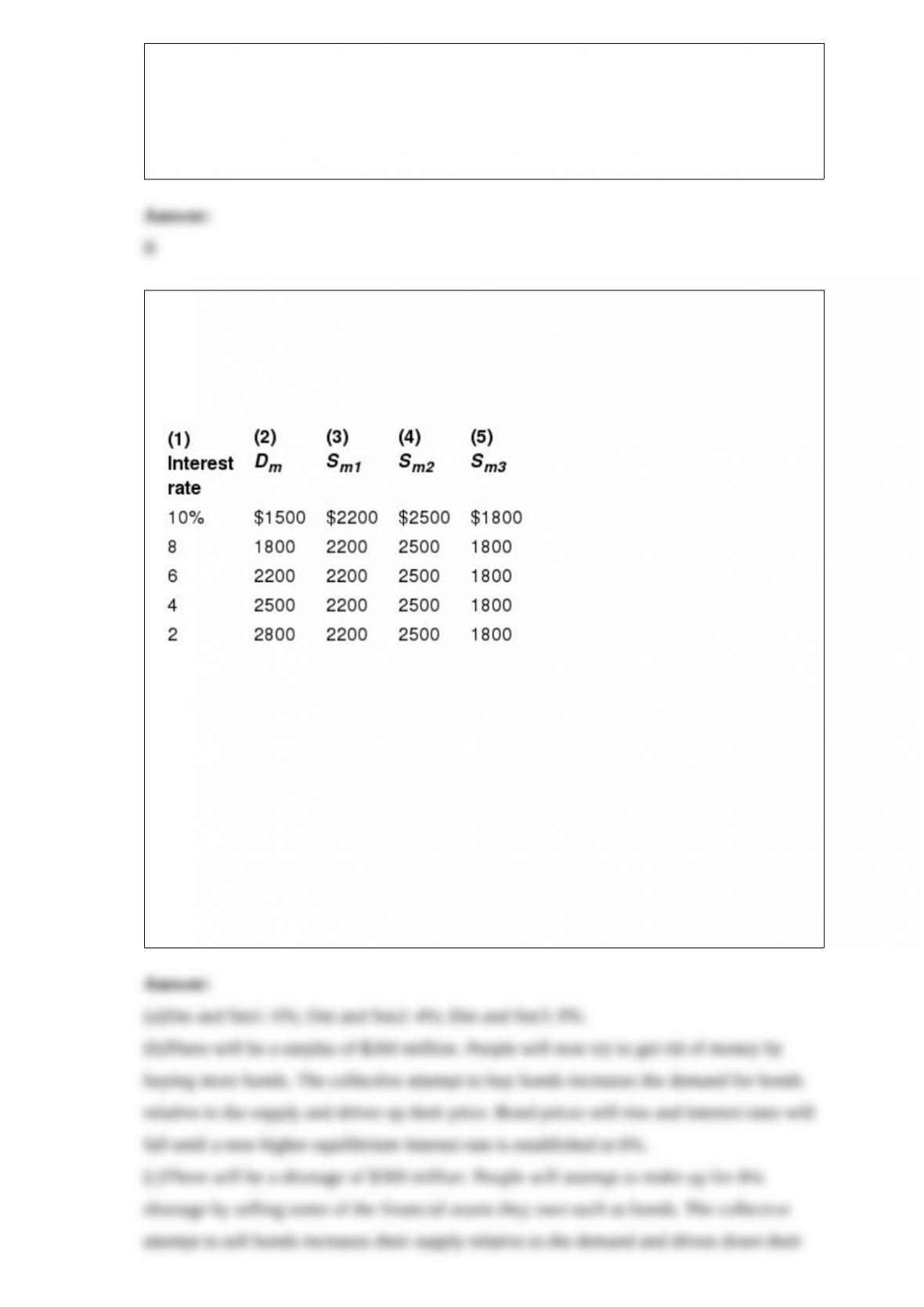
2) Use the table below for the next set of questions. Column 1 shows the interest rate,
column 2 shows the demand for money, and columns 35 show the supply of money. All
quantities are in millions ($).
(a)Given the demand for money, what will the equilibrium interest rate be for each of
the different supply of money schedules?
(b)Assume the economy was in equilibrium at Dm and Sm1. If the FED decides to
change the money supply to Sm2 and the interest rate stays the same, how much of a
shortage or surplus in the money supply will there be? Describe what will happen in the
money market and the bond market to eliminate the surplus or shortage and restore a
new equilibrium interest rate.
(c)Assume the economy was in equilibrium at Dm and Sm1. If the FED decides to
change the money supply to Sm3 and the interest rate stays the same, how much of a
shortage or surplus in the money supply will there be? Describe what will happen in
this money market and the bond market to eliminate the surplus or shortage of money
and restore a new equilibrium interest rate.
3) The organization created to oversee the provisions of multilateral trade agreements,
resolve disputes under the international trade rules, and meet periodically to consider
further trade liberalization is called the:
A.International Monetary Fund (IMF).
B.World Trade Organization (WTO).
C.Common Market Organization (CMO).
D.International Trade Commission (ITC).
4) the long-run average total cost curve:
a.displays declining unit costs so long as output is increasing.
b.indicates the lowest unit costs achievable when a firm has had sufficient time to alter
plant size.
c.has a shape which is the inverse of the law of diminishing returns.
d.can be derived by summing horizontally the average total cost curves of all firms in
an industry.
5) In the absence of unexpected shocks, the economy will tend to experience:
A.positive, non-inflationary growth.
B.no changes in output or prices.
C.positive growth with mild amounts of deflation.
D.positive growth with mild amounts of inflation.
6)
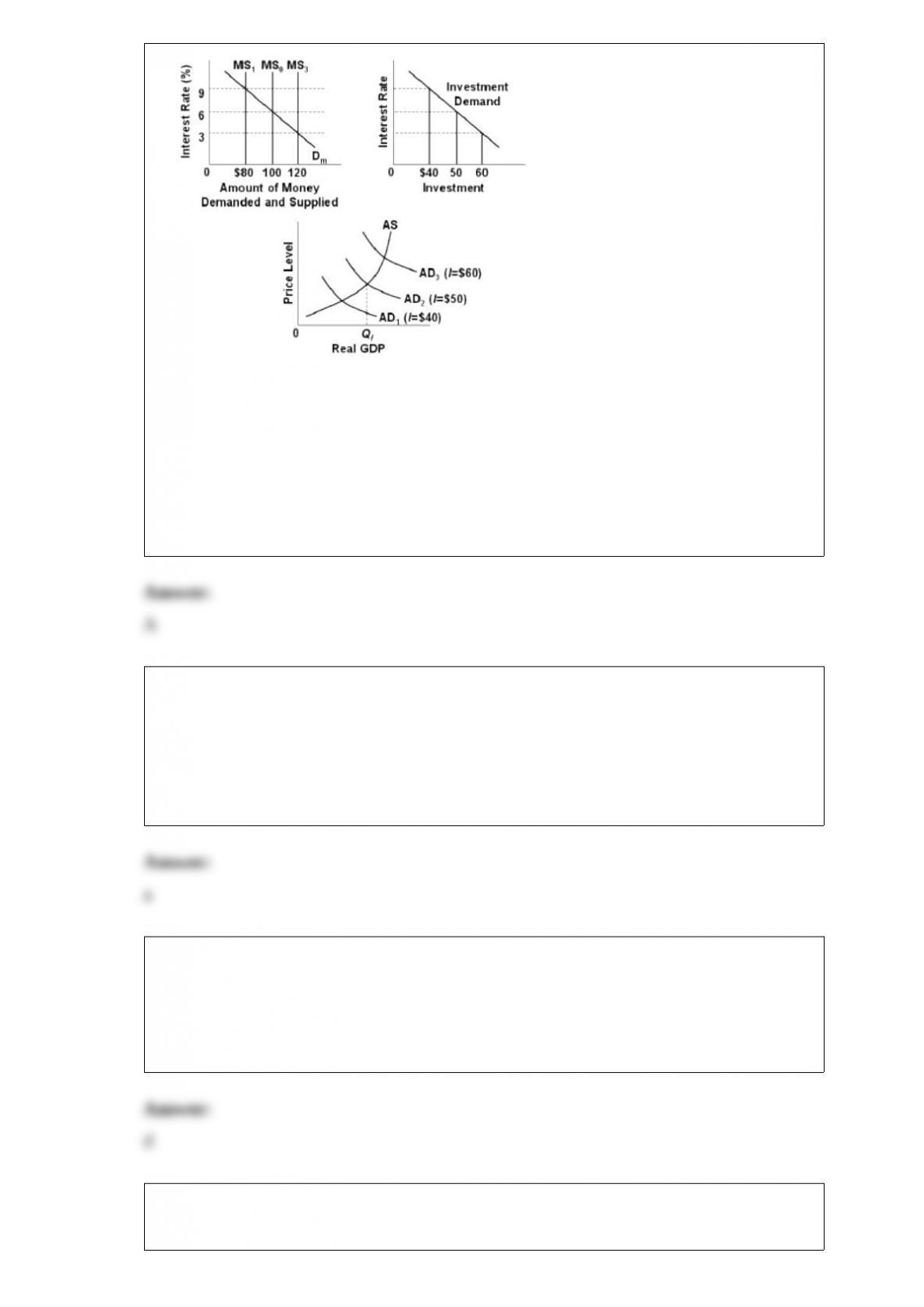
Refer to the above diagrams. The numbers in parentheses after the AD1, AD2, and AD3
labels indicate the levels of investment spending associated with each curve. All figures
are in billions. If the money supply is MS1and the goal of the monetary authorities is
full-employment output Qf, they should:
A.increase the money supply from $80 to $100.
B.increase the money supply from $80 to $120.
C.maintain the money supply at $80.
D.decrease the money supply from $80 to $60.
7) which of the following would most likely occur during the expansionary phase of the
business cycle?
a.demand-pull inflation
b.cost-push inflation
c.structural inflation
d.frictional inflation
8) which of the following is most likely to be accompanied by external benefits?
a.the construction of a nuclear power plant
b.studying in the library
c.eating dinner at an expensive french restaurant
d.being immunized for measles
9) if consumer desire for product x increases, all of the following will occur except:
a.an increase in the profits of industry x.
b.an increase in the quantity of resources employed by industry x.
c.an increase in the output of industry x.
d.a decrease in the quantity of resources employed in industry x.
10)
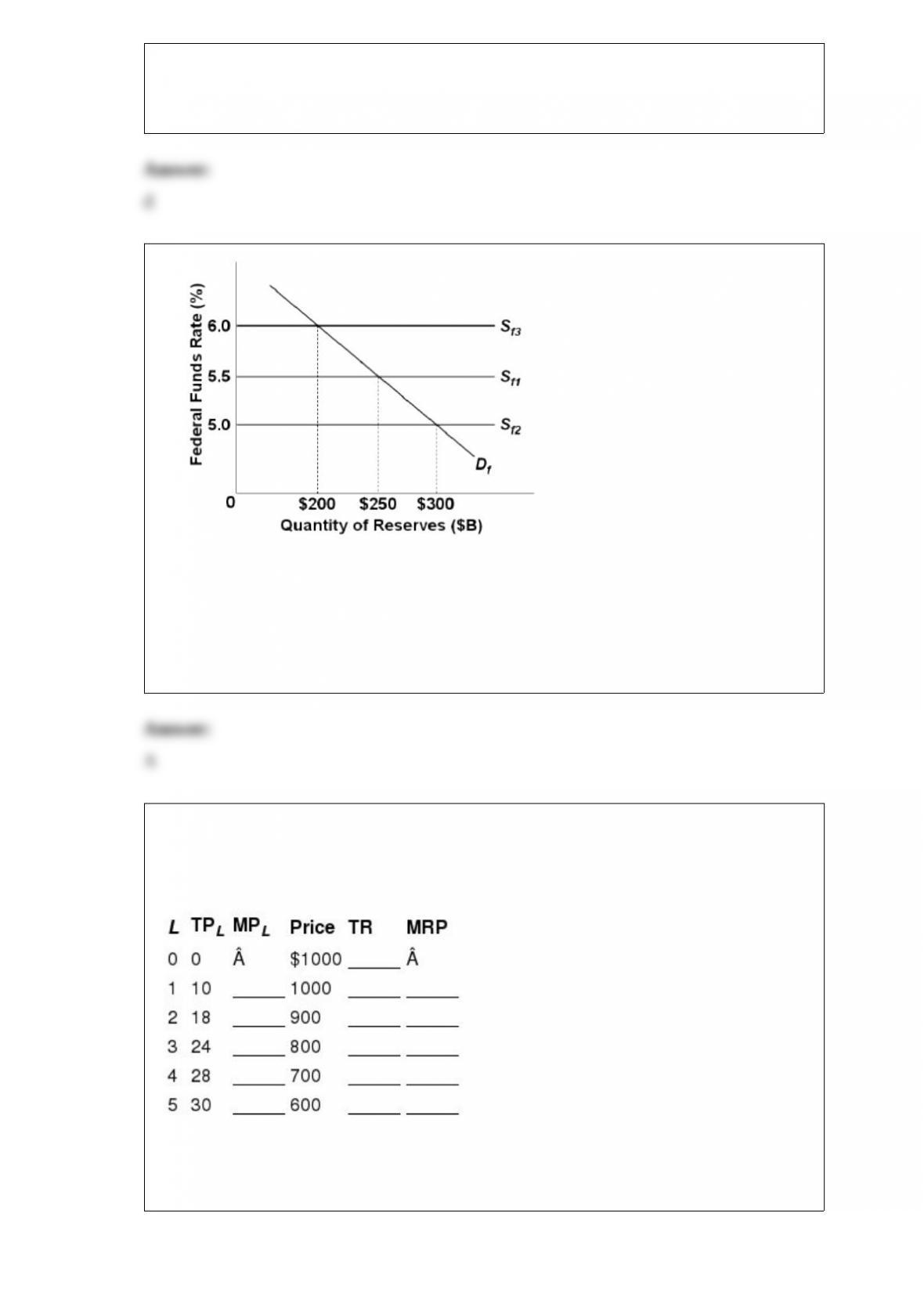
Refer to the above diagram for the Federal funds market. If the Fed wants to increase
reserves from $200 billion to $300 billion it should:
A.buy bonds from banks and the public.
B.sell bonds to banks and the public.
C.buy bonds from banks and sell them to the public.
D.buy bonds from the public and sell them to banks.
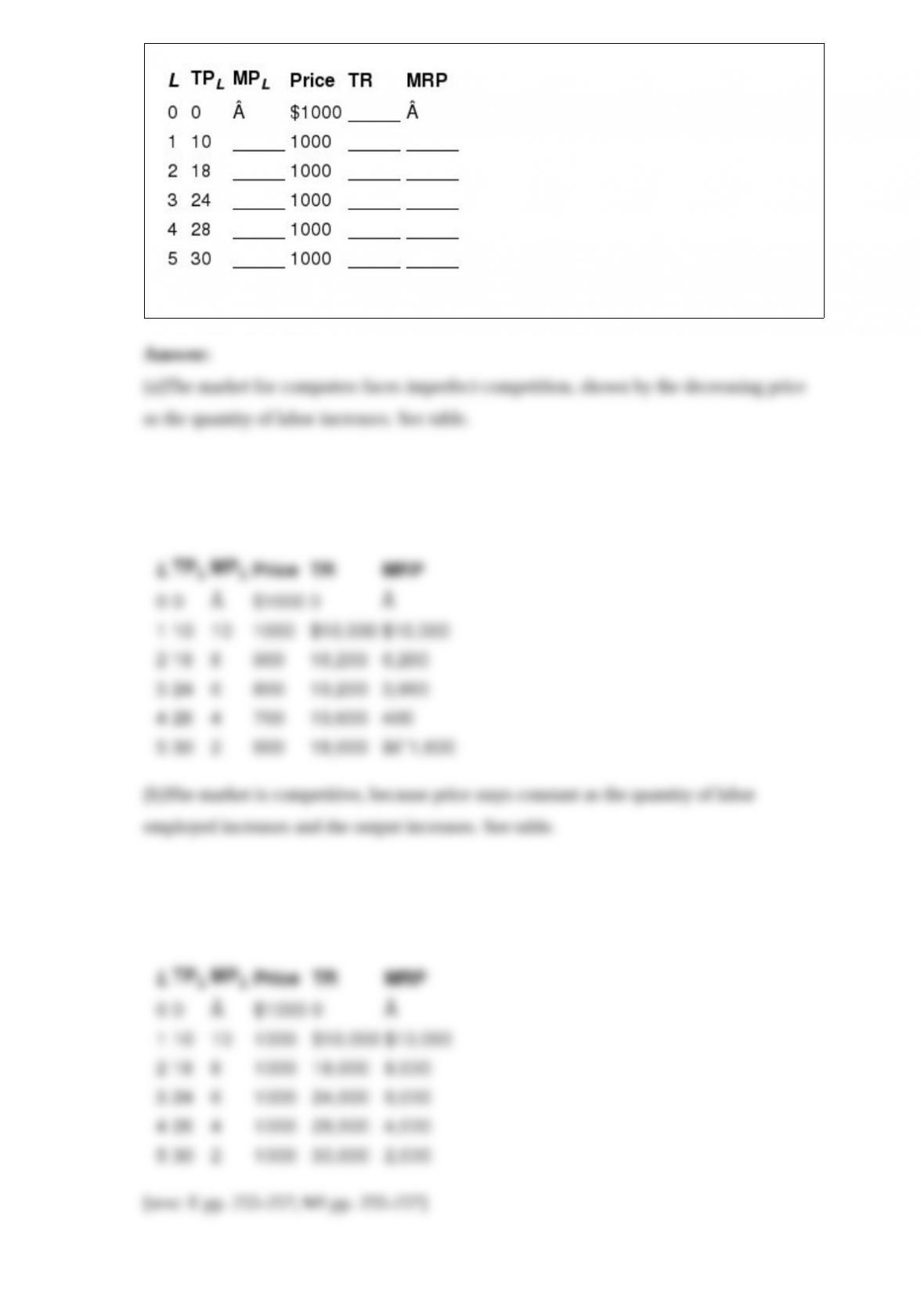
11) The table below summarizes the marginal product data for labor in producing
personal computers. Assume the other quantities employed by the firm remain constant.
Compute the MPL, TR, and MRP and answer the following questions.
(a)What type of market is the one for personal computers?
Now look at the table below showing a different market situation for the demand for
personal computers. Fill in the table and answer the following questions.
(b)What type of market does the firm face for personal computers?
12) depreciation of the dollar will:
a.increase the prices of u.s. imports, but decrease the prices of u.s. exports.
b.decrease the prices of u.s. imports, but increase the prices of u.s. exports.
c.increase the prices of both u.s. imports and exports.
d.decrease the prices of both u.s. imports and exports.
13) The primary function of the International Finance Corporation (IFC) is to:
A.provide U.S. surplus food to low-income countries.
B.provide short-term loans to poor countries to finance international trade deficits.
C.make infrastructure loans, that is, loans for highways, schools, communication
facilities, and so forth.
D.make loans to private enterprises in the DVCs.
14) we would expect the cross elasticity of demand between pepsi and coke to be:
a.positive, indicating normal goods.
b.positive, indicating inferior goods.
c.positive, indicating substitute goods.
d.negative, indicating substitute goods.
15) A decline in investment will shift the AD curve to the:
A.left by a multiple of the change in investment.
B.left by the same amount as the change in investment.
C.right by the same amount as the change in investment.
D.right by a multiple of the change in investment.
16) Technological advance improves allocative efficiency by:
A.enhancing monopoly power.
B.reducing income inequality.
C.giving society a more-preferred mix of goods and services.
D.encouraging saving.