
1) empirical studies suggest that:
a.labor productivity has declined throughout u.s. history.
b.technological advances account for about 40 percent of u.s. productivity growth.
c.the achieving of economies of scale is the most important factor in u.s. economic
growth.
d.all u.s. economic growth from between 2001 and 2007 can be attributed to increases
in the quantity of labor.
2) (consider this) european economists generally agree that:
a.high european rates of inflation reflect demand-pull rather than cost-push forces.
b.high european rates of poverty can be reduced by higher transfer payments.
c.high european unemployment rates have resulted from government policies and union
contracts that increase the costs of hiring and reduce the individual’s opportunity cost of
being unemployed.
d. european trade deficits stimulate the european economies.
3) if products were in short or surplus supply in the soviet union:
a.price and profit signals eliminated those shortages and surpluses.
b.price and profit signals intensified those shortages and surpluses.
c.producers would not react because no price or profit signals occurred.
d.the planners would immediately adjust production to achieve equilibrium.
4) In the aggregate expenditures model, technological progress will shift the investment
schedule:
A.downward and increase aggregate expenditures.
B.downward and decrease aggregate expenditures.
C.upward and increase aggregate expenditures.
D.upward and decrease aggregate expenditures.
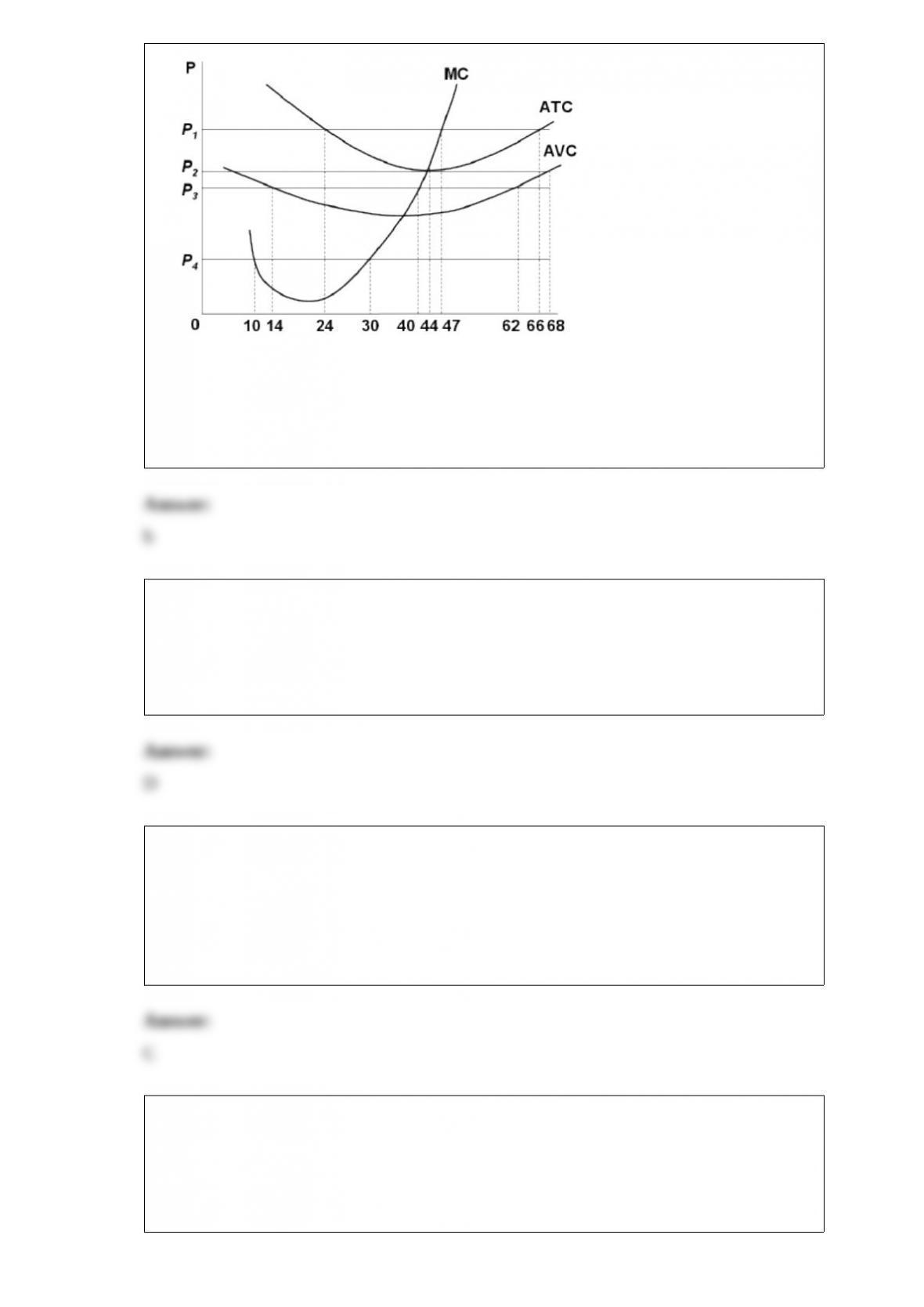
5)
refer to the above diagram. at p1, this firm will produce:
a.47 units and break even.
b.47 units and realize an economic profit.
c.66 units and earn only a normal profit.
d.24 units and earn only a normal profit.
6) Energy economics is concerned with:
A.attempting to find and exploit low cost energy sources.
B.per capita energy demand of an economy.
C.reducing energy costs for producers and consumers.
D.all of these.
7) The movement of individuals and households from one income quintile to another
over time is called:
A.income averaging.
B.wealth turnover.
C.income mobility.
D.the ratchet effect.
8) Which of the following taxes is most likely to be shifted?
A.a general sales tax
B.a flat-rate state income tax
C.a progressive Federal income tax
D.a property tax on an owner-occupied residence
9) the advent of dvds has virtually demolished the market for videocassettes. this is an
example of:
a.creative destruction.
b.derived demand.
c.capital accumulation.
d.the difference between normal and economic profits.
10) Suppose a local coffee shop in the downtown area decides to purchase a
neighboring abandoned lot and convert it into a garden area with outdoor seating.
(a)Does this decision create an externality? If so, what kind?
(b)Despite the citys positive response to the coffee shops renovation, other businesses
in the area have not followed suit in renovating the many decrepit buildings and
abandoned lots. How might the presence of an externality be in part the cause of this?
(c)In response to the lack of effort on the part of businesses to renovate the downtown
area, city council members to take action. What are some ways that the city government
could promote this kind of revival?

11) the accompanying table that shows average total costs (atc) for a manufacturing
firm whose total fixed costs are $10:
refer to the above data. the total cost of producing 4 units of output is:
a.$31.
b.$87.
c.$124.
d.$108.
12) from 1960 to 2004:
a.follower countries such as ireland, singapore, and hong kong caught up to and
surpassed leader countries such as france and the united kingdom.
b.leader country growth rates were about double those of follower countries.
c.japan’s rapid growth pushed its real gdp per capita above that of the united states.
d.growth rates in follower nations such as south korea and hong kong averaged about
10 percent per year.
13) In the aggregate expenditures model, equilibrium GDP in a private closed economy
is indicated by:
A.the equality of saving and planned investment.
B.the intersection of aggregate expenditures and the 45-degree line.
C.the absence of unplanned changes in inventories.
D.all of these.
14) According to the concept of present value, a $50 barrel of oil today is worth:
A.less than a $50 barrel in 2 years.
B.more than a $50 barrel in 2 years.
C.the same as a $50 barrel in 2 years.
D.the same as a $50 barrel in 2 years, but only if there is no inflation during those 2
years.
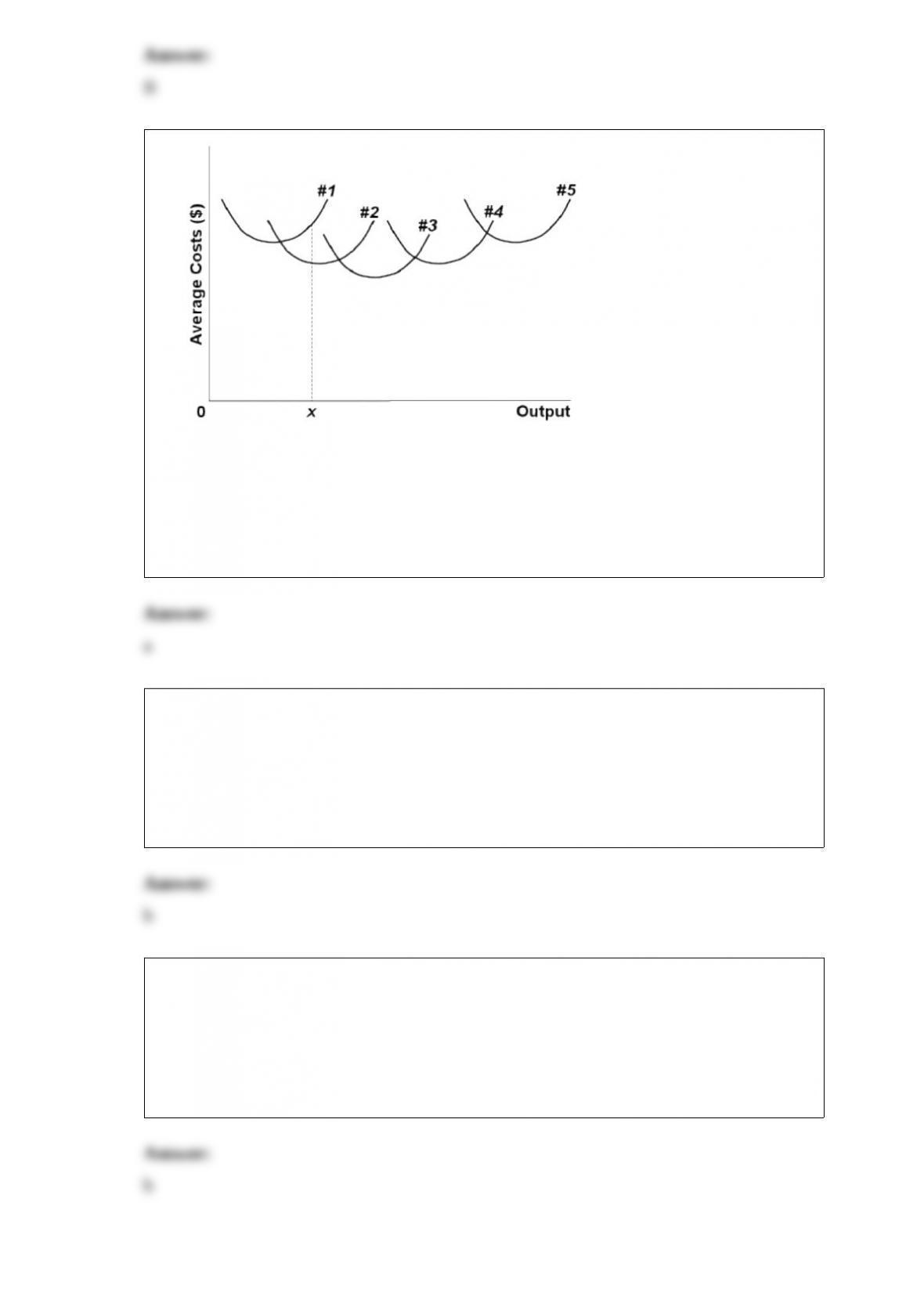
15)
the above diagram shows the short-run average total cost curves for five different plant
sizes of a firm. the shape of each individual curve reflects:
a.increasing returns, followed by diminishing returns.
b.economies of scale, followed by diseconomies of scale.
c.constant costs.
d.increasing costs, followed by decreasing costs.
16) which of the following is incorrect? imperfectly competitive producers:
a.face downsloping demand curves.
b.do not compete with one another.
c.can alter their output by changing price.
d.find that, when they reduce price, their total revenue increases by less than the new
price.
17) innovations such as the microchip and the internet lead to business cycle variations
because:
a.they cause prices to be sticky.
b.significant innovations occur irregularly and unexpectedly.
c.the central bank will often change the money supply in response.
d.they cause prices to be flexible.