Some individuals seek to use government action to make themselves better off at the
expense of others. The actions of these individuals
A) are examples of fraud; but these individuals usually avoid prosecution because of
logrolling and rational ignorance.
B) are examples of rent seeking.
C) offer proof that Adam Smith’s “invisible hand” is not valid.
D) are evidence of the voting paradox.
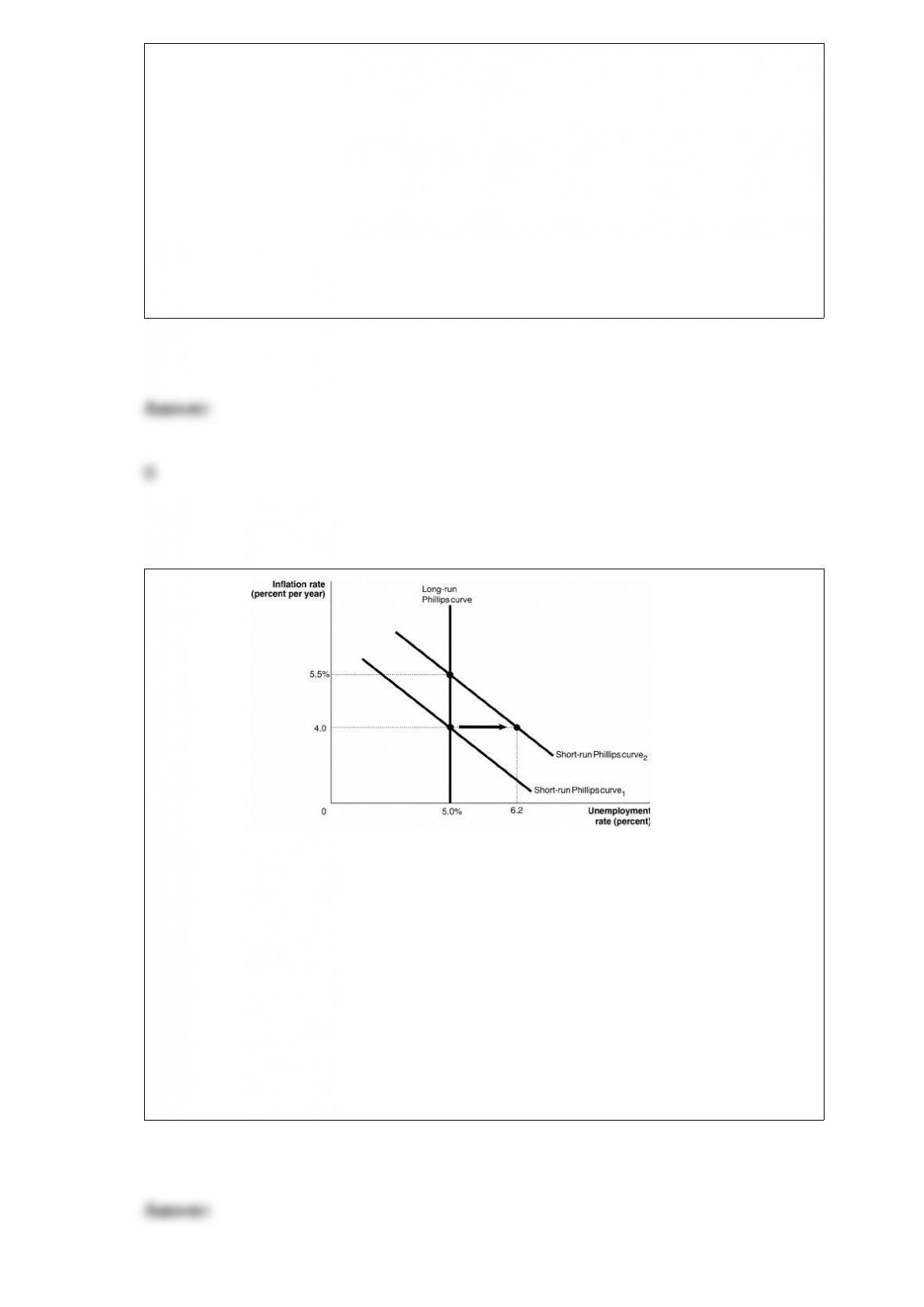
Figure 17-4
Consider the shift in the short-run Phillips curves shown in the above graph. This shift
may be explained by
A) an increase in the natural rate of unemployment from 5.0 to 6.2 percent.
B) an increase in the expected rate of inflation from 4.0 to 5.5 percent.
C) either an increase in the natural rate of unemployment from 5.0 to 6.2 percent or an
increase in the expected rate of inflation from 4.0 to 5.5 percent.
D) None of the above is correct.

A corporation is owned by its
A) board of directors.
B) stockholders.
C) employees.
D) CEO.
Assume that the tuna fishing industry is perfectly competitive. Which of the following
best characterizes the industry if, as demand for tuna increases, fishing boats have to go
farther into the ocean to harvest tuna?
A) a constant-cost industry
B) an increasing-cost industry
C) a decreasing-cost industry
D) a fixed-cost industry
If actual inflation is less than expected inflation, which of the following will be true?
A) Real wages will rise.

B) Real wages will fall.
C) The Phillips curve will be a vertical line.
D) The unemployment rate will fall.
If strong aggregate demand is pushing the economy beyond potential real GDP, which
of the following must be true?
A) The economy is at an equilibrium that is on the long-run aggregate supply curve.
B) The economy is at an equilibrium that is on the long-run Phillips curve.
C) The economy is at an equilibrium that is not on the long-run Phillips curve.
D) Expansionary monetary policies will push the economy back to the long-run Phillips
curve.
The aggregate expenditure model focuses on the ________ relationship between real
spending and ________.
A) short-run; real GDP
B) short-run; inflation
C) long-run; real GDP
D) long-run; inflation
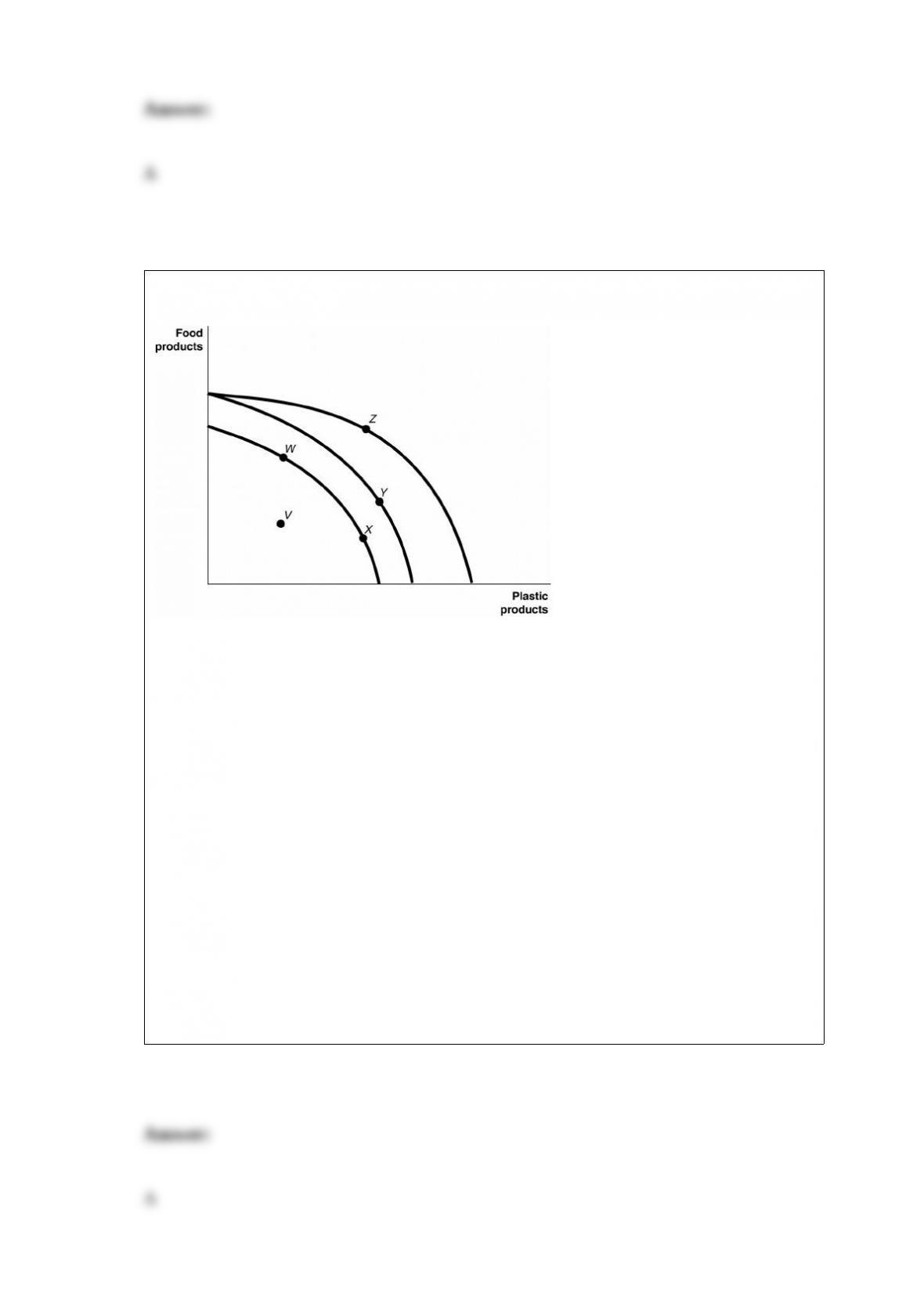
Figure 2-4
Figure 2-4 shows various points on three different production possibilities frontiers for
a nation. Consider the following events:
a. a decrease in the unemployment rate
b. general technological advancement
c. an increase in consumer wealth Which of the events listed above could cause a
movement from V to W?
A) a only
B) a and b only
C) b and c only
D) a, b, and c

Explain why member firms of a cartel like OPEC have incentives to agree to a low
cartel production level and then produce more than its quota.
Why does a prisoner’s dilemma lead to a noncooperative equilibrium?
A) because each player had agreed before the game started to minimize the harm that he
can inflict on the other players
B) because each player is uncertain how other players will play the game
C) because players must choose from a limited number of non-dominant strategies
D) because each rational player has a dominant strategy to play a certain way regardless
of what other players do
If the number employed is 190 million, the working-age population is 230 million, and
the number unemployed is 10 million, then the unemployment rate is
A) 5%.
B) 5.2%.

C) 8%.
D) 10%.
E) 50%.
The process of an economy adjusting from a recession back to potential GDP in the
long run without any government intervention is known as
A) monetary policy.
B) an automatic mechanism.
C) “releasing sticky prices.”
D) fiscal policy.