1) (Consider This) The Consider This box “Of Catfish and Art (and Other Things in
Common)” lists examples of recent antitrust cases involving:
A.monopolization.
B.tying contracts.
C.price fixing.
D.horizontal mergers.
2) The equality-efficiency tradeoff refers to:
A.the conflict between risk averters and risk takers.
B.the willingness of Congress to abandon existing welfare programs in favor of a
comprehensive plan to increase education and training for low-income persons.
C.possible conflicts between the goals of economic efficiency and greater income
equality.
D.the difference between the goals of income equality and equality of economic
opportunity.
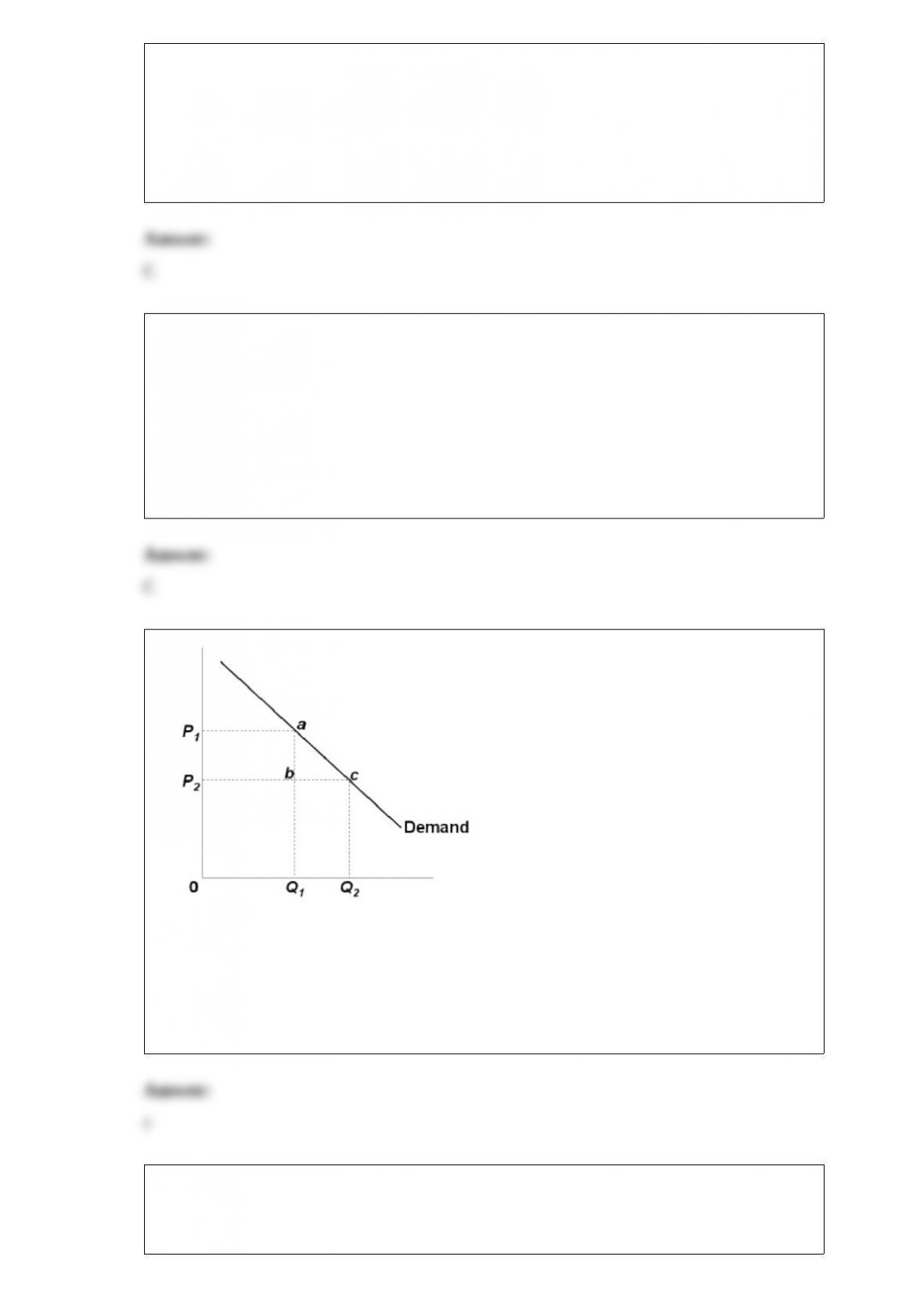
3)
refer to the above diagram. the quantitative difference between areas q1bcq2 and
p1p2ba in the above diagram measures:
a.marginal cost.
b.total revenue.
c.marginal revenue.
d.average revenue.
4) When most consumers and firms reduce spending only because they expect other
consumers and firms to reduce spending, and a recession results:
A.a self-correction has occurred.
B.an adverse aggregate supply shock has occurred.
C.a coordination failure has occurred.
5) in calculating the gdp national income accountants:
a.treat inventory changes as an adjustment to personal consumption expenditures.
b.ignore inventories because they do not represent final goods.
c.subtract increases in inventories or add decreases in inventories.
d.add increases in inventories or subtract decreases in inventories.
6) If P equals the price level expressed as an index number and $V equals the value of
the dollar, then:
A.P = $V – 1.
B.$V = 1/P.
C.1 = $V/P.
D.$V = P – 1.
7) which of the following is not a possible source of natural monopoly?
a.large-scale network effects
b.simultaneous consumption
c.greater use of specialized inputs
d.rent-seeking behavior
8) A fishery collapse:
A.necessarily happens when harvesting rates increase.
B.necessarily happens when reproduction rates fall.
C.occurs when harvesting outpaces reproduction for an extended period.
D.is irreversible.
9) The term “growing income inequality” implies that the:
A.poor are getting poorer in both a relative and an absolute sense.
B.Lorenz curve is shifting toward the diagonal.
C.diagonal is shifting toward the Lorenz curve.
D.top quintile of income receivers is getting relatively more of the total income than
before and the bottom quintile is getting relatively less.
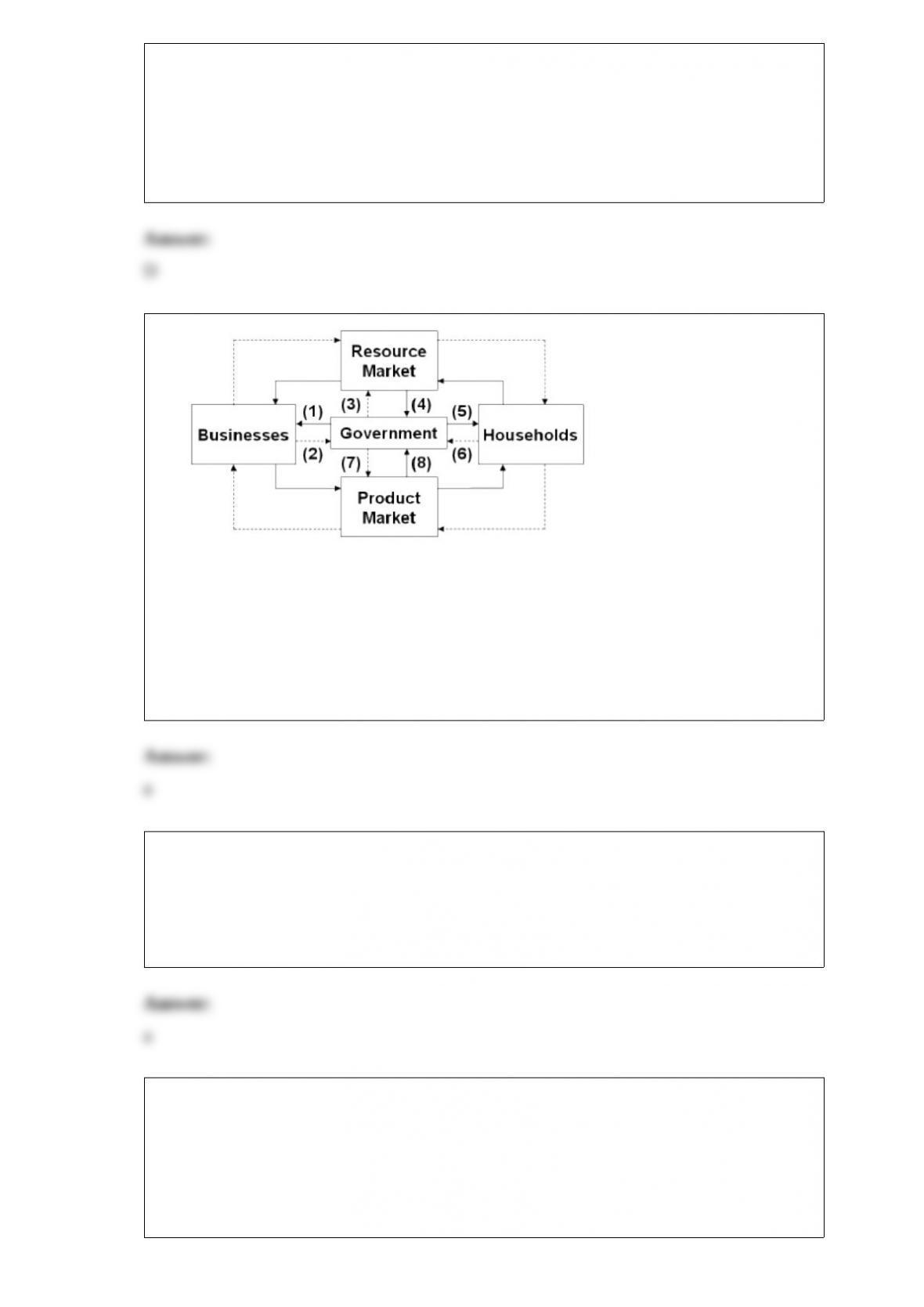
10)
refer to the above diagram, in which solid arrows reflect real flows; broken arrows are
monetary flows. if the economy were in a serious recession, it would be most
appropriate for government to:
a.increase flows (3) and (7) and reduce flows (2) and (6).
b.decrease flows (3) and (7) and increase flows (2) and (6).
c.increase flows (2) and (3) and reduce flows (6) and (7).
d.increase all of the monetary flows.
11) macroeconomics approaches the study of economics from the viewpoint of:
a.the entire economy.
b.governmental units.
c.the operation of specific product and resource markets.
d.individual firms.
12) (Last Word) Classical macroeconomics was dealt severe blows by:
A.the Great Depression and Keynes’s macroeconomic theory.
B.the Second World War and the writings of Milton Friedman.
C.Adam Smith and his idea of the invisible hand.
D. the strong recovery after the Second World War and Alvin Hansen’s stagnation
thesis.
13) use the list below to answer the following questions:
1. improvements in technology
2. increases in the supply (stock) of capital goods
3. purchases of expanding output
4. obtaining the optimal combination of goods, each at least-cost production
5. increases in the quantity and quality of natural resources
6. increases in the quantity and quality of human resources
refer to the above list. as distinct from the supply factors and demand factor of
economic growth, the efficiency factor of economic growth is:
a.1 only.
b.4 only.
c.1 and 3 only.
d.3 only.
14) cost-of-living adjustment clauses (colas):
a.invalidate the “rule of 70.”
b.apply only to demand-pull inflation.
c.increase the gap between nominal and real income.
d.tie wage increases to changes in the price level.
15) Under the managed floating system of exchange rates:
A.all exchange rates vary with changes in the free-market prices of gold.
B.industrialized nations meet once each year to negotiate readjustments in their
exchange rates.
C.exchange rates are essentially flexible, but governments intervene to offset disorderly
fluctuations in rates.
D.exchange rates are adjusted at the discretion of the IMF.
16) Examples of exports based on actual or perceived quality superiority, and not
simply on cost-advantages, include:
A.wheat from the United States and natural gas from Russia.
B.bottled water from France and chocolates from Belgium.

C.pine furniture from Mexico and textiles from China.
D.coffee from Brazil and wool from Australia.