
You have been promised a payment of $400 in the future. In which of the following
cases is the present value of this payment the lowest?
a. You receive the payment 4 years from now and the interest rate is 4 percent.
b. You receive the payment 4 years from now and the interest rate is 5 percent.
c. You receive the payment 5 years from now and the interest rate is 4 percent.
d. You receive the payment 5 years from now and the interest rate is 5 percent.
Other things the same, if a country saves more, then
a. net capital outflow rises, so net exports rise.
b. net capital outflow rises, so net exports fall.
c. net capital outflow falls, so net exports rise.
d. net capital outflow falls, so net exports fall.
A favorable supply shock shifts the short-run Phillips curve
a. right and inflation rises.
b. right and inflation falls.

c. left and inflation rises.
d. left and inflation falls.
A manufacturing company is thinking about building a new factory. The factory, if
built, will yield the company $300 million in 7 years, and it would cost $220 million
today to build. The company will decide to build the factory if the interest rate is
a. no less than 4.53 percent.
b. no greater than 4.53 percent.
c. no less than 5.81 percent.
d. no greater than 5.81 percent.
Figure 2-20
RelationshipBetweenYearsofEducationandAnnualIncome

RefertoFigure2-20.The graph above is a
a. bar graph
b. scatterplot
c. pie chart
d. time series analysis
Suppose that the Bureau of Labor Statistics predicts that the number of jobs for dental
hygienists will grow faster than most occupations while the number of jobs for
bookbinders will decline. This change in the labor market could lead to
a. frictional unemployment created by efficiency wages.
b. structural unemployment created by efficiency wages.
c. frictional unemployment created by sectoral shifts.
d. structural unemployment created by sectoral shifts.

A decrease in the money supply might indicate that the Fed had
a. purchased bonds in an attempt to increase the federal funds rate.
b. purchased bonds in an attempt to reduce the federal funds rate.
c. sold bonds in an attempt to increase the federal funds rate.
d. sold bonds in an attempt to reduce the federal funds rate.
An increase in the price of ink will shift the supply curve for pens to the left.
a. True
b. False
Financial intermediaries are
a. the same as financial markets.
b. individuals who make profits by buying a stock low and selling it high.

c. a more general name for financial assets such as stocks, bonds, and checking
accounts.
d. financial institutions through which savers can indirectly provide funds to borrowers.
A Minnesota farmer buys a new tractor made in Iowa by a German company. As a
result,
a. U.S. investment and GDP increase, but German GDP is unaffected.
b. U.S. investment and German GDP increase, but U.S. GDP is unaffected.
c. U.S. investment, U.S. GDP, and German GDP are unaffected because tractors are
intermediate goods.
d. U.S. investment, U.S. GDP, and German GDP all increase.
If a U.S. company buys an electrical generator made in Japan by a Japanese firm, and
the Japanese firm uses the payment to buy stocks issued by a U.S. company then
a. U.S. exports and U.S imports increase.
b. U.S. exports but not U.S. imports increase.
c. U.S. imports but not U.S. exports increase.

d. neither U.S. exports nor U.S. imports increase.
Stephen is restoring a car and has already spent $4,000 on the restoration. He expects to
be able to sell the car for $5,800. Stephen discovers that he needs to do an additional
$2,400 of work to make the car worth $5,800 to potential buyers. He could also sell the
car now, without completing the additional work, for $3,800. What should he do?
a. He should sell the car now for $3,800.
b. He should keep the car since it wouldn”t be rational to spend $6,400 restoring a car
and then sell it for only $5,800.
c. He should complete the additional work and sell the car for $5,800.
d. It does not matter which action he takes since the outcome will be the same either
way.
Suppose that in Brazil total annual output is worth $600 million and people work 30
million hours. In Peru total annual output is worth $800 million and people work 50
million hours. Productivity is higher
a. in Brazil. Most variation in the standard of living across countries is due to
differences in productivity.
b. in Brazil. Differences in productivity explain very little of the variation in the
standard of living across countries.

c. in Peru. Most variation in the standard of living across countries is due to differences
in productivity.
d. in Peru. Differences in productivity explain very little of the variation in the standard
of living across countries.
Esmerelda worked parttime for her mother’s business without pay. Tabitha was absent
from work because she had strep throat. Who is counted as “employed” by the Bureau
of Labor Statistics?
a. Esmerelda but not Tabitha
b. Tabitha but not Esmerelda
c. both Esmerelda and Tabitha
d. neither Esmerelda nor Tabitha
The aggregate quantity of goods and services demanded changes as the price level falls
because
a. real wealth falls, interest rates rise, and the dollar appreciates.
b. real wealth falls, interest rates rise, and the dollar depreciates.
c. real wealth rises, interest rates fall, and the dollar appreciates.

d. real wealth rises, interest rates fall, and the dollar depreciates.
Public policy can reduce frictional unemployment.
a. True
b. False
Over the past two centuries, the average annual rates of return were about
a. 5 percent for stocks and about 1.5 percent for short-term government bonds.
b. 6 percent for stocks and about 2.5 percent for short-term government bonds.
c. 8 percent for stocks and about 3 percent for short-term government bonds.
d. None of the above is correct.

Which of the following would a permanent increase in the growth rate of the money
supply change permanently?
a. inflation
b. unemployment
c. both inflation and unemployment
d. neither inflation nor unemployment
Suppose a country repealed its investment tax credit. The effects of this are represented
by shifting the
a. demand for and the supply of loanable funds to the right.
b. demand for and the supply of loanable funds to the left.
c. supply of loanable funds to the right and the demand for loanable funds to the left.
d. None of the above is correct.
What is the present value of a payment of $100 one year from today if the interest rate
is 5 percent?

a. $95.50
b. $95.24
c. $95.00
d. None of the above are correct to the nearest cent.
When the wage is above the equilibrium level,
a. the labor market is functioning more efficiently than it otherwise would function.
b. there is a shortage of labor.
c. the quantity of labor supplied exceeds the quantity of labor demanded.
d. job search is the primary explanation for the unemployment that is observed.
Consider two countries, Muria and Zenya. In Muria total annual output is worth $800
million and people work 40 million hours. In Zenya total annual output is worth $900
million and people work 50 million hours. In which country is productivity higher?
An open economy’s GDP is always given by
a. Y= C+ I+ G.
b. Y= C+ I+ G+ T.
c. Y= C+ I+ G+ S.
d. Y= C+ I+ G+ NX.
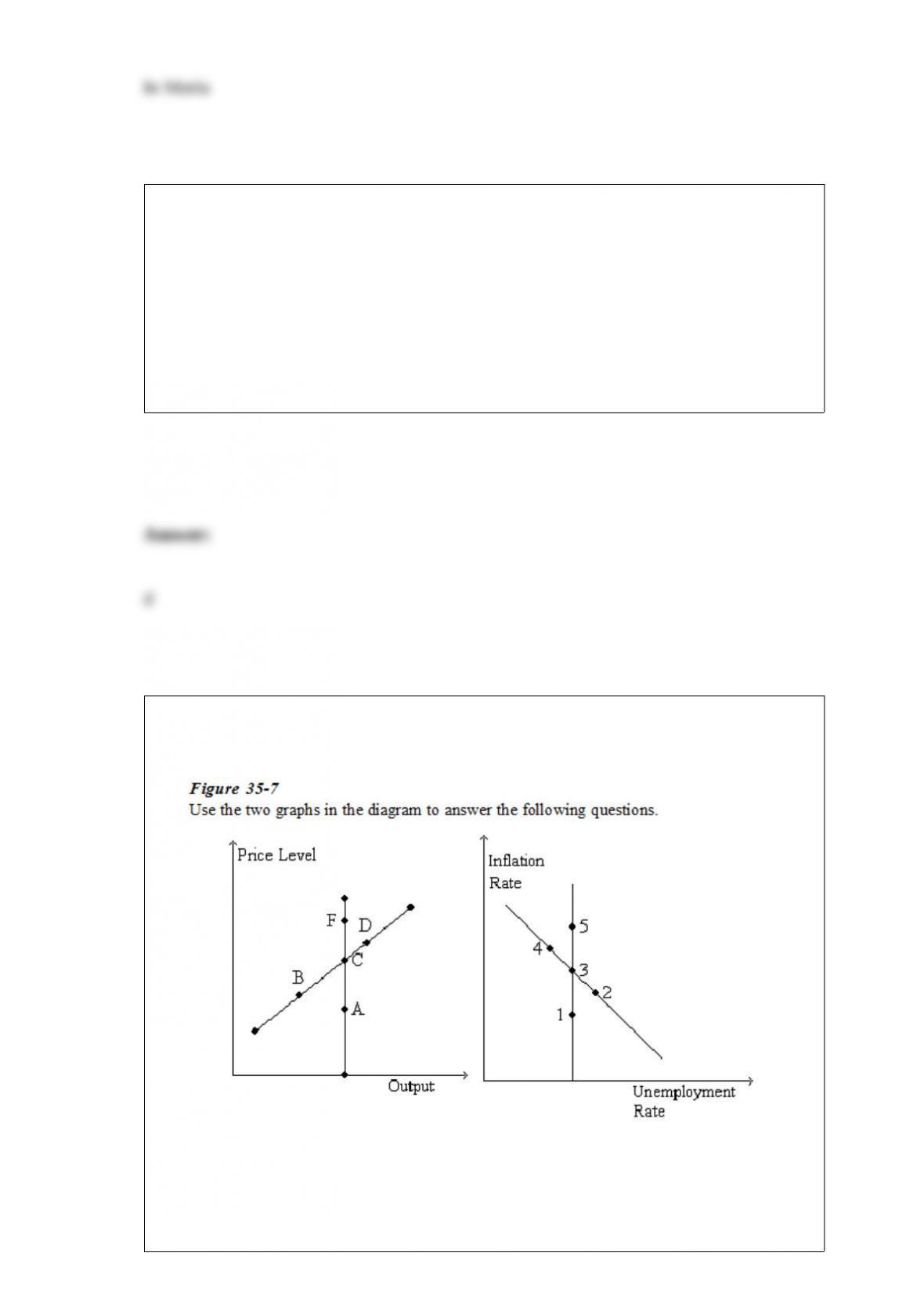
RefertoFigure35-7. Starting from C and 3, in the short run an unexpected increase in
money supply growth moves the economy to
a. A and 1.

b. B and 2.
c. back to C and 3.
d. D and 4.
Classical economist David Hume observed that as the money supply expanded after
gold discoveries
a. prices and output both increased immediately.
b. prices increased immediately while output remained unchanged.
c. it took time for prices to rise; in the meantime output was lower.
d. it took time for prices to rise; in the meantime output was higher.
Figure30-2. On the graph, MS represents the money supply and MD represents money
demand. The usual quantities are measured along the axes.
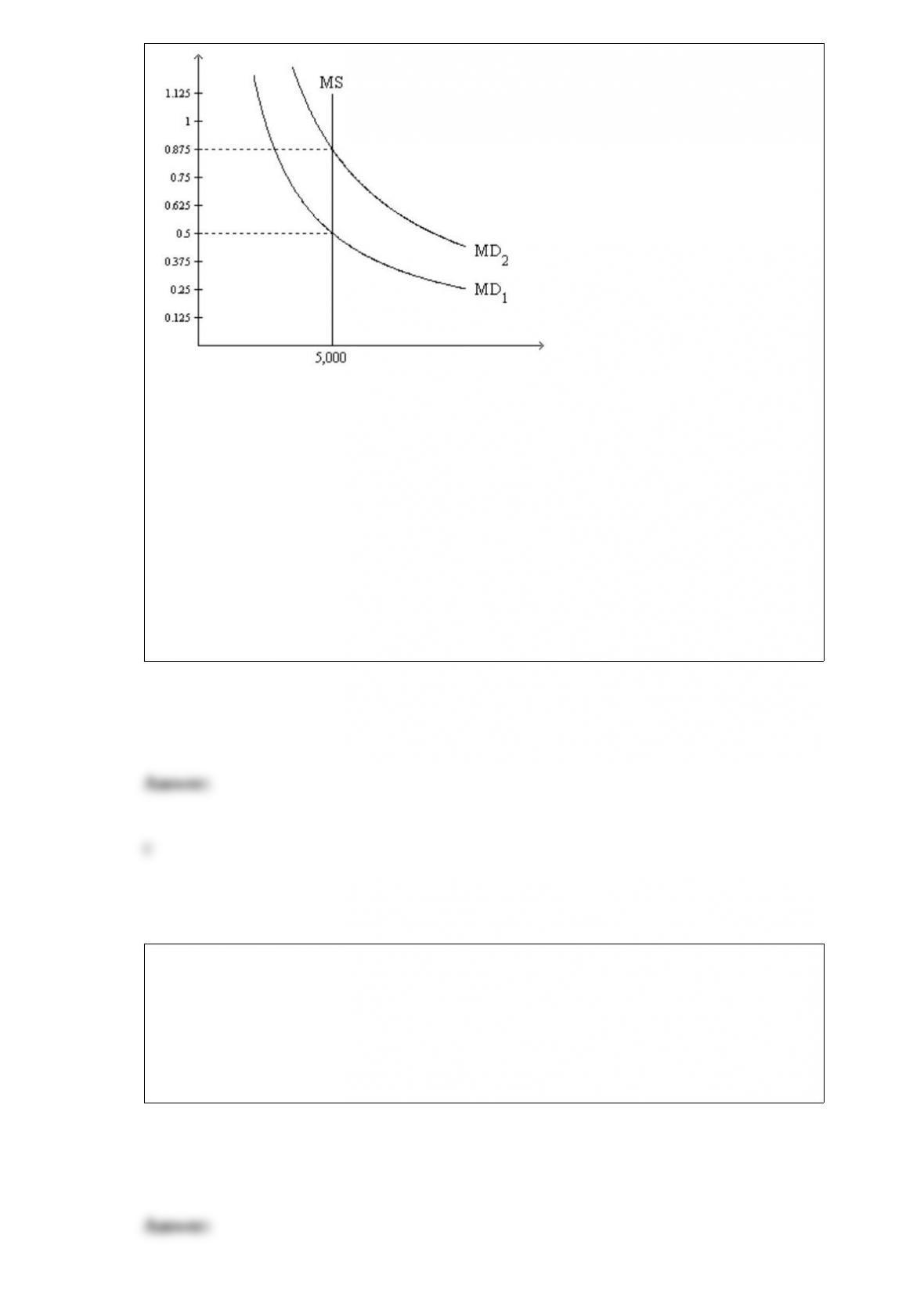
RefetoFigure30-2. Suppose the relevant money-demand curve is the one labeled MD1;
also suppose the velocity of money is 4. If the money market is in equilibrium, then the
economy’s real GDP amounts to
a. 2,500.
b. 7,500.
c. 10,000.
d. 40,000.
If banks hold any amount of their deposits in reserve, then they do not have the ability
to influence the money supply.
a. True
b. False

Which costs of inflation could the government reduce without reducing inflation?
a. shoeleather and menu costs
b. menu costs and relative price variability
c. unintended changes in tax liabilities and arbitrary redistributions of wealth
d. none of the above is correct.
Scenario 29-2.
The Monetary Policy of Tazi is controlled by the country’s central bank known as the
Bank of Tazi. The local unit of currency is the taz. Aggregate banking statistics show
that collectively the banks of Tazi hold 300 million tazes of required reserves, 75
million tazes of excess reserves, have issued 7,500 million tazes of deposits, and hold
225 million tazes of Tazian Treasury bonds. Tazians prefer to use only demand deposits
and so all money is on deposit at the bank.
RefetoScenario29-2.Assuming the only other thing Tazian banks have on their balance
sheets is loans, what is the value of existing loans made by Tazian banks?
a. 6,900 million tazes
b. 7,125 million tazes
c. 7,350 million tazes
d. None of the above is correct.

In the open-economy macroeconomic model, the market for loanable funds identity can
be written as
a. S= I
b. S= NCO
c. S= I+ NCO
d. S+ I= NCO