
What is the present value of $888 in a one year if the current rate of interest is five
percent?
A) $4,440
B) $845.71
C) $177.60
D) none of these
Macroeconomics, as opposed to microeconomics, includes the study of what
determines the level of
A) employment in a specific industry.
B) employment in the economy.
C) output of a specific firm.
D) output of a specific industry.
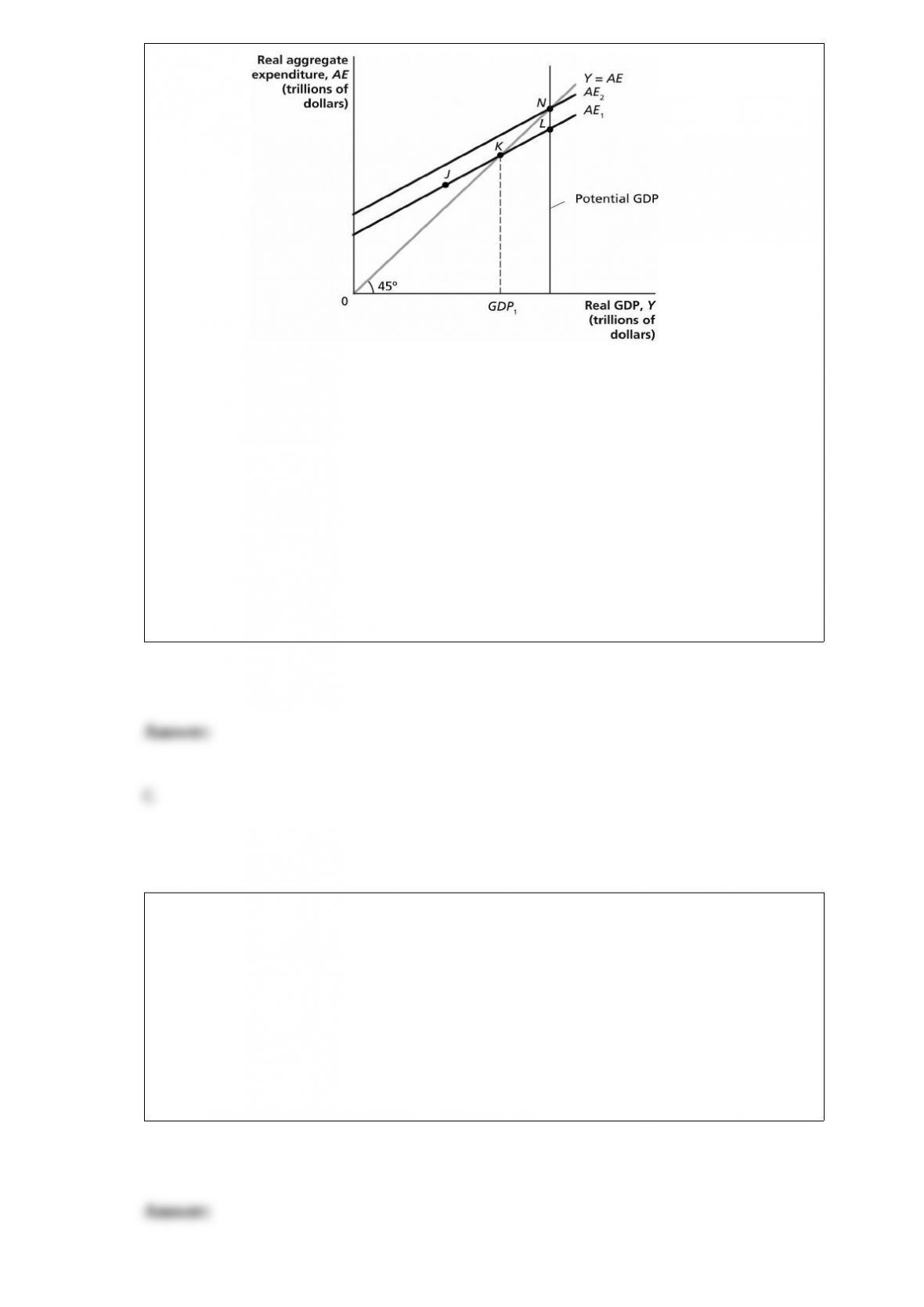
Figure 23-4
Potential GDP equals $500 billion. The economy is currently producing GDP1 which is
equal to $450 billion. If the MPC is 0.8, then how much must autonomous spending
change for the economy to move to potential GDP?
A) -$40 billion
B) -$10 billion
C) $10 billion
D) $40 billion
Which of the following will increase the real interest rate?
A) an increase in the supply of loanable funds
B) an increase in household saving
C) an increase in the demand for loanable funds
D) an increase in the budget surplus
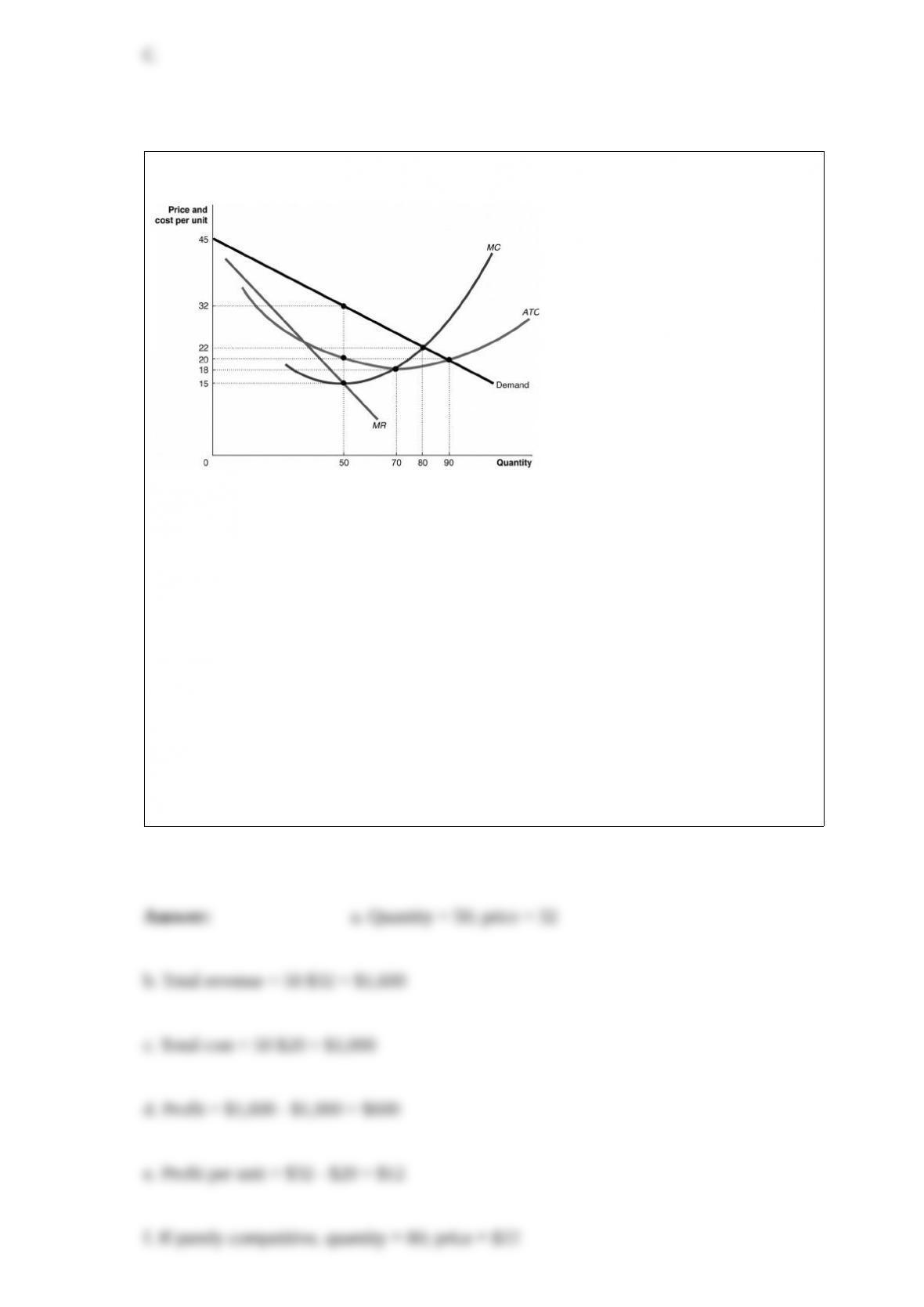
Figure 15-7
Use the figure above to answer the following questions.
a. What is the profit-maximizing quantity and what price will the monopolist charge?
b. What is the total revenue at the profit-maximizing output level?
c. What is the total cost at the profit-maximizing output level?
d. What is the profit?
e. What is the profit per unit (average profit) at the profit-maximizing output level?
f. If this industry was organized as a perfectly competitive industry, what would be the
profit-maximizing price and quantity?

Because firms can free ride on the research and development of other firms,
A) firms choose a level of research and development where the marginal cost of
research is equal to the economy’s marginal return of research.
B) firms choose a level of research and development where the marginal cost of
research is above the economy’s marginal return of research.
C) firms choose a level of research and development where the marginal cost of
research is below the economy’s marginal return of research.
D) firms choose a level of research and development where the marginal cost of
research is below the individual firm’s marginal return of research.
If a monopolist’s marginal revenue is $35 per unit and its marginal cost is $25, then
A) to maximize profit the firm should increase output.
B) to maximize profit the firm should decrease output.
C) to maximize profit the firm should continue to produce the output it is producing.
D) Not enough information is given to say what the firm should do to maximize profit.

The three most widely followed stock indexes in the United States include all of the
following except
A) the Dow Jones Industrial Average.
B) the S&P 500.
C) the Fortune 500.
D) The NASDAQ.
Free trade ________ living standards by ________ economic efficiency.
A) raises; increasing
B) lowers; decreasing
C) raises; equalizing
D) lowers; eliminating
The invention of the cotton gin ushered in the Industrial Revolution and began a long
period of technological innovation. What did this technological change do the short-run
supply curve?
A) It shifted the short-run aggregate supply curve to the left.
B) It shifted the short-run aggregate supply curve to the right.
C) It moved the economy up along a stationary short-run aggregate supply curve.

D) It moved the economy down along a stationary short-run aggregate supply curve.
Studies have shown that
A) firms often cut nominal wages during recessions and allow inflation to gradually
increase real wages.
B) firms are reluctant to cut nominal wages during recessions but instead increase
workers’ nominal wages and allow inflation to gradually increase real wages.
C) firms are reluctant to cut nominal wages during recessions but instead freeze
workers’ nominal wages and allow inflation to gradually reduce real wages.
D) firms often freeze workers’ nominal wages during a recession and keep the wages
frozen well after the recession has ended.
In 2012, Peelville consumed 30,000 bananas. In 2013, banana consumption rose to
35,000. Calculate the percentage change in banana consumption.
A) 11.66%
B) 14.28%
C) 16.67%
D) 22.25%

Net foreign investment minus net foreign portfolio investment is equal to
A) capital outflows.
B) net foreign financial investment.
C) the balance of trade.
D) net foreign direct investment.
Brett buys a new cell phone for $100. He receives consumer surplus of $80 from the
purchase. How much does Brett value his cell phone?
A) $180
B) $100
C) $80
D) $20
The only way the standard of living of the average person in a country can increase is if

________ increases faster than ________.
A) production; population
B) population; GDP per capita
C) population; production
D) population; income
Suppose the following two events occur in the domestic market for radiologists:
a. Some hospitals are outsourcing some radiology services such as reading x-rays.
b. Some medical schools have closed down their radiology departments as fewer
students enroll in this field. What is likely to happen to the equilibrium wage and
quantity of radiologists following these two events?
A) The equilibrium wage and the equilibrium quantity of radiologists rise.
B) The equilibrium wage and the equilibrium quantity of radiologists fall.
C) The equilibrium quantity falls and the effect on the equilibrium wage of radiologists
is indeterminate.
D) The equilibrium wage falls and the effect on equilibrium quantity of radiologists is
indeterminate.
To maximize profit, a perfectly competitive firm

A) should sell the quantity of output determined by the interaction between industry
demand and supply.
B) should sell the quantity of output that results in a value for total revenue that is equal
to total cost.
C) should produce the quantity of output that results in the greatest difference between
total revenue and total cost.
D) should produce the quantity of output that results in the greatest difference between
marginal revenue and marginal cost.
Assume that the market for barley is in equilibrium and the demand for barley is
inelastic. Predict what happens to the revenue of barley farmers if a prolonged drought
reduces the supply of barley. The drought will cause farm revenue to
A) rise because there will be a shortage of barley.
B) rise because the percentage decrease in quantity sold is less than the percentage
increase in price.
C) rise because the percentage increase in quantity sold is greater than the percentage
increase in price.
D) fall because of the decrease in the quantity of barley sold.
If a firm could practice perfect price discrimination, it would
A) allow resale of its product.
B) charge every buyer a different price.
C) charge a price based on the quantity of a product bought.
D) use odd pricing.
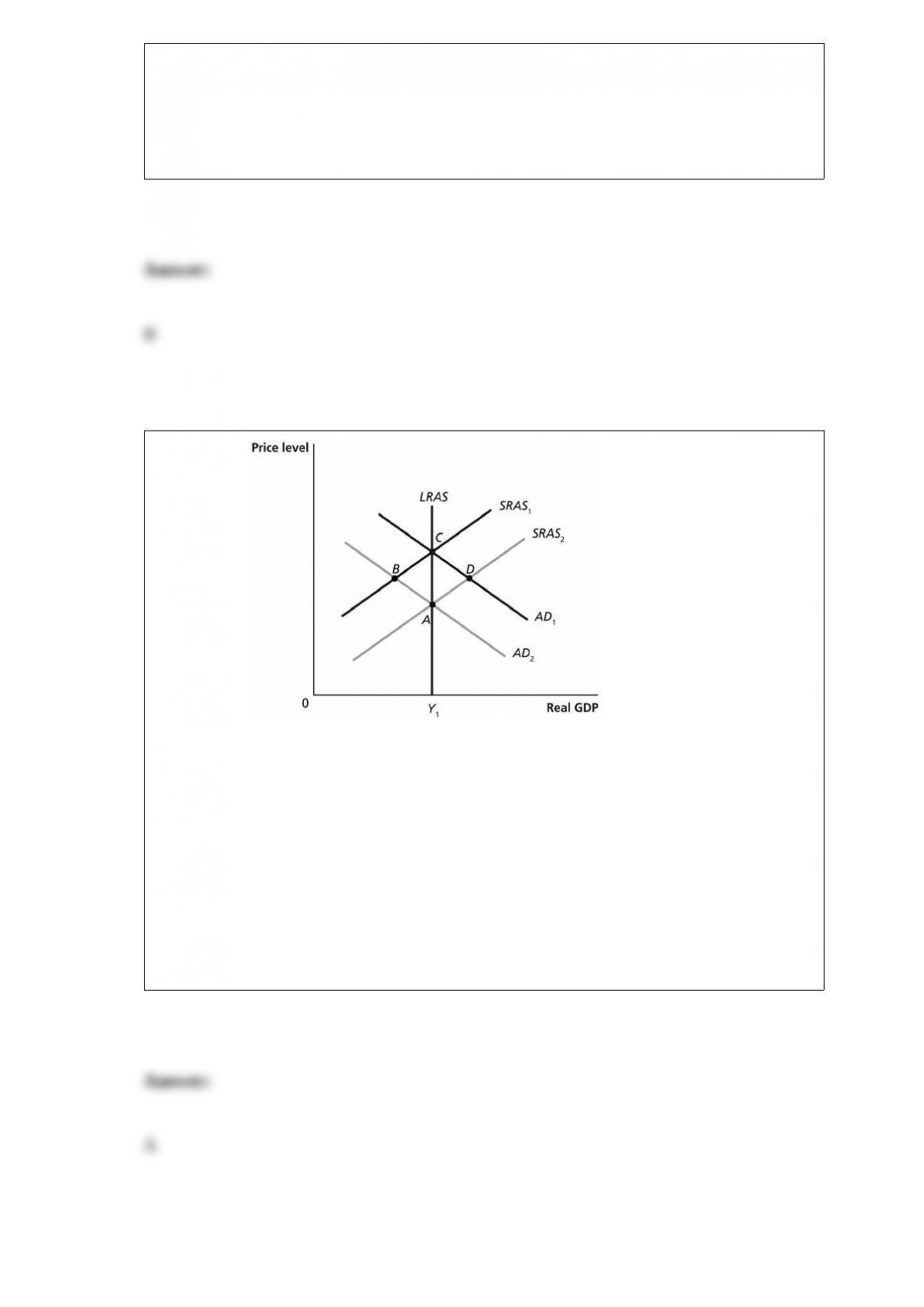
Figure 13-3
Suppose the economy is at point C. If government spending decreases in the economy,
where will the eventual long-run equilibrium be?
A) A
B) B
C) C
D) D