
Rent-seeking behavior, unlike profit-maximizing behavior in competitive markets,
wastes society’s scarce resources.
The marginal propensity to consume measures the average amount of wealth that a
consumer spends in a given period of time.
With the Troubled Asset Relief Program (TARP), the Treasury provided funds to banks
in exchange for stock.
At the end of an expansion, wages of workers are usually rising faster than prices.

In an open economy, there is interaction with other economies in terms of both trading
of goods and services and borrowing and lending.
Included in government expenditures are government purchases and transfer payments.
A borrower defaults on a loan when he stops making payments on the loan.
If economies of scale are significant, the typical firm will not reach the minimum point
on its long-run average cost curve until it has produced a large fraction of industry
sales.

Direct finance includes the sale by a corporation of stocks or bonds, but does not
include borrowing money from a bank.
If the cross-price elasticity of demand for goods A and B is zero, this means the two
goods are unrelated.
Which of the following statements is false?
A) Anytime you have to decide which action to take you are facing an economic
trade-off.
B) Trade-offs do not apply when the consumers purchase a product for which there is
excess supply, such as a stock clearance sale.
C) Every individual, no matter how rich or poor, is faced with making trade-offs.
D) Economics is a social science that studies the trade-offs we are forced to make
because of scarcity.
If the bank of Waterloo receives a $10,000 deposit, and the reserve requirement is 10
percent, how much can the bank loan out? (Assume that before the deposit this bank is
just meeting its legal reserve requirement.)
A) $1,000
B) $9,000
C) $10,000
D) $11,000
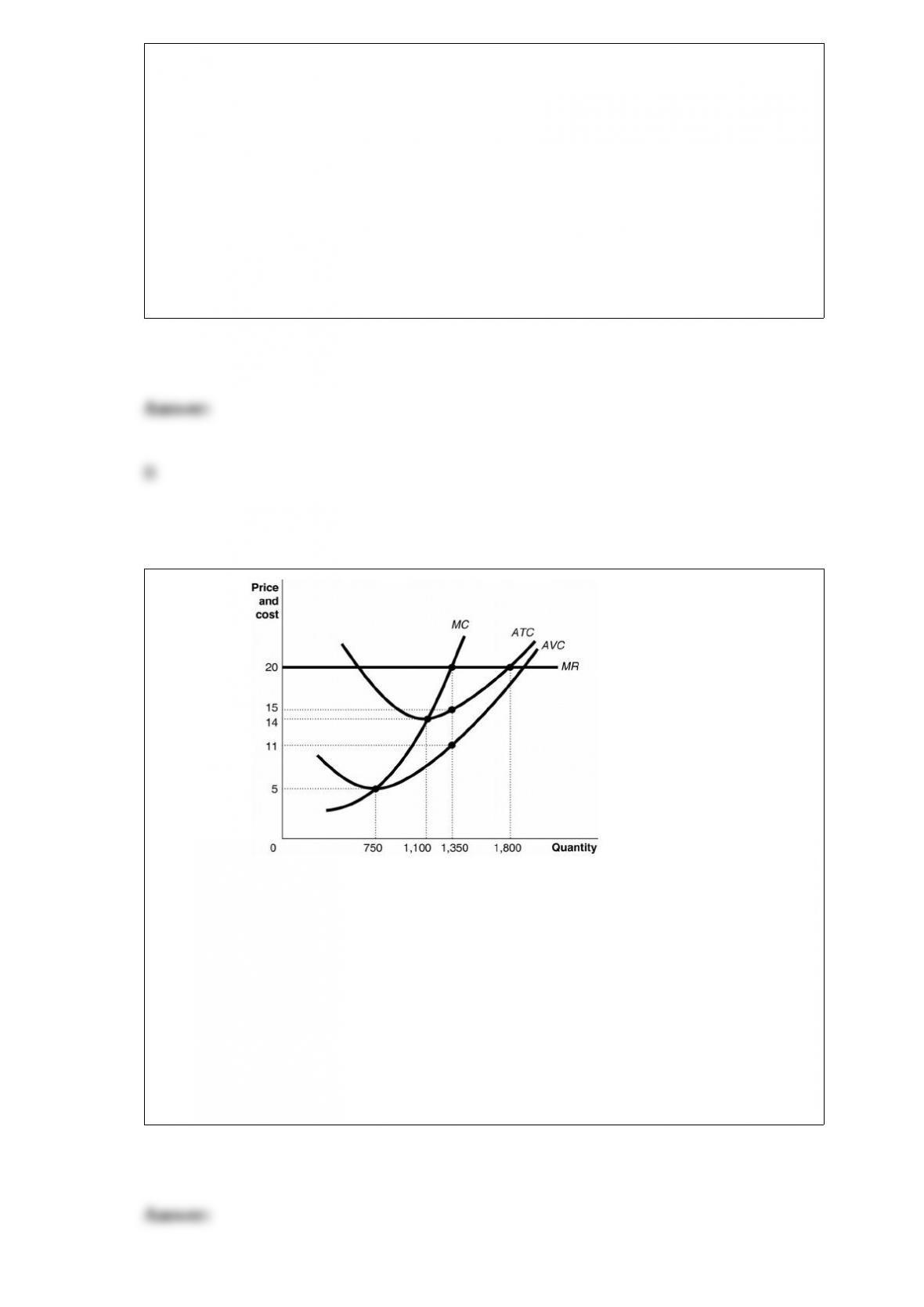
Figure 12-5 Figure 12-5 shows cost and
demand curves facing a typical firm in a constant-cost, perfectly competitive industry.
If the market price is $20, what is the firm’s profit-maximizing output?
A) 750 units
B) 1,100 units
C) 1,350 units
D) 1,800 units

Suppose the consumer’s income increases while the prices of the goods remain constant.
Then the
A) budget constraint shifts inward parallel to the original budget constraint.
B) budget constraint shifts outward parallel to the original budget constraint.
C) indifference curves shift outward away from the origin.
D) indifference curves become flatter.
Should European nations which are not currently using the euro choose to adopt the
euro as their currency, these countries would risk giving up the ability to use ________
to stabilize their economies in the event of a recession.
A) expansionary fiscal policy
B) contractionary fiscal policy
C) expansionary monetary policy
D) contractionary monetary policy
If we want to use a measure of inflation that foreshadows price changes before they
affect prices at the retail level, we would base our measure of inflation on

A) the producer price index.
B) the consumer price index.
C) the GDP deflator.
D) the household price index.
Under the Soviet system of communism,
A) managerial pay was determined by the extent to which managers could lower the
per-unit costs of production.
B) technological progress was slow because managers had little incentive to develop
new technologies.
C) competitive pressures in the Soviet Union allowed the country’s technological
progress to keep pace with the rest of the world.
D) the per-worker production function in the Soviet Union shifted up more rapidly than
production functions in other countries.
Conceptually, the efficient level of carbon emissions is the level for which
A) the marginal benefit of reducing carbon emissions is maximized.
B) the marginal cost of reducing carbon emissions is minimized.
C) the marginal benefit of reducing carbon emissions is equal to the cost of reducing
carbon emissions.
D) the marginal benefit of reducing carbon emissions is minimized and the marginal
cost of reducing carbon emissions is maximized.
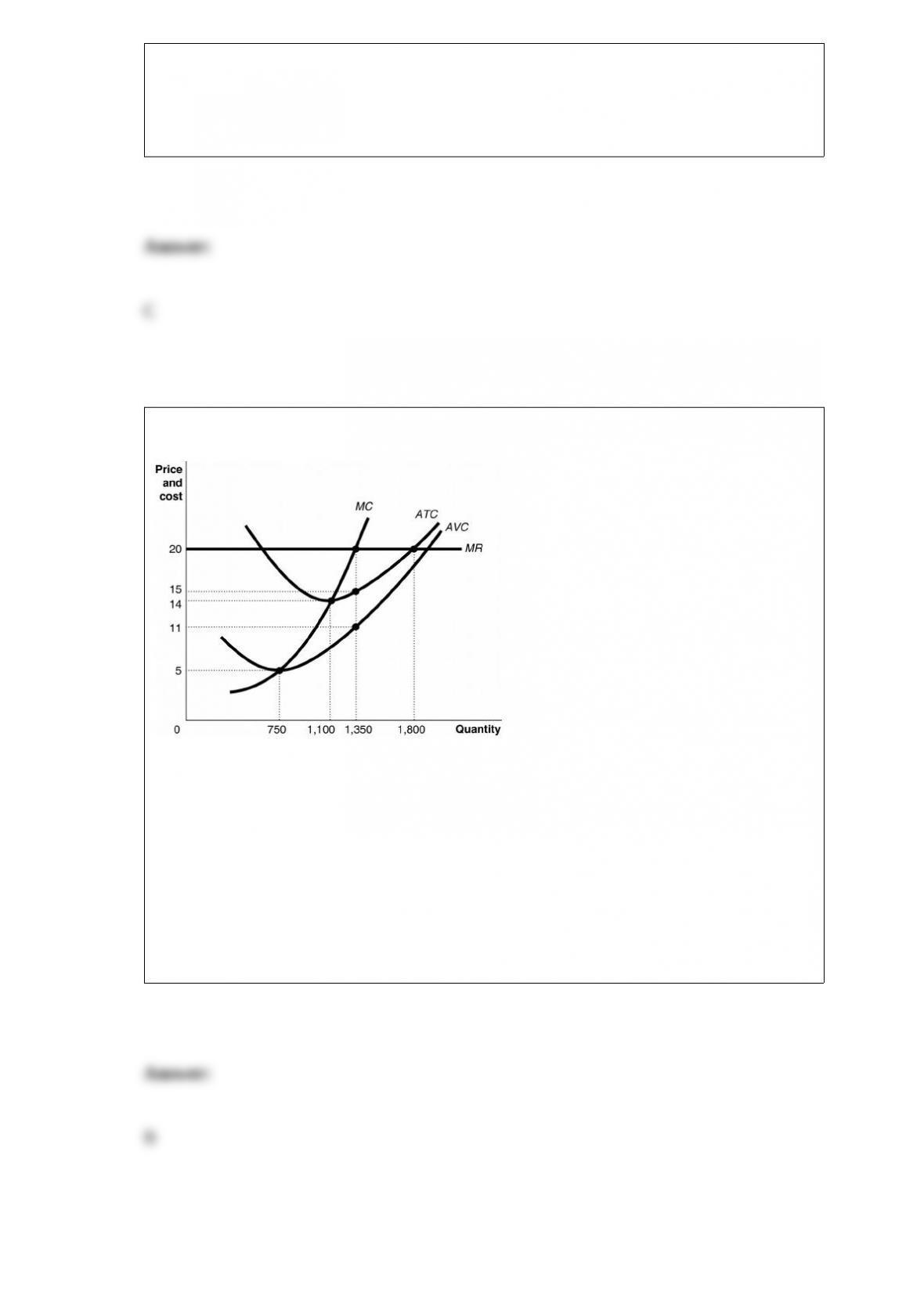
Figure 12-5
Figure 12-5 shows cost and demand
curves facing a typical firm in a constant-cost, perfectly competitive industry. If the
market price is $20, what is the amount of the firm’s profit?
A) $5,400
B) $6,750
C) $8,100
D) $16,200

According to the saving and investment equation, if net foreign investment rises by $60
million,
A) national saving will increase by $60 million.
B) national saving will fall by $60 million.
C) domestic investment will rise by $60 million.
D) private saving will fall by $60 million.
A currency pegged at a value below the market equilibrium exchange rate is
A) overvalued.
B) undervalued.
C) achieving purchasing power parity.
D) None of the above are correct.
How do current tax laws in the United States favor employer-based health care
insurance?
A) Individuals who receive health insurance benefits are allowed to deduct the value of
these benefits from their taxable income.

B) Employers who provide health insurance benefits are reimbursed by the government
and are not taxed on these reimbursements.
C) Individuals who receive health insurance benefits do not pay taxes on the value of
these benefits.
D) Health insurance companies that provide insurance to employers are subject to a
lower tax rate than those insurance companies that provide insurance to private
individuals.
If you expect the economy is going to boom and average income in the economy will
rise in the foreseeable future, the type of firm that would be able to increase its sales if
your expectations are met is
A) one that sells an inferior good.
B) one that sells a necessity good.
C) one that sells a luxury good.
D) one that sells a price inelastic good.
Explain the relationships between a corporation’s shareholders, its board of directors,
and its top managers.
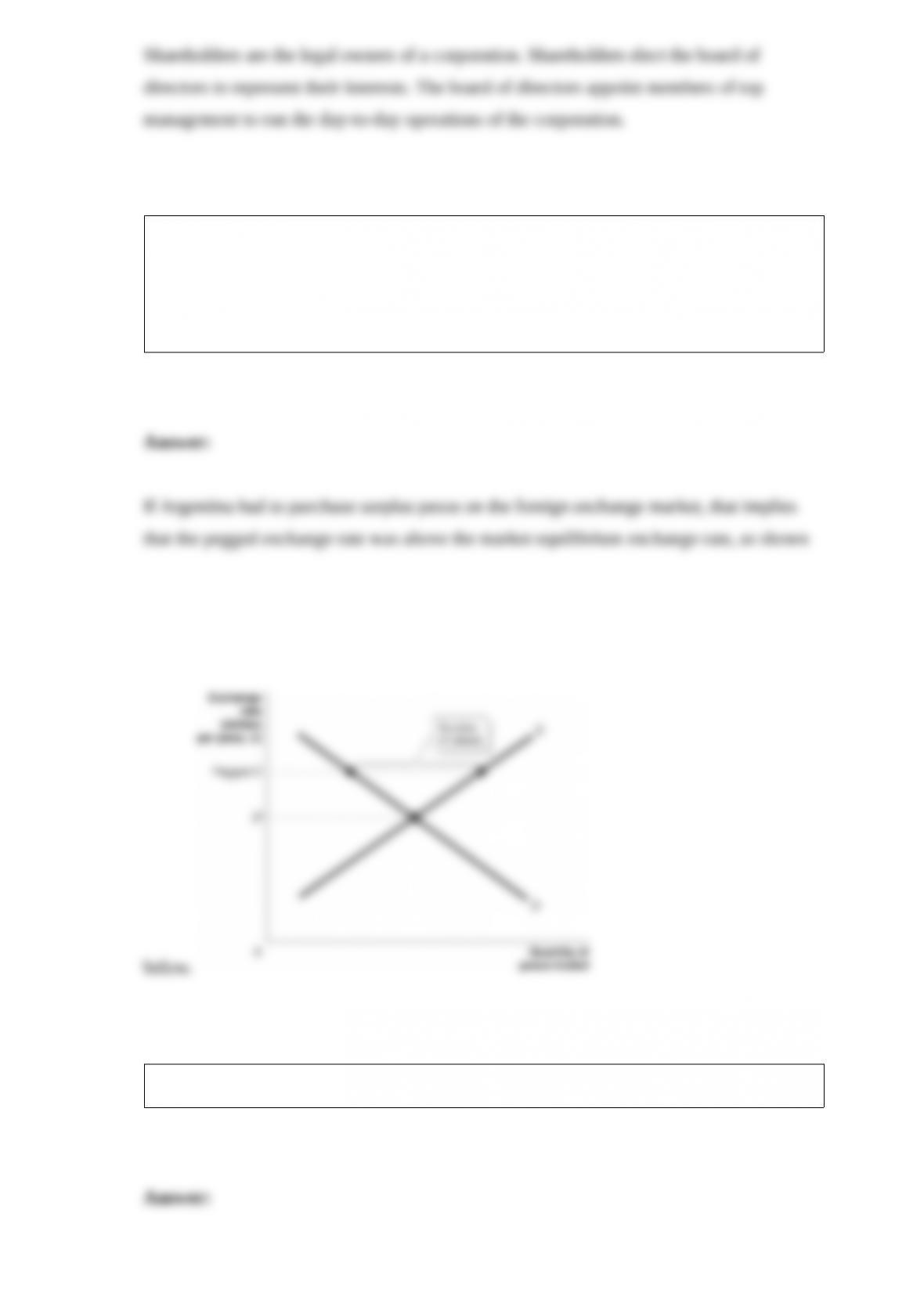
In 1991, Argentina decided to peg its currency (the Argentinean peso) to the U.S. dollar.
To maintain the peg, Argentina had to purchase surplus pesos on the foreign exchange
market, depleting its reserves of dollars to such an extent that it eventually had to
abandon the peg. Show graphically what this implies about the peg relative to the
equilibrium exchange rate in the market for the Argentinean peso.
Explain the term “economics.”
When will a decrease in aggregate demand not result in a lower inflation rate in the
short run?
What is an entrepreneur, and what decisions does an entrepreneur make in a market
system?
Consider the Taylor rule for the target of the federal funds rate. Suppose the equilibrium
real federal funds rate is 2 percent, the target rate of inflation is 3 percent, the current
inflation rate is 3 percent, real GDP equals potential real GDP, and the weights are 1/2
for the inflation gap and the output gap. Using the Taylor rule, what does the target for
the federal funds rate equal? Next, if the Federal Reserve lowered the target for the
inflation rate to 1 percent, how much would the target for the federal funds rate change?
Music writer Anthony Kuzminski praised rock star Tom Petty in a 2007 article in the
online Unrated Magazine. Kuzminski wrote: “Something Petty never can get enough
credit for is his fan-friendly attitude. He kept ticket prices for [his concerts] at $50 when
other acts this summer are charging upwards of $100 for stadium gigs. Petty could
charge more, but he doesn’t see the point. He has stated time and time again he still
makes millions when he’s on the road, regardless of his ticket prices. He is the last of
the fan friendly rock stars out there.” Use economic reasoning to write a rationale for
Tom Petty’s decision to charge prices for his band’s (“Tom Petty and the
Heartbreakers”) concerts that are less than market clearing prices.
Source: Anthony Kuzminski, “Tom Petty & The Heartbreakers at the Vic Theater”
http://www.unratedmagazine.com/
Explain what economists mean by full employment and why this rate of unemployment
is not zero.
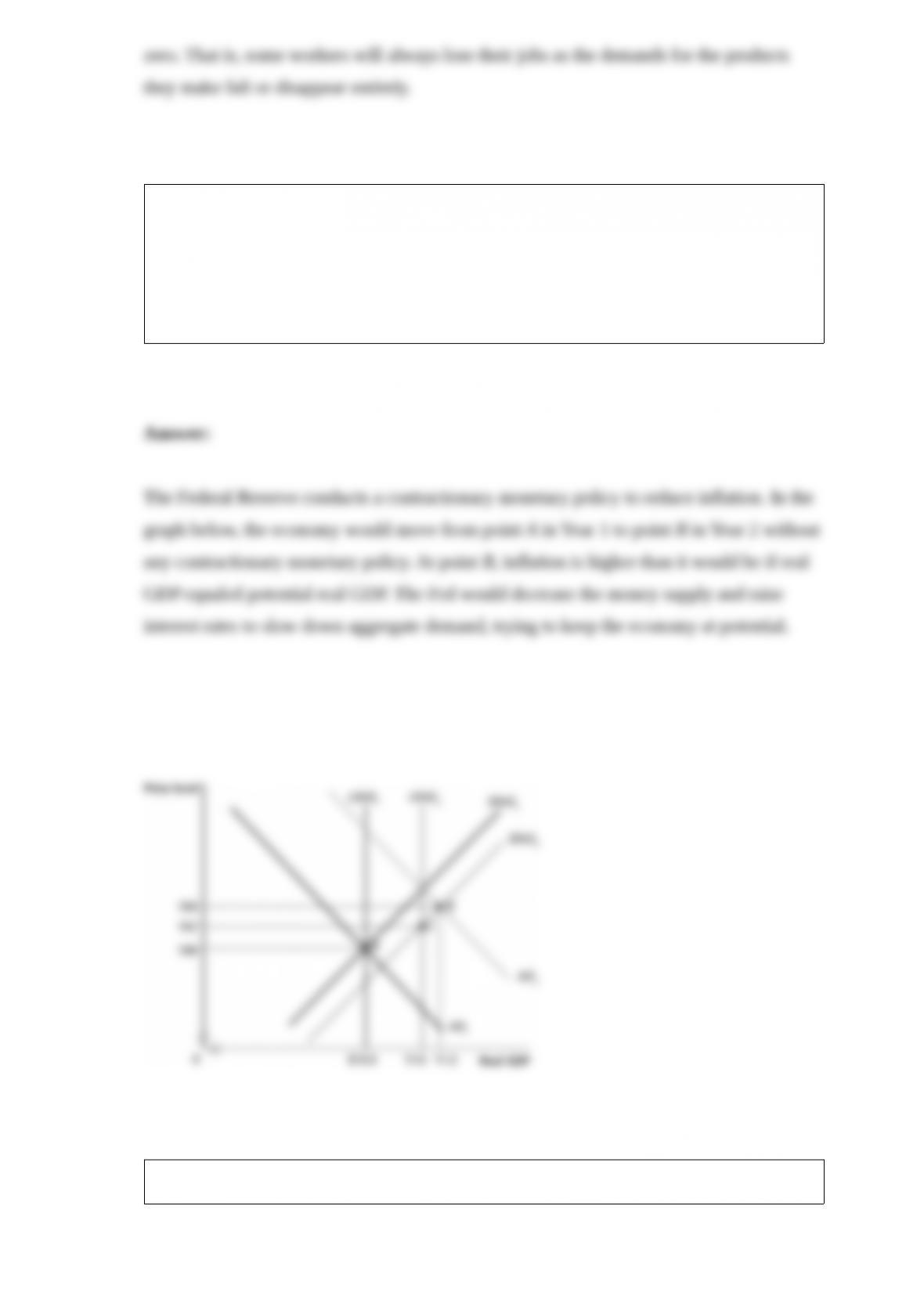
Use the dynamic aggregate demand and aggregate supply model and start with Year 1 in
long-run macroeconomic equilibrium. For Year 2, graph aggregate demand, long-run
aggregate supply, and short-run aggregate supply such that the condition of the
economy will induce the Federal Reserve to conduct a contractionary monetary policy.
Briefly explain the condition of the economy and what the Federal Reserve is
attempting to do.
Describe the main factors economists believe cause inequality of income.