
Refer to the figure below. The total utility of consuming two dinners out per week is:
A. less than 100.
B. 75.
C. 175.
D. 160.
An example of a government policy to increase physical capital formation is:
A. the construction of an interstate highway system.
B. government support for basic research.
C. maintaining a well-functioning legal system.
D. the provision of publicly-funded education.
Suppose the natural rate of unemployment is 4 percent. What is the actual rate of
unemployment if actual output is 2 percent above potential output?
A. 0 percent
B. 2 percent
C. 3 percent

D. 6 percent
As the market price of a service increases, more potential sellers will decide to perform
that service because:
A. higher prices result in higher revenue.
B. more potential sellers will find that the market price exceeds their reservation price.
C. it’s more prestigious to produce high-priced services.
D. higher prices lead to lower opportunity costs.
The market for bagels contains two firms: BagelWorld (BW) and Bagels’R’Us (BRU).
The owners of the two firms decide to fix the price of bagels. The table below shows
how each firm’s profit (in dollars) depends on whether they abide by the agreement or
cheat on the agreement.

Suppose the game above is repeated every day, and both firms adopt the following
strategy: cooperate on the first day, then if the other firm cheats, cheat the next day, and
if the other firm abides, abide the next day. This type of strategy is likely to increase the
probability that:
A. both firms cheat.
B. Bagel World cheats.
C. both firms abide.
D. Bagels’R’Us cheats.
In Macroland there is $10,000,000 in currency. The public holds half of the currency
and banks hold the rest as reserves. If banks’ desired reserve/deposit ratio is 10%,
deposits in Macroland equal ______ and the money supply equals _______.
A. $50,000,000; $60,000,000
B. $55,000,000; $55,000,000
C. $50,000,000; $55,000,000
D. $100,000,000; $100,000,000

Which of the following would be expected to increase the demand for money in the
U.S.?
A. Financial investors become concerned about increasing riskiness of stocks.
B. The economy enters a recession.
C. Political instability decreases dramatically in developing nations.
D. On-line banking allows customers to transfer funds between checking and stock
mutual funds 24 hours a day.
Assume both the demand and the supply of bagels increase. Which of the following
outcomes is certain to occur?
A. The equilibrium price of bagels will rise.
B. The equilibrium quantity of bagels will rise.
C. The equilibrium price of bagels will fall.
D. The equilibrium quantity of bagels will fall.

Because of diminishing returns to capital, there is a limit to the increases in average
labor productivity that can be gained from additional or improved ______.
A. availability of land and natural resources
B. physical capital
C. imports
D. entrepreneurship
A pure public good is one that is:
A. highly nonrival and highly nonexcludable.
B. neither nonrival nor nonexcludable.
C. nonexcludable but rival.
D. nonrival but excludable.
All of the following would be included in planned aggregate expenditure except:
A. spending on consumer durables.
B. planned changes in inventories.

C. sales of domestically produced goods to foreigners.
D. interest paid on the government debt.
Refer to the figure below. If Cory chooses A, then Jess’s best response is:
A. non-existent.
B. to choose A.
C. to choose B.
D. to choose the cell in which Jess’s payoff is 10.
To say that a given welfare program is means-tested implies that:
A. in order to qualify, one must have the means.
B. the size of the payment reflects the mean value of consumption based on family size.
C. in order to qualify, one must show that one means to find a job.
D. the more income one earns, the smaller the size of the benefit.
Which branch of economics is most likely to study differences in countries’ growth
rates?
A. microeconomics
B. normative economics
C. macroeconomics
D. experimental economics
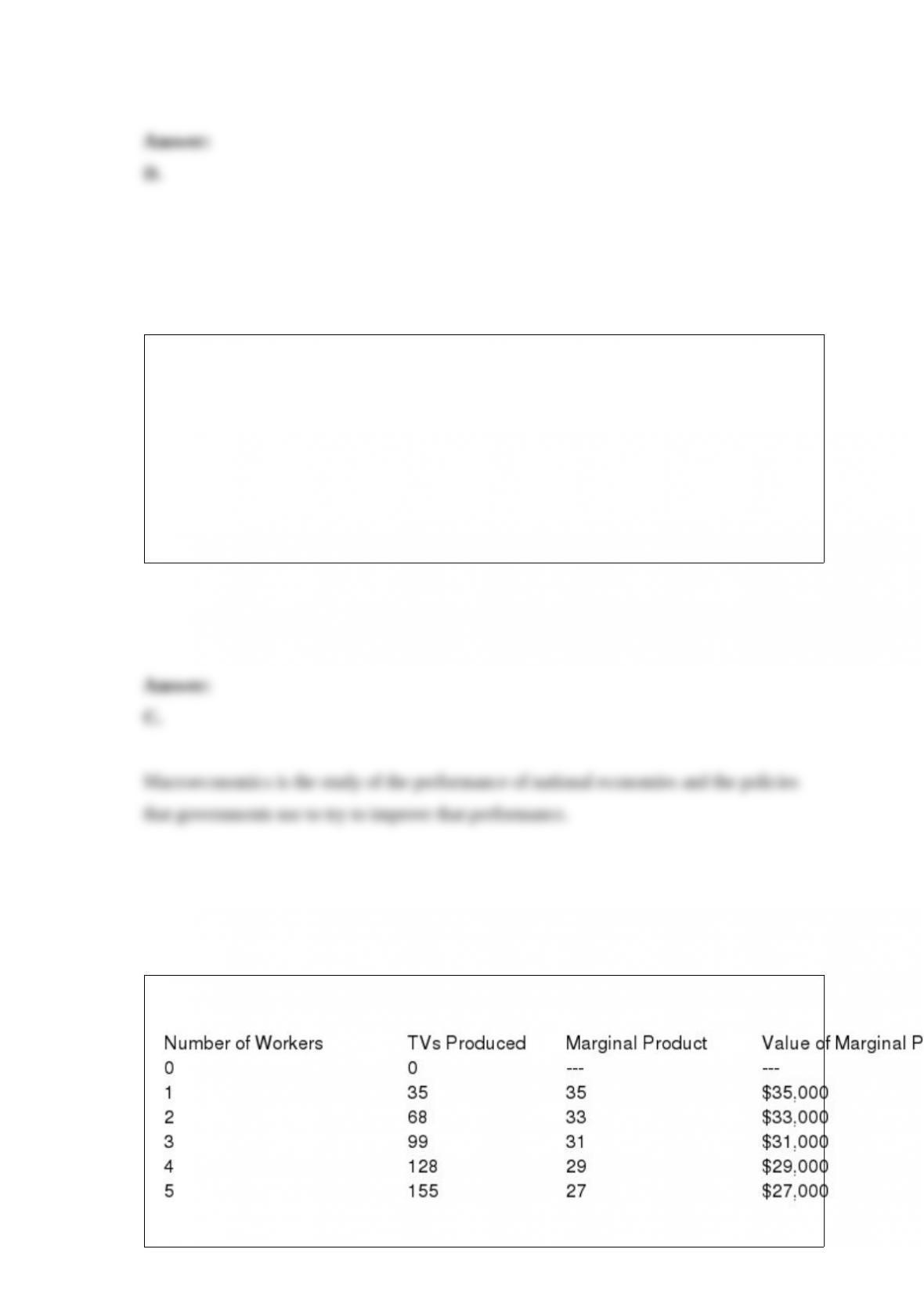
The following table provides information about production at the XYZ-TV Company.
How many workers will XYZ-TV Company hire if the going wage for TV production

workers is $30,000?
A. 0
B. 1
C. 2
D. 3
Providing workers with on-the-job training will increase:
A. average labor productivity.
B. the share of the population employed.
C. the unemployment rate.
D. the labor force participation rate.
European households wishing to purchase shares of stock in an American company are
______ the foreign exchange market.
A. suppliers of U.S. dollars in
B. demanders of Euros in
C. supplied dollars by the European Central Bank for use in
D. demanders of U.S. dollars in

Adam Smith coined the term “invisible hand” to describe the process by which the
actions of independent, self-interested buyers and sellers will:
A. always lead an economy to ruin.
B. often lead to the most efficient allocation of resources.
C. always lead to the most efficient allocation of resources.
D. often lead to increasing inequality.
Pat used to work as an aerobics instructor at the local gym earning $35,000 a year. Pat
quit that job and started working as a personal trainer. Pat makes $50,000 in total annual
revenue. Pat’s only out-of-pocket costs are $12,000 per year for rent and utilities,
$1,000 per year for advertising and $3,000 per year for equipment.
Pat’s accounting profit is _______, and Pat’s economic profit is _______.
A. $50,000; $15,000
B. $34,000; -$1,000

C. $34,000; $15,000
D. $15,000; -$1,000
In general, individuals and nations should specialize in producing those goods for
which they have a(n):
A. absolute advantage.
B. comparative advantage.
C. absolutely comparative advantage.
D. absolute advantage and a comparative advantage.

______ start new economic enterprises, while ______ run the enterprises on a
day-to-day basis.
A. Entrepreneurs; managers
B. Mangers; entrepreneurs
C. Mangers; laborers
D. Entrepreneurs; laborers
Suppose the figure below shows the demand curve, marginal revenue curve and
marginal cost curve for a monopolist.
At this monopolist’s profit-maximizing level of output, consumer surplus is ______.
A. $9,000
B. $4,500
C. $4,000
D. $2,000

The dilemma in a prisoner’s dilemma is that:
A. the outcome is random, so players are uncertain about which strategy to play.
B. only one player has a dominant strategy, but the other player is uncertain about what
to do.
C. the players would be better off if they both played a dominated strategy.
D. the players may be trapped in a game they don’t know how to play.
Holding other factors constant, if a change in tax laws discourages people from saving
more for retirement, then the real interest rate will ______ and the equilibrium quantity
of saving and investment will _____.
A. increase; increase
B. increase; decrease
C. decrease; decrease
D. decrease; increase

As coffee becomes more expensive, Joe starts drinking tea, and therefore quantity
demanded for coffee decreases. This is called:
A. the income effect.
B. the change in equilibrium.
C. the substitution effect.
D. a shift in the demand curve.
The average annual growth rates of labor productivity from 1947to 1973 were ______
the average rates over the period from 1973 to 1995.
A. more rapid than
B. slower than
C. about the same as
D. more rapid in the U.S., but slower in other industrialized countries than
Who from among the following would be counted as unemployed?

A. A person with a part-time job who wants and is looking for a full-time job.
B. A person who is willing to work and has looked for a job in the last week.
C. A person who is willing to work but has not looked for a job in two months.
D. All of these people would be counted as unemployed.
A firm’s revenue from selling its product minus the cost of inputs purchased from other
firms is called:
A. profits.
B. investment.
C. value added.
D. production costs.
A bond is a(n):
A. regular payment made to owners of a firm.
B. claim to partial ownership of a firm.
C. agreement issued by a financial intermediary linking savers and investors.
D. legal promise to repay a debt.

Leo is a welfare recipient who qualifies for two means-tested cash benefit programs. If
he does not earn any income, he receives $225 from each program. For each dollar he
earns (which his employer is required to report to the welfare agency), his benefit from
each program is reduced by 75 cents until the benefit equals zero.Suppose Leo earns
$10. He will lose ______ from each benefit, for a total loss of _____.
A. $.75; $1.00
B. $7.50; $7.50
C. $7.50; $15.00
D. $.75; $1.50
Leo is a welfare recipient who qualifies for two means-tested cash benefit programs. If
he does not earn any income, he receives $225 from each program. For each dollar he
earns (which his employer is required to report to the welfare agency), his benefit from
each program is reduced by 75 cents until the benefit equals zero.When Leo’s earnings
are less than $300, each extra dollar he earns causes his total income (earnings plus
benefits) to:
A. fall by 25 cents.
B. rise by 50 cents.
C. fall by 50 cents.

D. rise by 75 cents.
According to the theory of the invisible hand, if buyers and sellers are free to pursue
their own self-interest, the result often will be:
A. an incomplete allocation of resources.
B. the exploitation of productive resources.
C. an equitable allocation of resources.
D. an efficient allocation of resources.
John is trying to decide how to divide his time between his job as a stocker in the local
grocery store, which pays $7 per hour for as many hours as he chooses to work, and
cleaning windows for the businesses downtown. He makes $2 for every window he
cleans. John is indifferent between the two tasks, and the number of windows he can
clean depends on how many hours he spends cleaning in a day, as shown in the table
below:

What is John’s opportunity cost of cleaning windows for an hour?
A. $14
B. $8
C. $7
D. $2
Entrepreneurs contribute to increased average labor productivity in each of the
following ways except by:
A. introducing new production methods.
B. implementing new technological processes.
C. developing new products.
D. assigning workers to jobs.