1) other things equal, and given that the elasticity of demand of health care is 0.2, a 10
percent increase in the price of health care in the united states will reduce the quantity
of health care demanded by about:
a.1 percent.
b.2 percent.
c.5 percent.
d.10 percent.
2)
Refer to the above diagram in which line AB is the United States production possibility
curve and AC is its trading possibilities curve. We can conclude that the United States:
A.has chosen to specialize in the production of cheese.
B.has chosen to specialize in the production of beef.
C.has decided to trade beef for cheese.
D.is relatively more efficient than its trading partners in producing both cheese and
beef.
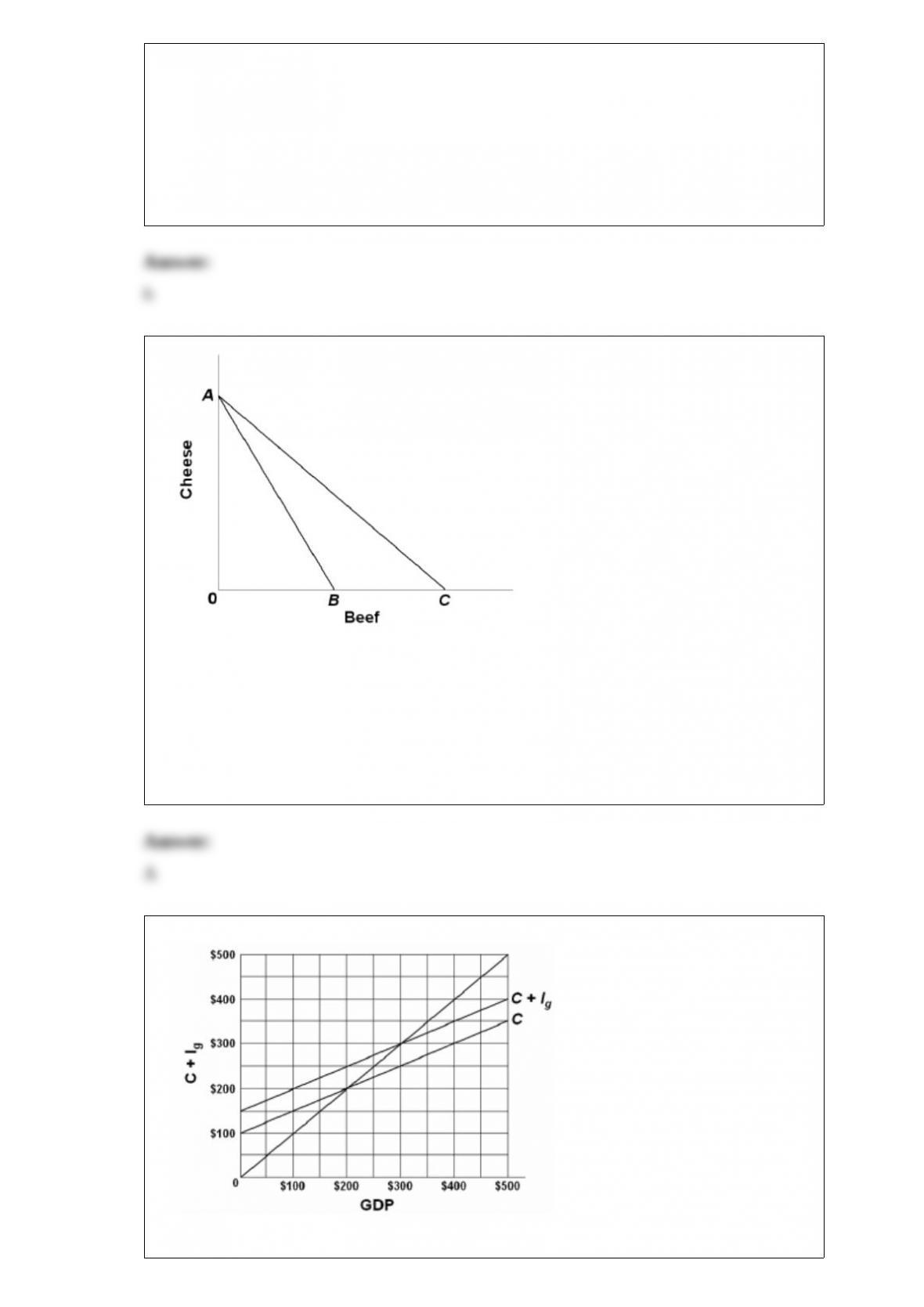
3)
Refer to the above diagram for a private closed economy. Unplanned changes in

inventories will be zero:
A.only at the $300 level of GDP.
B.only at the $200 level of GDP.
C.at all levels of GDP.
D.only at the $400 level of GDP.
4) Appreciation of the Canadian dollar will:
A.intensify an existing disequilibrium in Canada’s balance of payments.
B.make Canada’s exports less expensive and its imports more expensive.
C.make Canada’s exports more expensive and its imports less expensive.
D.make Canada’s exports and imports both more expensive.
5) demand-pull inflation:
a.occurs when prices of resources rise, pushing up costs and the price level.
b.occurs when total spending exceeds the economy’s ability to provide output at the
existing price level.
c.occurs only when the economy has reached its absolute production capacity.
d.is also called cost-push inflation.
6) which list provides, in order, examples of a private good, a public good, and a
quasi-public good?
a.a weather warning system, a dvd player, higher education.
b.higher education, a dvd player, a weather warning system.
c.a weather warning system, higher education, a dvd player.
d.a dvd player, a weather warning system, higher education.
7) if a consumer is initially in equilibrium, an increase in money income will:
a.move him to a new equilibrium on a lower indifference curve.
b.make his indifference curves steeper, but will not alter the equilibrium position.
c.have no effect on the equilibrium position because product prices have not changed.
d.move him to a new equilibrium on a higher indifference curve.

8) under a system of national health insurance:
a.the federal government would provide a basic health care package to all citizens at no
direct cost.
b.health care would be financed out of tax revenues.
c.government could negotiate to reduce the fees charged by doctors and hospitals.
d.all of these might be done.
9) If a firm is a monopsonist in the hiring of both labor and capital, it will obtain the
profit-maximizing quantities of labor and capital when:
A.MRPL/PL = MRPC/PC = 1.
B.MRPL/MRCL = MRPC/MRCC = 1.
C.the MRP of labor equals the MRP of capital.
D.the MRC of labor equals the MRC of capital.
10) An increase in the reserve ratio:
A.increases the size of the spending income multiplier.
B.decreases the size of the spending income multiplier.
C.increases the size of the monetary multiplier.
D.decreases the size of the monetary multiplier.