
A rise in the dollar price of the Chinese yuan signals an appreciation of the yuan and a
depreciation of the dollar.
Answer:
To increase gas mileage, automobile manufacturers make cars small and light. Large
cars absorb more of the impact of an accident than small cars but yield lower gas
mileage. These facts suggest that a negative relationship exists between safety and gas
mileage.
Answer:
Economic efficiency requires that a natural monopoly’s price be set corresponding to
the quantity where marginal revenue equals marginal cost.
Answer:
If the demand for a product decreases and the supply of the same product increases, the
equilibrium quantity will increase.
Answer:

Of all industrialized nations, real GDP per capita was the highest in Japan in 2012.
Answer:
Most of the countries of Africa are considered newly industrializing countries.
Answer:
If a tax is imposed on a product, the buyer will always bear the entire burden of the tax.
Answer:

Figure 2-2 Figure 2-2 above shows the production
possibilities frontier for Vidalia, a nation that produces two goods, roses and orchids.
The linear production possibilities frontier in the figure indicates that
A) Vidalia has a comparative advantage in the production of orchids.
B) Vidalia has a comparative disadvantage in the production of roses.
C) the tradeoff between roses and orchids is constant.
D) it is progressively more expensive to produce orchids.
Answer:
If policymakers use a pollution tax to control pollution, the tax per unit of pollution
should be set
A) equal to the marginal external cost at the economically efficient level of pollution.
B) equal to the marginal private cost of production at the economically efficient level of
pollution.
C) equal to the amount of the deadweight loss created in the absence of a pollution tax.
D) at a level low enough so that producers can pass along a portion of the additional
cost onto consumers without significantly reducing demand for the product.
Answer:

The term that is used to refer to a situation in which one party to an economic
transaction has less information than the other party is
A) inefficient market hypothesis.
B) moral hazard.
C) information disparity.
D) asymmetric information.
Answer:
You are given the following market data for Venus automobiles in Saturnia.
Demand: P = 35,000 – 0.5Q
Supply: P = 8,000 + 0.25Q
where P = Price and Q = Quantity. a. Calculate the equilibrium price and quantity.
b. Calculate the consumer surplus in this market.
c. Calculate the producer surplus in this market.
Answer:

Which of the following would decrease the current account balance of the United
States?
A) a decrease in imports
B) a decrease in the amount of money the U.S. government sends in foreign aid to other
countries
C) a decrease in the balance of trade
D) a decrease in the amount of income U.S. companies pay out to foreigners who own
investments in the U.S.
Answer:
Fiscal policy refers to changes in
A) state and local taxes and purchases that are intended to achieve macroeconomic
policy objectives.
B) federal taxes and purchases that are intended to achieve macroeconomic policy
objectives.
C) federal taxes and purchases that are intended to fund the war on terrorism.
D) the money supply and interest rates that are intended to achieve macroeconomic
policy objectives.
Answer:
A change in which variable will change the market demand for a product?

A) the price of the product
B) expected future prices
C) the number of firms in the market
D) the quantity supplied of the product
Answer:
For the recessions in the United States since the 1950s,
A) cyclical unemployment has been non-existent.
B) unemployment rises on average by about 1.2 percentage points 12 months after a
recession begins.
C) unemployment falls on average by 2 percentage points 12 months after a recession
begins.
D) unemployment rises on average about 5 percentage points 12 months after a
recession begins.
Answer:
In the 1960s, many economists and policy makers considered the trade-off between
inflation and unemployment revealed in the Phillips curve to be permanent. This belief
was challenged by ________, who argued that there is no trade-off between inflation
and unemployment and the long run.
A) Robert Lucas and Thomas Sargent
B) Finn Kydland and Edward Prescott

C) Paul Samuelson and James Tobin
D) Milton Friedman and Edmund Phelps
Answer:
The PPI is the
A) price parity index.
B) prime producer index.
C) producer price index.
D) production performance indicator.
Answer:
Figure 2-16
In the circular flow diagram, economic agents M represent

A) households.
B) product markets.
C) firms.
D) factor markets.
Answer:
A numerical limit imposed by a government on the quantity of a good that can be
imported into the country is called a
A) tariff.
B) quota.
C) quantity floor.
D) barricade.
Answer:
A monopolistically competitive firm faces a downward-sloping demand curve because
A) it is able to control price and quantity demanded.
B) there are few substitutes for its product.
C) of product differentiation.
D) its market decisions are affected by the decisions of its rivals.

Answer:
If the social benefit of consuming a good or a service exceeds the private benefit
A) a negative externality exists.
B) the market achieves economic efficiency.
C) a positive externality exists.
D) the sum of consumer surplus and producer surplus is maximized.
Answer:
If a corporation goes bankrupt, which of the following has first claim on the firm’s
assets?
A) stockholders
B) the state where chartered
C) employees
D) bondholders
Answer:
In a production possibilities frontier model, a point inside the frontier is

A) allocatively efficient.
B) productively efficient
C) allocatively inefficient.
D) productively inefficient.
Answer:
Diminishing marginal product of labor occurs when adding another unit of labor
A) decreases output.
B) changes output by an amount smaller than the output added by the previous unit of
labor.
C) increases output by an amount larger than the output added by the previous unit of
labor.
D) decreases output by an amount smaller than the output added by the previous unit of
labor.
Answer:
What two measures of macroeconomic activity are often referred to as the “twin
deficits”?
A) net capital flows and net exports
B) the foreign exchange deficit and net foreign investment
C) the budget deficit and the trade balance
D) the saving-investment deficit and the export deficit
Answer:
Explain how collusion makes firms better off. Given the incentives to collude, briefly
explain why every industry does not become a cartel.
Answer:
How do open market operations work?
Answer:

Suppose that a perfectly competitive industry becomes a monopoly. What effect will
this have on consumer surplus, producer surplus, and deadweight loss?
Answer:
The reasons why someone cannot get a job are similar to the reasons why someone
cannot get a date. Using the ideas of frictionally unemployed, structurally unemployed,
and cyclically unemployed, describe and explain how a student at your university might
be frictionally “undated,” structurally “undated,” and cyclically “undated.”
Answer:
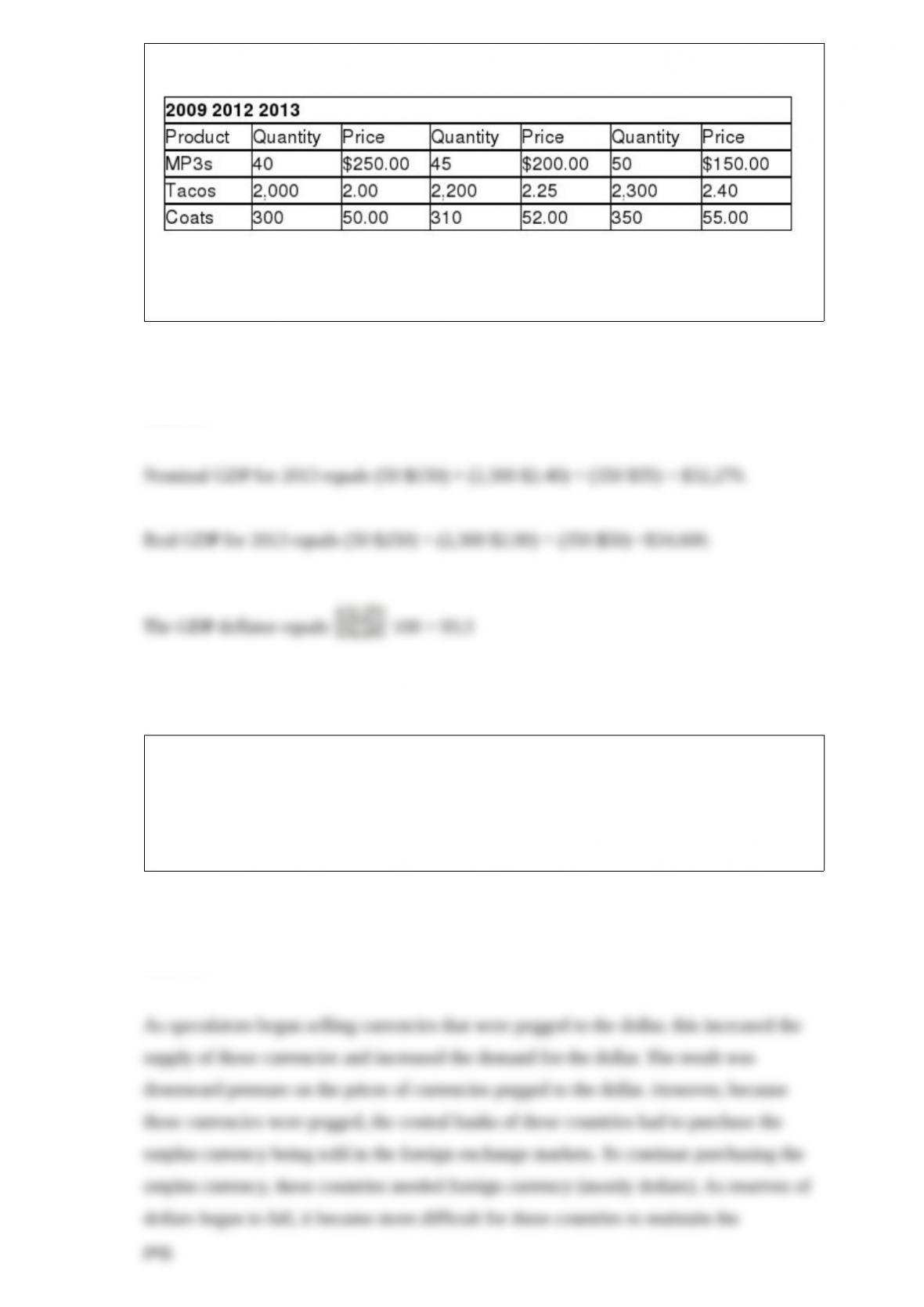
Table 19-22
Consider the data above for a simple economy: Using 2009 as the base year, calculate
nominal GDP, real GDP, and the GDP deflator for 2013. Show your work.
Answer:
South Korea, Indonesia, Malaysia, and Thailand all pegged their currencies to the dollar
at one point in time. Because some of these currencies were overvalued at the pegged
rate, speculators anticipated these countries would abandon the peg and speculators
began selling those currencies. Explain how this speculation would affect the ability of
a country to maintain a pegged exchange rate.
Answer:

What are the advantages of setting up a corporation as opposed to a proprietorship or
partnership?
Answer:
Mortgage lenders often resell mortgages in secondary markets. How might this make
lenders act differently than if they intended to hold the mortgages themselves?
Answer: