
The owner of a firm signs a binding one-year lease on a factory for $10,000 rent a
month and pays the first month’s rent. The $10,000 rent is
a. a fixed cost but not a sunk cost.
b. a sunk cost but not a fixed cost.
c. both a fixed cost and a sunk cost.
d. neither a fixed cost nor a sunk cost.
e. none of the above
If the demand for a good is unit elastic and the price of the good increases, then
a. total revenue increases.
b. total revenue decreases.
c. total revenue is not affected.
d. the direction of the change in total revenue cannot be determined from the
information given.
Exhibit 5-2
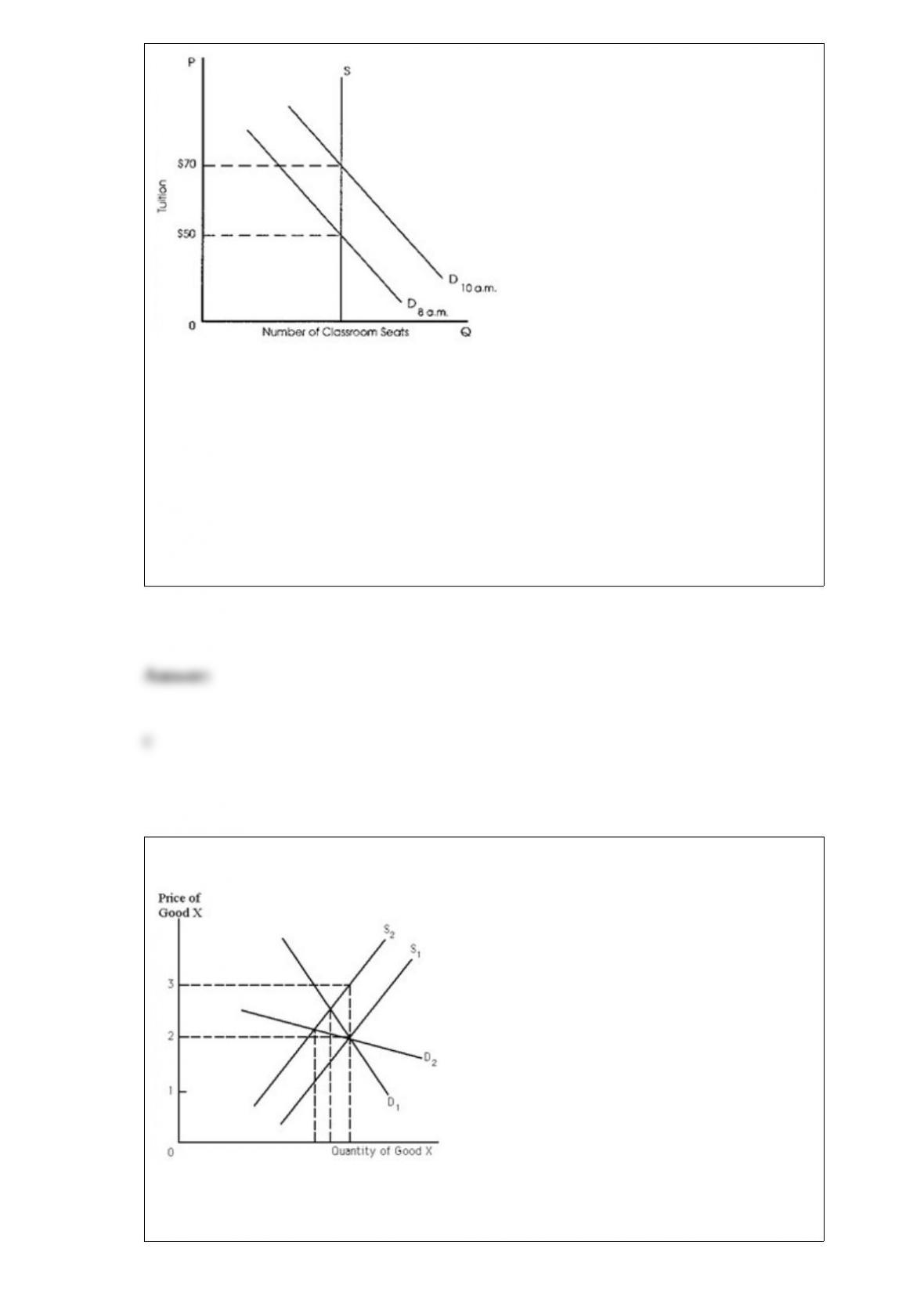
If the tuition is set at $70 there will be
a. a shortage at 10 a.m. and a surplus at 8 a.m.
b. a surplus at 10 a.m. and a shortage at 8 a.m.
c. equilibrium at 10 a.m. and a surplus of seats at 8 a.m.
d. equilibrium at 10 a.m. and a shortage of seats at 8 a.m.
Exhibit 20-6
Suppose the three equilibrium quantities are 700, 800, and 900, and the two equilibrium
prices are $2.20 and $2.75. What is the tax revenue collected from the tax that shifted

S1 to S2 when D1 is the relevant demand curve?
a. $440
b. $600
c. $800
d. $900
If an economy can produce a maximum of 10 units of good X and the opportunity cost
of 1X is always 2Y, then what is the maximum units of good Y the economy can
produce?
a. 5
b. 200
c. 20
d. 500
e. none of the above
Exhibit 34-10
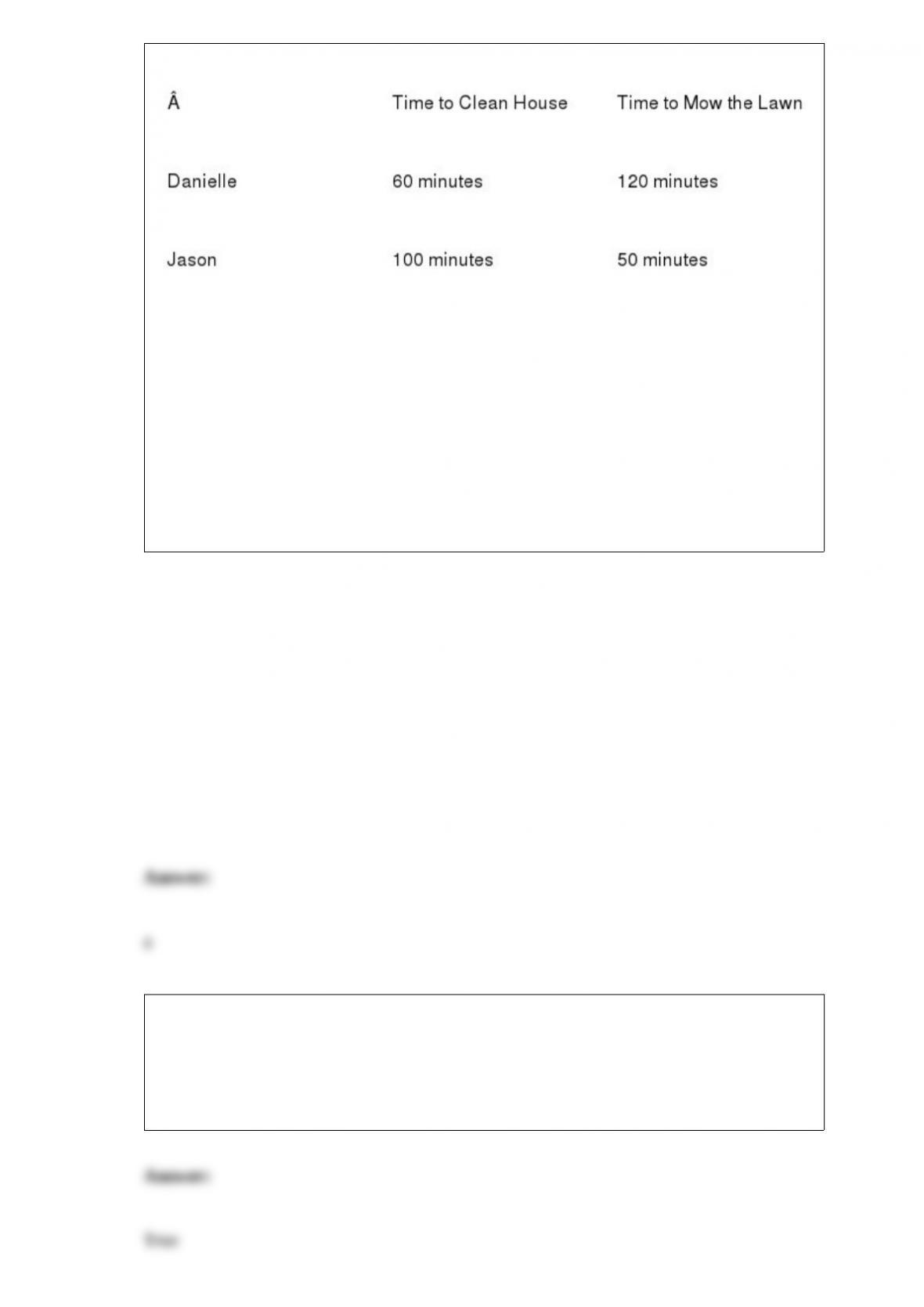
Who has the comparative advantage when it comes to cleaning the house?
a. Danielle
b. Jason
c. neither Jason nor Danielle
d. both Danielle and Jason
In long-run competitive equilibrium, no firm has an incentive to change its plant size.
a. True
b. False

Exhibit 4-8
Suppose that wheat producerslobby the government for a price floor and receive
one.This price floor is set at PF.What has happened to the producers’ surplus as a result
of the imposition of the price floor?
a. Producers’ surplus has risen by (area 2 + 3)
b. Producers’ surplus has fallen by (area 4 + 5)
c. Producers’ surplus has changed by (area 3 – area 5)
d. Producers’ surplus has changed by (area 2 – area 5)
Price elasticity of demand is a measure of the responsiveness of quantity demanded to
changes in
a. interest rates.
b. price.
c. supply.
d. demand.

If the quantity of output rises as more of a variable input is added to a fixed input,
a. the law of diminishing marginal returns does not hold.
b. total fixed cost must be declining.
c. marginal cost must be constant.
d. marginal physical product of the variable input is necessarily rising.
e. none of the above
Exhibit 3-12
–
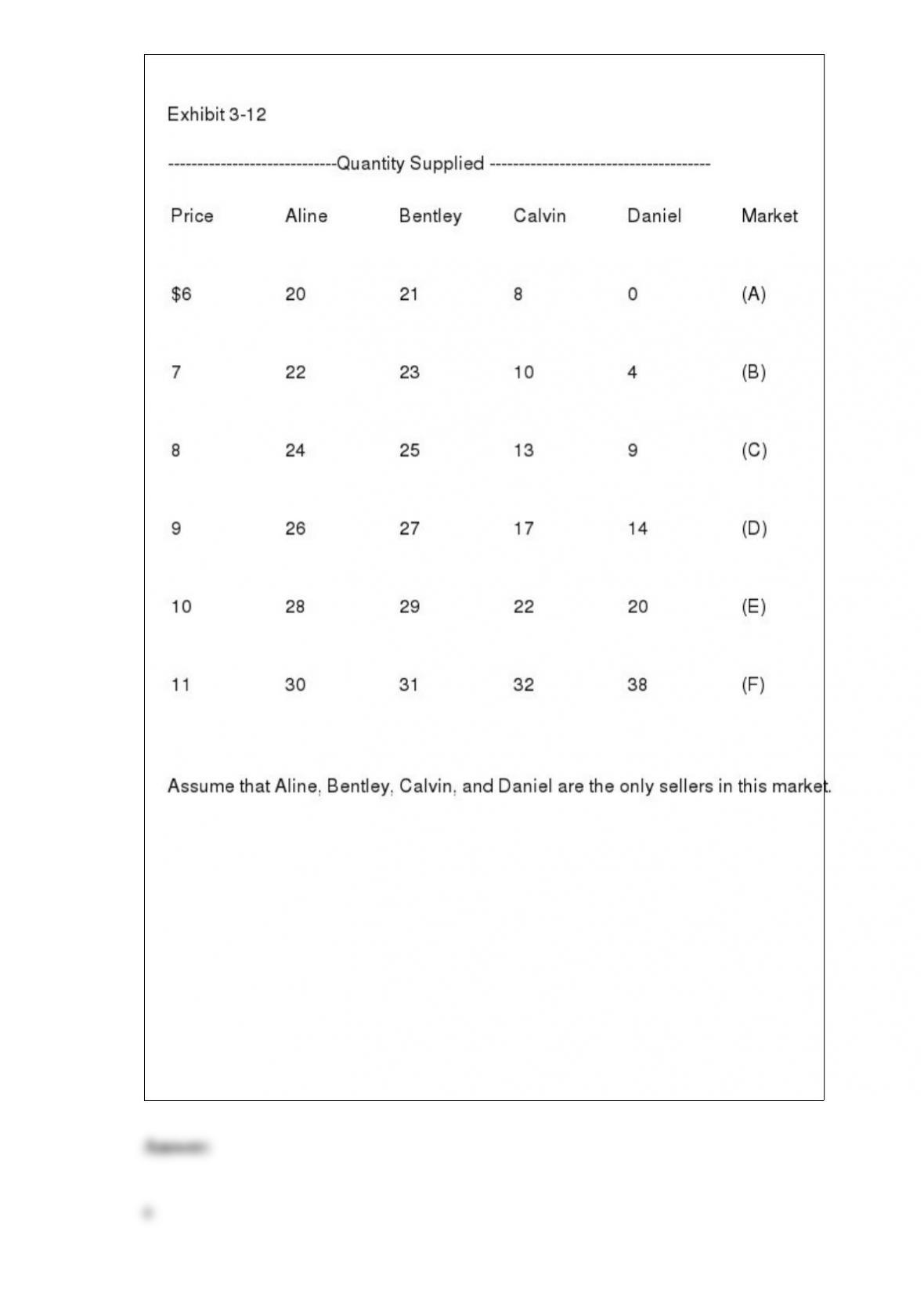
Each individual seller’s supply curve is ________________ sloping and the market
supply curve is _________________ sloping.
a. upward; also upward
b. downward; also downward
c. upward; downward
d. downward; upward
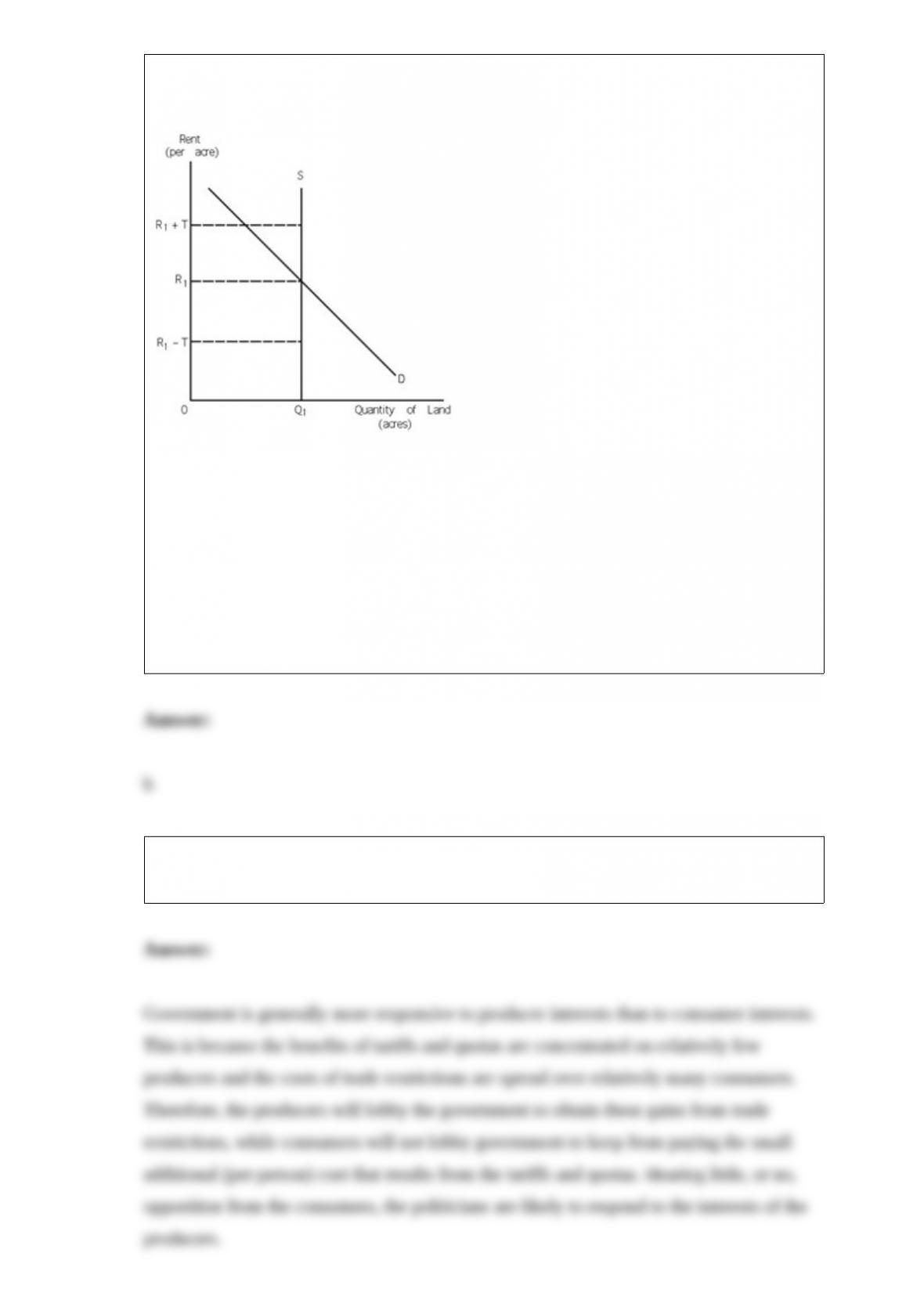
Exhibit 30-4
If a per acre tax, T, is imposed on land use, the pure economic rent on land will
a. increase.
b. decrease.
c. not be affected.
d. None of the above, because pure economic rent does not apply to land.
Explain why the government is often more responsive to producer interests than to
consumer interests when it comes to the imposition of tariffs and quotas.
Describe how nineteenth-century economist David Ricardo viewed the relationship
between rents and grain prices in England. How did his perspective differ from that of
the prevailing view on this situation?
Assume that there are only two countries in the world, the United States and Japan.
What creates the demand for and supply of Japanese yen on the foreign exchange
market?Name three different things that could cause the yen to appreciate in value.
List and describe the four broad categories of resources. Cite an example of each to
help support your answer.
Explain the difference between price elasticity of demand and the slope of a demand
curve.
List and describe four factors that are relevant to the determination of price elasticity of
demand.
How does the four-firm concentration ratio differ from the Herfindahl index?Which one
does the Justice Department currently rely on when evaluating whether or not a
proposed merger should be permitted?
Describe the difference between positive and normative economics. Cite an example of
each.