1) economic profit is found by subtracting accounting costs from total revenue.
2) A curve showing the quintile distribution of a nation’s income is called the Gini
Curve.
3) A contractionary fiscal policy shifts the aggregate demand curve leftward.
4) in the united states, real gdp per capita has increased more rapidly than real gdp.
5) A nation’s export supply curve is downsloping and its import demand curve is
upsloping.
6) Graphically, the height of the investment schedule depends on the real interest rate,
together with the location of the investment demand curve.
7) The vast majority of the labor forces of the low-income DVCs are engaged in
agriculture.
8) strong property rights inhibit economic growth by strictly regulating economic
behavior.
9) the real opportunity cost of producing product x is the amounts of products y, z, and
so forth, that might have been produced if resources had not been used to produce x.
10) Determine whether the following statement is true or false and provide an
explanation for your answer: An economy would adjust through changes in output if
there are demand shocks and prices are flexible.
11) “backflows” are payments made by immigrants back to their home countries.
12) The moral hazard problem is the tendency of some parties to a contract to alter their
behavior as a result of the contract in ways which are costly to the other party.
13) economic models of illegal immigration suggest that domestic-born workers avoid
certain types of work more because the inflow of immigrants has reduced wages, rather
than because the work is unpleasant.
14) price discrimination occurs whenever a firm sells a good for two different prices.
15) technological progress in the health care industry has typically reduced costs and
increased supply.
16) a market for human organs (rather than the current volunteer-donor system) would
be expected to:
a.reduce the price of organs.
b.create a surplus of organs.
c.reduce the supply of organs.
d.eliminate the shortage of organs.
17) Assume that many households and businesses reduce their spending only because
they expect other households and consumers to reduce their spending. Also suppose that
all households and consumers would be better off if they did not reduce their spending.
This situation best describes the:
A.real-business-cycle theory.
B.rational expectations theory.
C.idea of coordination failures.
D.adaptive expectations theory.
18) The entrepreneur:
A.makes routine day-to-day business decisions.
B.is a colorful figure from the past who is rarely relevant in today’s complex economy.
C.introduces innovations in the form of new products or new production processes.
D.receives income mainly as wages.
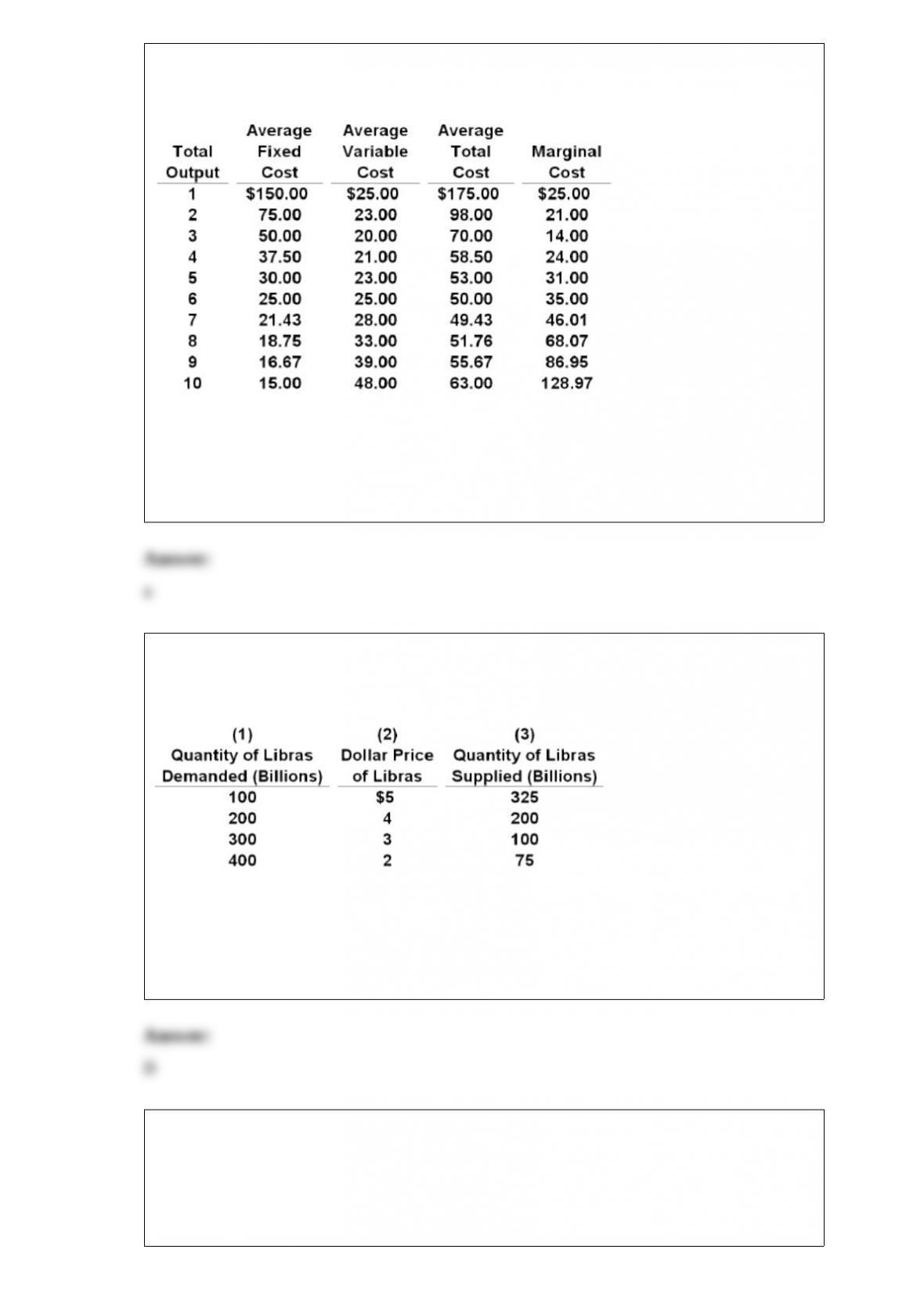
19) the following cost data for a firm that is selling in a purely competitive market.
refer to the above data. if the market price for this firm’s product is $14, it will produce:
a.0 units at a loss of $150.
b.3 units at a loss of $168.
c.3 units at an economic profit of zero.
d.4 units at a loss of $138.
20) The following table which indicates the dollar price of libras, the currency used in
the hypothetical nation of Libra. Assume that a system of freely floating exchange rates
is in place.
Refer to the above table. The equilibrium dollar price of libras is:
A.$5.
B.$4.
C.$3.
D.$2.
21) the lines on a topographical map are analogous to a(n):
a.series of demand curves.
b.series of supply curves.
c.indifference map.
d.series of budget constraints.
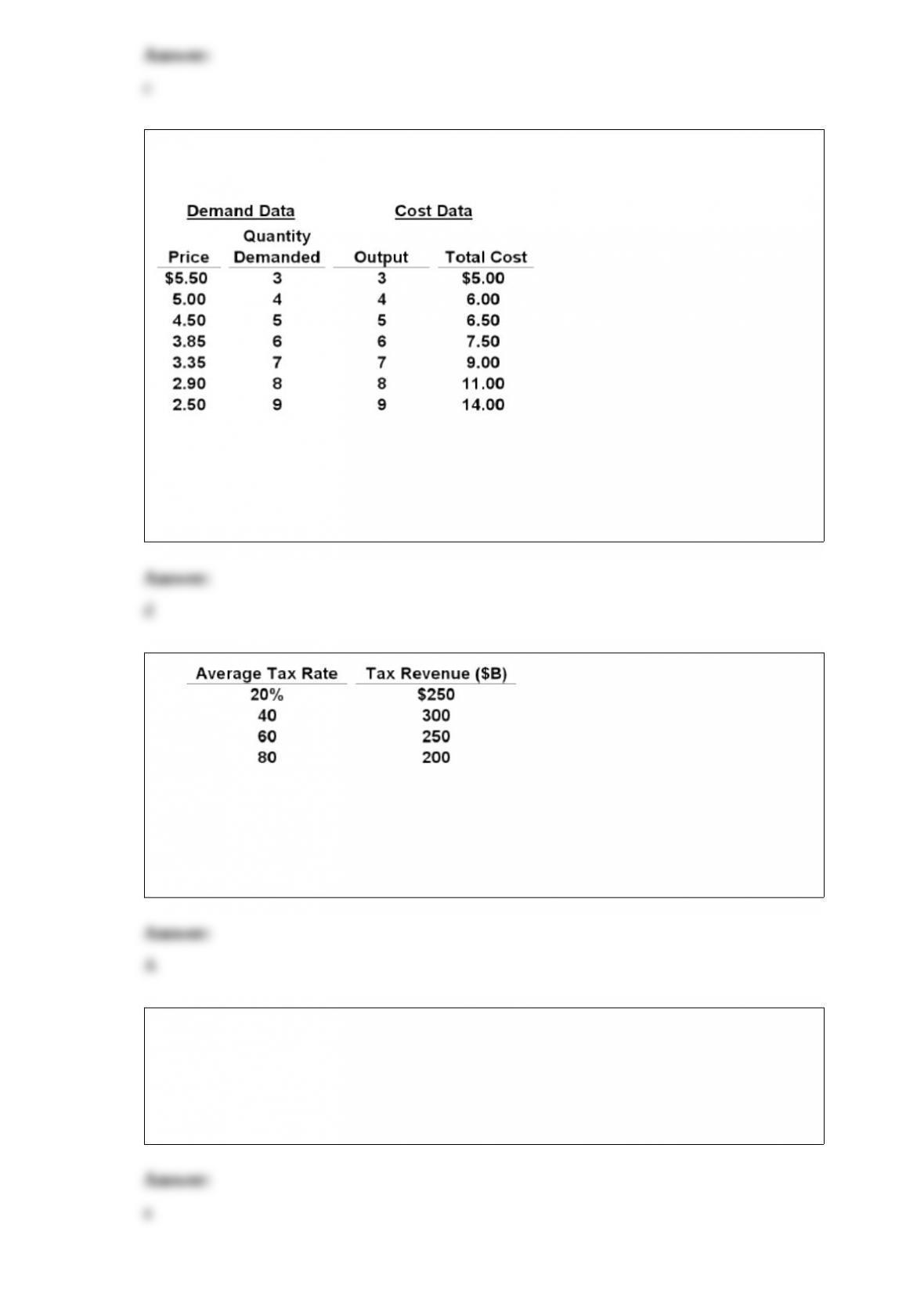
22) the following demand and cost data for a pure monopolist:
refer to the above data. the profit-maximizing price for the monopolist will be:
a.$5.00.
b.$2.90.
c.$3.35.
d.$4.50.
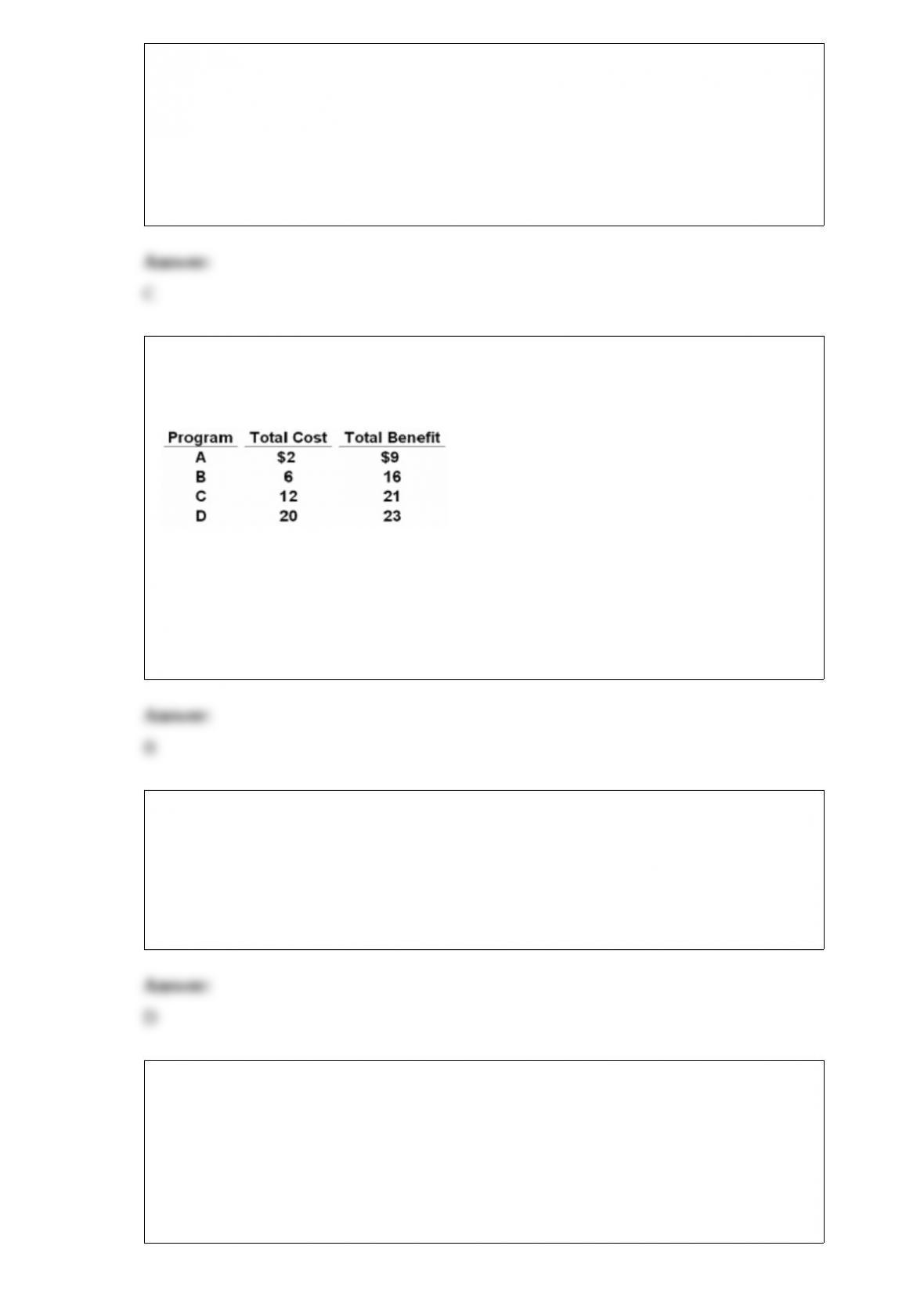
23)
If graphed, the relationship shown above would depict this economy’s:
A.Laffer Curve.
B.Lorenz Curve.
C.Tax Freedom Curve.
D.Phillips Curve.
24) which of the following is a final good or service?
a.a haircut
b.fertilizer purchased by a farm supplier
c.diesel fuel bought for a delivery truck
d.chevrolet windows purchased by a general motors assembly plant
25) An implication of the taste-for-discrimination model is that:
A.discrimination can lower a firm’s production costs.
B.discrimination will move a firm along its declining average total cost curve.
C.other things equal, nondiscriminating firms will have lower production costs than
discriminating firms.
D.other things equal, discriminating firms will have lower production costs than
nondiscriminating firms.
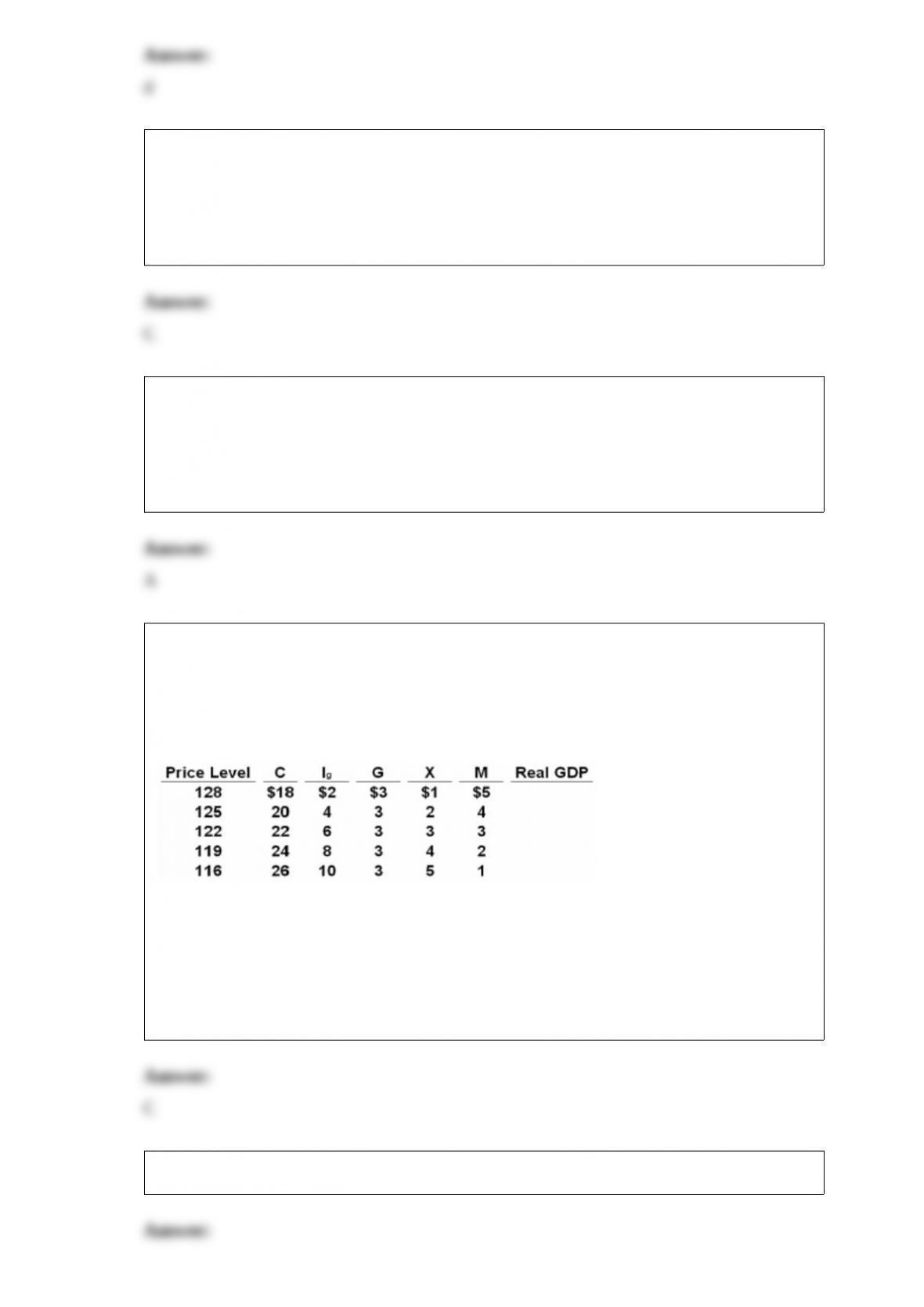
26) The following information is for four highway programs of increasing scope. All
figures are in millions of dollars.
The above data indicate that:
A.there is no highway program that is economically justifiable on the basis of
cost-benefit analysis.
B.the marginal cost and marginal benefit of Program A are $2 and $9 respectively.
C.the marginal cost and marginal benefit of Program C are $12 and $21 respectively.
D.the marginal cost and marginal benefit of Program A cannot be determined.
27) In which of the following cases was the firm found not guilty of violating the
Sherman Act?
A.Standard Oil case
B.Microsoft case
C.Alcoa case
D.DuPont cellophane case
28) the amount of pizzas that consumers want to buy per week is reflected in the
equation p = 15 – .02qd, where qd is the amount of pizzas purchased per week and p is
the price of pizzas. on the basis of this information we can say that:
a.if pizzas were free, people would consume 800 per week.
b.more pizzas will be purchased at a high price than at a low price.
c.if the price of pizzas is $6, then 150 will be purchased.
d.50 fewer pizzas will be purchased per week for every $1 increase in price.
29) Investment and saving are, respectively:
A.income and wealth.
B.stocks and flows.
C.injections and leakages.
D.leakages and injections.
30) The equation of exchange indicates that:
A.MV = PQ.
B.other things equal, an increase in the demand for money will increase P and/or Q.
C.the velocity and the supply of money vary directly with one another.
D.MP = VQ.
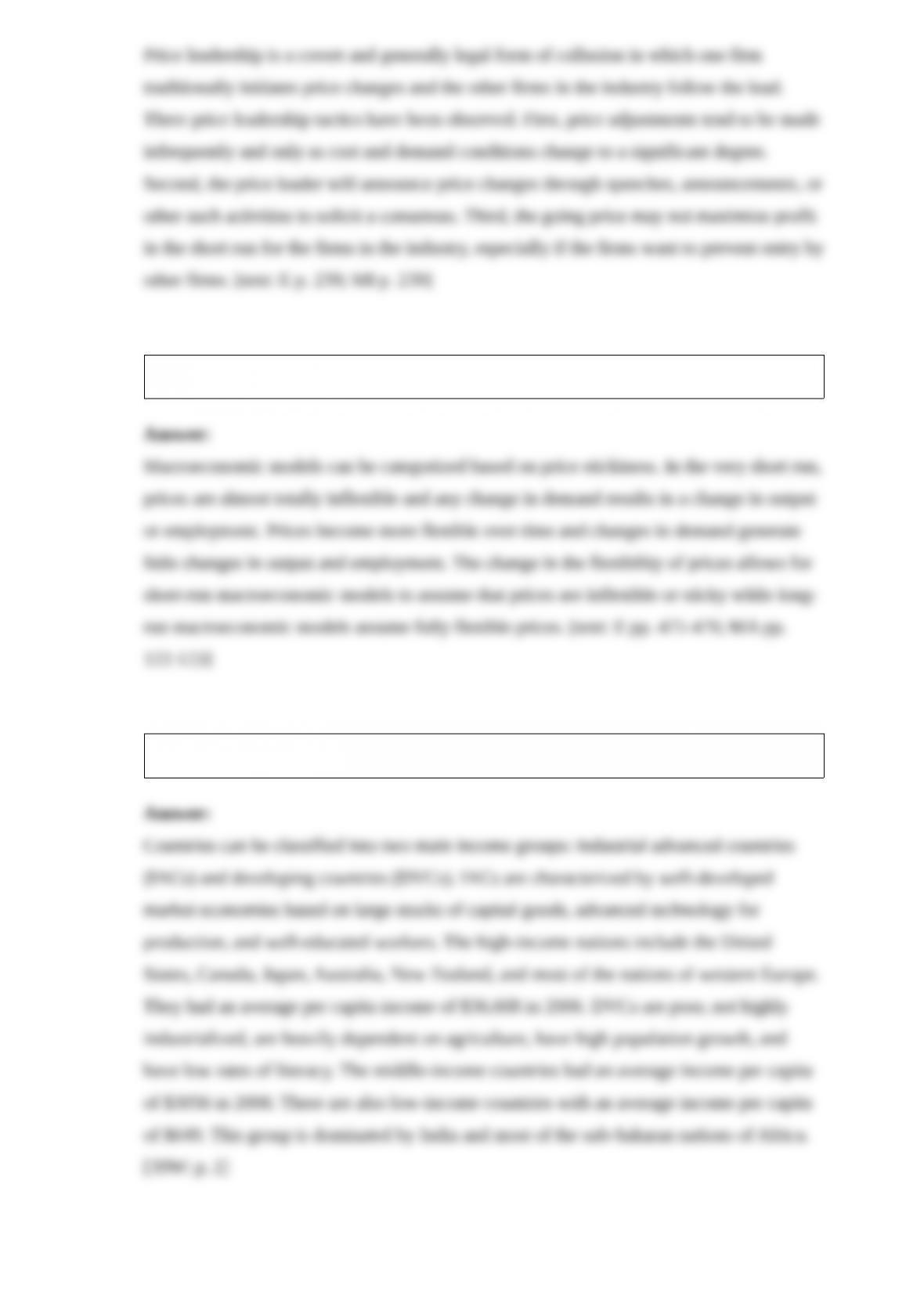
31) Answer the next question(s) on the basis of the following table for a particular
country in which C is consumption expenditures, Ig is gross investment expenditures, G
is government expenditures, X is exports, and M is imports. All figures are in billions of
dollars. Each question is independent of the other questions.
Refer to the above table. If equilibrium real GDP is $31 billion, the equilibrium price
level will be:
A.128.
B.125.
C.122.
D.119.
32) What is the price leadership model of oligopoly pricing and what are its tactics?
33) How can price stickiness be used to categorize macroeconomic models?
34) How are countries classified based on income?
35) Compare the problems in achieving growth in an advanced nation with those of a
developing nation. Do these problems differ in degree or in kind? Explain.
36) What is the fast-second strategy? What are the risks to a dominant firm from using
such a strategy?
37) What are the three common features of all investments and why are they important?
38) How does an economy adjust to demand shocks when prices are inflexible?
39) Define the full-employment or natural rate of unemployment and give its
approximate percentage rate as economists currently define it.
40) If economic forecasting was a more exact science, the business cycle could be
entirely corrected by fiscal measures. Do you agree?

41) What are types of firms that exemplify monopolistic competition?