Explain why each of the following transactions would or would not be counted in the
GDP of the United States.
a. Japanese auto producer Honda builds a factory in Indiana.
b. You buy a new pair of pants produced at a factory in Honduras.
c. You mow your uncle’s yard and he gives you $10 for a job well done.
When the economy is at full employment, _____ is zero.
A) unemployment
B) cyclical unemployment
C) frictional unemployment
D) the natural rate of unemployment

In the local market for coffee, if Joyce’s Java and Everyday Joe’s coffee shops go out of
business, the _____ curve shifts to the _____.
A) supply; right
B) demand; left
C) supply; left
D) demand; right
An increase in the price of hamburger would probably result in _____ in the demand for
hamburger buns.
A) a decrease
B) an increase
C) no change
D) random fluctuations
The theory that assets embody all publicly available information about their
fundamentals is the:
A) efficient markets hypothesis.
B) multiplier theory.
C) accelerator theory
D) Fisher effect.
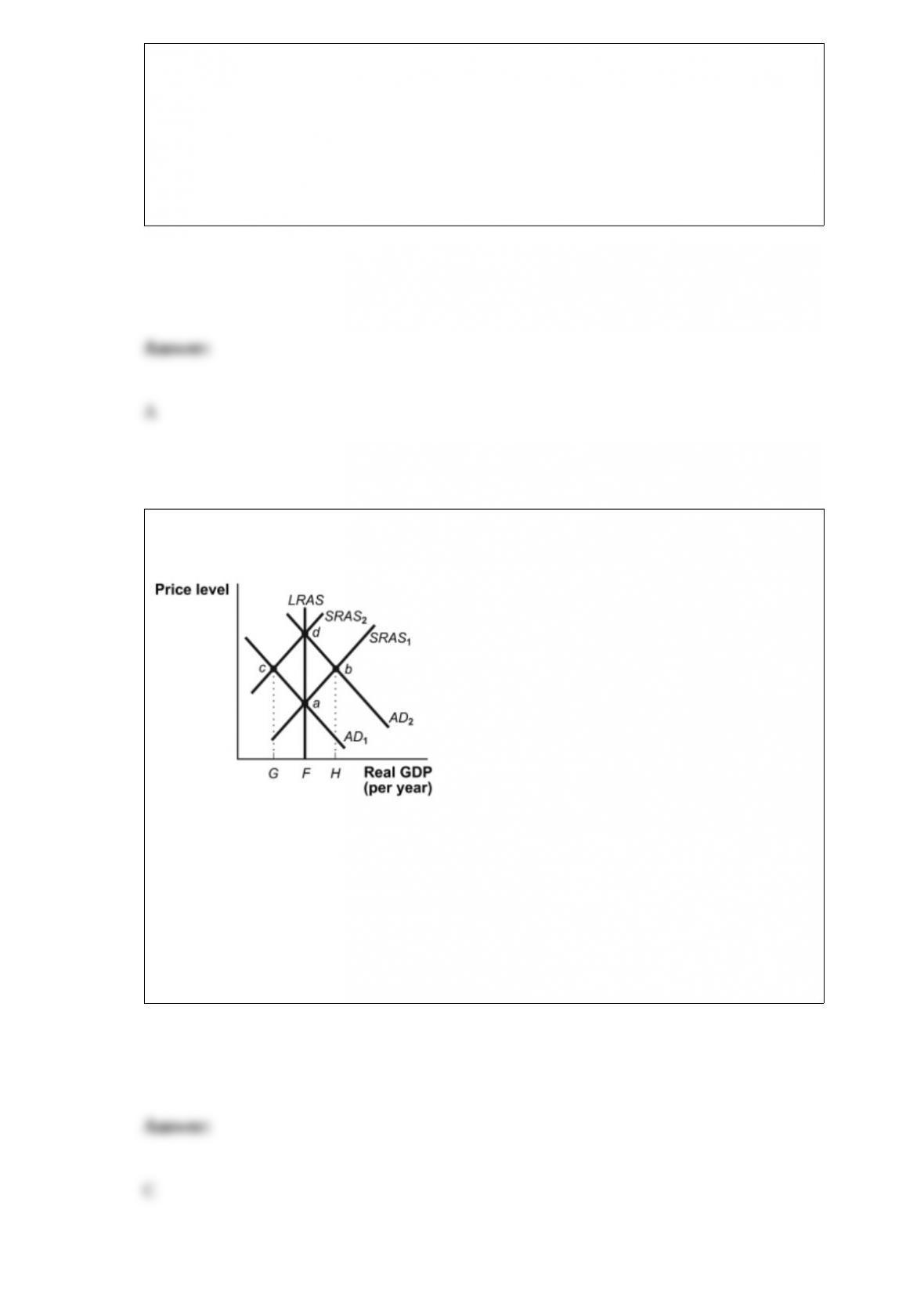
Figure: Economic Adjustments
Look at the figure Economic Adjustments. Assume that the economy is at point c. The
effect of an increase in the money supply is represented by a shift of the _____ curve to
_____.
A) SRAS1; SRAS2
B) SRAS2; SRAS1
C) AD1; AD2
D) AD2; AD1

A change in government transfers shifts the aggregate demand curve by more than a
change in government spending for goods and services and has a larger effect on real
GDP.
A) True
B) False
If a store has 10,000 CDs at the start of the period and 15,000 CDs at the end, then its
inventory investment during the period was _____ CDs:
A) “5,000.
B) 0.67.
C) 1.5.
D) 5,000.
Proponents of rational expectations believe that:
A) changes in AD cause business cycles.
B) people will not be surprised by systematic monetary and fiscal policies.
C) the economy will have to undergo long periods of unemployment during recessions.
D) the velocity of money does not exist.

Rising inventories typically indicate _____ unplanned inventory investment and a
_____ economy.
A) positive; slowing
B) negative; slowing
C) positive; expanding
D) negative; expanding
The real wage is the wage multiplied by the price level.
A) True
B) False
If the price index in year 1 is 146 and in year 2 is 163, the rate of inflation between year
1 and year 2 is:
A) 8.2%.

B) 10.43%.
C) 11.64%.
D) 17.0%.
Which of the following is (are) a source (sources) of funding for private investment
spending?
I. savings of the owners of a family business
II. profits of a large corporation
III. borrowing
A) I only
B) II only
C) III only
D) I, II, and III
A recent college graduate with a major in economics attends a job fair but has not yet
found a job. This graduate is counted as a _____ unemployed worker.

A) structurally
B) seasonally
C) cyclically
D) frictionally
A country has a floating exchange rate if the government lets the exchange rate go
wherever the market may take it.
A) True
B) False
France and England both produce wine and cloth with constant opportunity costs.
France can produce 150 barrels of wine if it produces no cloth or 100 bolts of cloth if it
produces no wine. England can produce 50 barrels of wine if it produces no cloth or
100 bolts of cloth if it produces no wine. Using this information, we can conclude that:
A) France has a comparative advantage in cloth production.
B) England has a comparative advantage in cloth production.
C) France has a comparative advantage in both goods.
D) mutually beneficial international trade is not possible.

The long-run level of output is known as _____ output.
A) recognized
B) structural
C) potential
D) balanced budget
Which of the following is the consensus among most economists today with respect to
the management of unemployment?
A) Government can’t do anything about it.
B) Expansionary policy can be used to achieve permanently low unemployment.
C) Unemployment cannot be kept below the natural rate.
D) Unemployment cannot be kept anywhere near the natural rate.

Which of the following is a shadow bank?
A) credit union
B) commercial bank
C) savings and loan
D) hedge fund
New classical macroeconomists believe that the short-run aggregate:
A) supply curve is vertical.
B) demand curve is vertical.
C) demand curve has a positive slope.
D) supply curve is horizontal.
Which of the following is a government transfer?
A) wages paid to U.S. senators
B) purchases of tanks for the army
C) Social Security payments to retired auto workers

D) payments to contractors for repairs on interstate highways
In the consumer price index of the United States:
A) the current cost of a basket of goods is compared to the base-period cost of the same
basket of goods.
B) the base-period index is always equal to 100.
C) the base period is 1982″1984.
D) the current cost of a basket of goods is compared to the base-period cost of the same
basket of goods, the calculation of the base-period index is always equal to 100, and the
base period is 1982″1984.
Subprime loans are made:
A) on houses that are below average value.
B) with interest rates that are below the prime rate.
C) with very short maturities.
D) to buyers who don’t meet the usual criteria for getting a mortgage.

If an economy is open:
A) anyone can immigrate to the country.
B) trading with other countries makes up a portion of its economy.
C) it does not trade with other countries.
D) Its real GDP will drop.
After a devaluation, all other things equal, a country’s balance of payments on the
current account will likely increase.
A) True
B) False
A bank run can break a bank because:

A) borrowers default on their loans, and the bank’s assets become worthless.
B) banks cannot quickly convert illiquid loans to liquid assets without facing a large
financial loss.
C) depositors’ panic spreads to borrowers, who want to take additional loans from the
bank.
D) the bank’s reserves kept with the Federal Reserve are in the form of illiquid U.S.
Treasury bonds.
Most economists today believe that:
A) the Federal Reserve should be abolished.
B) fiscal policy can decrease the unemployment rate below the natural rate of
unemployment.
C) the federal government should always balance its budget.
D) the federal government should not seek to balance the budget annually, but let it
function as an automatic stabilizer.
In the United States, recessions are typically associated with a(n):
A) falling unemployment rate.

B) decrease in the number of people living in poverty.
C) decrease in the percentage of Americans with health insurance.
D) increase in corporate profits.
If the Chinese government wants to keep the real and nominal exchange rates between
the yuan and the U.S. dollar fixed at 8 yuan per dollar without government intervention
in the foreign exchange market, the _____ rate in China must be _____ that in the
United States.
A) inflation; equal to
B) interest; higher than
C) inflation; constantly lower than
D) inflation; constantly higher than
Which of the following would shift the demand curve for new textbooks to the right?
A) a decrease in the price of paper
B) a fall in the price of used textbooks
C) an increase in college enrollment
D) a fall in the price of new textbooks
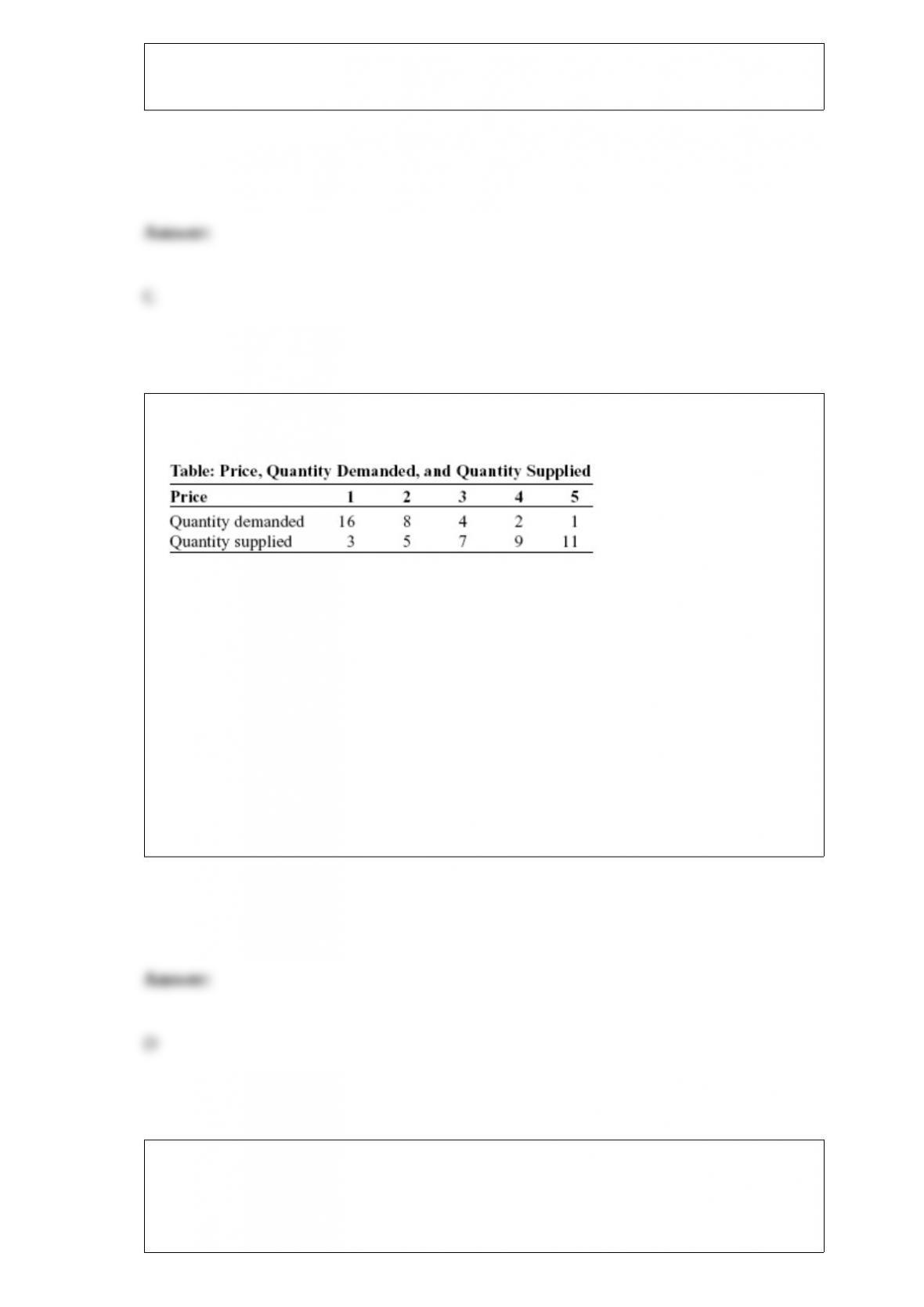
Look at the table Price, Quantity Demanded, and Quantity Supplied. The slope of the
line representing the relationship between price on the vertical axis and quantity
demanded on the horizontal axis is:
A) equal to 1/2.
B) equal to 1.
C) equal to 2.
D) different at different points on the line.
An increase in the nation’s _____ is generally accepted as a long-run indicator of a
rising standard of living.
A) output per person
B) unemployment rate
C) inflation rate
D) trade deficit
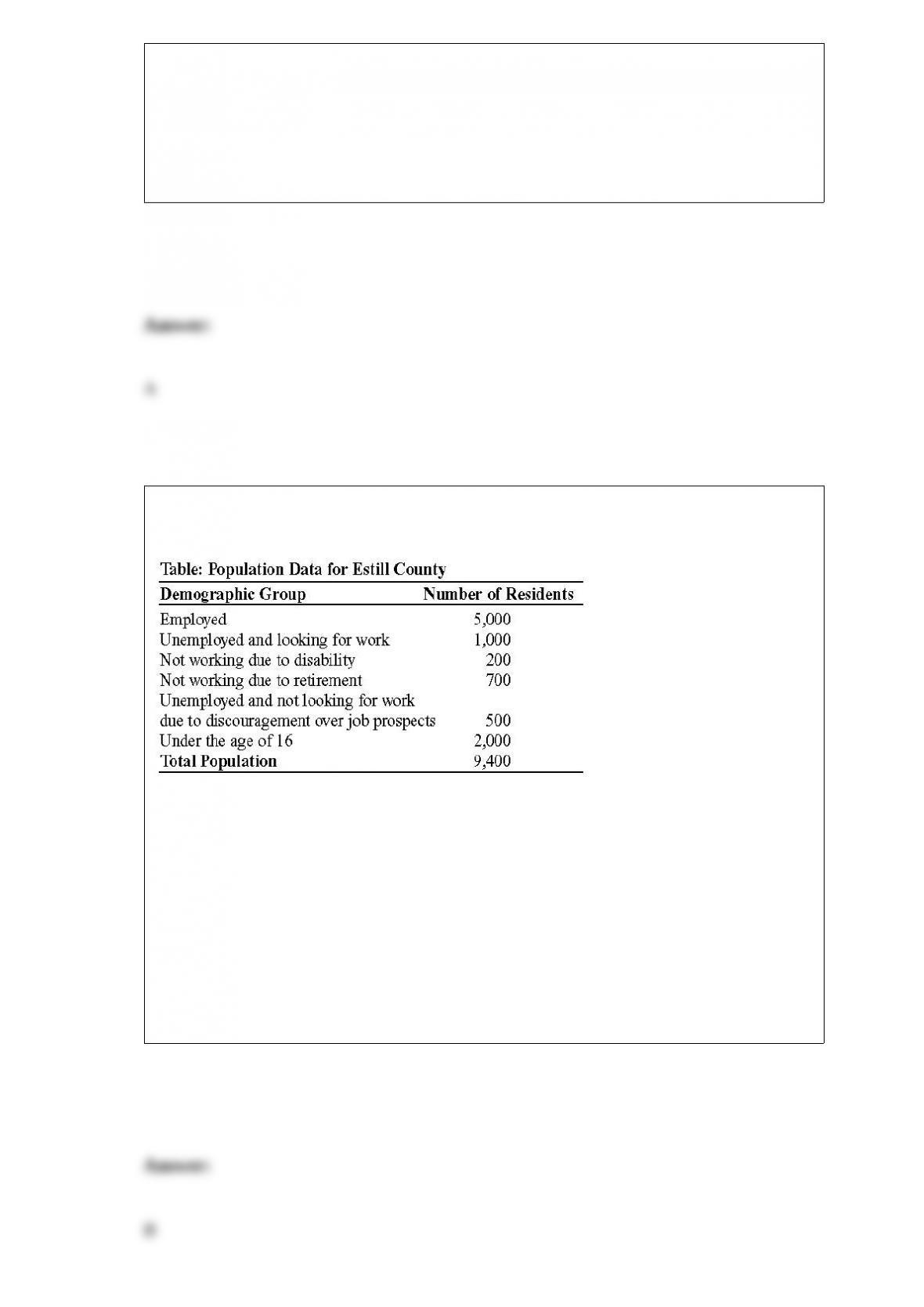
Look at the table Population Data for Estill County. If marginally attached workers are
included, the labor force in Estill County is:
A) 7,400.
B) 6,500.
C) 6,000.
D) 5,500.

The consumer price index measures the cost of the consumption of a family of four
living in a typical U.S. city.
A) True
B) False