1) with fixed money income, an increase in the price of one good and a decrease in the
price of the other will cause the new budget line to intersect the original budget line.
2) rising health care costs have prompted workers to change jobs with greater
frequency.
3)
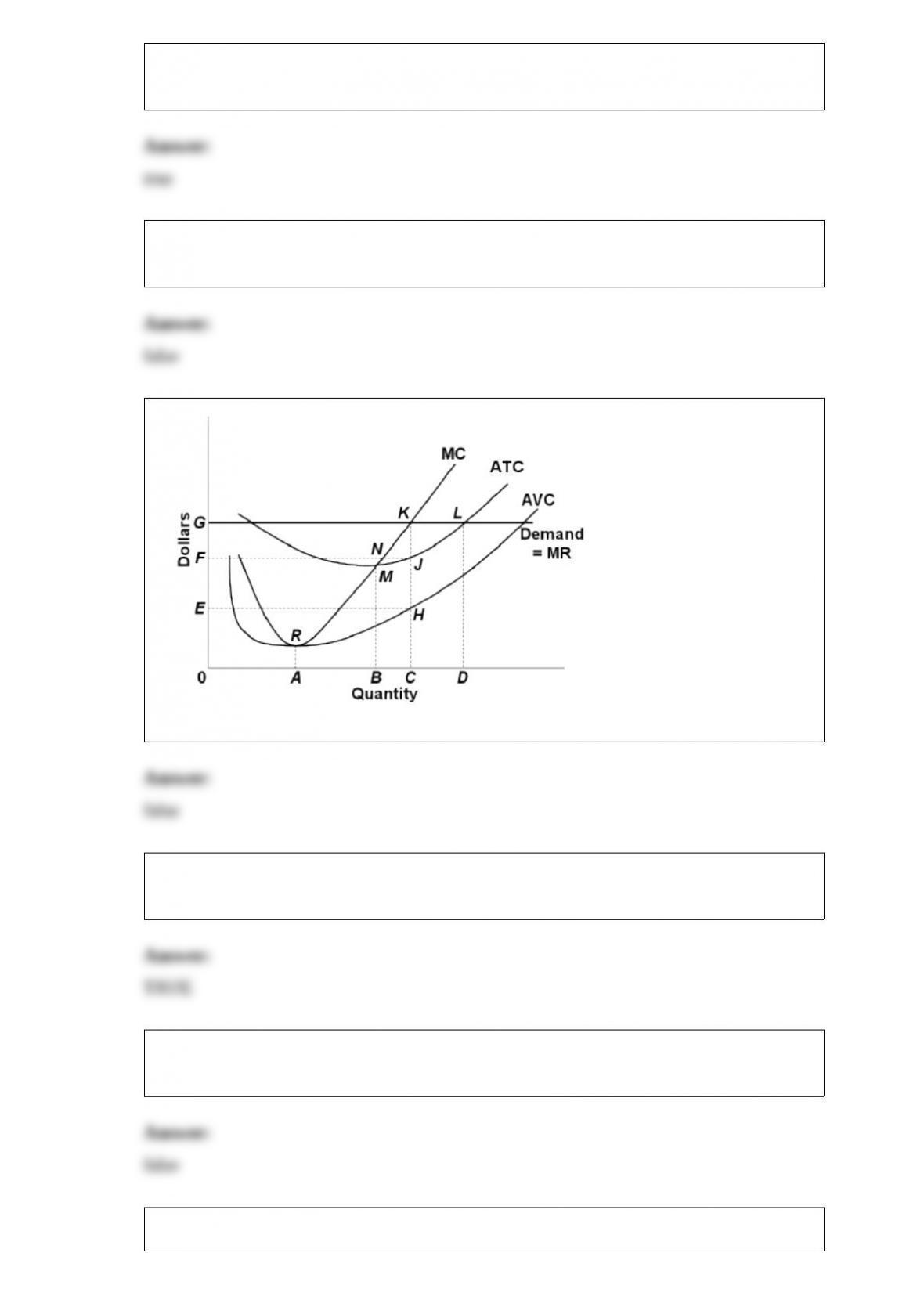
refer to the above diagram. this firm will maximize profits by producing output d.
4) An increase in the price of capital will reduce the demand for labor if capital and
labor are complementary resources.
5) growth is a widely held economic goal primarily because it creates a more equal
distribution of wealth and income.
6) For an open mixed economy the equilibrium level of GDP is determined where Sa +

Ig + X = T + G.
7) It will be profitable for a firm to hire additional units of any resource up to the point
at which its MRP is equal to its MRC.
8) An expansionary monetary policy is one that reduces the supply of money.
9) monopolistic competition is more like monopoly than pure competition because
sellers have considerable control over price.
10) Depository institutions are a major source of money in the U.S. economy.
11) about two-thirds of all federal spending is for national defense.
12) Bond prices and interest rates are directly or positively related.
13) in drawing a particular budget line, money income and the prices of the two
products are fixed.
14) assume there is an increase in the demand for hand calculators. the subsequent:
a.increase in price will be greater in the long run than in the short run.
b.increase in price will be greater the greater the inelasticity of supply.
c.increase in price will be greater the greater the elasticity of supply.
d.decline in price will be greater the greater the elasticity of supply.
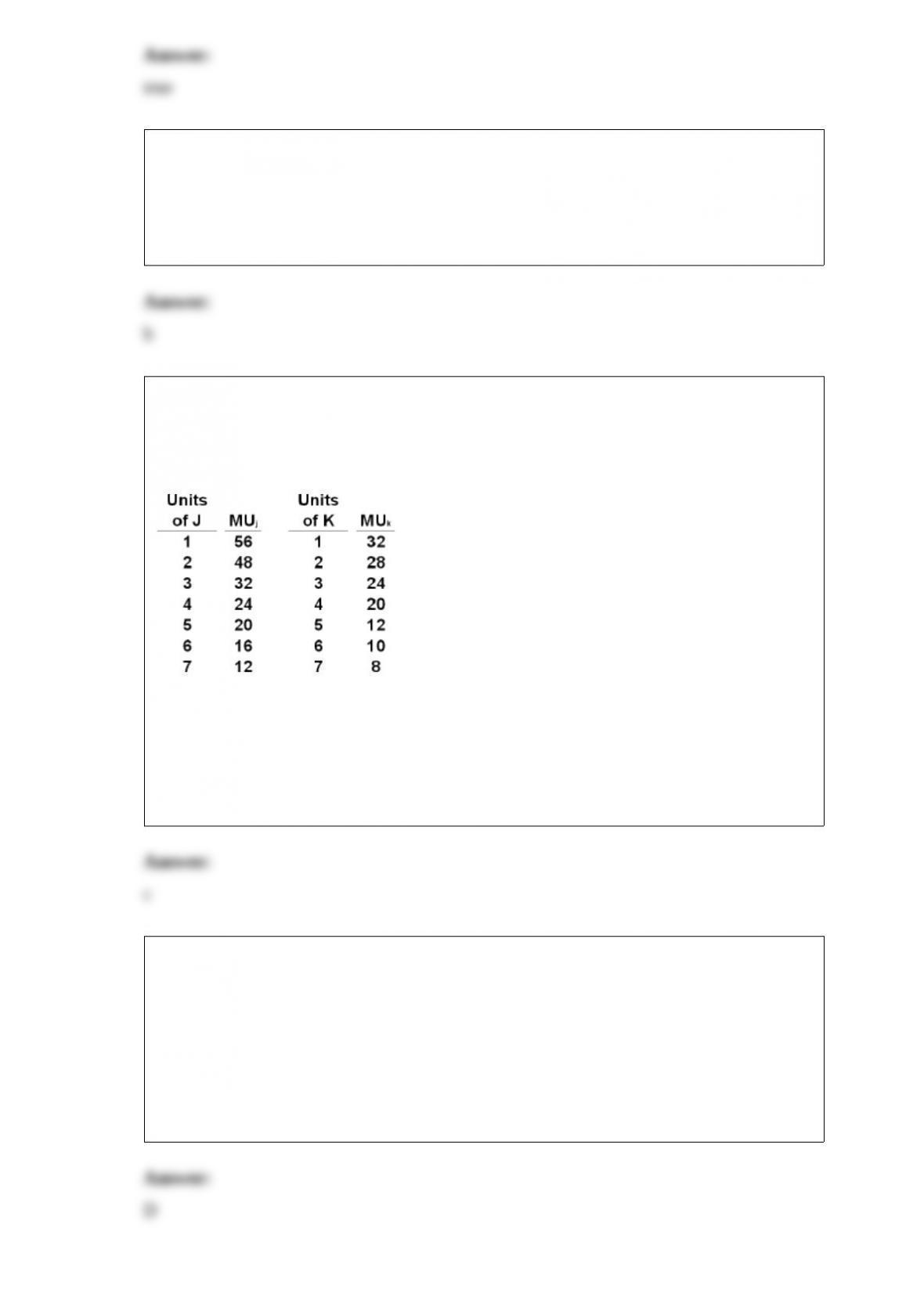
15) the following two schedules which show the amounts of additional satisfaction
(marginal utility) which a consumer would get from successive quantities of products j
and k.
refer to the above data. if the consumer has a money income of $52 and the prices of j
and k are $8 and $4 respectively, the consumer will maximize her utility by purchasing:
a.2 units of j and 7 units of k
b.5 units of j and 5 units of k
c.4 units of j and 5 units of k
d.6 units of j and 3 units of k
16) The prime interest rate:
A.affects investment spending while the Federal funds rate affects consumption
spending.
B.affects consumption spending while the Federal funds rate affects investment
spending.
C.has no affect on exchange rates and net exports.
D.affects investment spending while the Federal funds rate affects overnight borrowing
of bank reserves.
17) Assuming no other changes, if checkable deposits decrease by $40 billion and
balances in money market mutual funds increase by $40 billion, the:
A.M1 money supply will decline and M2 money supply will remain unchanged.
B.M1 and M2 money supplies will not change.
C.M1 money supply will increase and M2 money supply will remain unchanged.
D. M1 and M2 money supplies will both decline.
18) Viewed through the aggregate expenditures model, the U.S. recession of 2001
resulted mainly from:
A.a fall in the average propensity to save.
B.insufficient aggregate expenditures.
C.reduced government spending.
D.increased taxes.
19) health care:
a.is an inferior good.
b.is a normal good.
c.is highly elastic with respect to price.
d.has a price elasticity of 1.
20) About ____ percent of business R&D spending is for basic research.
A.1
B.4
C.13
D.20
21) (Last Word) According to economists Ayres and Levitt, Lojack and other car
retrieval systems that rely on hidden radio transmitters create a significant:
A.negative externality because they cause numerous false alarms.
B.negative externality in the form of radio signals that are disruptive to cell phone
communications.
C.positive externality because they help police find and break-up “chop-shops.”
D.moral hazard problem because people who own them tend to park their cars in riskier
locations than they would otherwise.
22) if a firm can sell 3,000 units of product a at $10 per unit and 5,000 at $8, then:
a.the price elasticity of demand is 0.44
b.a is a complementary good.
c.the price elasticity of demand is 2.25
d.a is an inferior good.
23) Unintended changes in inventories:
A.cause the economy to move away from the equilibrium GDP.
B.are treated as components of consumption.
C.bring actual investment and saving into equality only at the equilibrium level of GDP.
D.bring actual investment and saving into equality at all levels of GDP.
24) Which of the following best describes the cause-effect chain of a restrictive
monetary policy?
A.A decrease in the money supply will lower the interest rate, increase investment
spending, and increase aggregate demand and GDP.
B.A decrease in the money supply will raise the interest rate, decrease investment
spending, and decrease aggregate demand and GDP.
C.An increase in the money supply will raise the interest rate, decrease investment
spending, and decrease aggregate demand and GDP.
D.An increase in the money supply will lower the interest rate, decrease investment
spending, and increase aggregate demand and GDP.
25) an industry comprised of four firms, each with about 25 percent of the total market
for a product is an example of:
a.monopolistic competition.
b.oligopoly.
c.pure monopoly.
d.pure competition.
26) Assume that the price level is flexible both upward and downward and that the Fed’s
policy is to keep the price level from either rising or falling. If aggregate supply
increases in the economy, the Fed:
A.will have to increase interest rates to keep the price level from falling.
B.will have to reduce the money supply to keep the price level from rising.
C.will have to increase the money supply to keep the price level from falling.
D.can keep the price level stable without altering the money supply or interest rate.
27) In the extended aggregate demand-aggregate supply model:
A.long-run equilibrium occurs wherever the aggregate demand curve intersects the
short-run aggregate supply curve.
B.the long-run aggregate supply curve is horizontal.
C.the price level is the same regardless of the location of the aggregate demand curve.
D.long-run equilibrium occurs at the intersection of the aggregate demand curve, the
short-run aggregate supply curve, and the long run aggregate supply.
28) macroeconomics can best be described as the:
a.analysis of how a consumer tries to spend income.
b.study of the large aggregates of the economy or the economy as a whole.
c.analysis of how firms attempt to maximize their profits.
d.study of how supply and demand determine prices in individual markets.
29)
Refer to the above data. What will be the profit-maximizing selling price of the
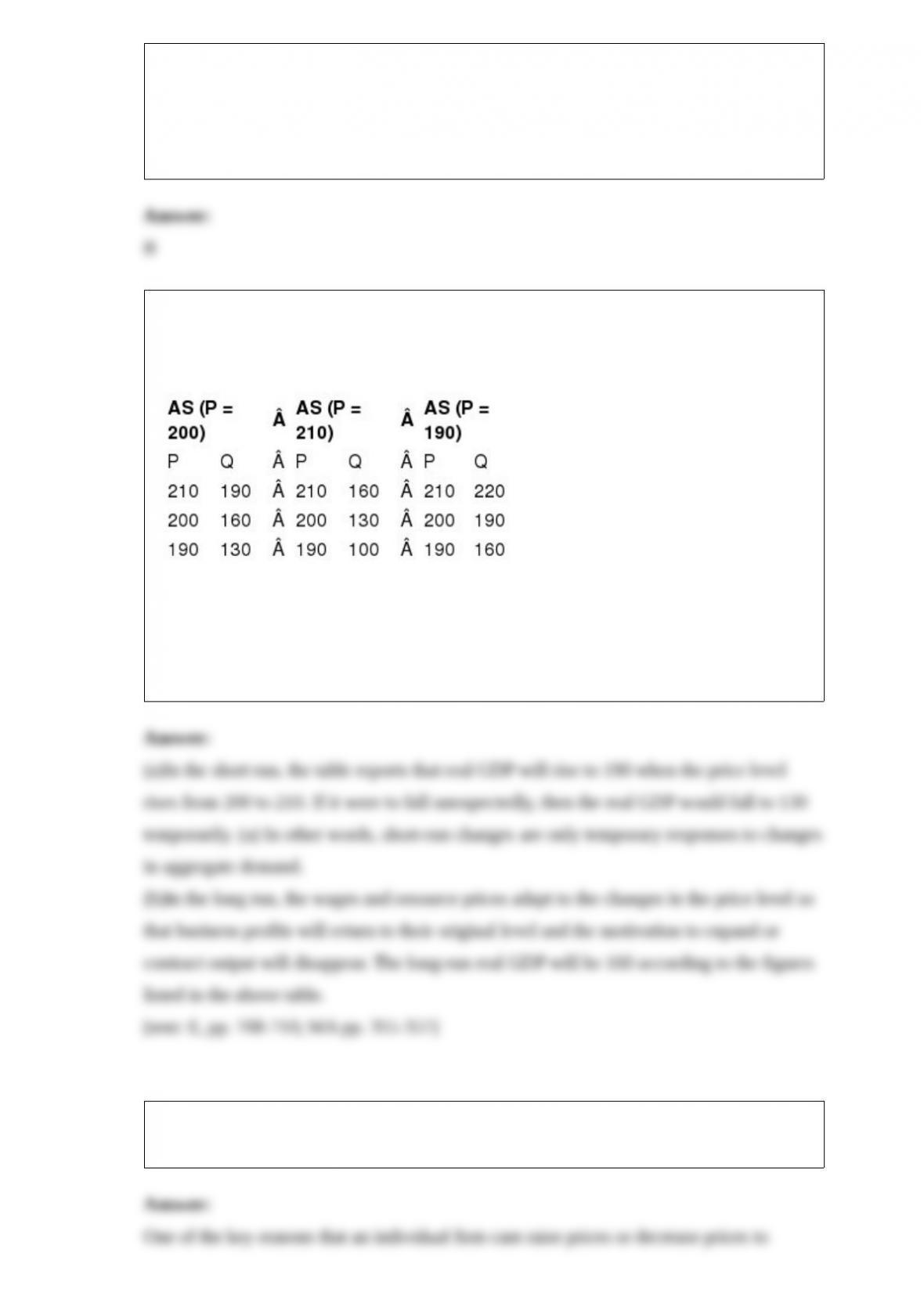
product?
A.$1.40
B.$1.60
C.$1.80
D.$2.00
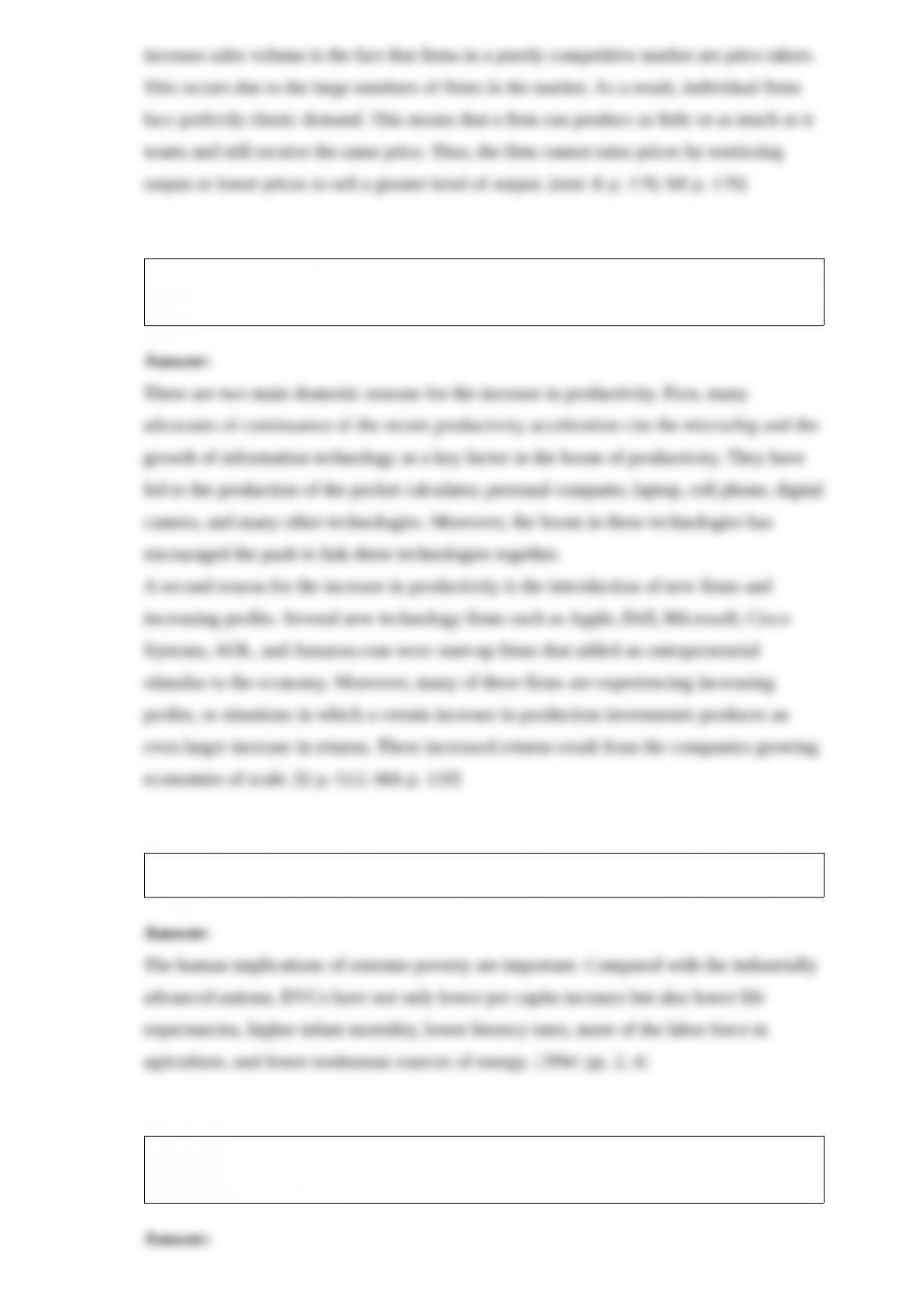
30) Suppose the potential level of real domestic output (Q) for a hypothetical economy
is $160 and the price level (P) initially is 200. Use the following short-run aggregate
supply schedules to answer the questions.
(a)What will be the short-run level of real GDP if the price level rises unexpectedly
from 200 to 210 because of an increase in aggregate demand? Falls unexpectedly from
200 to 190 because of a decrease in aggregate demand? Explain each situation.
(b)What will be the long-run level of real GDP when the price level rises from 200 to
210? Falls from 200 to 190? Explain each situation.
31) Why cant an individual firm raise its price by reducing output or lower its price to
increase sales volume in a purely competitive market?
32) What are two domestic reasons for the recent productivity acceleration experienced
in the U.S.?
33) What are the human realities of poverty in DVCs?
34) Given all the complications that can result with fiscal policy, is fiscal policy still
considered an effective policy tool for stabilizing business cycle fluctuations?
35) Why do entrepreneurs and other innovators actively study the scientific output of
universities and government laboratories?