1) an unexpected increase in total spending will cause an increase in gdp:
a.if prices are sticky.
b.if prices are fully flexible.
c.regardless of whether prices are sticky or fully flexible.
d.only if prices are stuck in the long term.
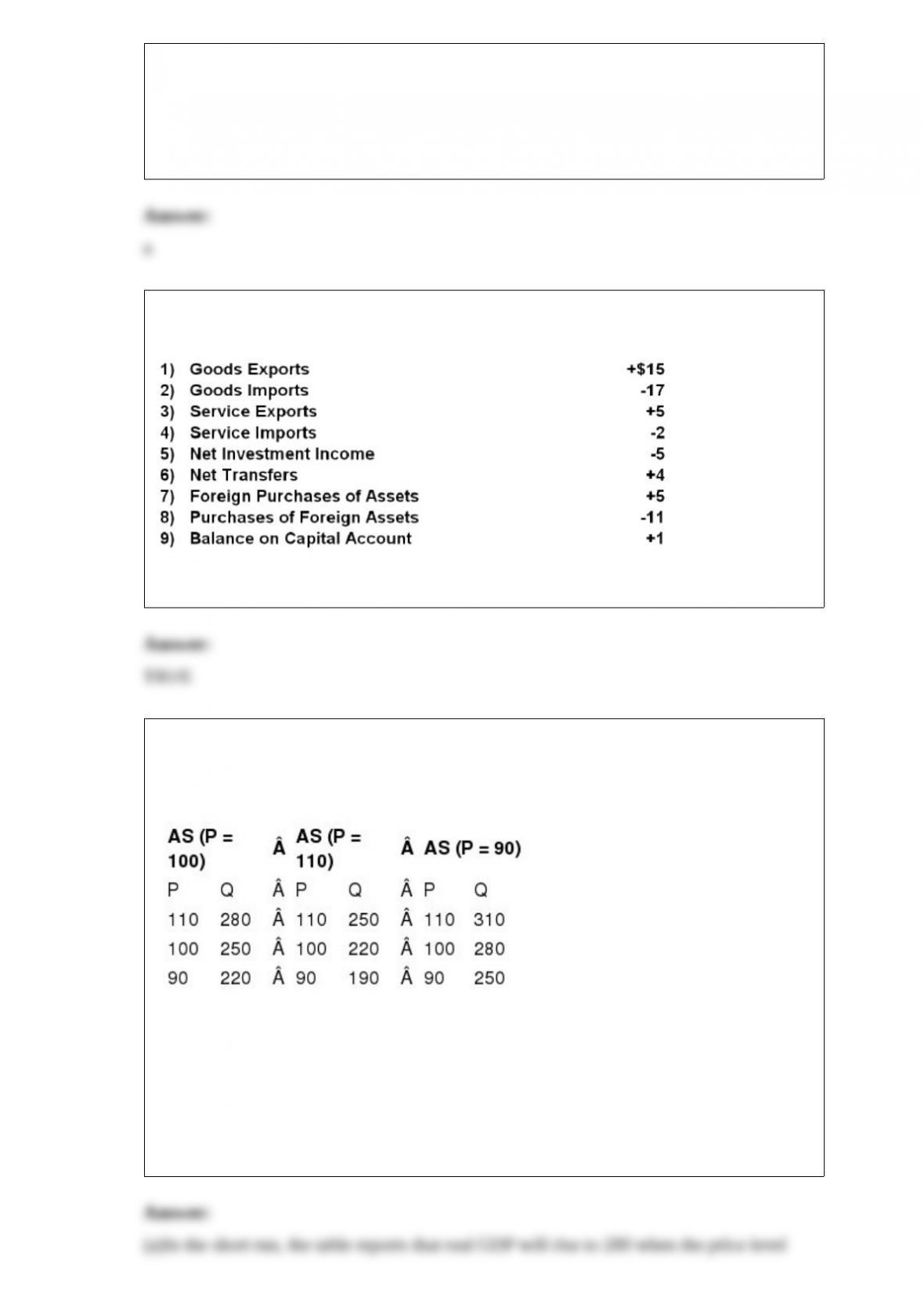
2) The following 2008 balance of payments statement for Transylvania. All figures are
in billions of dollars.
Refer to the above data. In 2008 Transylvania was a net recipient of transfers from the
rest of the world.
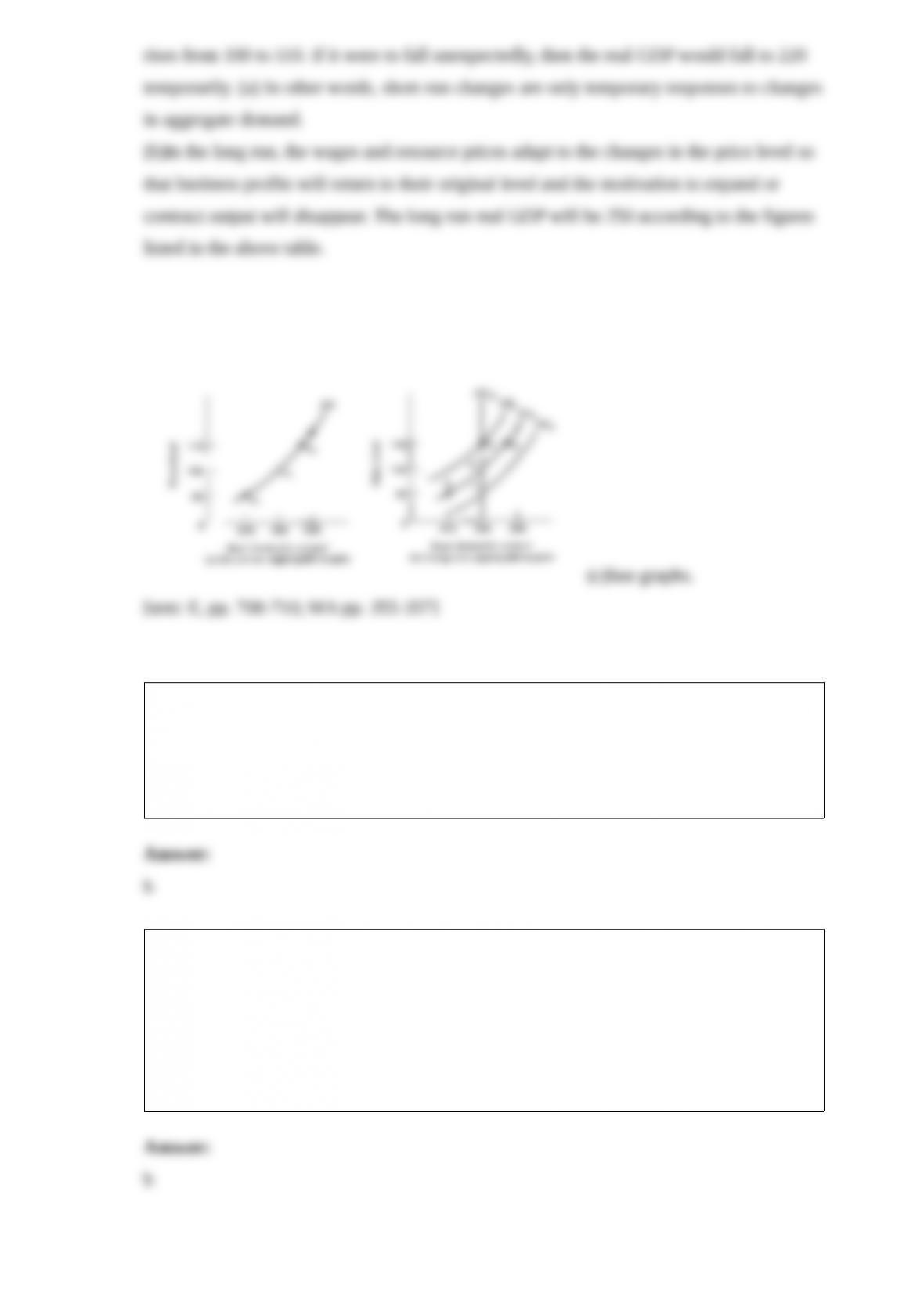
3) Suppose the potential level of real domestic output (Q) for a hypothetical economy is
$250 and the price level (P) initially is 100. Use the following short-run aggregate
supply schedules below to answer the questions.
(a)What will be the short-run level of real GDP if the price level rises unexpectedly
from 100 to 110 because of an increase in aggregate demand? Falls unexpectedly from
100 to 90 because of a decrease in aggregate demand? Explain each situation.
(b)What will be the long-run level of real GDP when the price level rises from 100 to
110? Falls from 100 to 90? Explain each situation.
(c)Show the circumstances described in (a) and (b) on the graph below and derive the
long-run aggregate supply curve.
4) the elasticity of supply of product x is unitary if the price of x rises by:
a.5 percent and quantity supplied rises by 7 percent.
b.8 percent and quantity supplied rises by 8 percent.
c.10 percent and quantity supplied stays the same.
d.7 percent and quantity supplied rises by 5 percent.
5) we would expect:
a.the demand for coca-cola to be less elastic than the demand for soft drinks in general.
b.the demand for coca-cola to be more elastic than the demand for soft drinks in
general.
c.no relationship between the elasticity of demand for coca-cola and the elasticity of
demand for soft drinks in general.
d.none of these to hold true.
6) Which of the following best describes the built-in stabilizers as they function in the
United States?
A.The size of the multiplier varies inversely with the level of GDP.
B.Personal and corporate income tax collections automatically fall and transfers and
subsidies automatically rise as GDP rises.
C.Personal and corporate income tax collections and transfers and subsidies all
automatically vary inversely with the level of GDP.
D.Personal and corporate income tax collections automatically rise and transfers and
subsidies automatically decline as GDP rises.
7) Which of the following best describes the idea of a political business cycle?
A.Politicians are more willing to cut taxes and increase government spending than they
are to do the reverse.
B.Fiscal policy will result in alternating budget deficits and surpluses.
C.Politicians will use fiscal policy to cause output, real incomes, and employment to be
rising prior to elections.
D.Despite good intentions, various timing lags will cause fiscal policy to reinforce the
business cycle.
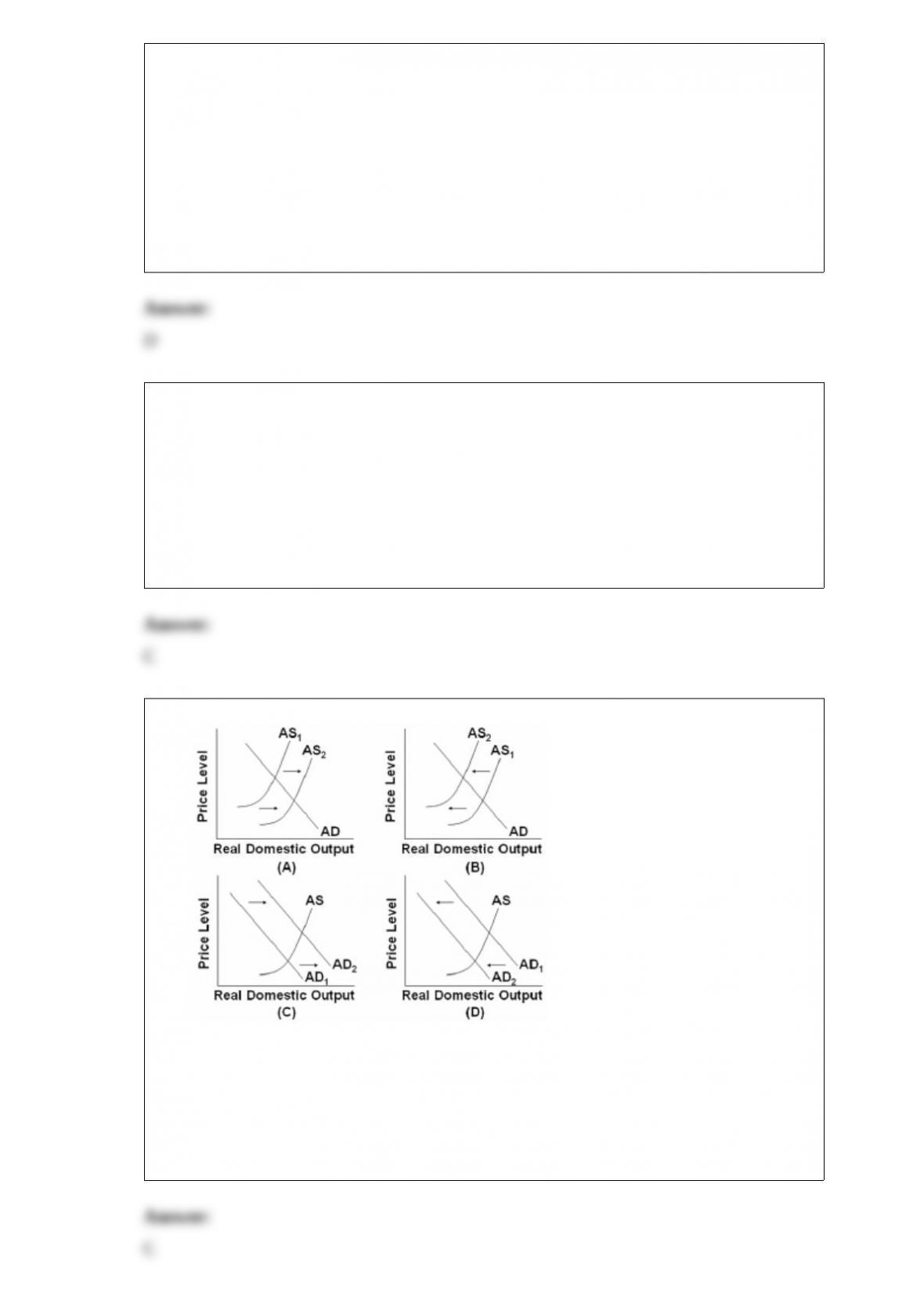
8)
Which of the above diagrams best portrays an improvement in expected rates of return
on investment?
A.A
B.B
C.C
D.D
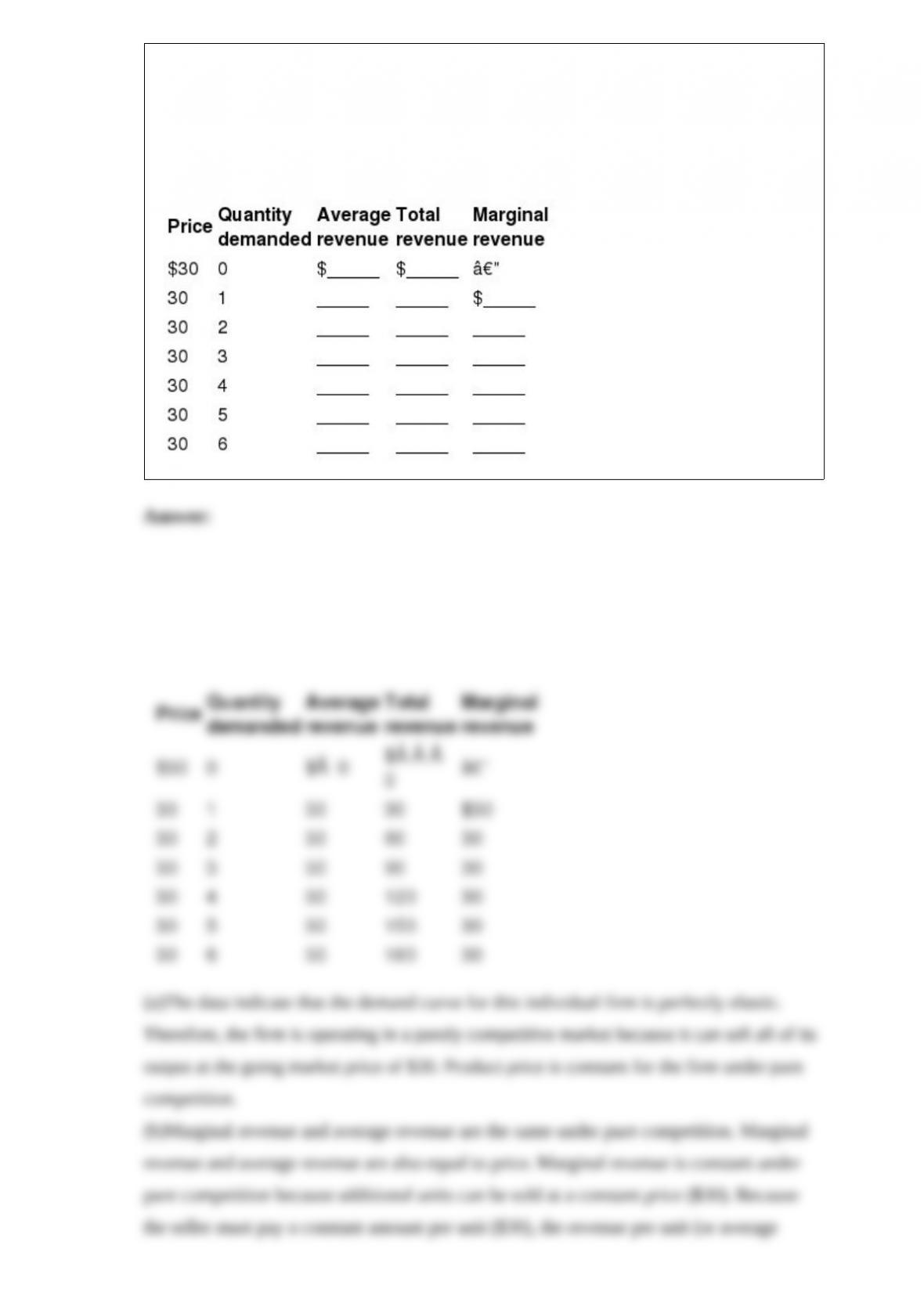
9) Below is a demand schedule facing an individual firm. Complete the table by
computing average revenue, total revenue, and marginal revenue. Then answer the
following two questions: (a) How can you tell whether a firm is operating in a market
that is purely competitive? (b) What relationship exists between average revenue and
marginal revenue?

10) Suppose capital and labor are used in fixed proportions so that each machine
requires only one worker. If a decline in the price of capital occurs, then the demand for
labor will:
A.decline solely because of the substitution effect.
B.increase solely because of the substitution effect.
C.increase solely because of the output effect.
D.decrease solely because of the output effect.