1) which of the following is a fallacy of international trade?
a.trade is a zero-sum activity
b.exports increase employment in exporting industries
c.import restrictions increase employment in import-competing industries
d.tariffs and quotas reduce trade volume
2) a main disadvantage of the european monetary union is that:
a.each member country loses the use of monetary policy as to tool to combat recession
b.there is a high degree of labor mobility among the member countries
c.prices are highly flexible in response to changing economic conditions
d.wages are highly flexible in response to changing economic conditions
3) a tax of 15 percent per imported item would be an example of:
a.ad valorem tariff
b.specific tariff
c.effective tariff
d.compound tariff
4) which organization is largely intended to make long-term reconstruction loans to
developing nations?
a.export-import bank
b.world bank
c.international monetary fund
d.united nations
5) joint ventures lead to national welfare gains if the newly established business yields
productivity increases that would have been unavailable if each parent performed the
same function separately.

a.true
b.false
6) regarding the applicability of free trade to cigarettes, it is correct to say:
a.the rules of free trade apply to cigarettes
b.the rules of free trade should not apply to cigarettes
c.a and b are the topic of current debate
d.there are special rules applying to cigarettes world-wide
7) an import tariff will worsen the terms of trade for a ‘small” country but improve the
terms of trade for a “large” country.
a.true
b.false
8) suppose that canada has domestic firms that could supply its entire market for radios
at a price of $50, while u.s. firms could supply radios at $40 and mexico at $30.
suppose that canada initially has a 50 percent tariff on imports of radios and then forms
a free trade area with the united states. as a result, canada realizes:
a.trade creation, no trade diversion, and overall welfare gains
b.trade creation, no trade diversion, and overall welfare losses
c.trade diversion, no trade creation, and potential overall welfare losses
d.trade diversion, trade creation, and potential overall welfare gains
9) for a nation to maximize its productivity in a global economy:
a.only imports are necessary
b.only exports are necessary
c.both imports and exports are necessary
d.neither imports nor exports are necessary
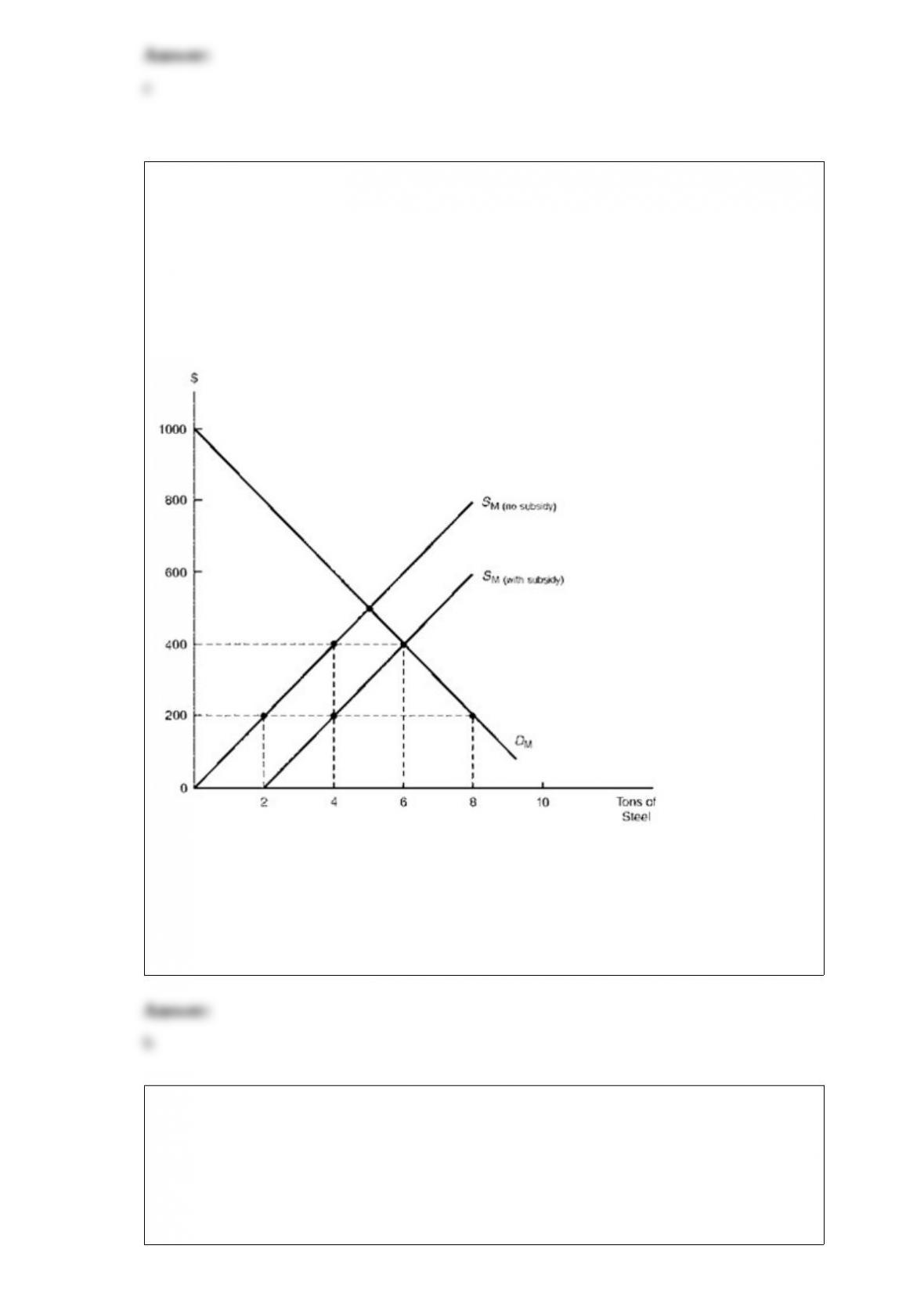
10) figure 5.1 illustrates the steel market for mexico, assumed to be a ‘small” country
that is unable to affect the world price. suppose the world price of steel is given and
constant at $200 per ton. now suppose the mexican steel industry is able to obtain trade
protection.
figure 5.1. alternative nontariff trade barriers levied by a ‘small” country
consider figure 5.1. with free trade, mexico’s consumer surplus and producer surplus
respectively equal:
a.$2000 and $1200
b.$3200 and $200
c.$3600 and $800
d.$4000 and $600
11) the general agreement on tariffs and trade and its successor, the world trade
organization, have resulted in:
a.termination of export subsidies applied to manufactured goods
b.termination of import tariffs applied to manufactured goods
c.encouragement of beggar-thy-neighbor policies
d.reductions in trade barriers via multilateral negotiations

12) assume that russia has a comparative advantage in vodka. if the united states
extends russia the benefits of the normal-trade-relations (most favored nation)principle,
u.s. consumer surplus decreases in the vodka market.
a.true
b.false
13) free traders maintain that an open economy is advantageous in that it provides all of
the following except:
a.increased competition for world producers
b.a wider selection of products for consumers
c.the utilization of the most efficient production methods
d.relatively high wage levels for all domestic workers
14) assume a system of floating exchange rates. in response to relatively high domestic
interest rates, suppose that foreign investors place their funds in domestic capital
markets. the result would be
a.a depreciation of the domestic currency and a rise in net exports
b.a depreciation of the domestic currency and a fall in net exports
c.an appreciation of the domestic currency and a rise in net exports
d.an appreciation of the domestic currency and a fall in net exports
15) figure 5.3 illustrates the apple market for sweden, assumed to be a ‘small” country
that is unable to affect the world price. ssweden is the domestic supply and dsweden is
the domestic demand. ssweden+quota is sweden’s supply schedule with an import
quota.
figure 5.3. sweden’s apple market
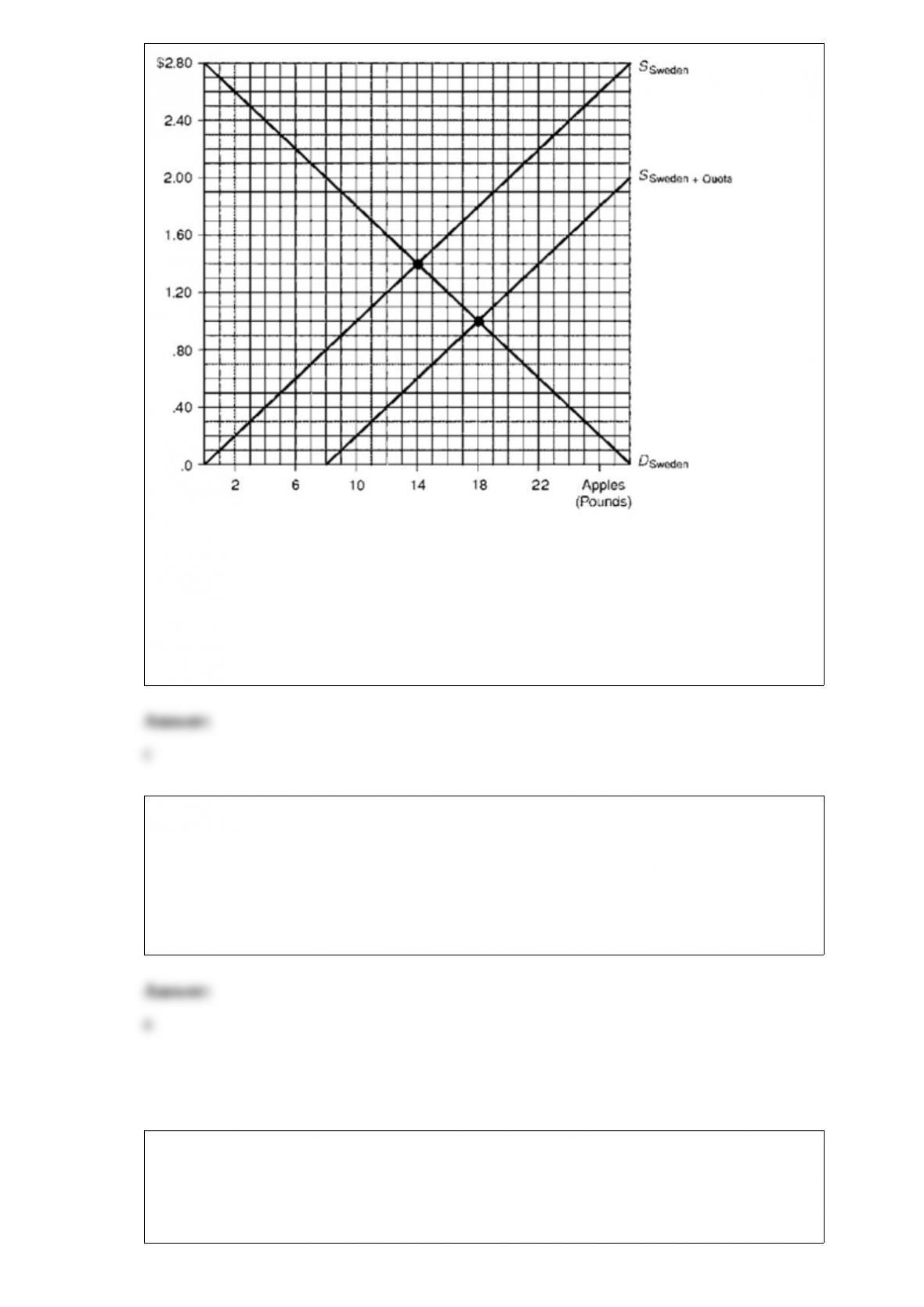
consider figure 5.3. assume that swedish import companies behave as a monopoly
buyer while foreign export companies behave as competitive sellers. compared to free
trade, sweden’s import quota results in domestic welfare:
a.gains totaling $1.60
b.gains totaling $3.20
c.losses totaling $1.60
d.losses totaling $3.20
16) suppose that the yen-dollar exchange rate changes from 85 yen per dollar to 80 yen
per dollar. one can say that the:
a.yen has appreciated against the dollar and the dollar has depreciated against the yen
b.yen has depreciated against the dollar and the dollar has appreciated against the yen
c.yen has appreciated against the dollar and the dollar has appreciated against the yen
d.yen has depreciated against the dollar and the dollar has depreciated against the yen
17) if the u.s. demand for korean steel is price elastic, an export subsidy granted to
korean steel firms will increase korea’s export revenue.
a.true
b.false
18) given floating exchange rates, if japan increases its demand for canadian goods at
the same time that canada increases its demand for japanese goods, then we would
expect the yen’s exchange value to:
a.appreciate against the dollar
b.depreciate against the dollar
c.remain constant against the dollar
d.appreciate, depreciate, or remain constant against the dollar
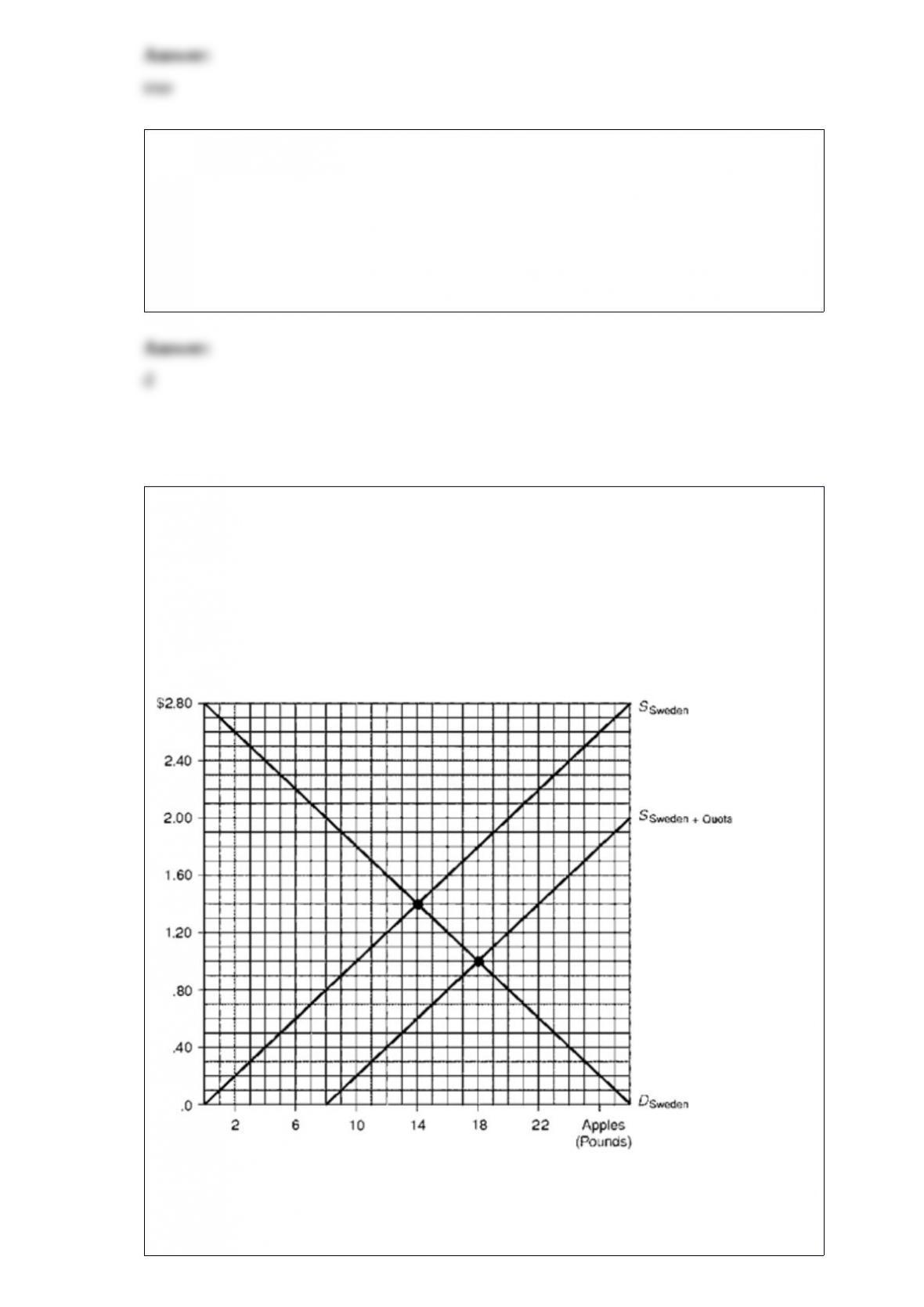
19) figure 5.3 illustrates the apple market for sweden, assumed to be a ‘small” country
that is unable to affect the world price. ssweden is the domestic supply and dsweden is
the domestic demand. ssweden+quota is sweden’s supply schedule with an import
quota.
figure 5.3. sweden’s apple market
consider figure 5.3. suppose the rest of the world can supply apples to sweden at a price
of $0.60 per pound. with free trade, sweden produces ____ pounds of apples and
imports ____ pounds of apples.
a.10, 8

b.10, 18
c.6, 22
d.6, 16
20) over the long run, the formation of a customs union may yield welfare gains due to
economies of scale, greater competition, and stimulus to investment.
a.true
b.false