
Table 25-3
Consider the following simplified balance sheet for a bank: If the required reserve ratio
is 10 percent, the bank can make a maximum loan of
A) $2,000.
B) $5,000.
C) $6,300.
D) $45,000.
Suppose when the price of hybrid automobiles rises, consumers buy fewer hybrid
automobiles. This implies that
A) there is a positive relationship between hybrid automobile prices and quantities
purchased by consumers.
B) there is a negative relationship between hybrid automobile prices and quantities
purchased by consumers.
C) there is a direct relationship between hybrid automobile prices and quantities
purchased by consumers.
D) there is a one-to-one relationship between hybrid automobile prices and quantities
purchased by consumers.

If firms find that consumers are purchasing more than expected, which of the following
would you expect?
A) Aggregate expenditure will likely be greater than GDP.
B) Aggregate expenditure will likely be less than GDP.
C) The economy will adjust to macroeconomic equilibrium as inventories rise, and
production and employment fall.
D) The economy will adjust to macroeconomic equilibrium as inventories fall, and
production and employment fall.
Economists estimated that the cross-price elasticity of demand for beer and wine is
-0.83 and the income elasticity of wine is 5.03. This means that
A) beer and wine are substitutes and wine is an inferior good.
B) beer and wine are complements and wine is a luxury good.
C) beer and wine are substitutes and wine is a luxury good.
D) beer and wine are complements and wine is an inferior good.
The economic growth model predicts that ________ across countries will converge
over time.
A) income levels
B) GDP per capita
C) foreign direct investment rates
D) growth rates
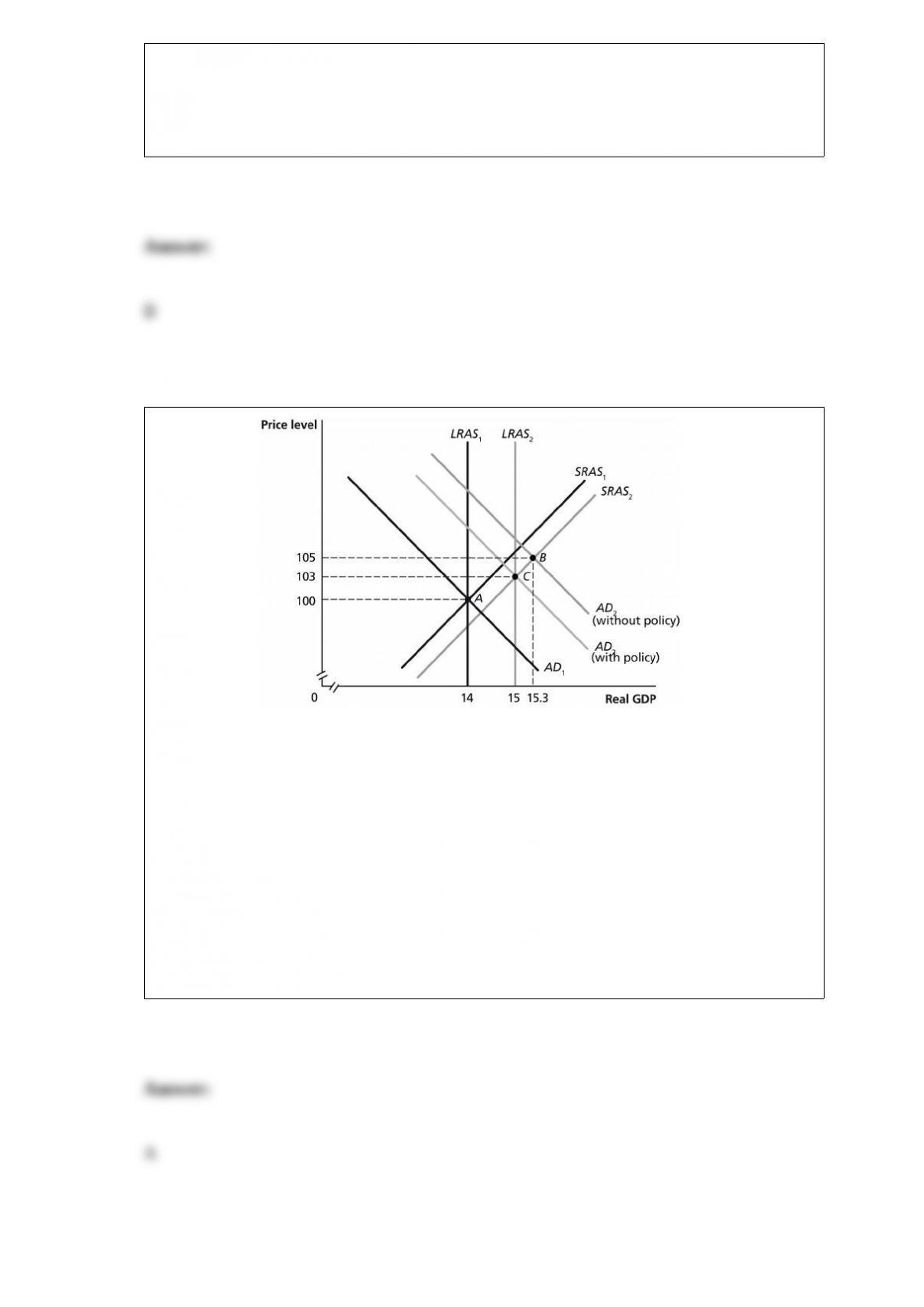
Figure 16-10
In the graph above, suppose the economy in Year 1 is at point A and expected in Year 2
to be at point B. Which of the following policies could the Congress and the president
use to move the economy to point C?
A) increase income taxes
B) increase government spending
C) buy Treasury bills
D) decrease the discount rate

Which of the following is one explanation as to why the aggregate demand curve slopes
downward?
A) Decreases in the price level raise the interest rate and increase consumption
spending.
B) Decreases in the price level raise the interest rate and increase investment spending.
C) Decreases in the U.S. price level relative to the price level in other countries lower
net exports.
D) Decreases in the price level raise real wealth and increase consumption spending.
Total income in an economy is equal to
A) GDP minus net exports.
B) income minus taxes.
C) the sum of wages, interest, rent, and profit.
D) firm revenues.
The financial statements of firms generally are audited by
A) employees of the firm being audited.
B) employees of private accounting firms.
C) employees of the federal government.

D) the board of directors of the corporation being audited.
What is different about buying stocks and buying bonds?
A) A stock can possibly pay dividends forever, but bonds have a fixed number of
payments.
B) Differences of opinion about a stock’s future may vary considerably but there is less
difference about a bond’s future.
C) The future growth of a stock is more uncertain than the payments of a bond.
D) All these are differences between stocks and bonds.
Most film processing companies have a policy of printing every picture on a roll of film
and allowing customers to request a refund for pictures that were not clearly developed.
The companies do this knowing that most customers do not ask for refunds. This is an
example of consumers
A) failing to ignore sunk costs.
B) being overly optimistic about their future behavior.
C) not taking nonmonetary opportunity costs into account.
D) not making themselves aware of the policy regarding refunds.
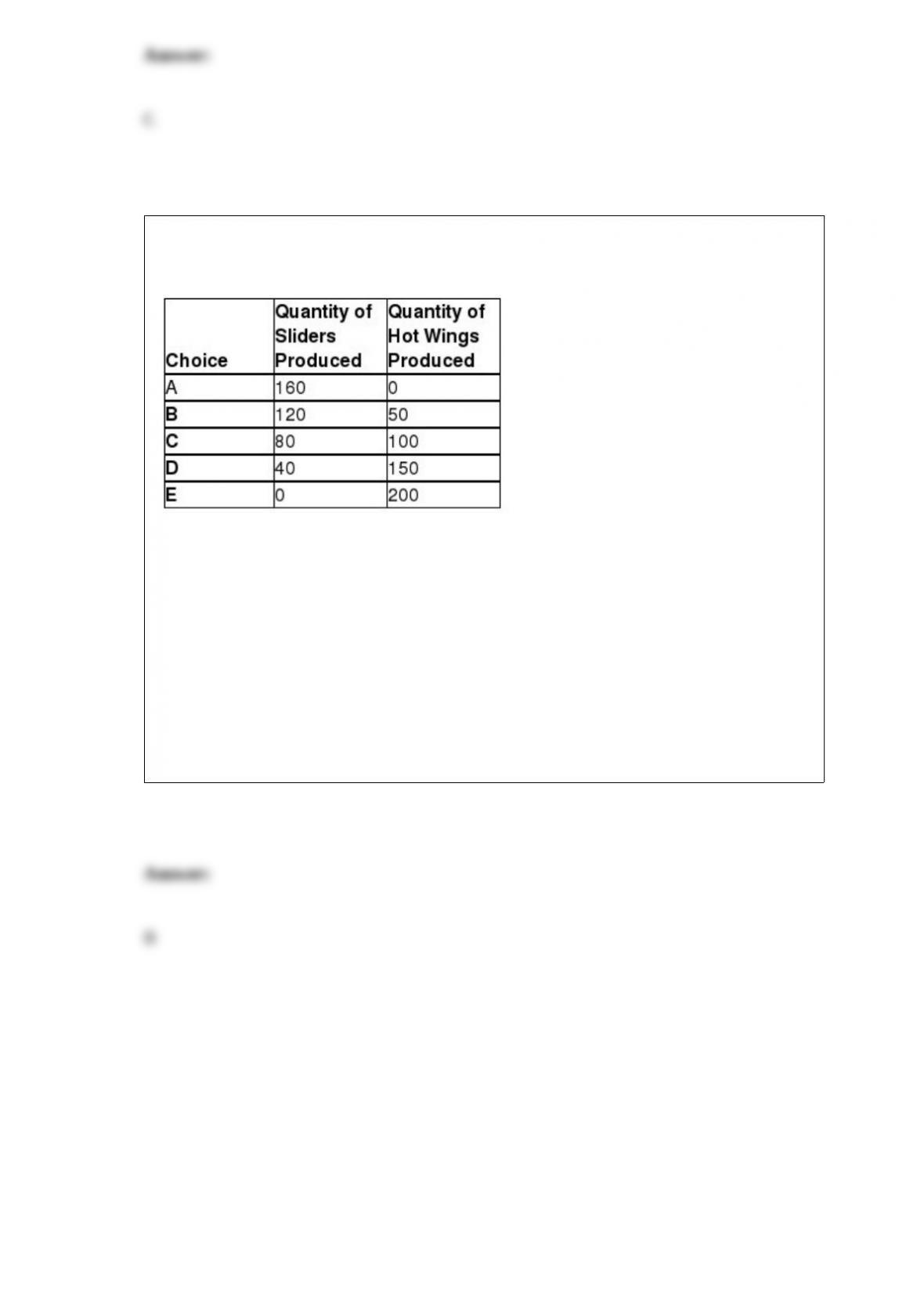
Table 2-3
Production Choices for Dina’s Diner
Assume Dina’s Diner only produces sliders and hot wings. A combination of 80 sliders
and 50 hot wings would appear
A) along Dina’s production possibilities frontier.
B) inside Dina’s production possibilities frontier.
C) outside Dina’s production possibilities frontier.
D) at the vertical intercept of Dina’s production possibilities frontier.