A product is considered to be nonexcludable if
A) you can keep those who did not pay for the item from enjoying its benefits.
B) you cannot keep those who did not pay for the item from enjoying its benefits.
C) your consumption of the product reduces the quantity available for others to
consume.
D) it is jointly owned by all members of a community.
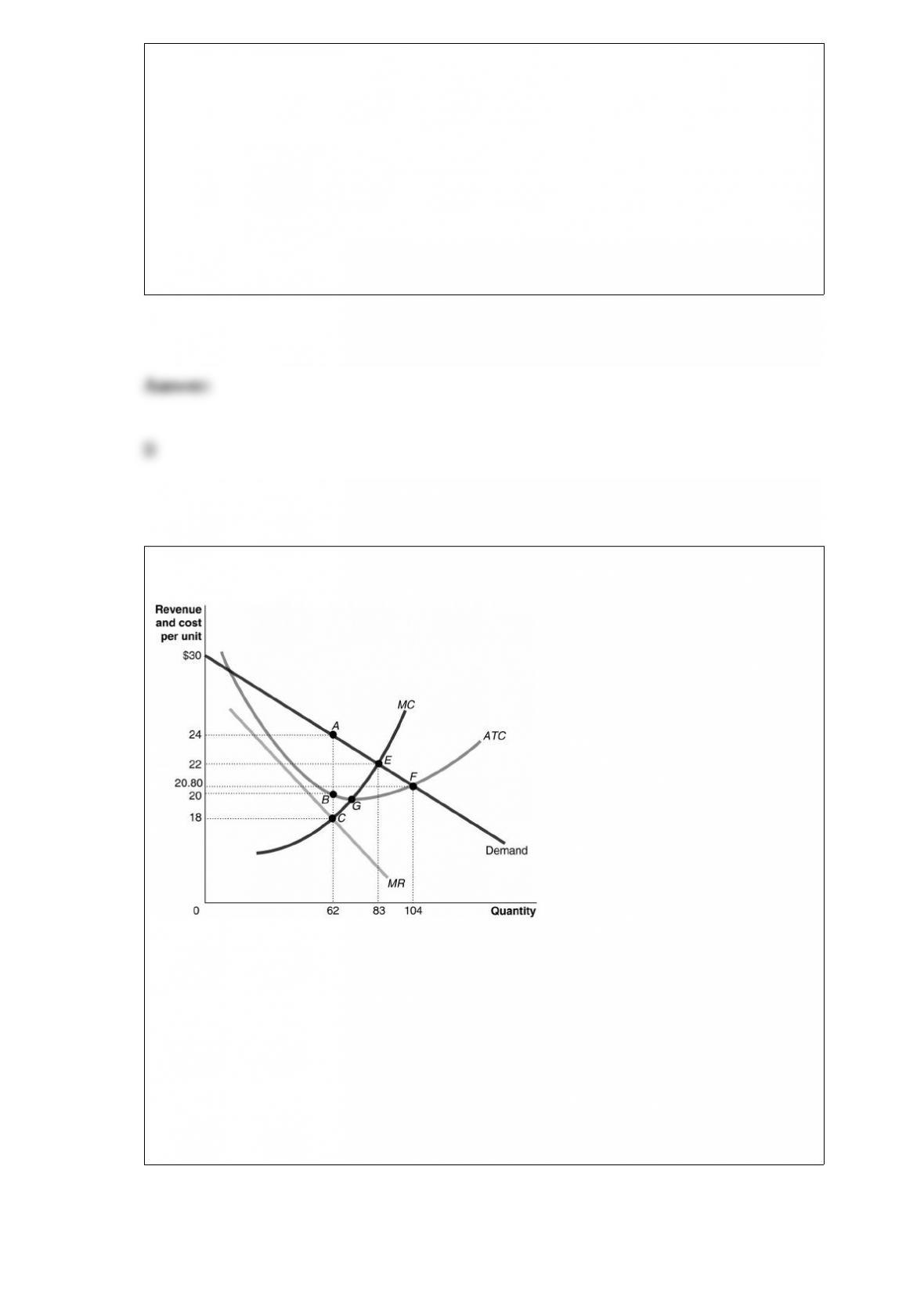
Figure 15-12
Figure 15-12 shows the cost and
demand curves for a monopolist. If the firm maximizes its profits, the deadweight loss
to society due to this monopoly is equal to the area
A) ABF.
B) ABEG.
C) ACE.
D) EFG.

Both buyers and sellers are price takers in a perfectly competitive market because
A) the price is determined by government intervention and dictated to buyers and
sellers.
B) each buyer and seller knows it is illegal to conspire to affect price.
C) both buyers and sellers in a perfectly competitive market are concerned for the
welfare of others.
D) each buyer and seller is too small relative to others to independently affect the
market price.
The World Trade Organization (WTO) promotes foreign trade and investment, or
globalization. In recent years opposition to globalization has led to violent protests at
meetings of the WTO. One reason for these anti-globalization protests is
A) foreign trade and investment are examples of zero-sum games.
B) protesters believe that globalization will result in a return to communism in
developing countries.
C) protesters believe that free trade destroys the distinctive cultures of many countries.
D) protesters object to the loss of intellectual property (such as software programs and
movies) that results from foreign trade and investment.

If net exports are negative,
A) net foreign investment is also negative.
B) capital inflows must be less than capital outflows.
C) net foreign investment is positive.
D) Both A and B are correct.
You decide to work in London for the next 5 years, accumulate some savings, then
move back to the United States and convert your savings from British pounds to dollars.
At the time of your move, economists predict that consumers in the United States have
lost their affinity for British products, and expect that this declining preference for
British products will continue for the next decade. How should this influence your
decision to work and save in London?
A) You should be discouraged as the declining U.S. preference for British goods should
increasethe value of the pound to the dollar and decrease the value of your savings
when converted to dollars.
B) You should be discouraged as the declining U.S. preference for British goods should
decrease the value of the pound to the dollar and decrease the value of your savings
when converted to dollars.
C) You should be encouraged as the declining U.S. preference for British goods should
decrease the value of the pound to the dollar and raise the value of your savings when
converted to dollars.
D) You should be encouraged as the declining U.S. preference for British goods should
increase the value of the pound to the dollar and raise the value of your savings when
converted to dollars.

The marginal propensity to consume is defined as
A) consumption divided by disposable income.
B) disposable income divided by consumption.
C) the change in consumption divided by the change in disposable income.
D) the change in disposable income divided by the change in consumption.
A worker is hired in a
A) goods and services market.
B) product market.
C) government market.
D) factor market.
Figure 12-7
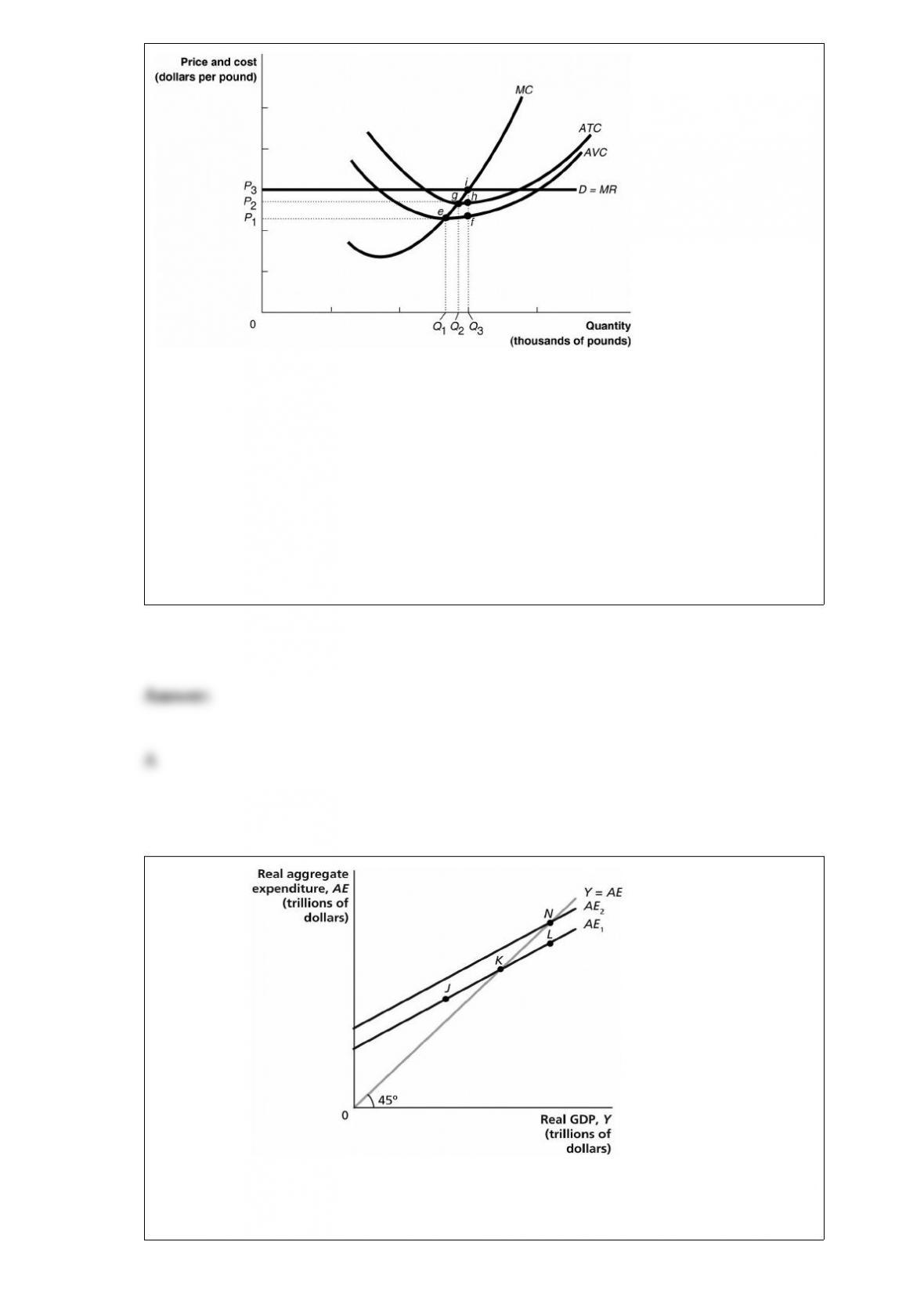
Figure 12-7 illustrates
the cost curves of a perfectly competitive firm. If the market price is P2 the firm
A) will break even and produce a quantity of Q2.
B) will make a profit and produce a quantity of Q2.
C) will make a profit and produce a quantity of Q1.
D) will make a profit and produce a quantity of Q3.
Figure 23-2
Suppose that the level of GDP associated with point N is potential GDP. If the U.S.
economy is currently at point K,

A) firms are operating above capacity.
B) the economy is at full employment.
C) the economy is in recession.
D) the level of unemployment is equal to the natural rate.
Economists reason that the optimal decision is to continue any activity up to the point
where the
A) marginal benefit is zero.
B) marginal benefit is greater than the marginal cost.
C) marginal cost is zero.
D) marginal benefit equals the marginal cost.
Which of the following is an example of a Pigovian tax?
A) payments by utilities to obtain tradable emissions allowances
B) a payroll tax
C) payments for licenses to pollute
D) a tax imposed on a utility that internalizes the cost of externalities caused by the
utility

The marginal product of labor is defined as
A) the change in total revenue that results when an additional unit of a labor is hired.
B) the additional labor required to produce one more unit of output.
C) the additional labor cost of producing one more unit of output.
D) the change in output that a firm produces as a result of hiring one more worker.
Which of the following is a result of government price controls?
A) Some people win and some people lose.
B) Price controls benefit poor consumers but harm producers and wealthy consumers.
C) Price controls increase economic efficiency.
D) The deadweight loss from price ceilings is greater than the deadweight loss from
price floors.

The term “payroll taxes” is often used to refer to
A) individual income taxes that are withheld from paychecks.
B) corporate income taxes.
C) Social Security and Medicare taxes.
D) sales taxes.
The supply curve for watches
A) shows the supply of watches consumers are willing and able to buy at any given
price.
B) is downward sloping.
C) shows the relationship between the quantity of watches firms are willing and able to
supply and the quantity of watches consumers are willing and able to purchase.
D) shows the relationship between the price of watches and the quantity of watches
supplied.
Calling long distance is often more expensive on weekdays between 8 am and 5 pm
than in the evening hours. Why is this the case?
A) Telephone companies hope to discourage customers from calling long distance
during the day to keep their labor costs down.
B) The cost of making long-distance connections is higher during the day than in the
evenings.
C) Businesses who must call suppliers or customers during business hours have few
alternatives and therefore have an inelastic demand during the workday compared to
after-work hours.
D) Increasingly, businesses who must call suppliers or customers during business hours
resort to the internet, thereby reducing demand for long-distance calls. To make up for
this fall in demand, telephone companies charge higher rates.
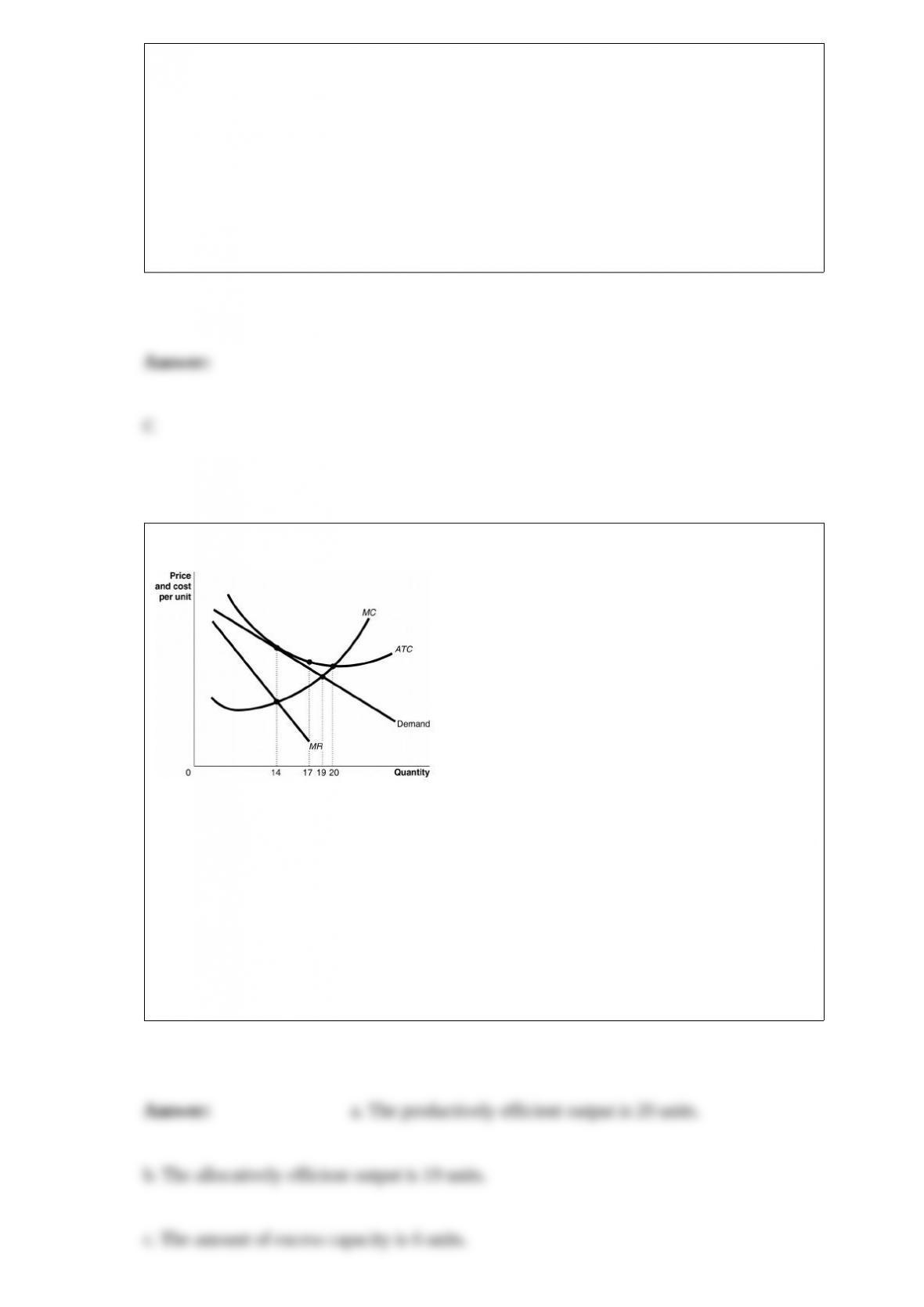
Figure 13-19
Answer the following questions.
a. What is the productively efficient output?
b. What is the allocatively efficient output?
c. What is the amount of excess capacity?
d. Suppose the firm is currently producing 14 units. What happens if it increases output
to 17 units?
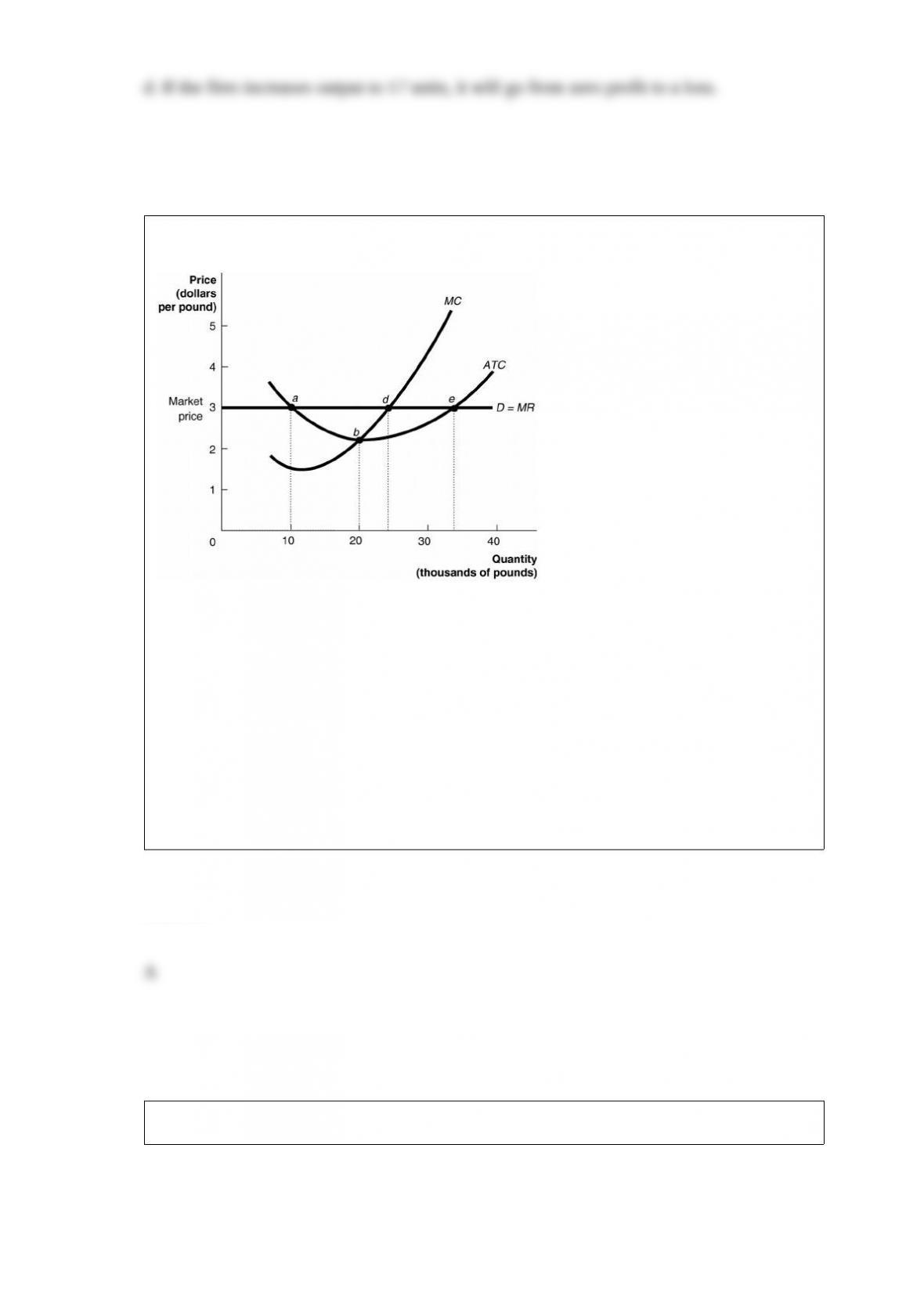
Figure 12-6
Figure 12-6 shows the demand,
marginal cost (MC) and average total cost (ATC) curves for Jason’s House of Apples. If
Jason maximizes his profit he will produce the output rate indicated by point ________
and his average profit will equal ________.
A) d; $3 minus ATC at point d
B) ; $3 minus ATC at point
C) e; $3 minus ATC at point e
D) a; $3
Table 19-17
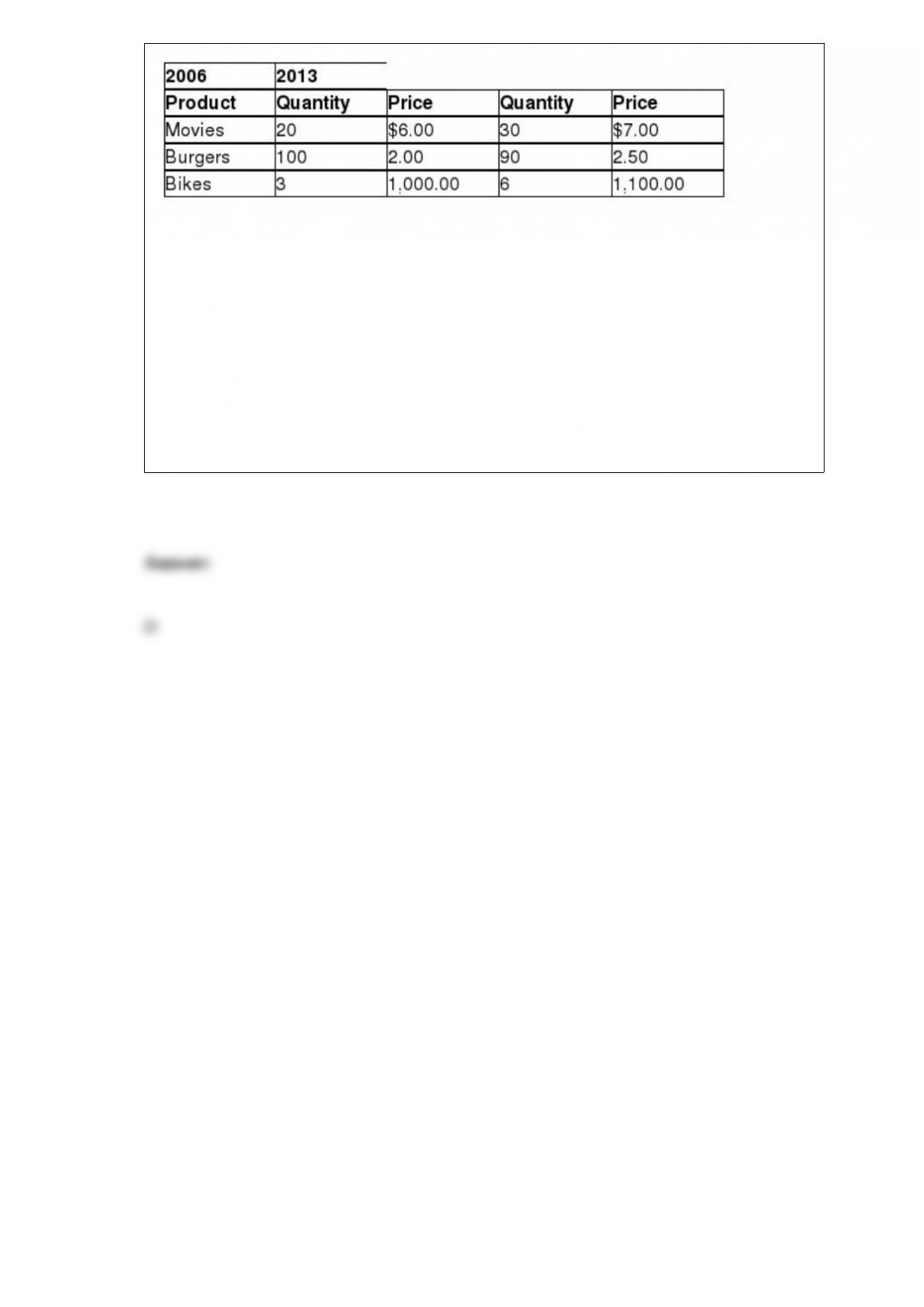
A very simple economy produces three goods: movies, burgers, and bikes. The
quantities produced and their corresponding prices for 2006 and 2013 are shown in the
table above. What is nominal GDP in 2013?
A) $3,320
B) $3,690
C) $6,360
D) $7,035