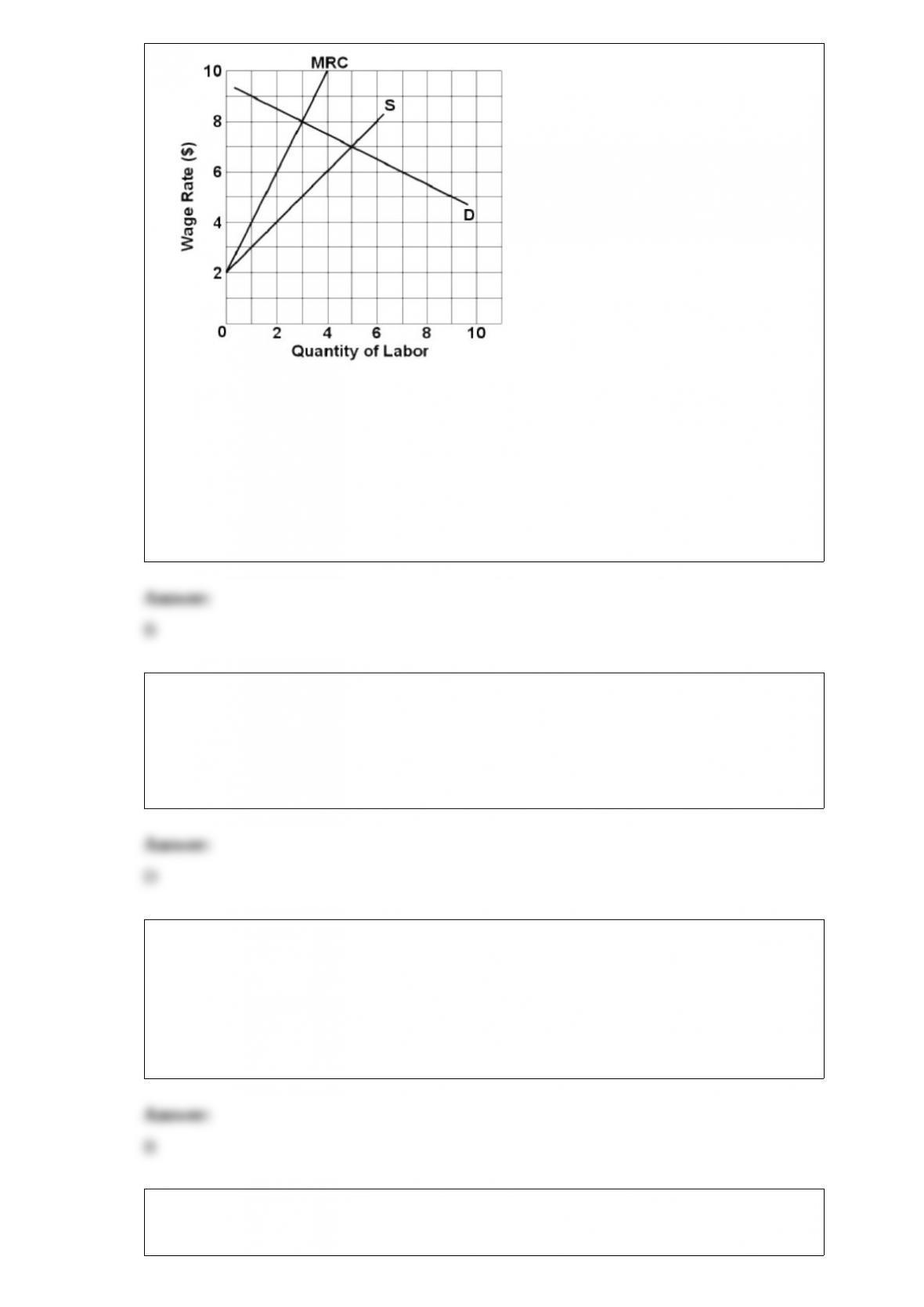
1)
Refer to the above labor market diagram where D is the labor demand curve, S is the
labor supply curve, and MRC is the marginal resource (labor) cost curve. An inclusive
union could increase the level of employment above that which the monopsonist would
provide if it could get the monopsonist to agree to any wage rate:
A.below $7.
B.between $5 and $8.
C.above $5.
D.above $8.
2) Currency held within banks is part of:
A.both the M1 and M2 definitions of the money supply.
B.the M2 definition of the money supply only.
C.the M1 definition of the money supply only.
D.none of these definitions of the money supply.
3) When deriving the aggregate demand (AD) curve from the aggregate expenditure
model, an increase in U.S. product prices would cause an increase in:
A.the value of household wealth and lower consumption expenditures.
B.interest rates and lower investment expenditures.
C.exports and imports.
D.U.S. resource prices and an increase in aggregate supply.
4) a firm reaches a break-even point (normal profit position) where:
a.marginal revenue cuts the horizontal axis.
b.marginal cost intersects the average variable cost curve.
c.total revenue equals total variable cost.
d.total revenue and total cost are equal.
5) if consumer desire for product x increases, all of the following will occur except:
a.an increase in the profits of industry x.
b.an increase in the quantity of resources employed by industry x.
c.an increase in the output of industry x.
d.a decrease in the quantity of resources employed in industry x.
6) If the marginal propensity to consume in an economy is 0.8, net exports are zero, and
government spending is $33 billion at each level of real GDP, the slope of the
economy’s aggregate expenditures schedule will be:
A..8.
B..2.
C.5.
D..125.
7) in terms of the circular flow diagram, businesses obtain revenue through the _____
market and make expenditures in the _____ market.
a.product; financial
b.resource; product
c.product; resource
d.capital; product
8) State right-to-work laws:
A.have been enacted by over one-half of the states in the nation.
B.make yellow dog contracts illegal.
C.allow for union shops while prohibiting closed shops.
D.make union and agency shops illegal.
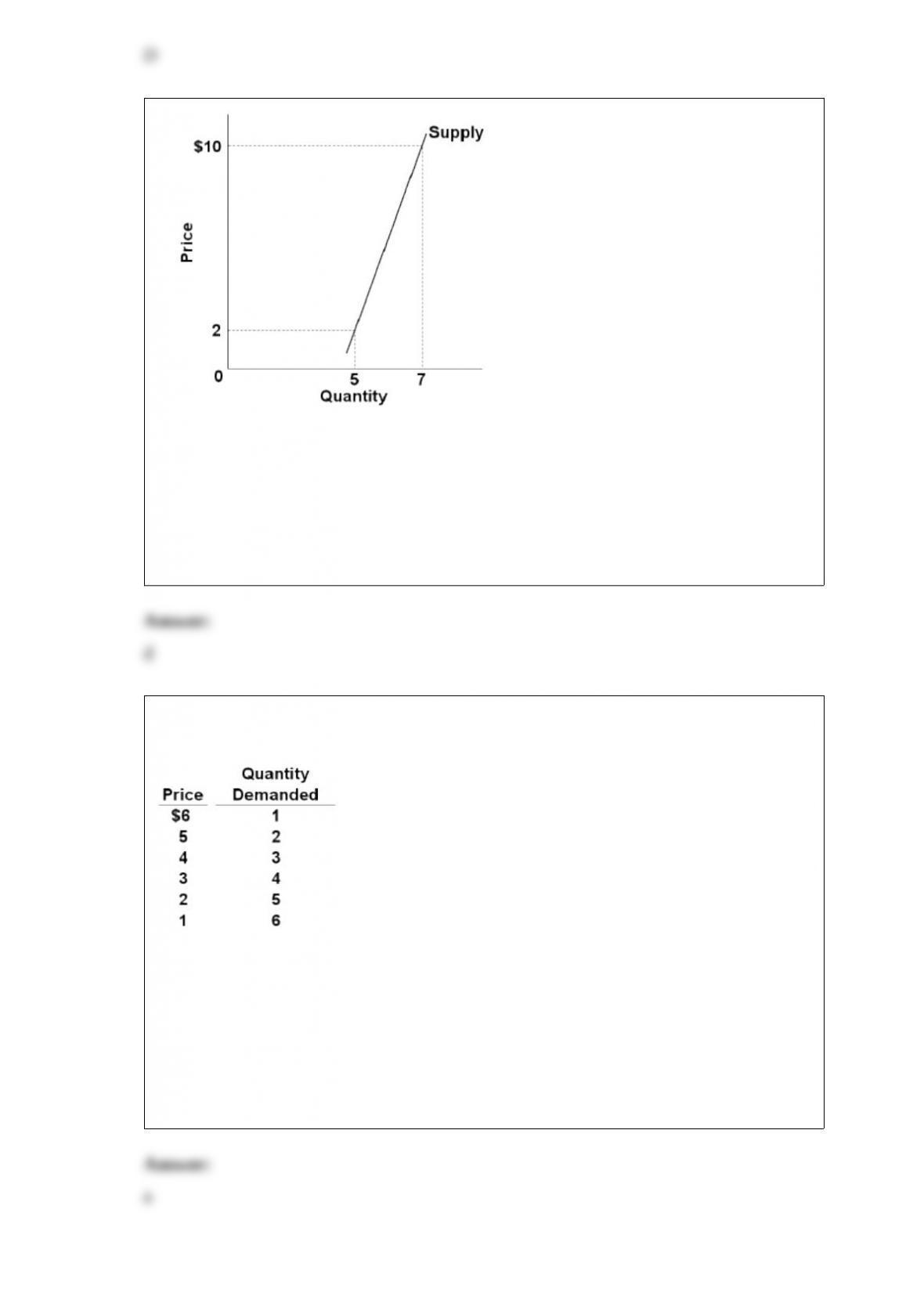
9)
refer to the above diagram and assume that price decreases from $10 to $2. the
coefficient of the price elasticity of supply (midpoints formula) relating to this price
change is about:
a.4 and supply is elastic.
b.1 and supply is unit elastic.
c..5 and supply is inelastic.
d..25 and supply is inelastic.
10) the following demand schedule:
refer to the above data. which of the following is correct?
a.although the slope of the demand curve is constant, price elasticity declines as we
move from high to low price ranges.
b.although the slope of the demand curve is constant, price elasticity increases as we
move from high to low price ranges.
c.although the demand curve is concave to the origin, price elasticity of demand is
constant throughout.
d.a steep slope means demand is inelastic; a flat slope means demand is elastic.
11) the general agreement on tariffs and trade (gatt) is based on the principle of:
a.establishing a single international currency.
b.tariff reductions through multilateral negotiations.
c.converting tariffs to import quotas.
d.establishing common environmental and labor standards for all member nations.
12) if the economy’s real gdp doubles in 18 years, we can:
a.not say anything about the average annual rate of growth.
b.conclude that its average annual rate of growth is about 5.5 percent.
c.conclude that its average annual rate of growth is about 2 percent.
d.conclude that its average annual rate of growth is about 4 percent.
13) if negative externalities are not internalized, the:
a.equilibrium output will exceed the most efficient output.
b.most efficient output will exceed the equilibrium output.
c.product must be a public good.
d.distribution of income will necessarily become more equal.
14) Suppose the demand for money and the supply of money increase simultaneously.
We can:
A.expect the interest rate to rise and bond prices to fall.
B.expect the interest rate to fall and bond prices to rise.
C.the nominal GDP to expand.
D. not predict what will happen to interest rates or bond prices.
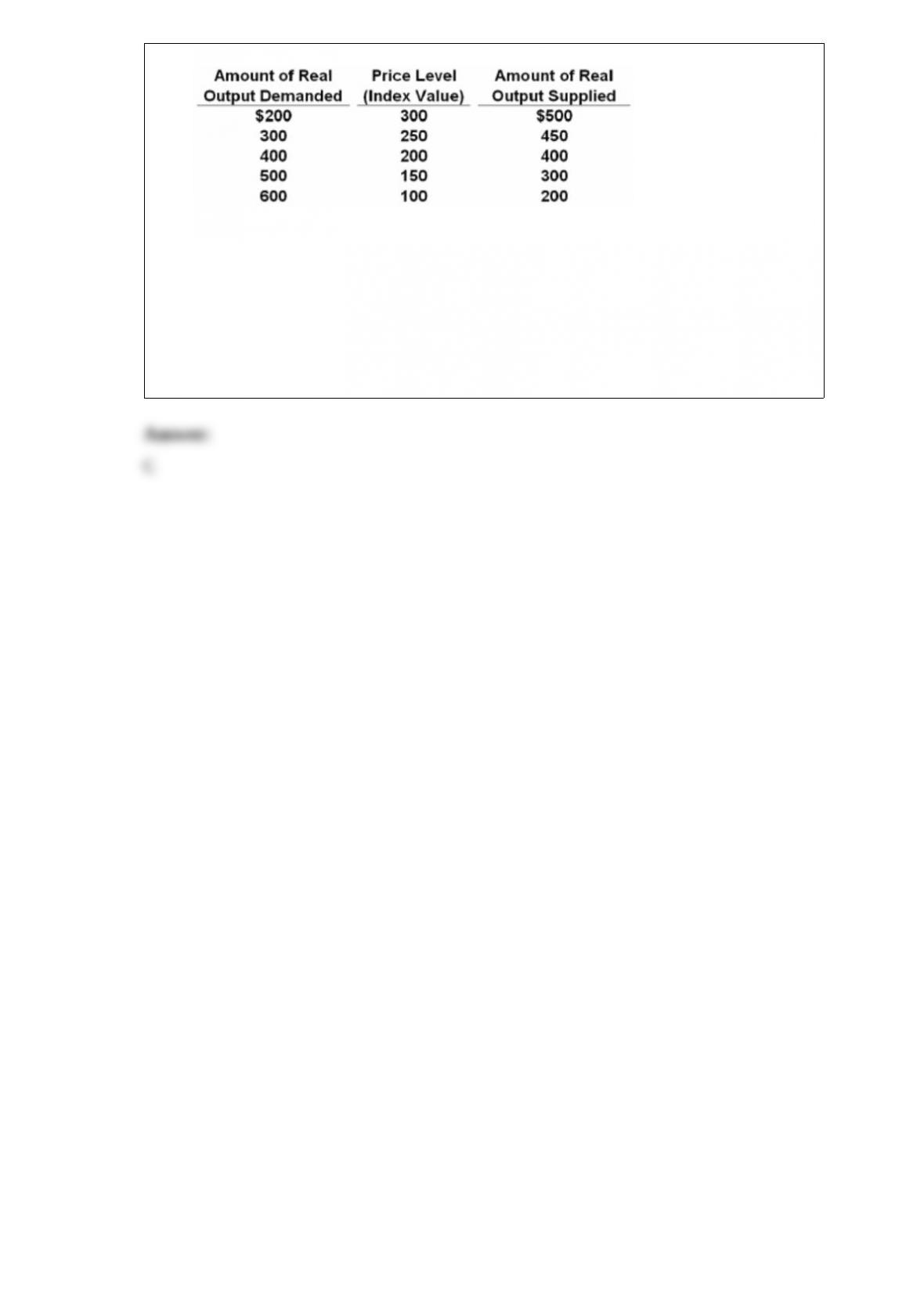
15)
Refer to the above data. If the amount of real output demanded at each price level falls
by $200, the equilibrium price level and equilibrium level of real domestic output will
fall to:
A.250 and $200, respectively.
B.200 and $300, respectively.
C.150 and $300, respectively.
D.150 and $200, respectively.