
The following equations represent the demand and supply for bottles of nail polish.
QD = 25 – P
QS = -15 + 3P
What is the equilibrium price (P) and quantity (Q – in thousands) of bottles of nail
polish?
A) P = $5; Q = 20 thousand
B) P = $15; Q = 30 thousand
C) P = $20; Q = 5 thousand
D) P = $10; Q = 15 thousand
“Because chips and salsa are complements, an increase in the price of chips will cause
the demand for salsa to decrease. This initial shift in demand for chips results in a
higher price for chips; this higher price will cause the demand curve for chips to shift to
the right.” Which of the following correctly comments on this statement?
A) The statement will be true if consumer tastes for chips and salsa do not change.
B) The statement is false because a change in the price of chips would not change the
demand for chips.
C) The statement is false because salsa is an inferior good; chips are normal goods.
D) The statement is false because one cannot assume that chips and salsa are
complements for all consumers.

Article Summary
Arguing that a merger would lead to higher prices, reduced service, and significantly
less competition, the Justice Department and attorneys general from 6 states and the
District of Columbia filed a lawsuit in August to challenge the pending merger of
American Airlines and US Airways. The lawsuit took some by surprise as the Justice
Department has in recent years approved the mergers of Delta with Northwest and
United with Continental. The European Union approved the merger in August, and
American and US Airways had hoped to complete the merger by September.
Source: Even Perez, “US government seeks to block American-US Airways merger,”
CNN.com, August 13, 2013.
Refer to the Article Summary. The standards used by the Department of Justice and the
FTC to evaluate a potential merger such as the one between American Airlines and US
Airways are based on market concentration as determined by the
A) Herfindahl-Hirschman Index.
B) Clayton Antitrust Act.
C) Anti-Collusion Task Force.
D) Robinson-Patman Act.
Figure 2-4
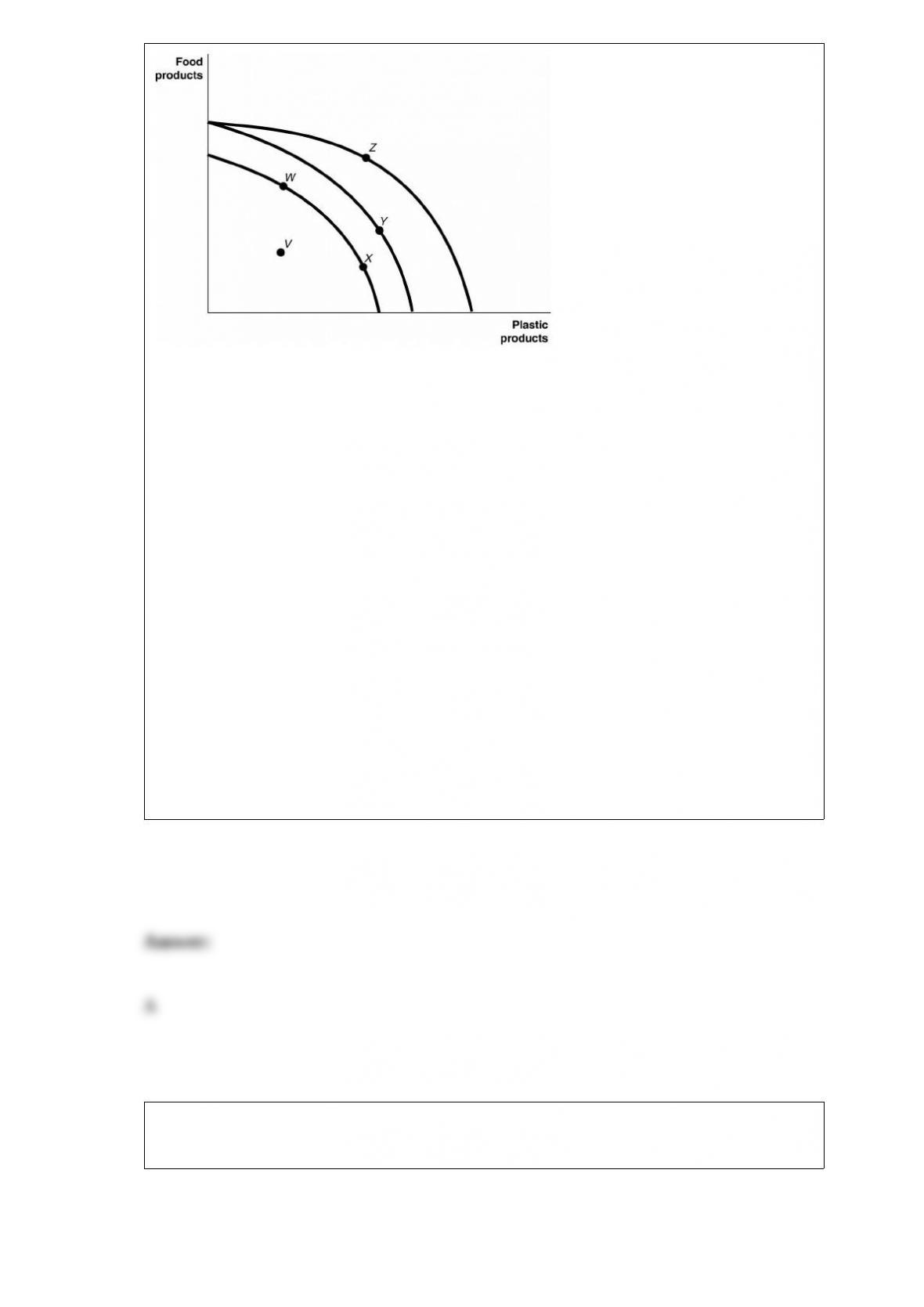
Figure 2-4 shows various points on three different production possibilities frontiers for
a nation.
Refer to Figure 2-4. Consider the following events:
a. a decrease in the unemployment rate
b. general technological advancement
c. an increase in consumer wealth
Which of the events listed above could cause a movement from V to W?
A) a only
B) a and b only
C) b and c only
D) a, b, and c
Figure 16-2
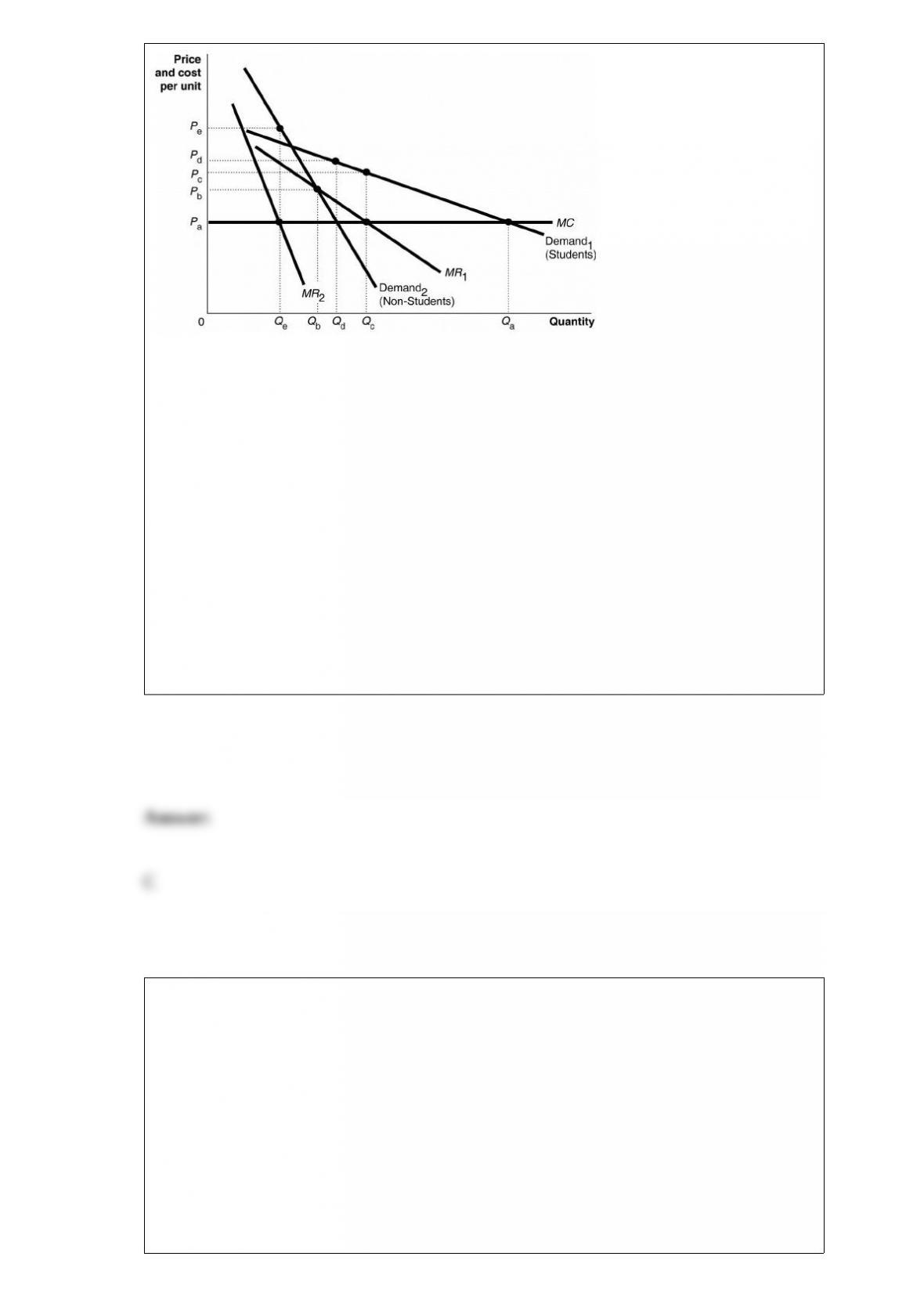
Plato Playhouse, a theatre company in the university town of Wegg, caters to two
groups of customers: students and the non-student population. Figure 16-2 shows the
demand curves for the two groups of customers.
Refer to Figure 16-2.What is the quantity sold to each group of customer and what is
the total quantity sold?
A) quantity sold to students=Qb;quantity sold to non-students=Qb; total sales=Qa
B) quantity sold to students=Qc;quantity sold to non-students=Qb; total sales=Qb+Qc
C) quantity sold to students=Qc;quantity sold to non-students=Qe; total sales=Qe+Qc
D) quantity sold to students=Qc;quantity sold to non-students=Qd; total sales=Qd+Qc
A monopolistically competitive firm that is profitable in the short run will face
competition that will eventually eliminate the firm’s profits in the long run. But the firm
can stave off competition and continue to earn economic profits if
A) it can successfully sue its competitors for copyright infringement.
B) it can move to another country where there is less competition.
C) it can lobby the government to establish a price floor for its product.
D) it can find new ways to differentiate its product.
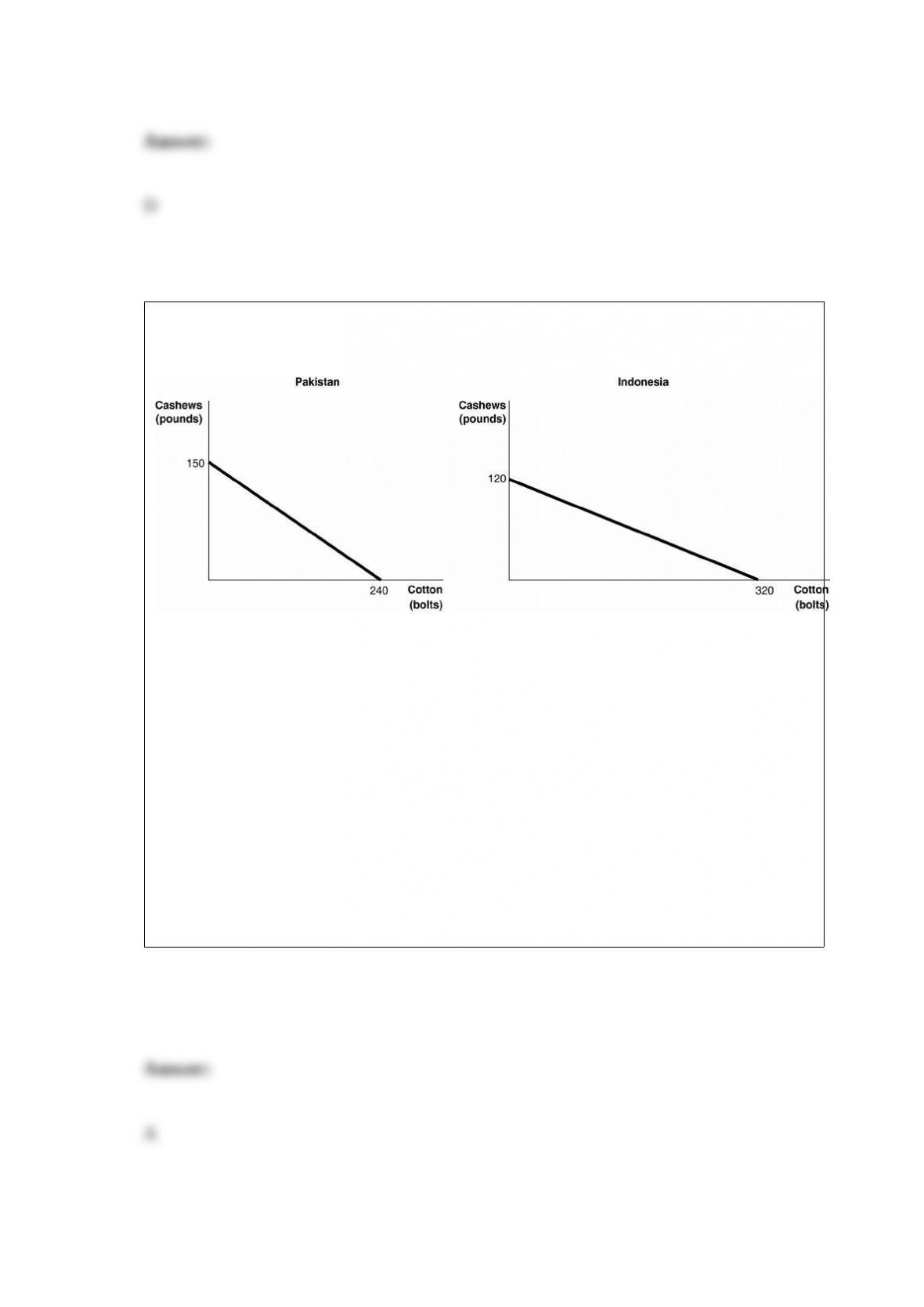
Figure 2-9
Figure 2-9 shows the production possibilities frontiers for Pakistan and Indonesia. Each
country produces two goods, cotton and cashews.
Refer to Figure 2-9. If the two countries have the same amount of resources and the
same technological knowledge, which country has an absolute advantage in the
production of cotton?
A) Indonesia
B) They have the same advantage.
C) Pakistan
D) cannot be determined

Traditionally, economists have considered culture, customs, and religion as
A) very important influences on the choices consumers make.
B) relatively unimportant factors in explaining the choices consumers make.
C) important influences in explaining consumer choices in command economies but
less important in market economies.
D) subject to normative economic analysis rather than positive economic analysis.
Assume that the price elasticity of demand for gasoline is -0.06. If the government tax
causes the price of gasoline to increase by 50 percent, what will be the decrease in the
quantity of gasoline demanded?
A) 0.5 percent
B) 3.0 percent
C) 8.33 percent
D) 50 percent
Price elasticity of supply is used to gauge
A) how responsive suppliers are to price changes.
B) how responsive suppliers are to changes in future prices.
C) how responsive suppliers are to a change in demand.
D) how responsive sales are to a change in input prices.
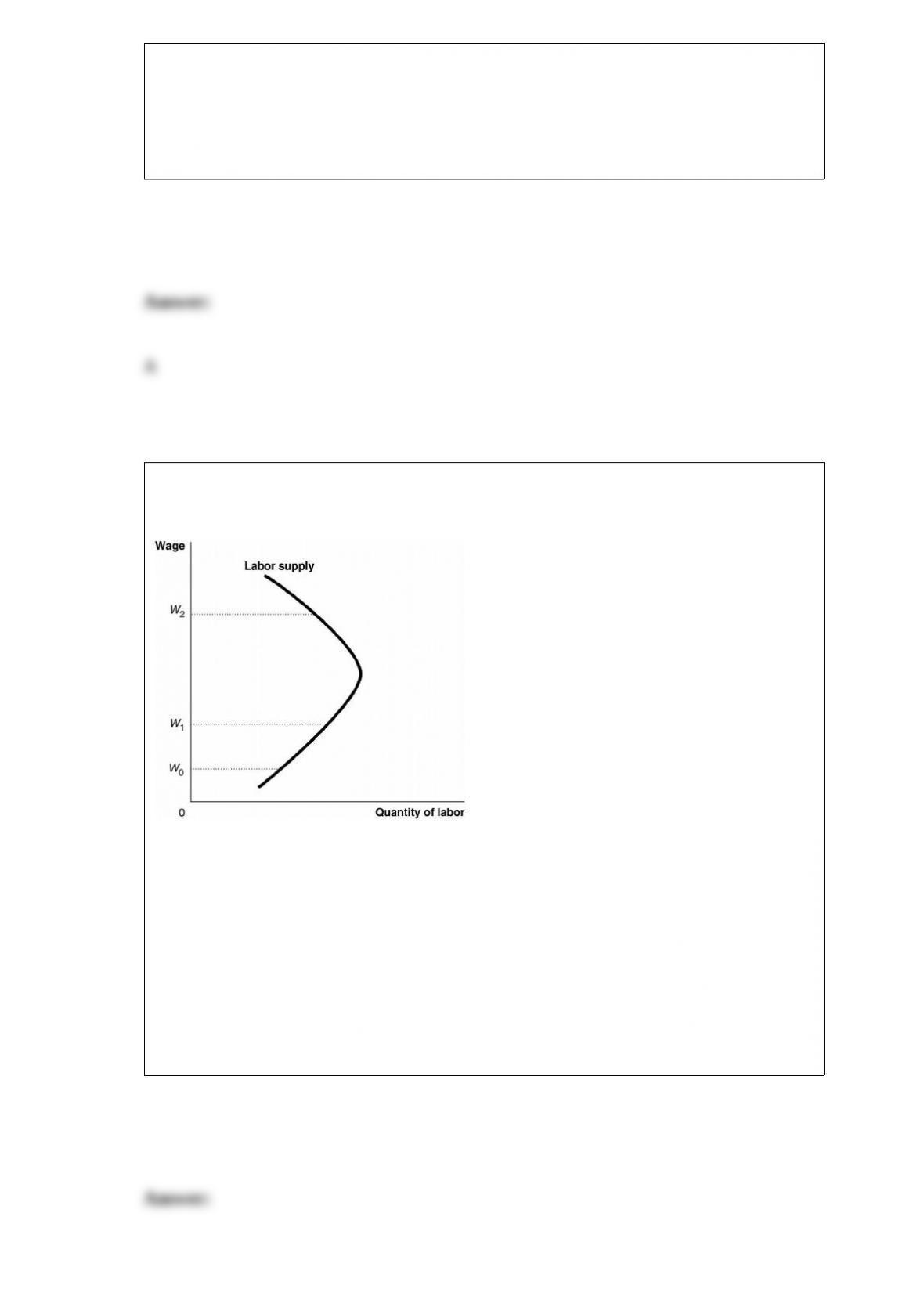
Figure 17-4
Refer to Figure 17-4. Which of the following is true if the wage rate increases from W1
to W2?
A) The income effect is larger than the substitution effect.
B) The substitution effect is larger than the income effect.
C) The income effect and the substitution effect are equal.
D) The supply curve is unit-elastic.
“Because apples and oranges are substitutes, an increase in the price of oranges will
cause the demand for apples to increase. This initial shift in demand for apples results in
a higher price for apples; this higher price will cause the demand curve for apples to
shift to the right.” Which of the following correctly comments on this statement?
A) The statement will be true if consumer tastes for apples and oranges do not change.
B) The statement is false because a change in the price of apples would not change the
demand for apples.
C) The statement is false because oranges are inferior goods; apples are normal goods.
D) The statement is false because one cannot assume that apples and oranges are
substitutes for all consumers.
Table 4-4
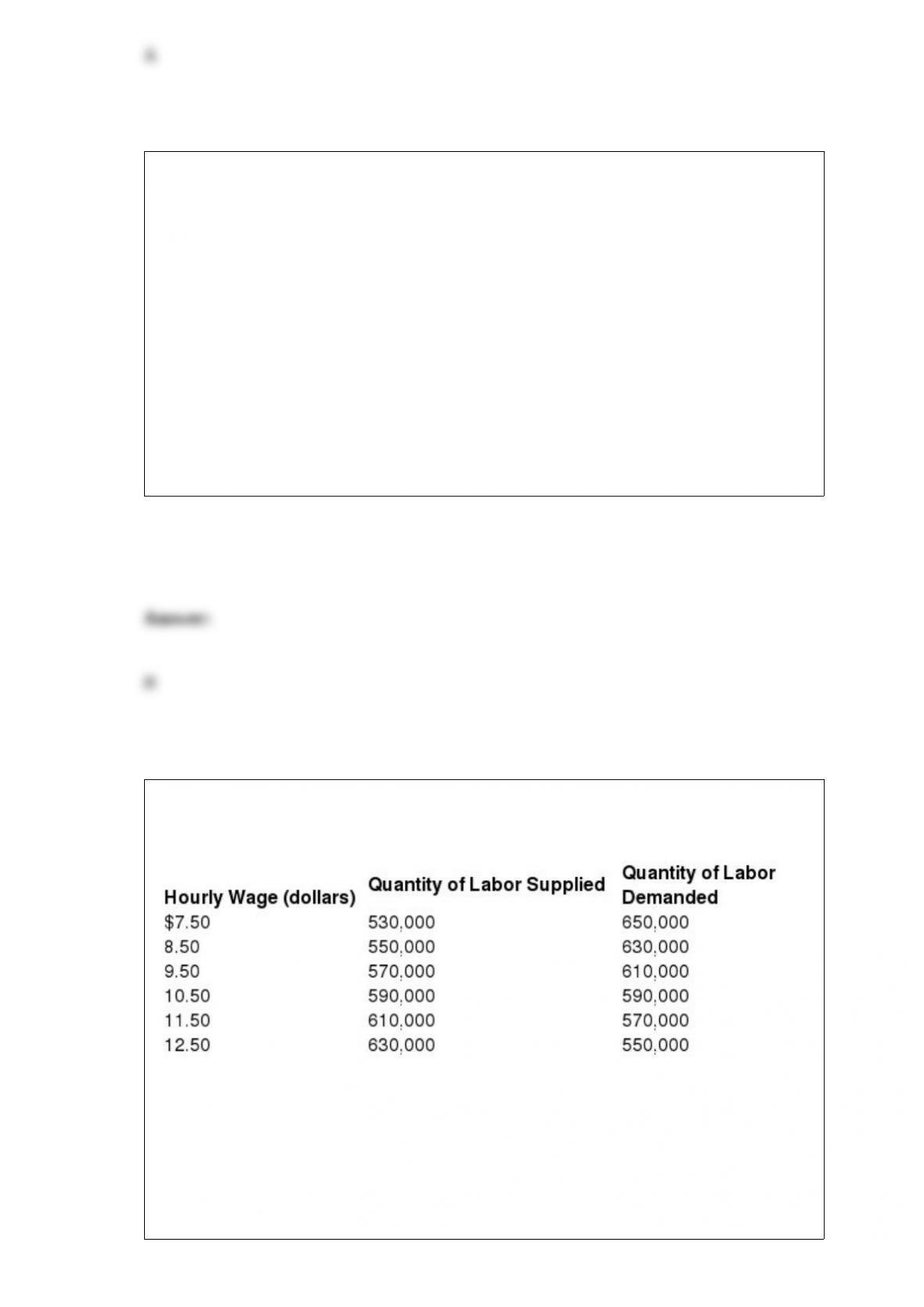
Table 4-4 shows the demand and supply schedules for labor market in the city of Pixley.
Refer to Table 4-4. If a minimum wage of $12.50 an hour is mandated, what is the
quantity of labor supplied?
A) 80,000

B) 550,000
C) 630,000
D) 1,180,000
Jeremy is thinking of starting up a small business selling NASCAR memorabilia. He is
considering setting up his business as a sole proprietorship. What is one disadvantage to
Jeremy of setting up his business as a sole proprietorship?
A) As a sole proprietor, Jeremy would be taxed twice.
B) As a sole proprietor, Jeremy would not have control of the business.
C) As a sole proprietor, Jeremy would face unlimited liability.
D) As a sole proprietor, Jeremy would be subject to significant rules and regulations.
Figure 9-2
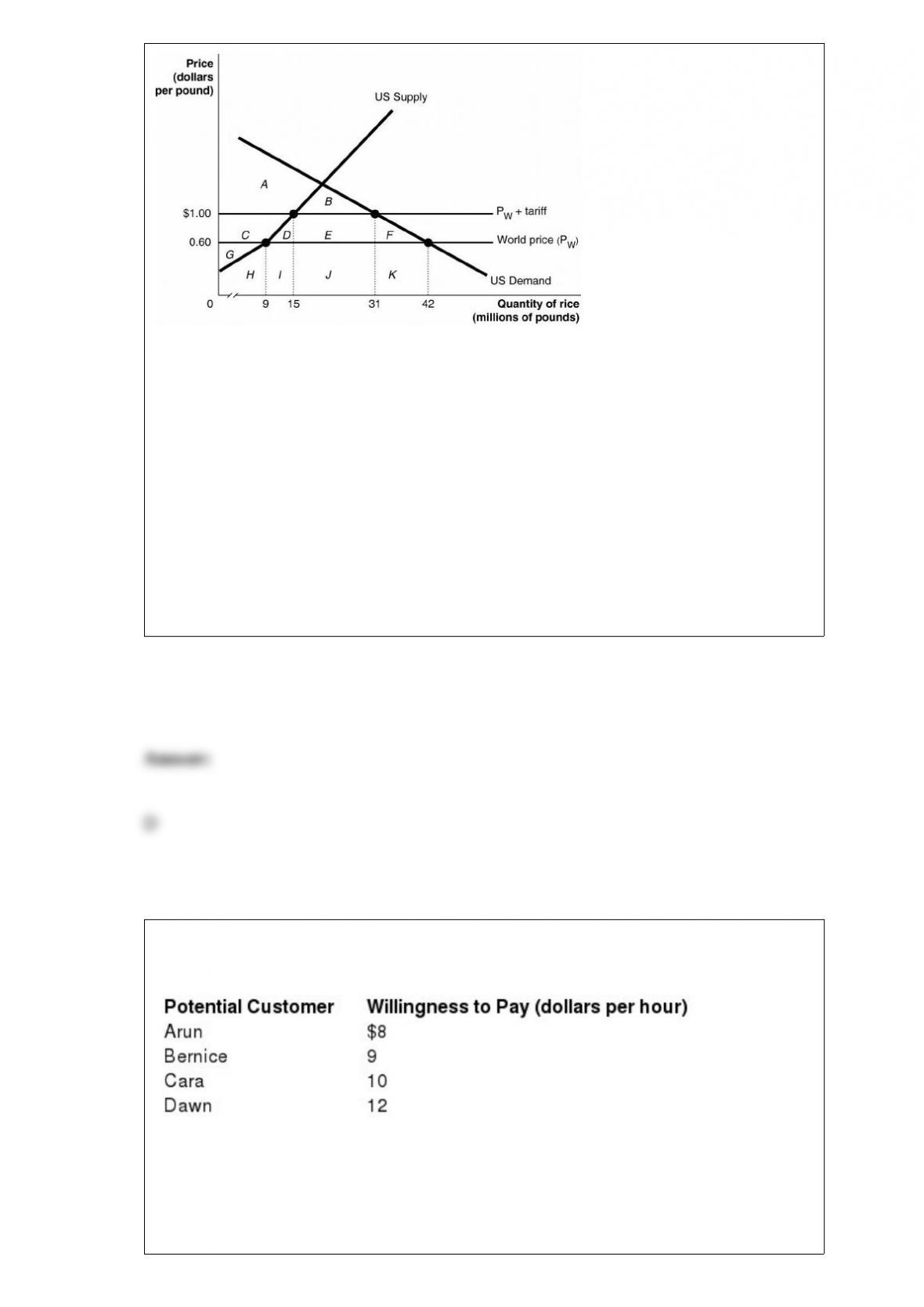
Suppose the U.S. government imposes a $0.40 per pound tariff on rice imports. Figure
9-2 shows the impact of this tariff.
Refer to Figure 9-2. As a result of the tariff, domestic producers increase their quantity
supplied by
A) 31 million pounds of rice.
B) 22 million pounds of rice.
C) 15 million pounds or rice.
D) 6 million pounds of rice.
Table 16-3
Julie plans to start a pet-sitting service. She surveyed her neighborhood to determine the
demand for this service. Assume that each person surveyed demands only one hour of
pet sitting services per period. Table 16-3 above shows a portion of her survey results.
Refer to Table 16-3. Suppose Julie’s marginal cost of providing this service is constant

at $7 and she charges $7. What is the value of the consumer surplus enjoyed by her
customers?
A) $39
B) $28
C) $11
D) $0
A form of implicit collusion where one firm in an oligopoly announces a price change
which is matched by other firms in the same industry is
A) “follow the leader” pricing.
B) price leadership.
C) retaliation pricing.
D) “tit-for-tat” pricing.
Table 16-3
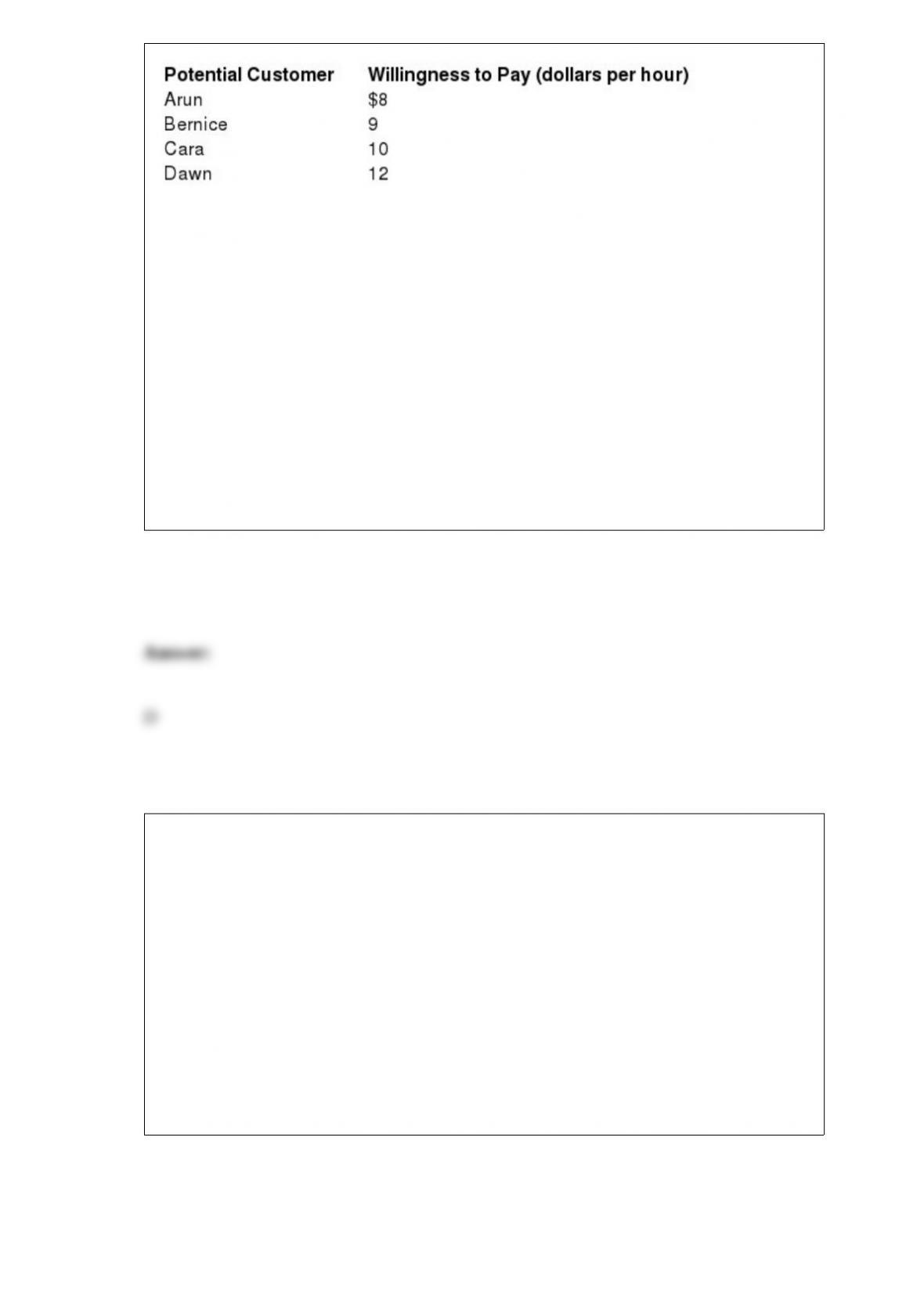
Julie plans to start a pet-sitting service. She surveyed her neighborhood to determine the
demand for this service. Assume that each person surveyed demands only one hour of
pet sitting services per period. Table 16-3 above shows a portion of her survey results.
Refer to Table 16-3. Suppose Julie’s marginal cost of providing this service is constant
at $7 and she decides to charge each customer according to his or her willingness to
pay. What is the value of consumer surplus by her customers?
A) $39
B) $28
C) $11
D) $0
Which of the following statements is true?
A) Consumer surplus under perfect price discrimination is greater than under
single-price monopoly pricing.
B) Consumer surplus under an optimal two-part tariff is greater than that under
single-price monopoly pricing.
C) Although consumers reap some consumer surplus under a single-price monopoly,
society is better off with optimal two-part tariff pricing.
D) Of the three pricing schedules, single-price monopoly, an optimal two-part tariff and
perfect price discrimination, profit is highest under single-price monopoly pricing.
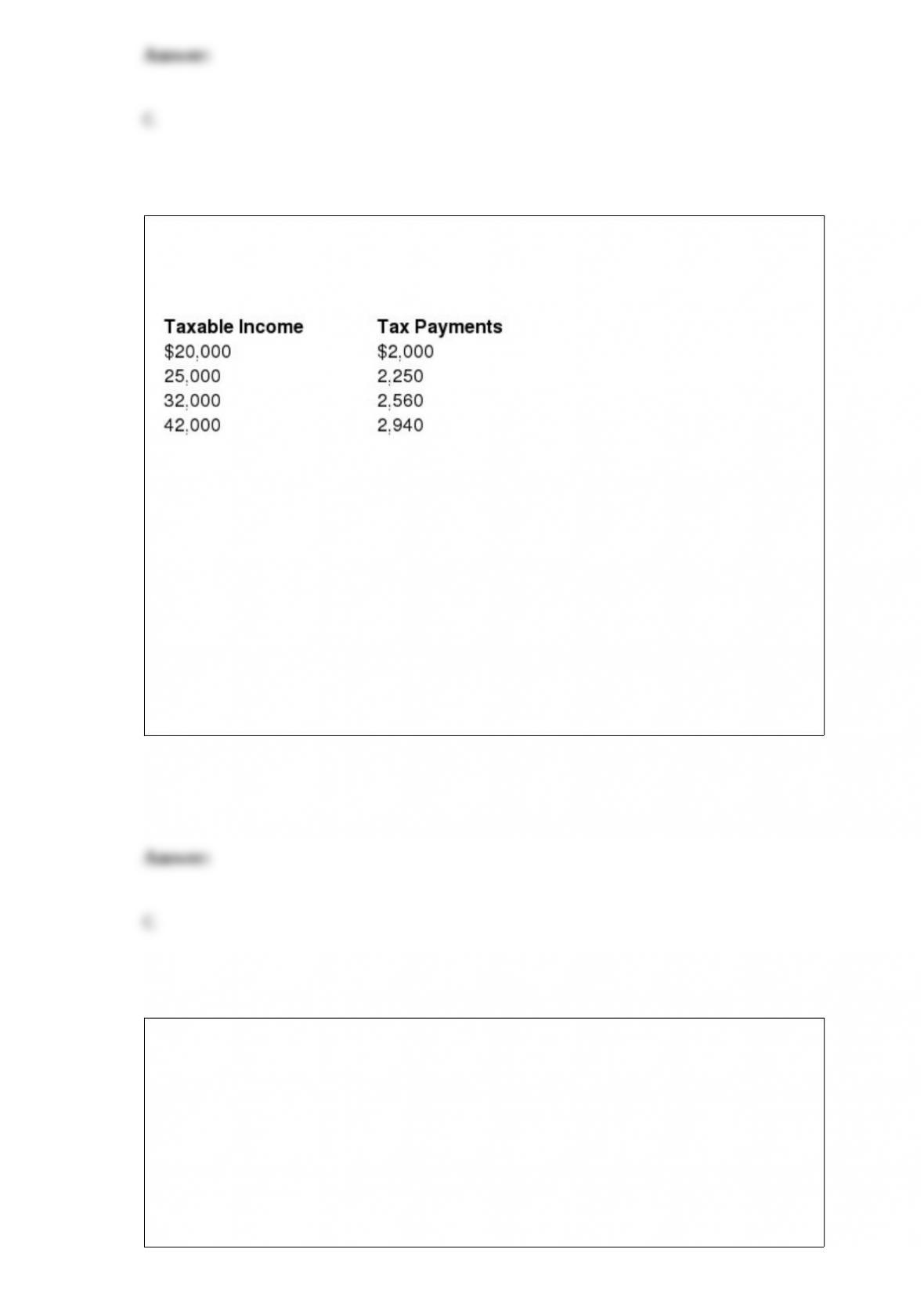
Table 18-5
Table 18-5 shows the amount of taxes paid on various levels of income.
Refer to Table 18-5. The tax system is
A) progressive throughout all levels of income.
B) proportional throughout all levels of income.
C) regressive throughout all levels of income.
D) regressive between $20,000 and $25,000 of income and progressive between
$32,000 and $42,000.
The larger the number of firms in an industry
A) the easier it is to implicitly collude to fix prices.
B) the more intense the rivalry among firms.
C) the greater the need for a price enforcement mechanism.
D) the larger the potential number of market segments.

In the United States in 2012, the percentage of firms that employed more than 200
workers and offered health insurance as a fringe benefit to the workers was about
A) 29%.
B) 42%.
C) 61%.
D) 98%.
Which of the following is an example of market “production,” as used by economist?
A) Garvey takes out a low-cost government loan to start his pet-sitting business.
B) Heidi makes a pizza for her family’s dinner.
C) Katrina works as a cashier at the local produce stand.
D) The theatre and film studies department in Fine Art’s College stages a play at the
local theatre.

The law of diminishing marginal returns
A) explains why the average total cost and marginal cost curves are U-shaped in the
short run.
B) explains why the average total cost, average fixed cost and the marginal cost curves
are U-shaped in the short run.
C) causes average total costs to rise at a decreasing rate as output increases.
D) causes the difference between average total cost and average variable cost to get
smaller as output increases.
New York Times writer Michael Lewis wrote that “The sad truth, for investors, seems to
be that most of the benefits….are passed through to consumers free of charge.” To
which of the following did Lewis refer?
A) apple farming in New York state
B) the Enron accounting scandal
C) the medical screening industry
D) new technologies developed in the 1990s

Between 1950 and 2013 the number of acres devoted to wheat production in the United
States ________ and the price of wheat ________.
A) declined; decreased
B) more than doubled; increased by about 50 percent
C) declined; more than doubled
D) increased; more than doubled
Which of the following is not an advantage of risk pooling?
A) By insuring large groups as opposed to individuals, health insurance providers
reduce adverse selection.
B) It gives very sick people in the group the same access to health care and to pay the
same premiums as healthy individuals.
C) It is easier for an insurance company to estimate the average number of claims likely
to be filed under a group policy than it is to predict the number of claims likely to be
filed under an individual policy.
D) Individuals who are insured and therefore do not have to pay the full cost of health
care services may be inclined to over-use those services.

Major League Baseball teams are similar to other firms in that they use factors of
production to produce a product (baseball games). An example of capital used by teams
to produce their products is
A) the money teams earn from television contracts and ticket sales.
B) the land on which baseball games are played.
C) the labor of baseball players.
D) the ballparks where the games are played.
What happens in the secondary market?
A) secondary inputs like electricity are sold
B) a corporate financial manager will raise funds for expansion of the firm
C) newly issued claims are sold by the borrowing firm to the initial buyer
D) already issued claims are sold from one investor to another
Table 6-3
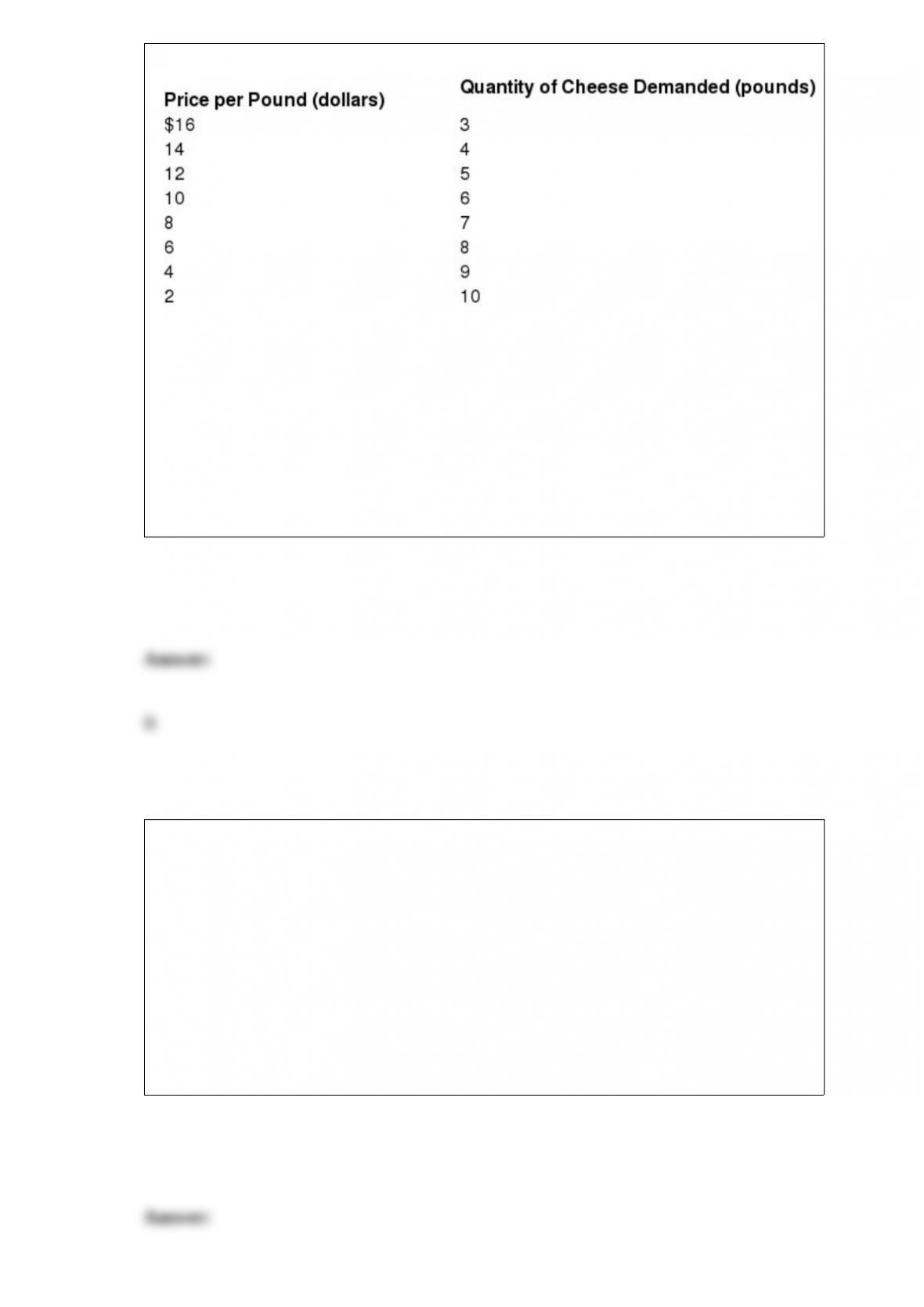
Refer to Table 6-3. Over what range of prices is the demand elastic?
A) over the entire range of prices
B) between $14 and $16
C) between $8 and $16
D) between $2 and $8
Assume that production from an electric utility caused acid rain. If the government
imposed a tax on the utility equal to the cost of the acid rain, the government’s action
would
A) externalize the externality.
B) result in a marginal social benefit greater than the marginal cost of the electricity.
C) be an example of supply side economic policy.
D) internalize the externality.

Scenario 1-2
Suppose a hat manufacturer currently sells 2,000 hats per week and makes a profit of
$5,000 per week. The plant owner observes, “Although the last 300 hats we produced
and sold increased our revenue by $1,000 and our costs by $1,100, we are still making
an overall profit of $5,000 per week so I think we’re on the right track. We are
producing the optimal number of hats.”
Refer to Scenario 1-2. Had the firm not produced and sold the last 300 hats, would its
profit be higher or lower, and if so by how much?
A) Its profit will be $1,100 higher.
B) Its profit will be $100 higher.
C) Its profit will be $100 lower.
D) Its profit will be $1,000 lower.
What three conditions must hold for a firm to successfully price discriminate?

What is an economic model?
Briefly describe the Sarbanes-Oxley Act and explain why it was passed.
Many state governments use lotteries to raise revenue. If a lottery is viewed as a tax, is
it most likely a progressive tax or a regressive tax? What information would you need
to determine whether the burden of a lottery is progressive or regressive?
Compare the distribution of income in the United States with the distribution of income
in other high-income countries.
What is an entrepreneur, and what decisions does an entrepreneur make in a market
system?
What effect does the entry of new firms in a monopolistically competitive market have
on the economic profits of existing firms in the market? How might existing firms
attempt to counteract this effect?
Explain the difference between a normal good and an inferior good.
What must be true in terms of the income effect, the substitution effect, and the type of
good for the good’s demand curve to be upward sloping?
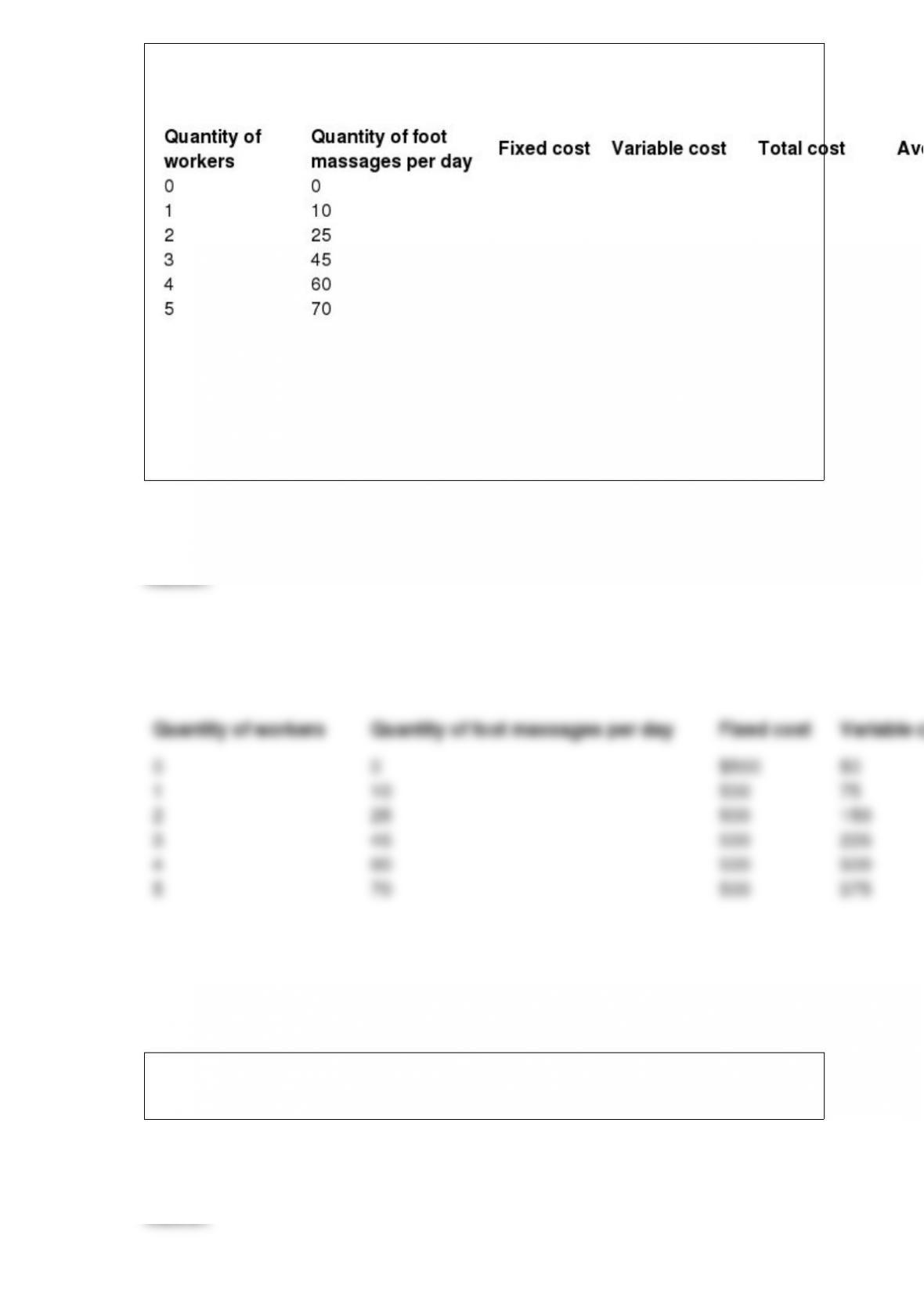
Table 11-6
Refer to Table 11-6. Alicia Gregory owns a foot massage business. She leases 4
computer-controlled massage booths, for which she pays $125 per day. She cannot
increase the number machines she leases without giving the manufacturer 3 months
notice. She can hire as many workers as she wants at a cost of $75 per day per worker.
These are the only two inputs she uses in her business. Use this information to fill in the
columns in the above table.
Your text refers to airlines as “The Kings of Price Discrimination.” Why is price
discrimination common in the airline industry?
In economics, what is the difference between the short run and the long run?
Does the strength of each of the five competitive forces from Michael Porter’s model
remain constant over time? Briefly explain.
Many book publishers use cost-plus pricing to establish prices for some of their books.
Would you expect a publishing company to use a strict cost-plus pricing system for all
its books? How might you determine if a publishing company actually does use
cost-plus pricing for all its books?
Describe the demand curve for a Giffen good.
Explain the significance of brand management to a firm that has differentiated its
product. Comment specifically on the importance of obtaining a trademark.
Explain how it would be possible for the equilibrium price and equilibrium quantity to
both increase in the market for motorcycles if consumer preference for motorcycles
increases and the number of motorcycle manufacturers decreases.
Music writer Anthony Kuzminski praised rock star Tom Petty in a 2007 article in the
online Unrated Magazine. Kuzminski wrote: “Something Petty never can get enough
credit for is his fan-friendly attitude. He kept ticket prices for [his concerts] at $50 when
other acts this summer are charging upwards of $100 for stadium gigs. Petty could
charge more, but he doesn’t see the point. He has stated time and time again he still

makes millions when he’s on the road, regardless of his ticket prices. He is the last of
the fan friendly rock stars out there.” Use economic reasoning to write a rationale for
Tom Petty’s decision to charge prices for his band’s (“Tom Petty and the
Heartbreakers”) concerts that are less than market clearing prices.
Source: Anthony Kuzminski, “Tom Petty & The Heartbreakers at the Vic Theater”
http://www.unratedmagazine.com/