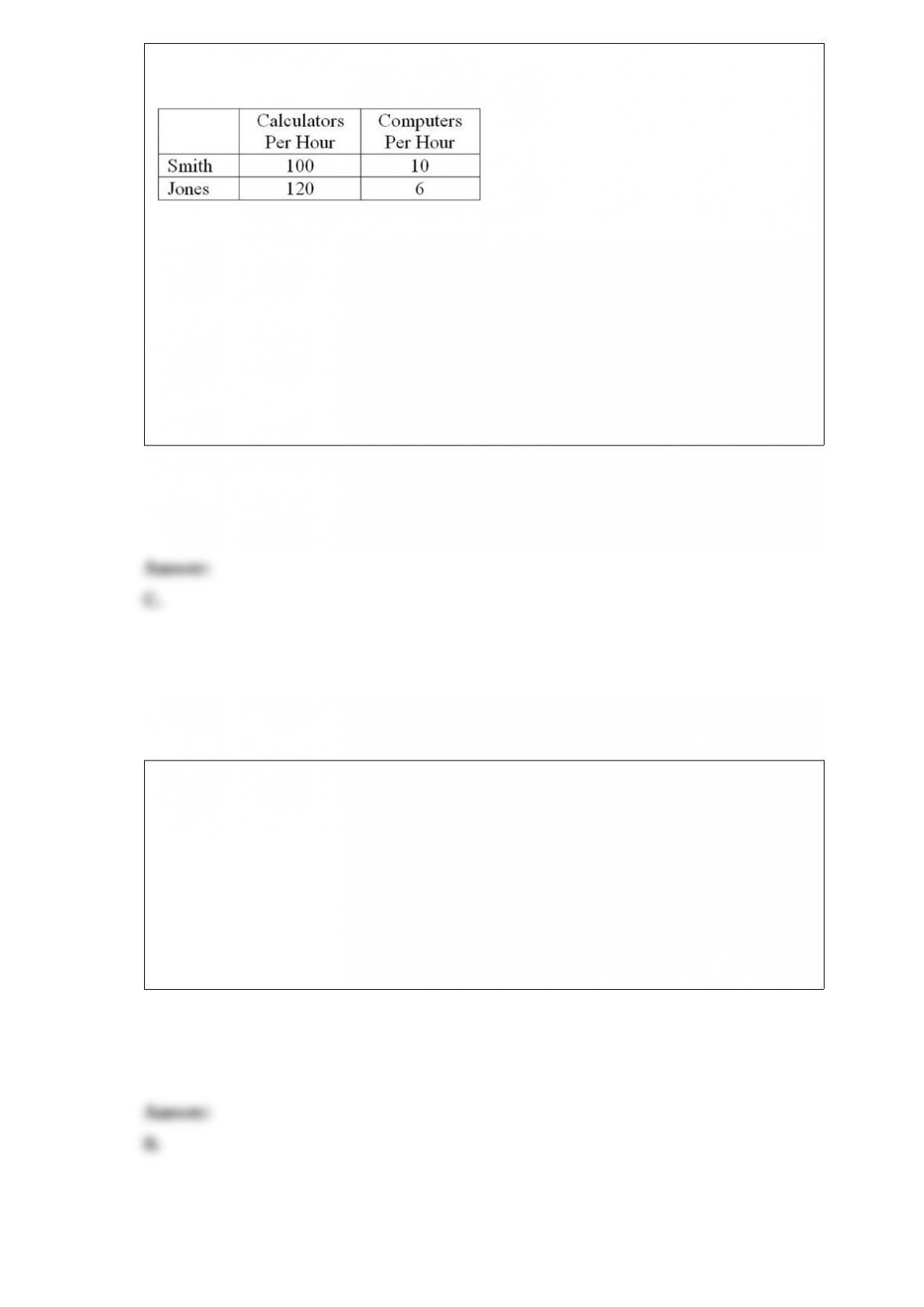
Smith and Jones comprise a two-person economy. Their hourly rates of production are
shown below.
Suppose Smith and Jones begin by producing 100 calculators per hour; as Smith and
Jones choose to efficiently produce fewer computers and more calculators, ______
should devote more time to calculators because his ______.
A. Smith; absolute advantage is larger
B. Jones; absolute advantage is smaller
C. Jones; opportunity costs are lower
D. Smith; opportunity costs are lower
If the nominal interest rate is 10% and the inflation rate is 3%, then the real interest rate
equals:
A. 3%
B. 7%
C. 10%
D. 13%

Suppose that the marginal cost of providing public television to one more viewer is
zero. If a public television station sets the price of public television equal to its marginal
cost, then:
A. the station will have an incentive to provide the optimal level of programming.
B. the station’s total revenue will be zero.
C. the station’s total revenue will be positive when there are only a few viewers, but will
decline as more viewers tune in.
D. the television station will earn zero economic profit.
In the basic Keynesian model, a decrease in government purchases:
A. reduces short-run equilibrium output.
B. increases short-run equilibrium output.
C. reduces potential output.
D. increases potential output.
Steve takes $500 from his paycheck and uses it to purchase U.S. Savings Bonds. Based
on this information:
A. Steve’s saving has increased by $500.
B. Steve’s saving has decreased by $500.
C. Steve has a capital gain of $500.
D. Steve’s wealth is unchanged.
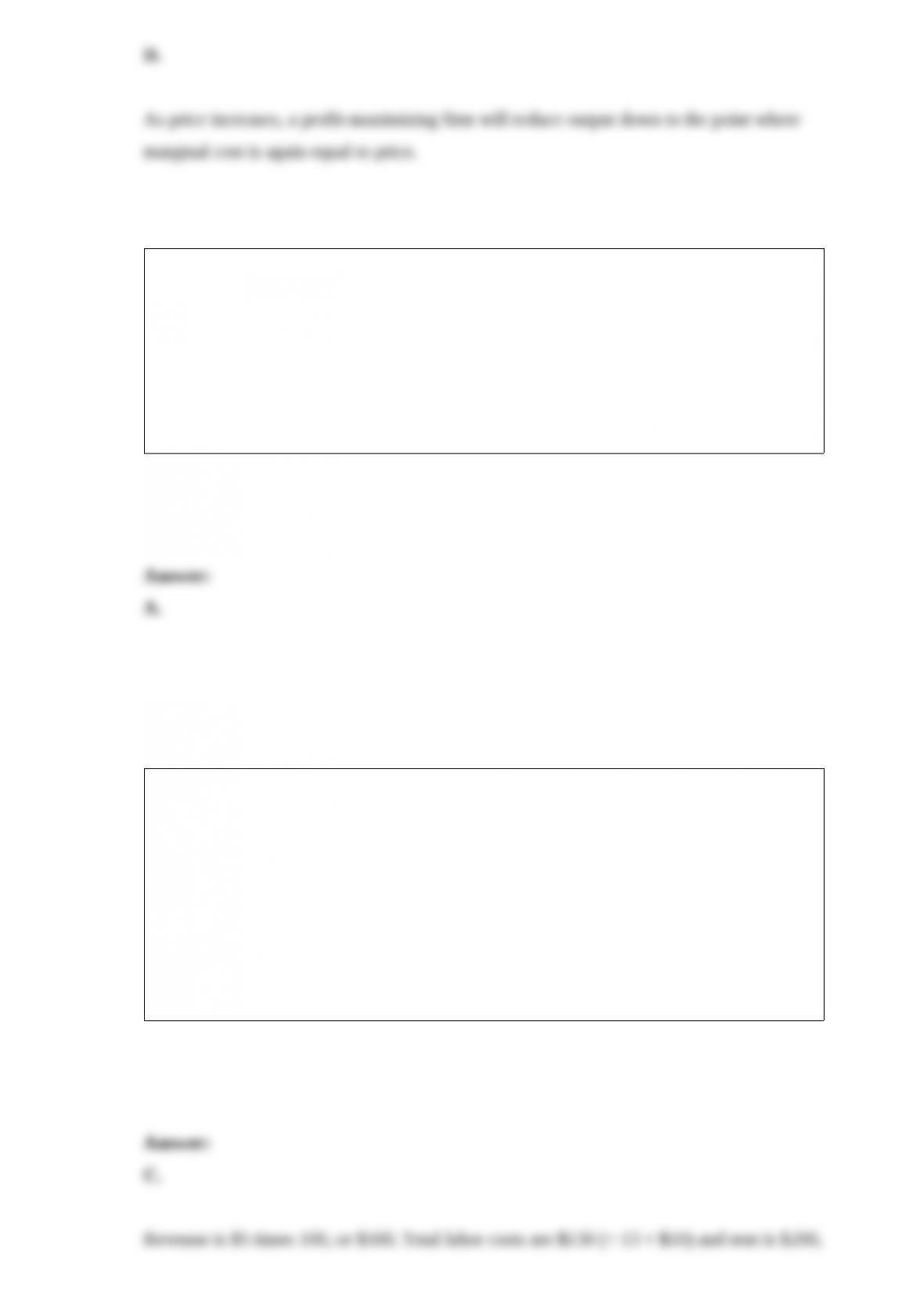
The following data give the dates of successive turning points in U.S. economic activity
and the corresponding levels of real GDP at the time.
Which of the following periods was an expansion?
A. November 1970 through November 1973
B. December 1969 through November 1970
C. November 1970 through March 1975
D. December 1969 through November 1973

Economic profit is equal to:
A. accounting profit plus implicit costs.
B. total revenue minus accounting profit.
C. total revenue minus the sum of explicit and implicit costs.
D. accounting profit minus explicit costs.
Which of the following is an example of the rationing function of price?
A. Switching from a Ph.D. in economics to one in finance because finance salaries are
higher.
B. Bill Gates purchasing the Mona Lisa for $5 billion.
C. A firm attempting to lower its explicit costs.
D. Government price controls.

Mexico and the members of OPEC produce crude oil. Realizing that it would be in their
best interests to form an agreement on production goals, a meeting is arranged and an
informal, verbal agreement is reached. If both Mexico and OPEC abide by the
agreement, then OPEC’s profit will be $200 million and Mexico’s profit will be $100
million. If both Mexico and OPEC cheat on the agreement, then OPEC’s profit will be
$175 million and Mexico’s profit will be $80 million. If only OPEC cheats, then
OPEC’s profit will be $185 million, and Mexico’s profit will be $60 million. If only
Mexico cheats, then Mexico’s profit will be $110 million, and OPEC’s profit will be
$150 million. You may find it helpful to fill in the payoff matrix below.
To OPEC, the payoff to abiding by the agreement is either:
A. $150 million or $200 million.
B. $200 million or $185 million.
C. $60 million or $100 million.
D. $175 million or $185 million.
Starting from potential output, if consumer confidence decreases and consumers decide
to spend less, then this will shift the ______ curve to the left and generate ______.
A. aggregate demand; a recessionary output gap
B. aggregate supply; a recessionary output gap
C. aggregate demand; an expansionary output gap

D. aggregate supply; an expansionary output gap
An economy with a trade deficit must also have:
A. a trade deficit.
B. a budget surplus.
C. positive net capital outflows.
D. positive net capital inflows.
A decrease in the price a firm receives for its output will lead the firm to:
A. expand output.
B. cut its payments to its factors of production.
C. leave output unchanged.
D. reduce output.
Varying the quantity of output produced and sold at preset prices is called:
A. meeting demand.
B. self-correcting economics.
C. Okun’s law.
D. spurring inflation.
Assume that each day a firm uses 13 employee-hours and an office to produce 100 units
of output. The price of each unit output is $5, the hourly wage rate is $10, and rent on
the office is $200 per day. Each day the firm earns a ______ of ______.
A. profit; $370
B. loss; $200
C. profit; $170
D. loss; $170

Differences in wage rates associated with differences in working conditions are called:
A. compensating income differentials.
B. equalizing wage ratios.
C. conditional differentials.
D. compensating wage differentials.
Peg’s Manicure Manor did 4,000 sets of nails in 2010 and 4,500 sets of nails in 2011.
The price of a set of nails was $20 in 2010 and $22 in 2011. If 2010 is the base year,
Peg’s contribution to nominal GDP in 2010 was ______ and in 2011 was _______.
A. $80,000; $88,000
B. $80,000; $90,000
C. $80,000; $99,000
D. $88,000; $90,000

Superstar professional athletes can sustain their economic rents because:
A. team owners will pay anything to win a championship.
B. they are represented by highly-skilled agents.
C. their opportunity costs of playing their sport are high.
D. they have unique talents that they can sell to the highest bidder.
Matt is offered a job driving the campus shuttle bus from 4 p.m. to 6 p.m. each Monday.
His reservation wage for this job is $7 per hour. Now suppose the director offers Matt
$50 per hour, but also announces that Matt’s earnings will be divided equally among
Matt and the 99 other students who live in Matt’s dorm. What will be Matt’s economic
surplus from accepting the job?
A. $0.50 per hour
B. $1.00 per hour
C. -$6.00 per hour
D. -$6.50 per hour

If the price of dynamite drops to $10, should Acme Dynamite continue to operate in the
short run?
A. No, because price is less than average total cost
B. Yes, because price is less than average variable cost
C. No, because price is not greater than average total cost
D. Yes, because price is greater than average variable cost
One trend in labor markets is:
A. a decrease in average real wages in the United States and other industrial countries.
B. decreasing wage inequality in the United States.
C. weak rates of job creation in the United States since 1980.
D. a slowdown in real wage growth in the United States since 1973.
Suppose that there is not enough parking at an urban university. Sometimes students
come to campus, spend a few minutes searching for a parking spot, and then decide that
going to class isn’t worth the effort of continuing to search for a parking spot, so they go

home. Assume that all professors give midterm exams on the same day. You would
expect the optimal amount of time spent searching for a parking spot on that day to
_____ because ______.
A. decrease; the marginal cost of search is higher
B. increase; the marginal cost of search is lower
C. increase; the marginal benefit of search is higher
D. decrease; the marginal benefit of search is lower
When the expected value of search increases:
A. fewer searches occur.
B. the number of searches does not change.
C. more searches occur.
D. the cost of searching falls.
Suppose Joe has a two-year old Honda Civic that’s in excellent condition and that he
would be willing to sell for $13,000. Lauren, who is risk-neutral, is considering whether
to buy Joe’s car. She’s willing to pay $14,000 for a two-year Honda Civic that’s in
excellent condition and only $10,000 for one that’s not in excellent condition. Lauren

cannot tell whether Joe’s car is in excellent condition. She believes that only 20 percent
of two-year old Hondas for sale in the market are in excellent condition and that the
other 80 percent are not in excellent condition. Will Lauren buy Joe’s car?
A. Yes, because Lauren is willing to pay $14,000 for a car that’s in excellent condition.
B. No, because Lauren will not be willing to pay Joe $13,000.
C. Maybe, because Lauren might be willing to pay as much as $14,000.
D. Yes, because Lauren will be willing to pay Joe more than $13,000.
Refer to the figure below. If this firm is a price taker and the price of each unit of output
is $10, then at its profit-maximizing level of output, this firm will earn a ______ of
______.
A. loss; $60
B. loss; $240
C. profit; $450
D. profit; $900
People’s expectations of future inflation that do not change even if inflation rises
temporarily are called _____ inflationary expectations.
A. aggregate

B. average
C. anchored
D. autonomous
As price increases, firms find that it is:
A. beneficial to produce more units of output.
B. more difficult to sell their product.
C. beneficial to produce fewer units of output.
D. easier to sell their product.
Since the cost of using more of any resource is ______, viewing any resource’s price as
zero leads to ______.
A. positive; underutilization

B. negative; overutilization
C. positive; a surplus
D. positive; overutilization
The long-run average annual growth of real GDP per person is the United States is
approximately ______ percent.
A. one
B. two
C. five
D. seven
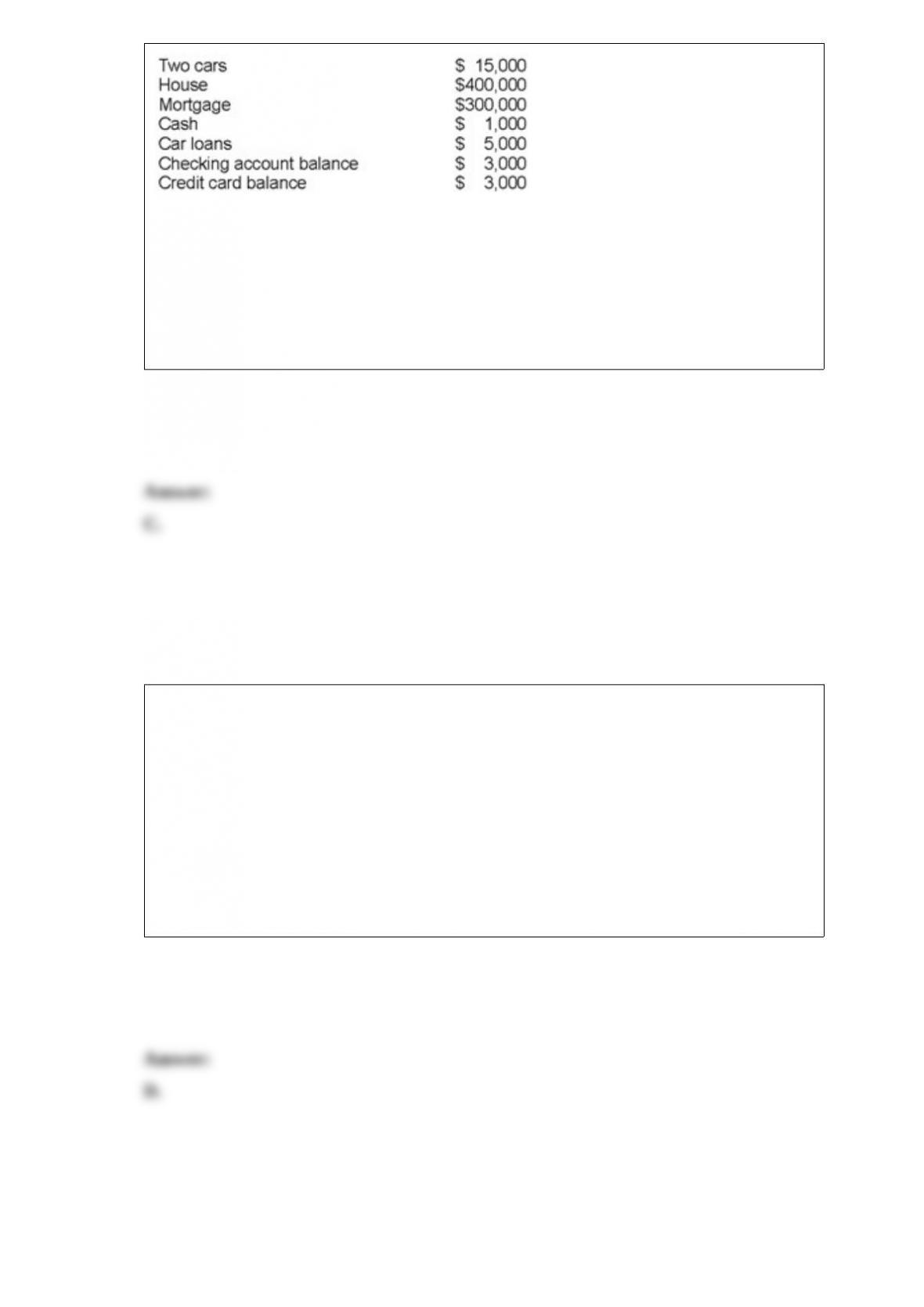
Suppose that Taylor receives a $10,000 bonus from her employer. If she puts that
money toward her mortgage, her wealth would ______; if she puts that money in her
checking account, her wealth would ______.
Taylor has the following assets and liabilities:
A. increase to $121,000; decrease to $101,000
B. increase to $115,000; decrease to $95,000
C. increase to $121,000; increase to $121,000
D. increase to $115,000; increase to $115,000
Supposethe price of gold is $300 per ounce in the United States and 2,400 pesos per
ounce in Mexico. If purchasing power parity holds then, if the price of oil is 200 pesos
per barrel in Mexico, the price of oil is ______ per barrel in the United States.
A. $1,600
B. $80
C. $36
D. $25

When economists use market values to aggregate output, they sum the:
A. number of items produced.
B. quantity of items produced.
C. price times the quantity of each item produced.
D. inputs of each item produced.
A fiscal policy action to close an expansionary gap is to:
A. decrease taxes.
B. increase transfer payments.
C. decrease government purchases.
D. increase the marginal propensity to consume.