Price discrimination was deemed illegal by the
a. Sherman Act.
b. Wheeler-Lea Act.
c. Clayton Act.
d. Federal Trade Commission Act.
e. none of the above
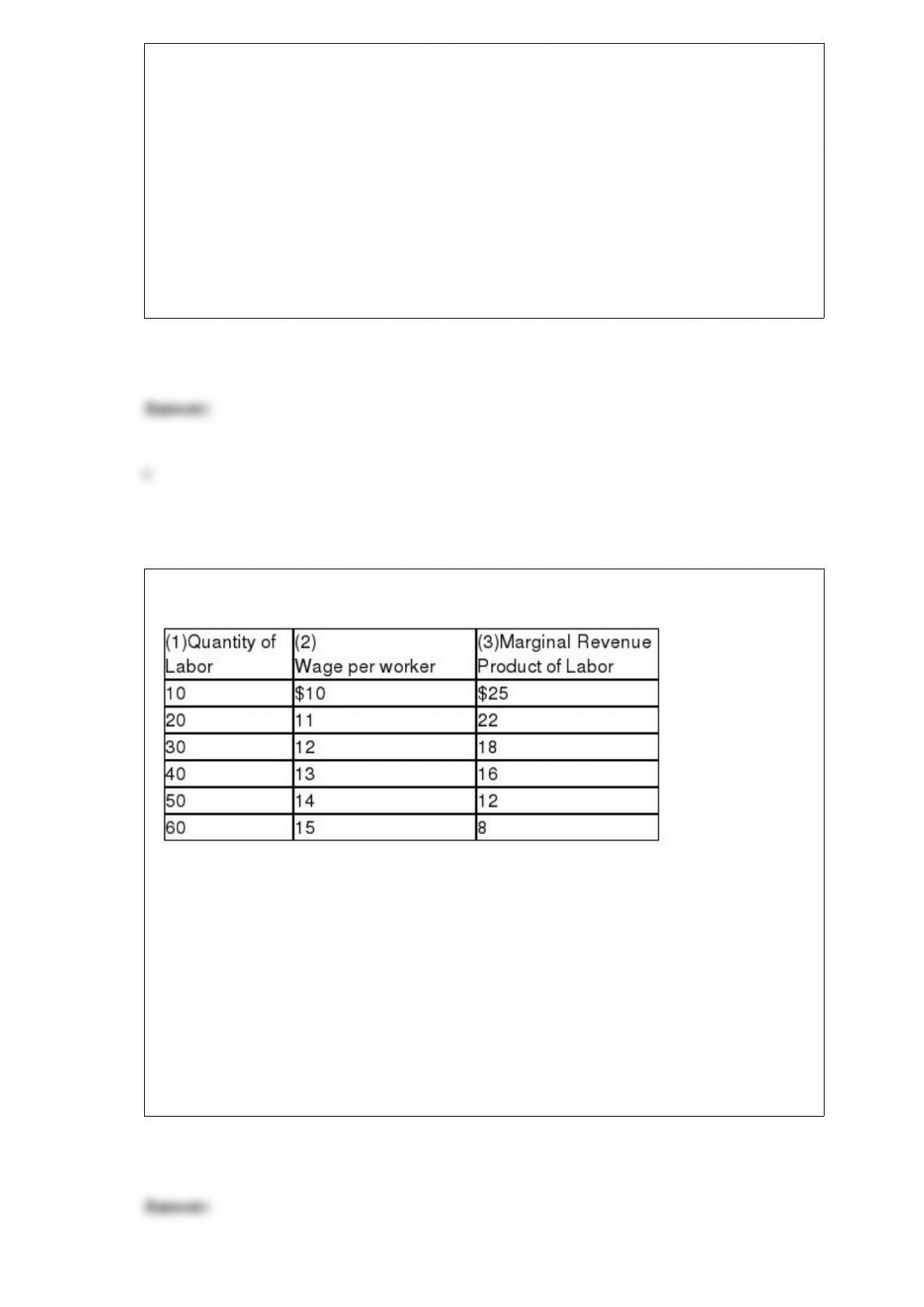
Exhibit 28-7
As the firm increases employment from 50 to 60 workers, by how much does total labor
cost increase?
a. $160
b. $40
c. $60
d. $200

When a good is nonexcludable, then individuals
a. will purchase the good for more than what it cost to produce the good.
b. can obtain the benefits of the good without paying for it.
c. have an incentive to become free riders.
d. will purchase more than the optimum amount.
e. b and c
In the case of a negative externality, the socially optimal output naturally exists if
a. the external costs associated with the negative externality are extremely small.
b. the external costs divided by price is equal to price divided by marginal private cost.
c. there are no free riders.
d. the public good aspects of the negative externality outweigh the costs incurred by the
negative externality.
e. none of the above
If a seller is a price taker it means that the seller sells his product at the price
a. he chooses.
b. determined in the market.
c. determined by the biggest firm in the market.
d. determined by the largest consumer in the market.
e. none of the above
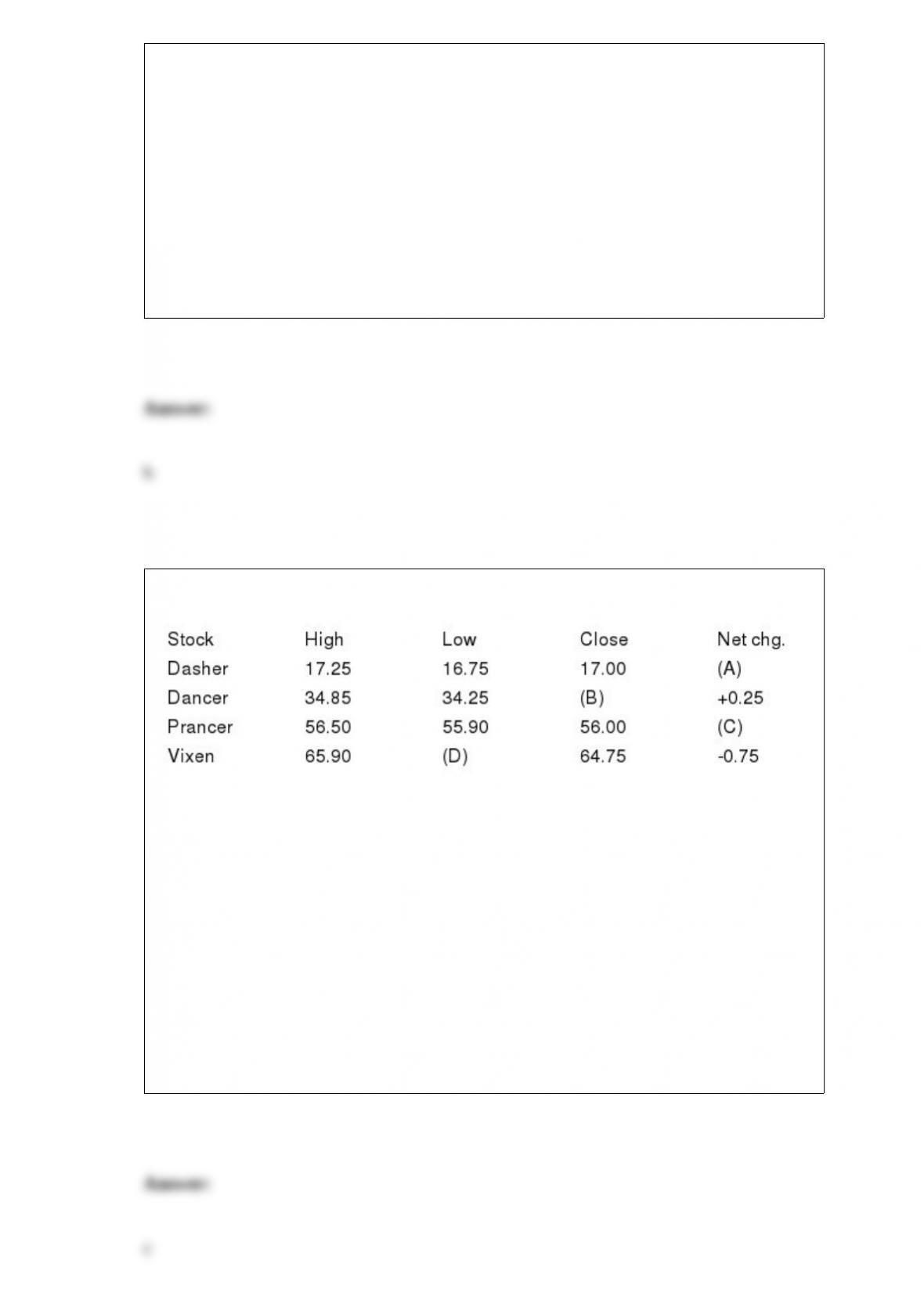
Exhibit 38-2
If the closing price of Prancer’s stock on the previous day was $55.50, what value goes
in blank (C)?
a. +0.75
b. -0.50
c. +0.50
d. +0.25
e. There is not enough information given to answer this question.

Exhibit 30-3
The real interest rate in year 4 is
a. -12 percent.
b. 2 percent.
c. 12 percent.
d. -2 percent.
e. -5 percent.
Exhibit 2-1

Scarcity exists
a. at point C but not at point A.
b. neither at point C nor at point A.
c. at both point C and at point A.
d. at point A but not at point C.
The act that set up a commission to deal with “unfair methods of competition” was the
a. Sherman Act.
b. Wheeler-Lea Act.
c. Celler-Kefauver Antimerger Act.
d. Clayton Act.
e. none of the above

The supply of labor in labor market X is a function of (or depends upon)
a. wage rates in other labor markets.
b. the marginal physical product of workers in any labor market.
c. the price of the product that is produced by workers in labor market X.
d. a and c
As the dollar price of a foreign currency (for example, dollars per yen) decreases,
foreign goods will be __________ expensive, __________ foreign goods will be
purchased, and __________ foreign currency will be demanded.
a. less; more; more
b. less; more; less
c. more; fewer; less
d. more; fewer; more
The primary characteristic of a public good is that it is nonrivalrous in consumption.
a. True

b. False
The term “positive rate of time preference” suggests that
a. people prefer more time to do something than less time.
b. people prefer goods to be available at an earlier time period than at a later time
period.
c. some people are irrational because they would rather have something now than wait
to consume it later when they can enjoy it more.
d. interest rates tend to increase over time.
e. businesses know that if they invest in capital goods, they will earn profits.
Exhibit 28-5
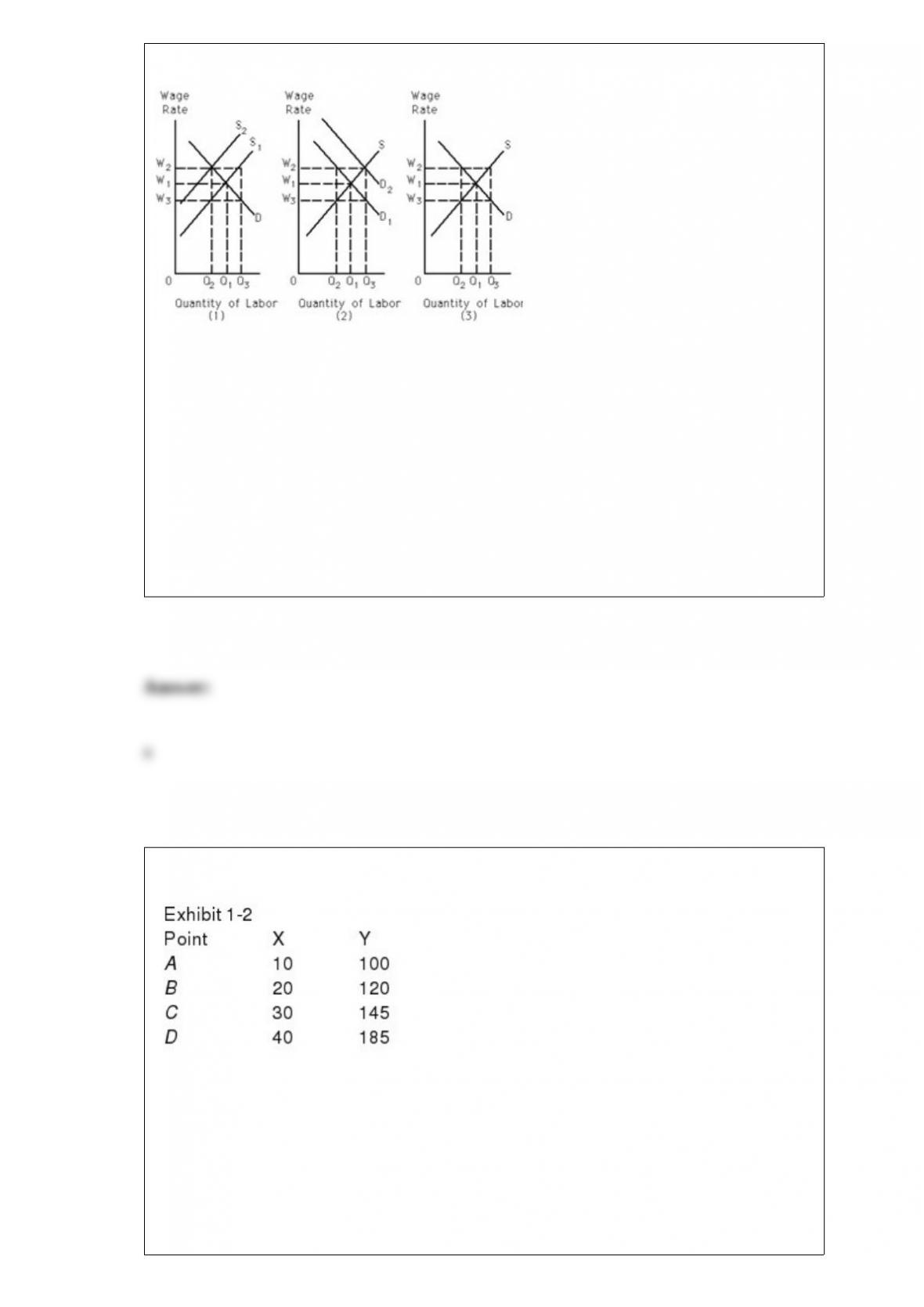
In which of the following cases has the increase in the wage from W1 to W2 been
brought about by a country-wide legalization of union shops?
a. (1)
b. (2)
c. (3)
d. none of the above
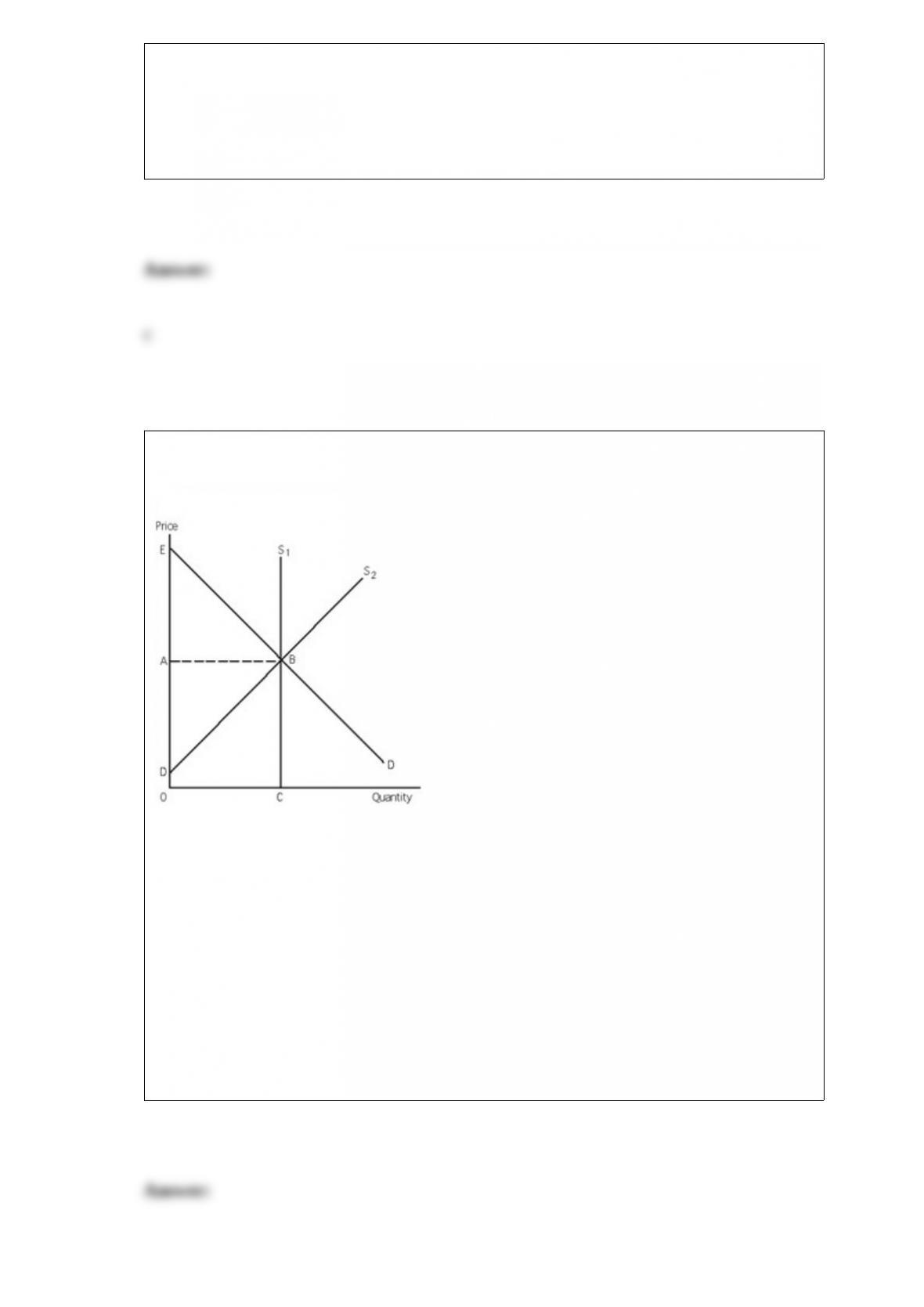
Based on the data provided in this table,if these data were plotted in a two-variable
diagram the result would be a ______________ sloping ____________________.
a. downward; (nonlinear) curve.
b. downward; (straight) line.
c. upward; (nonlinear) curve.
d. upward; (straight) line.
e. none of the above
Exhibit 30-1
Suppose the supply curve is S1 and the price is A. Pure economic rent equals area
a. ABD.
b. EBA.
c. ODBC.
d. EBD.
e. none of the above

Which of the following best describes the agricultural sector for much of the 20th
century and today?
a. high productivity, price elasticity of demand less than 1, income elasticity of demand
greater than 1
b. low productivity, price elasticity of demand greater than 1, income elasticity of
demand less than 1
c. high productivity, price elasticity of demand less than 1, income elasticity of demand
less than 1
d. low productivity, price elasticity of demand less than 1, income elasticity of demand
greater than 1
Exhibit 22-3
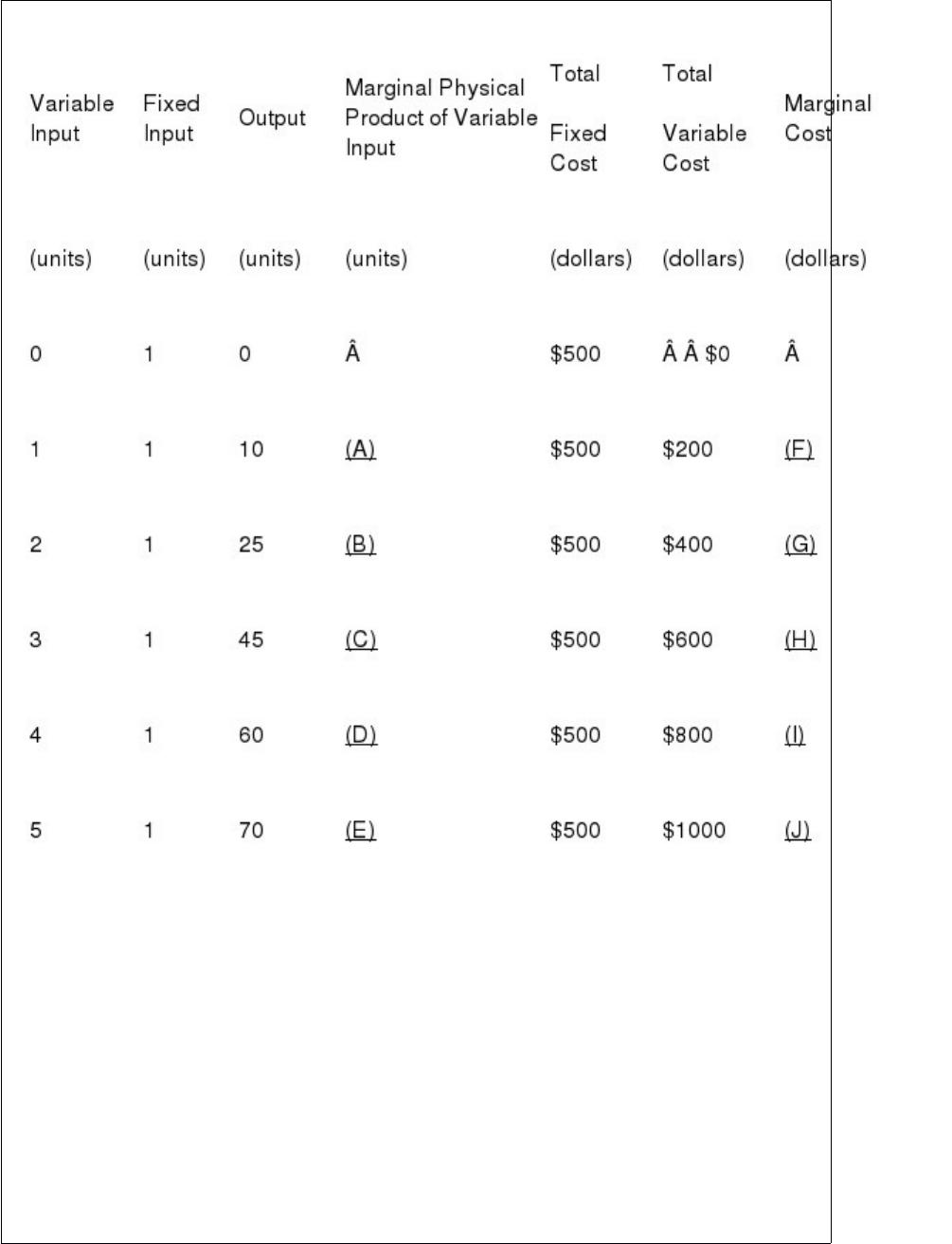
The average fixed cost of producing 25 units of output is
a. $500.00.
b. $20.00.
c. $50.00.
d. $2.50.
e. indeterminable with the information given.

An economy is productive efficient if it produces
a. more than enough food to feed everyone.
b. more goods and services in each successive year.
c. maximum output with given resources and technology.
d. enough output so that no one lives in poverty.
Anna gives Billy a gift of $200.We can be sure that Billy will
a. spend the $200 on what Anna hopes that he will spend it on.
b. save the $200, and not spend it on anything.
c. spend the $200 on whatever is next on Billy’s list of things to buy.
d. spend the $200 on something that Anna does not want him to spend it on.