
1) The Federal funds rate is the interest rate that _______ charge(s) _______.
A.banks; other banks.
B.the Fed; commercial banks.
C.banks; their best corporate customers.
D.banks; on federal student loans.
2) search unemployment and wait unemployment are types of:
a.frictional unemployment.
b.structural unemployment.
c.deficient-demand unemployment.
d.cyclical unemployment.
3) according to estimates, what percentage of food preparation workers in the united
states are illegal immigrants?
a.12
b.14
c.17
d.24
4) The size of the multiplier associated with an initial increase in spending will be:
A.the same whether or not inflation occurs.
B.diminished if inflation occurs.
C.zero if any increase in the price level occurs.
D.enhanced if inflation occurs.
5) real gdp per capita in the united states (as of 2004) exceeds that of france primarily
because:
a.the united states had higher annual rates of growth than france from 1960 through
2004.
b.the united states has a much larger population than france.
c.the united states has a higher percentage of the working-age population in the labor
force and because u.s. employees average about 20 percent more hours worked per
year.
d.european union rules severely limit france’s access to technologies developed outside
the region.
6) Which of the following ideas of the rational expectations theory has been absorbed
into mainstream macroeconomics?
A.the monetary rule
B.the idea that “money doesn’t matter”
C.the monetary multiplier
D.the idea that “expectations are important”
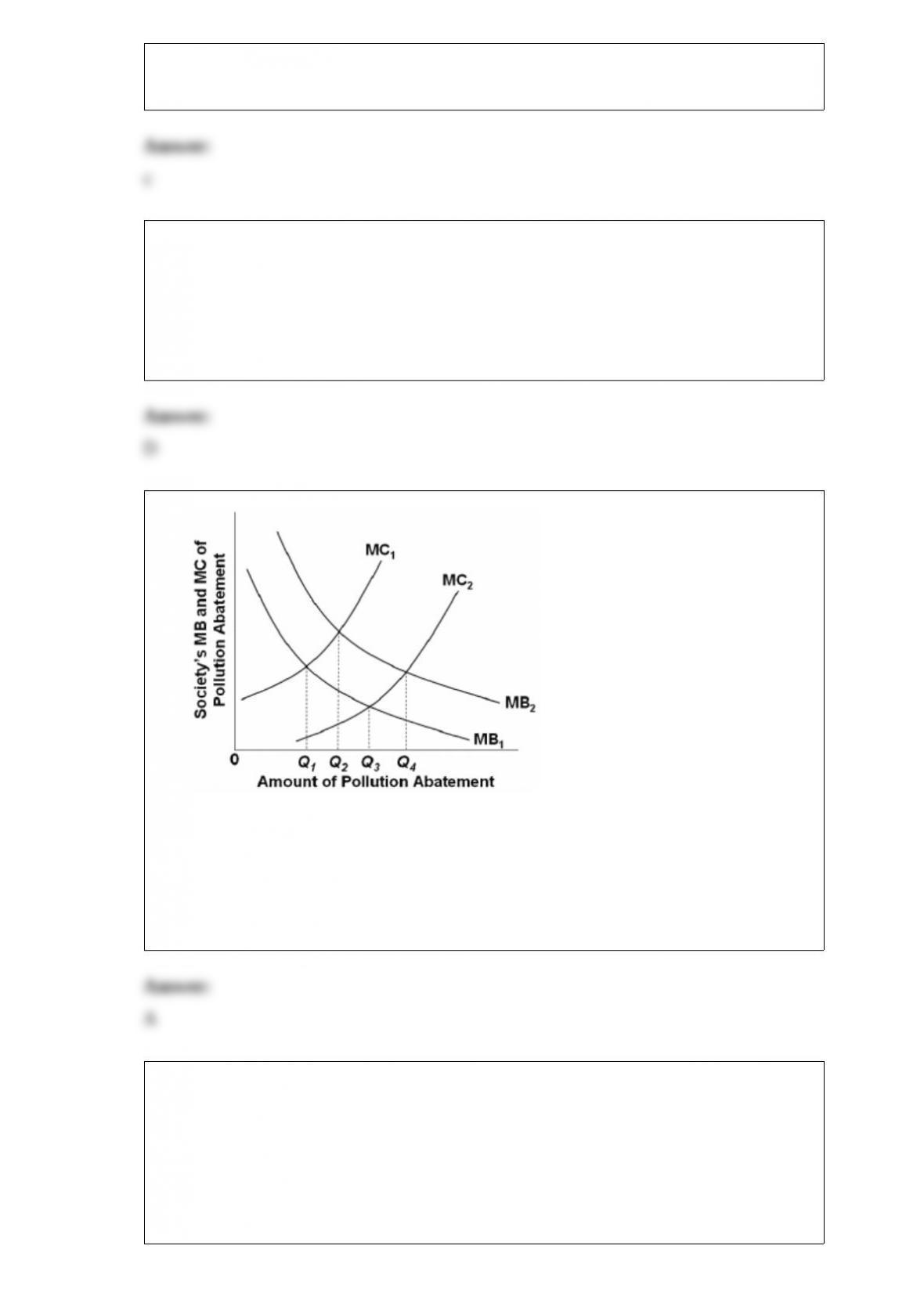
7)
Refer to the above diagram. Which one of the following might shift the marginal benefit
curve from MB1to MB2?
A.major new studies strongly linking cancer to pollution
B.improved technology for reducing pollution
C.a change in consumer tastes from manufacturing goods to services
D.a decrease in the price of recycled goods
8) Income mobility:
A.contributes to greater wealth inequality in the United States.
B.is less in the United States than in most developing nations.
C.is the movement of individuals and households from one income quintile to another
over time.
D.makes lifetime income inequality among income receivers in the United States
greater than income inequality in any single year.
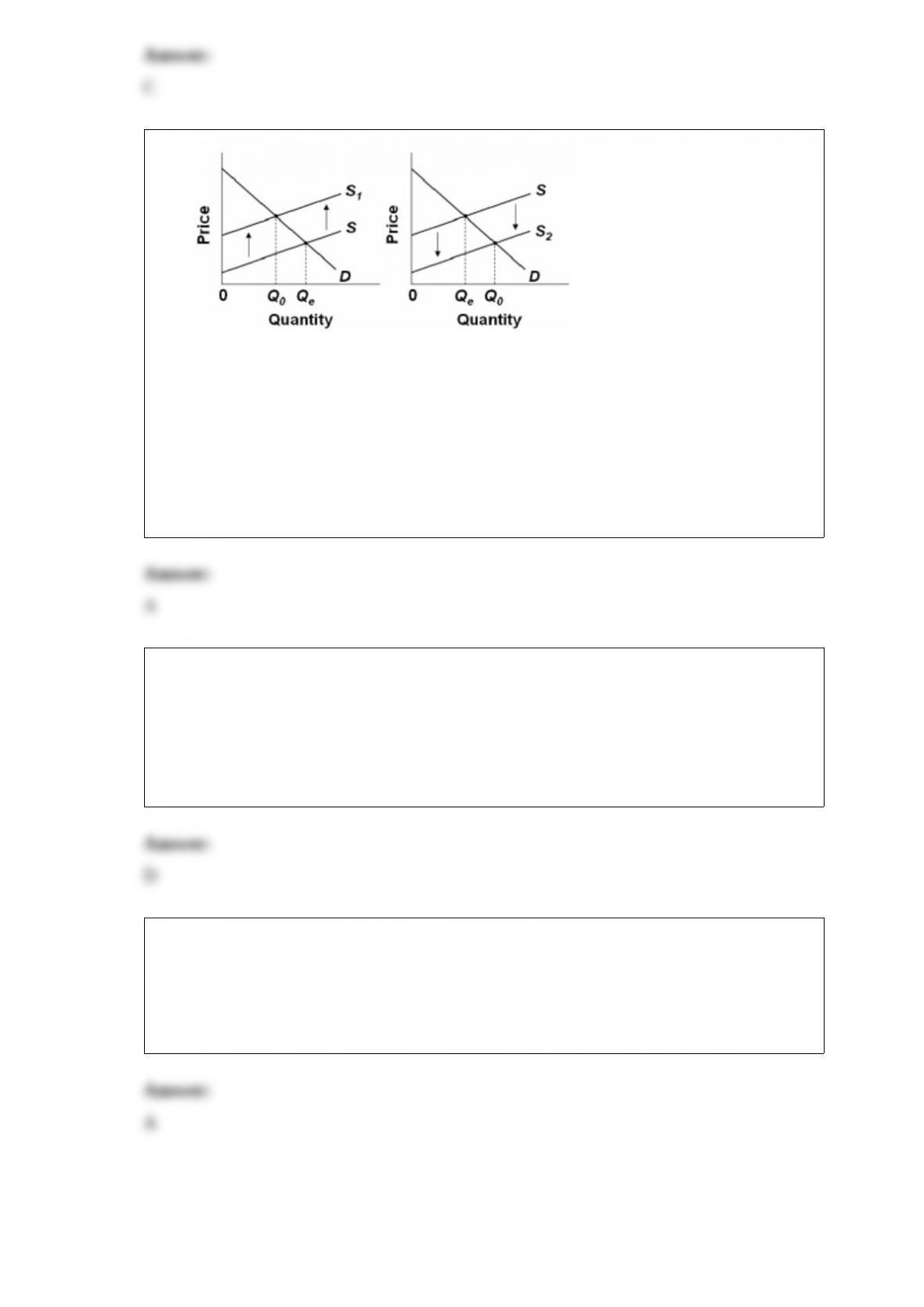
9)
Refer to the above diagrams for two separate product markets. Assume that society’s
optimal level of output in each market is Q0 and that government purposely shifts the
market supply curve from S to S1 in diagram (a) and from S to S2 in diagram (b). We
can conclude that the government is correcting for:
A.negative externalities in diagram (a) and positive externalities in diagram (b).
B.positive externalities in diagram (a) and negative externalities in diagram (b).
C.negative externalities in both diagrams.
D.positive externalities in both diagrams.
10) Which of the following is a market imperfection that might explain persistent wage
differentials within an occupation?
A.movement of labor from lower-wage to higher-wage jobs
B.readily available information about job opportunities and pay
C.principal-agent problems
D.discrimination
11) Checkable deposits are classified as money because:
A.they can be readily used in purchasing goods and paying debts.
B.banks hold currency equal to the value of their checkable deposits.
C.they are ultimately the obligations of the Treasury.
D.they earn interest income for the depositor.
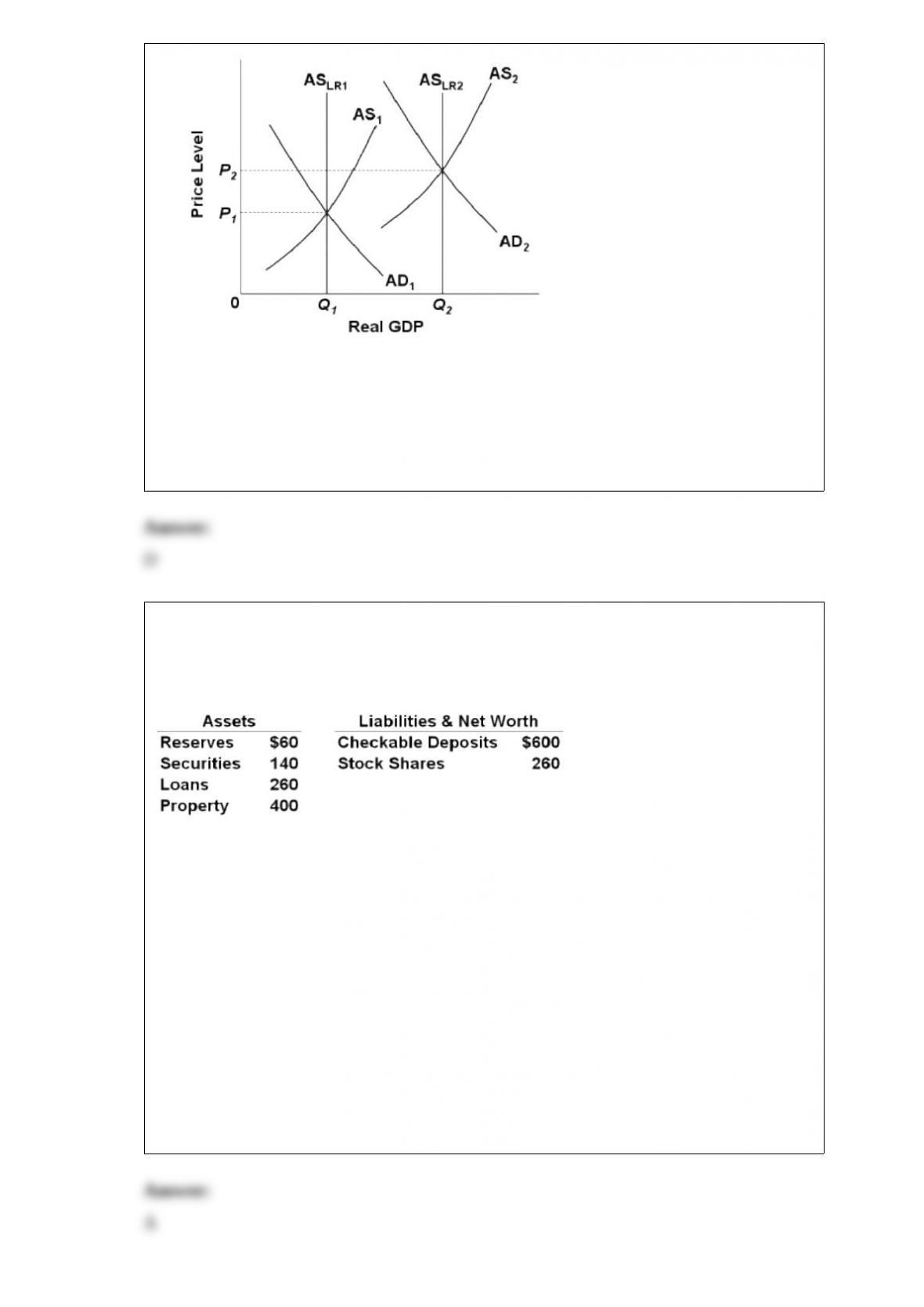
12)
Refer to the above graphs, where the subscripts on the labels denote years 1 and 2.
From the graphs we can clearly conclude that the economy:
A.is not at full employment in either year.
B.is at full employment in year 1, but not in year 2
C.is at full employment in year 2, but not in year 1
D.is at full employment in both years.
13) The following consolidated balance sheet of the commercial banking system.
Assume that the reserve requirement is 10 percent. All figures are in billions and each
question should be answered independently of changes specified in any preceding ones.
Refer to the above data. Suppose the Fed bought $20 billion of U.S. securities from the
banks. This would:
A.increase bank reserves to $80 billion, reduce bank-held securities to $120 billion, and
assuming a full money multiplier effect, increase the money supply (checkable
deposits) by $200 billion.
B.increase bank reserves to $80 billion, reduce bank-held securities to $120 billion, and
assuming a full money multiplier effect, decrease the money supply (checkable
deposits) by $200 billion.
C.reduce bank reserves to $40 billion, increase bank-held securities to $160 billion, and
assuming a full money multiplier effect, increase the money supply (checkable
deposits) by $200 billion.
D.reduce bank reserves to $40 billion, increase bank-held securities to $160 billion, and
assuming a full money multiplier effect, decrease the money supply (checkable
deposits) by $200 billion.