
1) in constructing models, economists:
a.make simplifying assumptions.
b.include all available information.
c.must use mathematical equations.
d.attempt to duplicate the real world.
2) which of the following is not correct?
a.where marginal product is greater than average product, average product is rising.
b.where total product is at a maximum, average product is also at a maximum.
c.where marginal product is zero, total product is at a maximum.
d.marginal product becomes negative before average product becomes negative.
3) Which of the following would most likely reduce aggregate demand (shift the AD
curve to the left)?
A.A reduced amount of excess capacity.
B.Increased government spending on military equipment.
C.An appreciation of the U.S. dollar.
D.Increased consumer optimism regarding future economic conditions.
4) Because the Federal government typically provides disaster relief to farmers, many
farmers do not buy crop insurance even through it is federally subsidized. This
illustrates:
A.the adverse selection problem.
B.the moral hazard problem.
C.a failure of the market for externalities.
D.the existence of positive externalities.
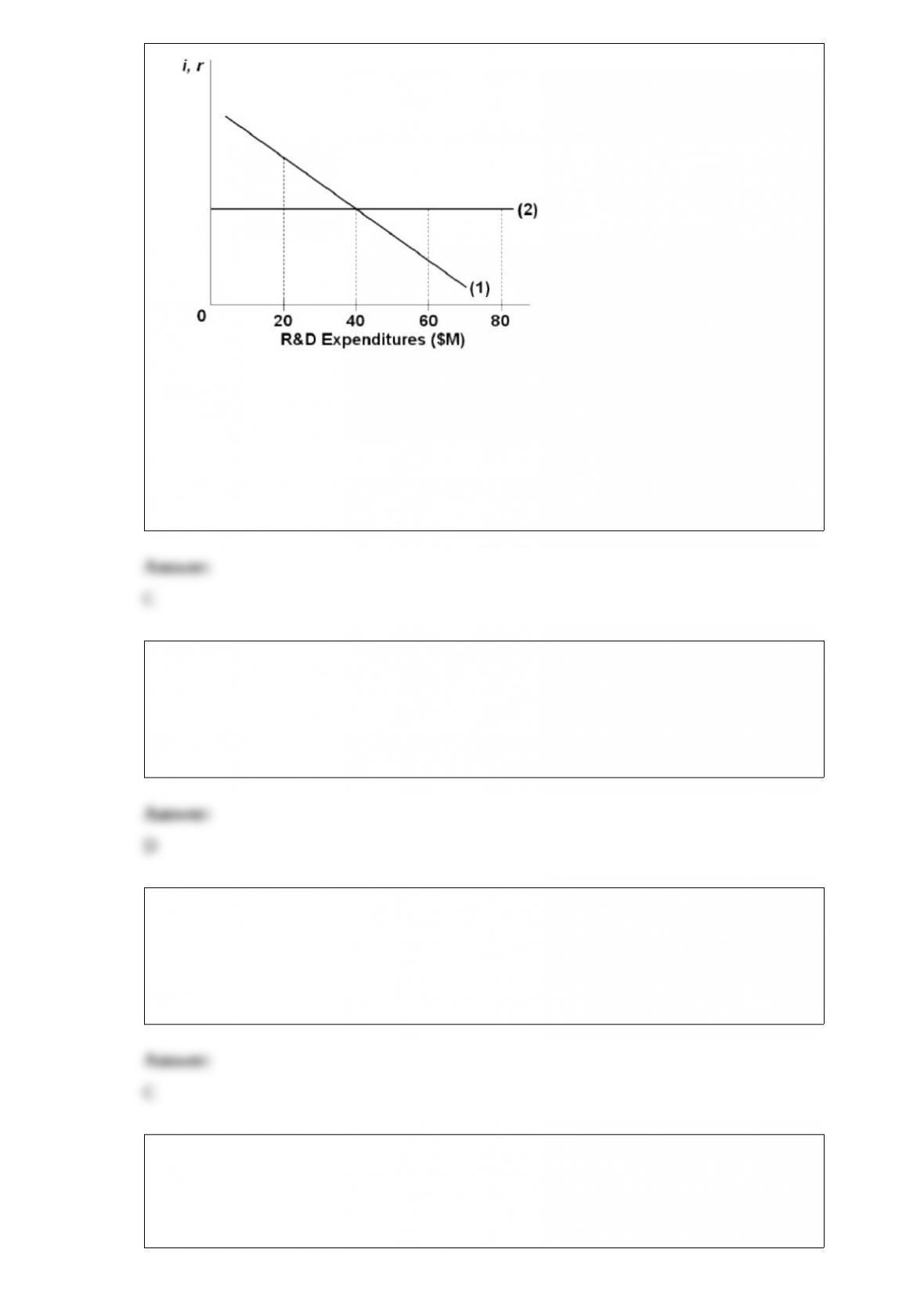
5)
Assume that a firm’s interest-rate-cost of funds curve for R&D is perfectly elastic.
Which of the following would decrease a firm’s optimal R&D expenditures and, in
equilibrium, leave the expected rate of return on the last dollar of R&D unchanged?
A.a rightward shift of the expected-rate-of-return curve
B.an upward shift of the interest-rate-cost of funds curve
C.a leftward shift of the expected-rate-of-return curve
D.a downward shift of the interest-rate-cost of funds curve
6) Which of the following is not a source of loanable funds?
A.the saving of households
B.business saving
C.commercial bank lending
D.government budget deficits
7) In 2007 the United States’ balance on goods was about:
A.-$435 billion.
B.+ $107 billion.
C.-$816 billion.
D.-$739 billion.
8) alex works in his own home as a homemaker and full-time caretaker of his children.
officially, he is:
a.unemployed.
b.employed.

c.not in the labor force.
d.in the labor force.
9) the industrial revolution and modern economic growth resulted in:
a.the average human lifespan more than doubling.
b.a major population shift from urban to rural areas.
c.increased production by local craftsmen.
d.all of these.
10) in introducing the opportunity cost of time into the theory of consumer behavior we
find that, all else equal:
a.one should consume less of time-intensive goods.
b.one should consume more of time-intensive goods.
c.the consumer’s equilibrium position is not altered.
d.the marginal utility derived from each product must be multiplied by consumption
time in determining equilibrium.
11) Export supply curves are __________________; import demand curves are
___________________.
A.horizontal; vertical
B.vertical; horizontal
C.downsloping; upsloping
D.upsloping; downsloping