If the production possibilities frontier is linear, then
A) opportunity costs are decreasing as more of one good is produced.
B) it is easy to efficiently produce output.
C) opportunity costs are increasing as more of one good is produced.
D) opportunity costs are constant as more of one good is produced.
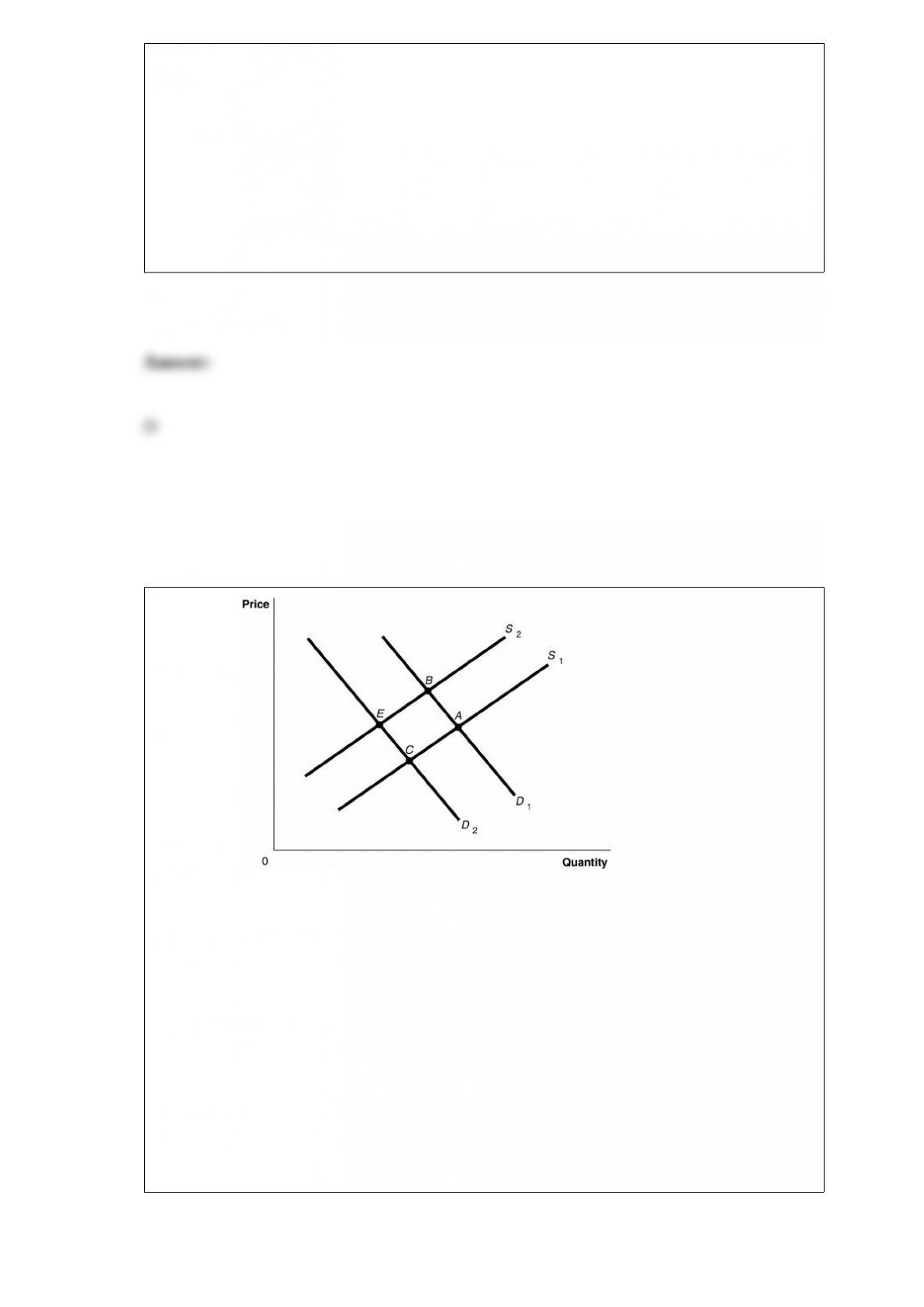
Figure 3-8
The graph in this figure illustrates an initial competitive equilibrium in the market for
motorcycles at the intersection of D2 and S1 (point C). If the price of motorcycle side
cars (a complement to motorcycles) decreases, and the wages of motorcycle workers
increase, how will the equilibrium point change?
A) The equilibrium point will move from C to E.
B) The equilibrium point will move from C to B.
C) The equilibrium point will move from C to A.
D) The equilibrium will first move from C to A, then return to C.
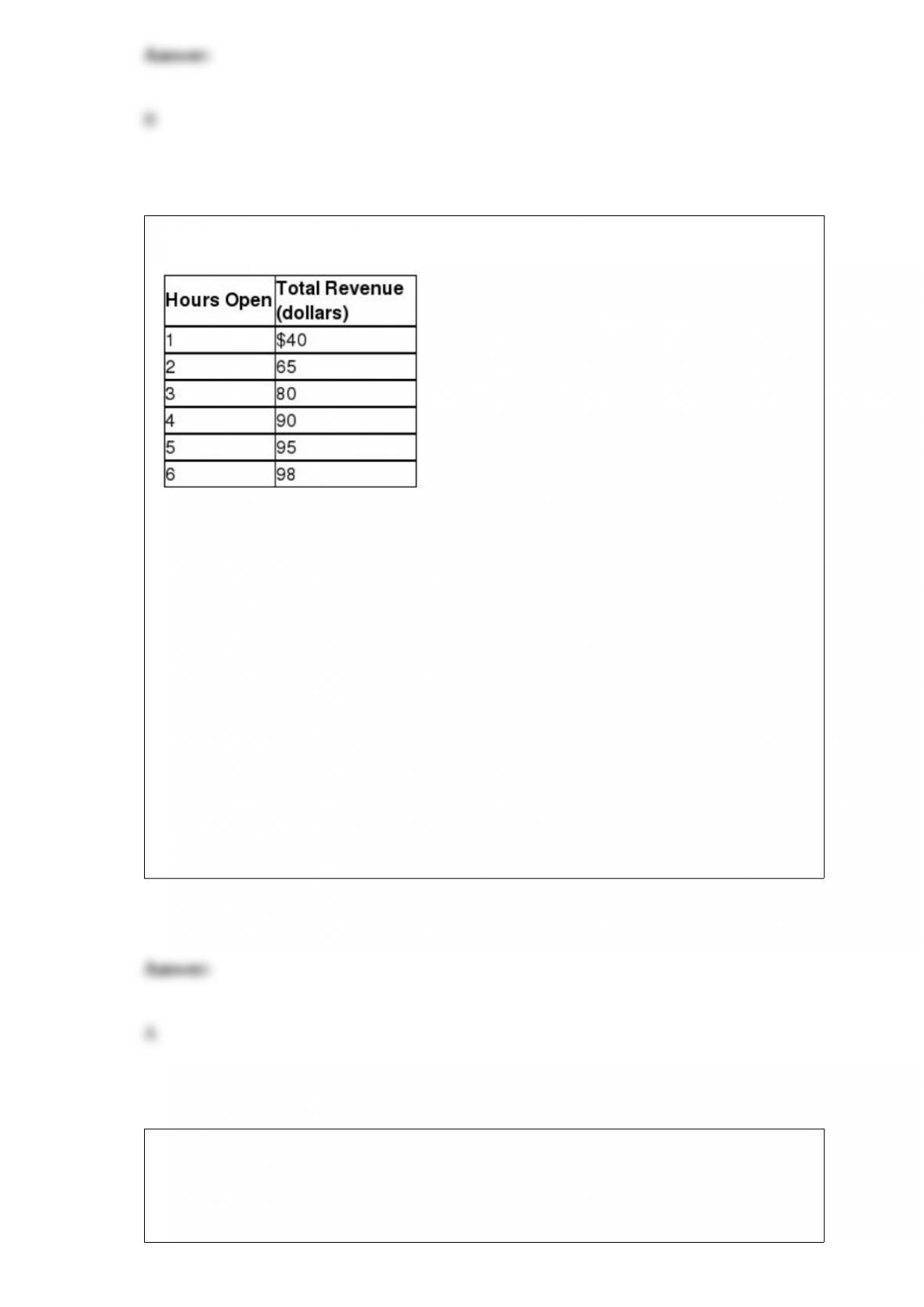
Table 1-5
Julius runs a small tailor shop in the city of Bloomfield. He is debating whether he
should extend his hours of operation. Julius figures that his sales revenue will depend
on the number of hours the tailor shop is open as shown in the table above. He would
have to hire a worker for those hours at a wage rate of $18 per hour.. Using marginal
analysis, determine how many hours should Julius extend his shop’s hours of
operations?
A) 2 hours
B) 3 hours
C) 4 hours
D) 5 hours
E) 6 hours
Which of the following will decrease aggregate expenditure in the United States?
A) a decrease in the value of the dollar

B) a decrease in the price level
C) a decrease in interest rates
D) a decrease in government purchases
The present value of $475 received 3 years in the future would be calculated as which
of the following when the interest rate is 6 percent?
A) 475/(1.6)3
B) 475/(1.06)3
C) 475 1.6 3
D) 3.06/475
Consumption is $5 million, planned investment spending is $8 million, government
purchases are $10 million, and net exports are equal to $2 million. If GDP during that
same time period is equal to $23 million, what unplanned changes in inventories
occurred?
A) There was an unplanned increase in inventories equal to $2 million.
B) There was no unplanned change in inventories.
C) There was an unplanned decrease in inventories equal to $2 million.
D) There was an unplanned decrease in inventories equal to $19 million.

A firm will make a profit when
A) P > AVC.
B) P > ATC.
C) P = ATC.
D) P = MC.
In each of the following situations, list what will happen to the equilibrium price and
the equilibrium quantity for a particular product, which is an inferior good. a. The
population decreases and productivity increases
b. The income increases and the price of inputs increase
c. The number of firms in the market decreases and income decreases
d. Consumer preference decreases and the price of a complement increases
e. The price of a substitute in consumption increases and the price of a substitute in
production increases

Arbitrage refers to the act of
A) resolving a dispute in front of an arbitrator instead of a court of law.
B) buying a product in one market at a low price and reselling in another market at a
higher price.
C) trading in the foreign exchange market.
D) suing a producer for illegal business practices.
In an oligopoly, firms can increase their market power by
A) selling to buyers who have market power.
B) pursuing dominant strategies.
C) colluding to set prices.
D) undertaking heavy advertising expenditure.

Many firms use technology to gather information on the preferences of consumers and
their responses to changes in prices. This information is then used to adjust prices of the
firms’ goods and services. This practice is called
A) price discovery.
B) empirical research.
C) yield management.
D) econometrics.
For a firm in a perfectly competitive market, price is
A) equal to both average revenue and marginal revenue.
B) equal to average revenue but greater than marginal revenue.
C) greater than marginal revenue but less than average revenue.
D) less than both average revenue and marginal revenue.
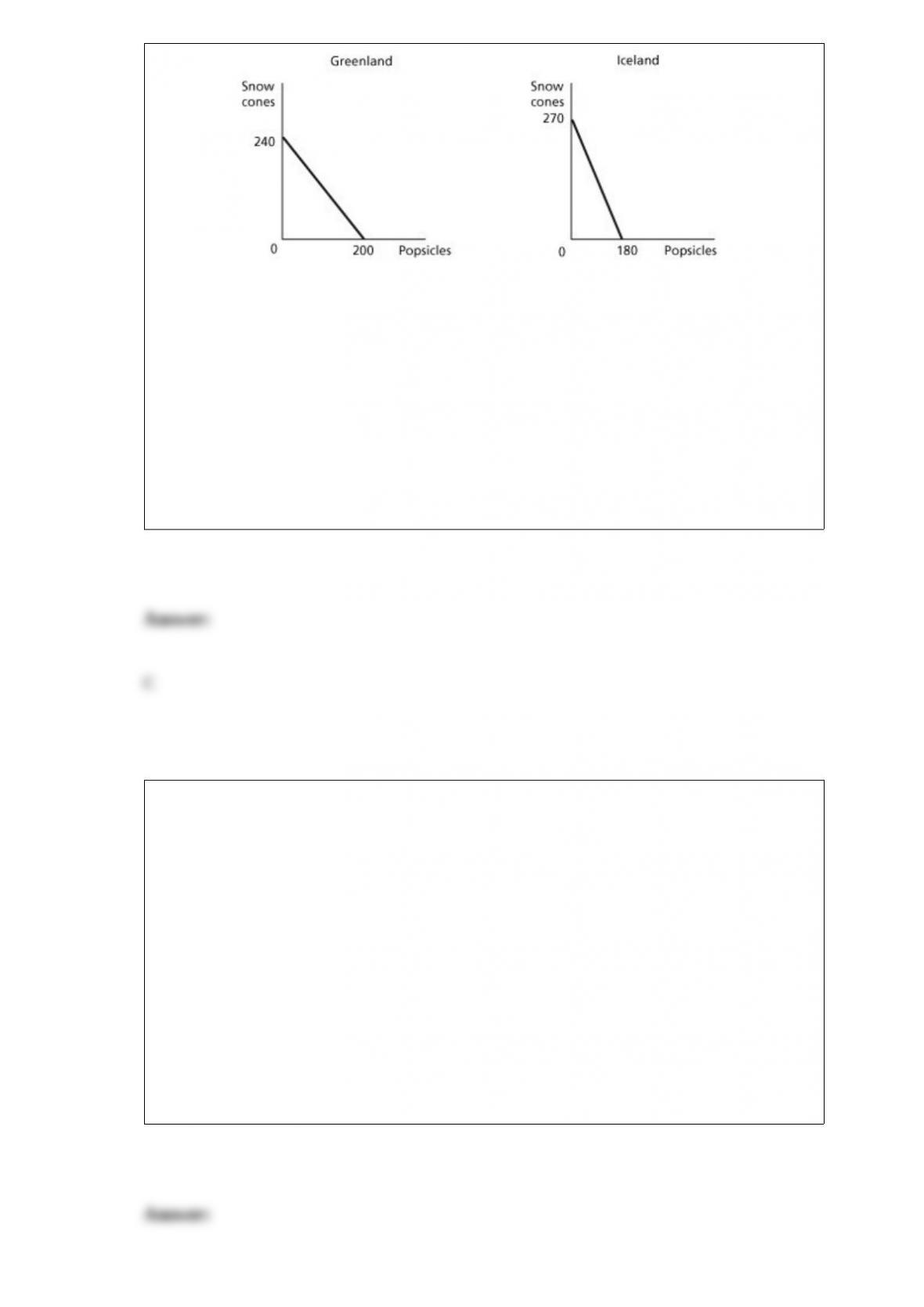
Figure 2-9 Figure 2-9
shows the production possibilities frontiers for Greenland and Iceland. Each country
produces two goods, snow cones and popsicles. Which country has a comparative
advantage in the production of snow cones?
A) Greenland
B) They have equal productive abilities.
C) Iceland
D) neither country
An important Difference between the demand for a private good and the demand for a
public good is that
A) individuals reveal their preferences for a public good but they do not have to reveal
their preferences a private good.
B) the resources used to provide public goods are common resources or government
owned; the resources used to produce private goods are all privately owned.
C) individuals reveal their preferences for a private good but they do not have to reveal
their preferences for a public good.
D) the demand for a private good produces consumption externalities; the demand for a
public good produces production externalities.