
1) a group of plants that is owned and operated by a single firm and that consists of oil
fields, refineries, and gasoline stations best illustrates a:
a.trust.
b.holding company.
c.vertically integrated firm.
d.multinational corporation.
2) the three basic legal forms of business enterprise are:
a.monopolists, competitors, and enterprises.
b.proprietorships, partnerships, and corporations.
c.vertical, horizontal, and conglomerate corporations.
d.conglomerates, multinationals, and partnerships.
3) which of the following sets of countries were among those admitted to the european
union in 2004?
a.spain, portugal, and turkey
b.estonia, bulgaria, and switzerland
c.poland, hungary, and the czech republic
d.belgium, the netherlands, and luxembourg
4) The conjecture that R&D expenditures as a percentage of firms’ sales first rise, reach
a peak, and then fall as industry concentration rises is known as the:
A.inverted-U theory of R&D.
B.average product of R&D theory.
C.bell-shaped curve.
D.theory of increasing and diminishing returns.
5) If labor’s share of the income paid to American resource suppliers is broadly defined
as the sum of wages and salaries and proprietors’ income, we can say that labor’s
relative share has:
A.remained approximately constant since 1900.
B.increased dramatically at the expense of capitalist income.
C.declined by about one-third since 1900.

D.decreased because of the decline of unionism.
6) Which of the following best describes the cause-effect chain of an expansionary
monetary policy?
A.A decrease in the money supply will lower the interest rate, increase investment
spending, and increase aggregate demand and GDP.
B.A decrease in the money supply will raise the interest rate, decrease investment
spending, and decrease aggregate demand and GDP.
C.An increase in the money supply will raise the interest rate, decrease investment
spending, and decrease aggregate demand and GDP.
D.An increase in the money supply will lower the interest rate, increase investment
spending, and increase aggregate demand and GDP.
7) Collective bargaining occurs under a framework of rules established in the:
A.Sherman Act.
B.Clayton Act.
C.National Labor Relations Act.
D.Employer-Employee Dispute Act.
8)
in the above diagram the equation for this line is:
a.y = 4 – 11/3 x.
b.y = 3 + 3/4 x.
c.y = 4 – 3/4 x.
d.y = 4 + 11/3 x.

9) Assume that the short-run cost and demand data given in the table below confront a
monopolistic competitor selling a given product and engaged in a given amount of
product promotion. Compute the marginal cost and marginal revenue of each unit of
output and enter these figures in the table.
(a)At what output level and at what price will the firm produce in the short run? What
will be the total profit?
(b)What will happen to demand, price, and profit in the long run?
10) The Coase theorem:
A.applies only to circumstances in which externalities are extensive and bargaining
costs are high.
B.holds that the median voter will decide the outcome of elections.
C.states that in some circumstances majority voting can yield inconsistent results.
D.suggests that in some circumstances government intervention is not needed to resolve
externality problems.
11) If government increases lump-sum taxes by $20 billion and the economy’s MPC is .
6, then the:
A.consumption schedule will shift upward by $12 billion.
B.consumption schedule will shift downward by $12 billion.
C.equilibrium GDP will increase by $40 billion.
D.equilibrium GDP will decrease by $40 billion.
12) (Last Word) In 2005, chief executive officers (CEOs) pay at U.S. firms with around
$500 million in annual sales averaged:
A.$600 thousand.
B.$1.2 million.
C.$2.2 million.
D.$4.5 million.
13) the demand schedules for such products as eggs, bread, and electricity tend to be:
a.perfectly price elastic.
b.of unit price elasticity.
c.relatively price inelastic.
d.relatively price elastic.
14)
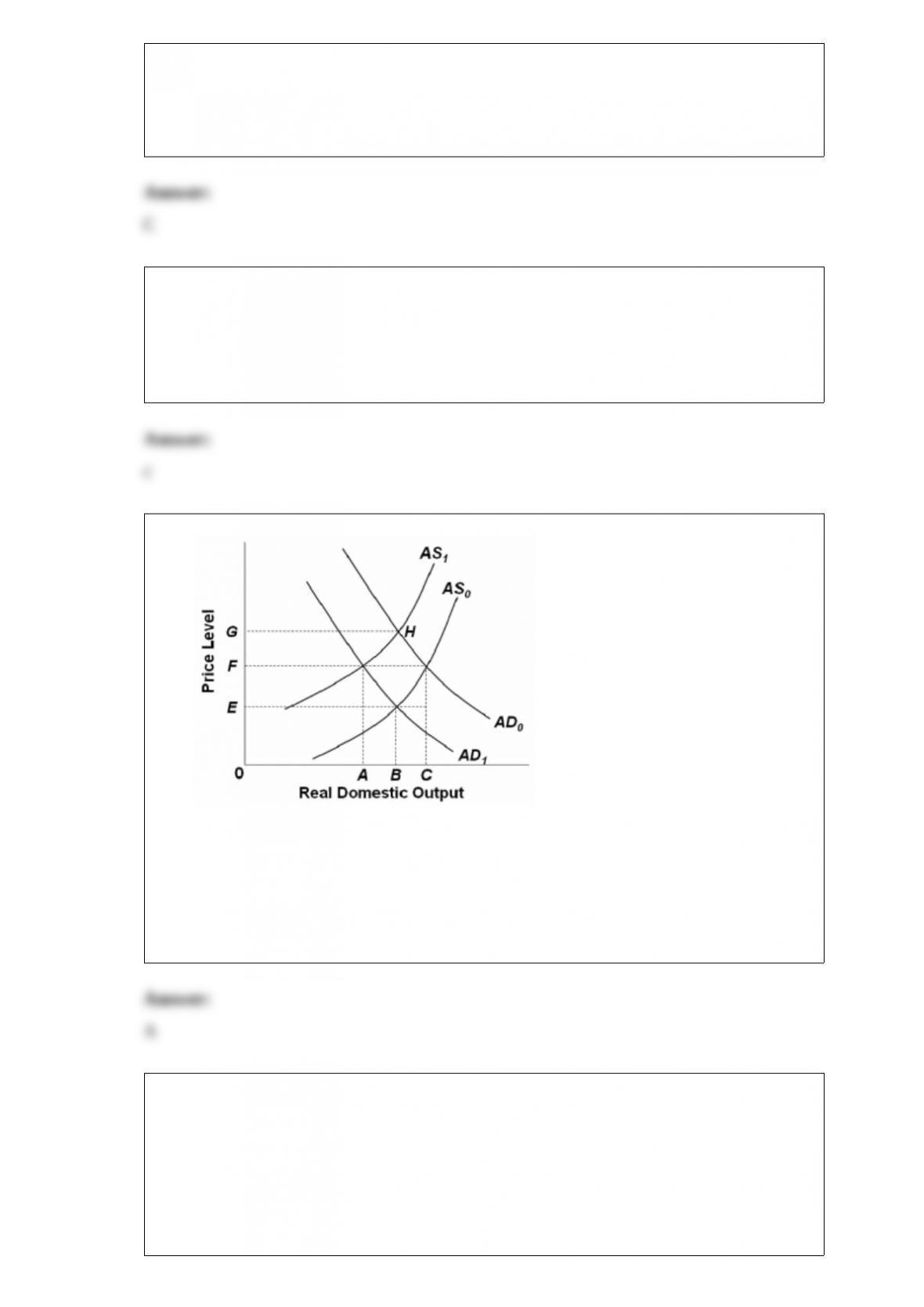
Refer to the above diagram. If the initial aggregate demand and supply curves are AD0
and AS0, the equilibrium price level and level of real domestic output will be:
A.F and C, respectively.
B.G and B, respectively.
C.F and A, respectively.
D.E and B, respectively.
15) Relative to 1950, the inflation-adjusted prices of:
A.cattle and hogs have increased in the United States, but the prices of corn and wheat
have declined.
B.cattle and hogs have decreased in the United States, but the price of corn and wheat
have increased.
C.cattle, hogs, corn, and wheat have decreased in the United States.
D.cattle, hogs, corn, and wheat have increased in the United States.
16) A rising standard of living will:
A.necessarily reduce the population by reducing the birthrate.
B.increase the birthrate.
C.reduce the birthrate, but population may continue to grow if the death rate falls more
quickly.
D.reduce the birthrate initially, but will increase the birthrate significantly at higher
levels of income as people can afford to have more children.
17) If at some level of GDP the economy is experiencing an unintended decrease in
inventories:
A.the aggregate level of saving will decline.
B.the price level will fall.
C.the business sector will lay off workers.
D.domestic output will increase.
18)
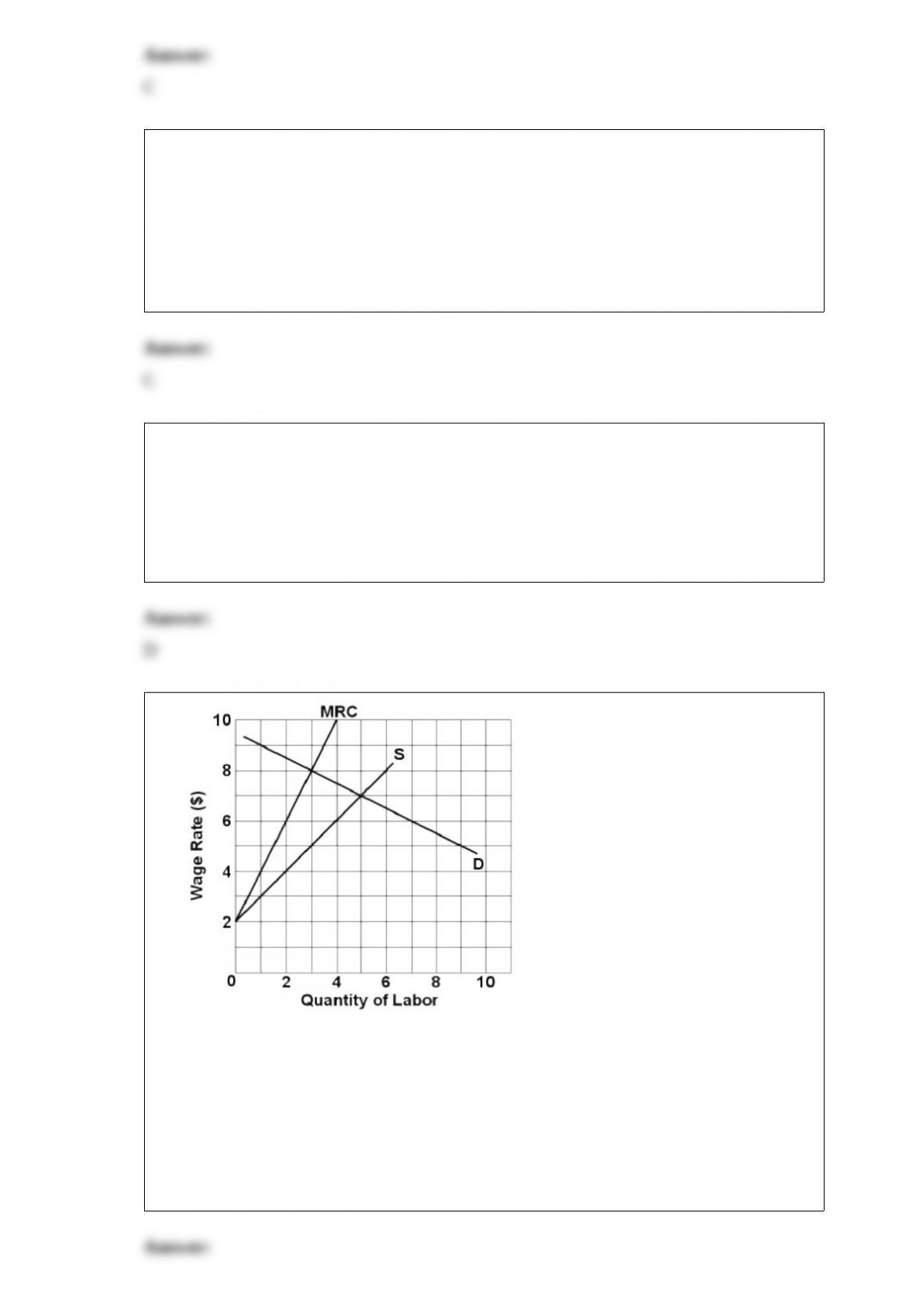
Refer to the above labor market diagram where D is the labor demand curve, S is the
labor supply curve, and MRC is the marginal resource (labor) cost curve. If an inclusive
union was formed and was able to get the monopsonist to agree to a $7 wage rate, then
the monopsonist would:
A.reduce employment from 5 to 3 workers.
B.reduce employment from 5 to 2 workers.
C.increase employment from 3 to 5 workers.
D.not alter its level of employment.

19) How would a purely competitive industry adjust and restore allocative efficiency
when there is an increase in the demand for a product?
20) Describe the relationship between the size of the MPC and the multiplier. How does
it compare to the relationship between the size of the MPS and the multiplier?
21) Explain how the exchange rate gets determined in a flexible exchange rate system.
22) What are the problems encountered in any strict application of benefits-received
and ability-to-pay principles of taxation?
23) What is the difference between society’s view and an individual firms view of
economic rent?
24) Describe the characteristics of private capital flows to DVCs.
25) (Last Word) Do tax increases reduce real GDP?
26) Crowding out can weaken the effect of an expansionary fiscal deficit. Explain.
27) Trade deficits are a mixed blessing. Interpret and elaborate.
28) Describe the economic case against monopoly.