
To counteract relative price changes, the government would implement:
A. monetary policy.
B. fiscal policy.
C. polices that affect the supply and demand for a specific good.
D. policies that affect the supply and demand for all goods and services.
Suppose the table below describes the relationship between price and quantity
demanded for a monopolist.
If the marginal cost of producing each unit of output is $5, then the socially optimal
level of output is ______.
A. 3 units
B. 6 units
C. 7 units
D. 4 units
Refer to the figure below. To increase output from 99 to 132 units requires ______ extra
employee-hours; to increase output from 132 to 165 units requires ______ extra
employee-hours.

A. 11; 18
B. 7; 11
C. 4; 3
D. 3; 4
In an industry with free entry and exit, positive economic profit:
A. indicates a market failure.
B. can never occur.
C. cannot be sustained indefinitely.
D. can be sustained indefinitely.
Earth Movers & Shakers operates 3 iron ore mines. The table below shows each mine’s
total daily production and the current number of miners at each mine. All miners work
for the same wage, and each miner in any given mine produces the same number of tons

per day as every other miner in that mine.
Suppose Earth Movers & Shakers needs to fill an order for 60 tons of ore in a single
day. If it has no other orders for that day, it should:
A. take it all from Mother Lode.
B. take it all from Middle Drift.
C. take 30 tons from Scraping Bottom and 30 tons from Middle Drift.
D. take 20 tons from each of the three mines.
If the money supply equals 2,000, velocity equals 3, and real GDP equals 4,000, then
the price level equals:
A. 1.5.
B. 2.
C. 3.
D. 6,000.

If the labor market in the United States is perfectly competitive, the labor supply curve
would shift to the right if:
A. the United States relaxed its immigration laws.
B. fewer mothers started returning to work after their children were born.
C. firms replaced human workers with robots.
D. firms opened more plants overseas.
Who from among the following would be classified as out of the labor force?
A. Brenda Smith, an 18 year old college student employed part-time at a fast food
restaurant.
B. Mario Faubert, a NHL hockey player at home sick with the flu.
C. Jack Little, a 21 year old new college graduate actively looking for his first job.
D. Amanda Pie, a full-time homemaker.
A village has five residents, each of whom has an accumulated savings of $50. Each
villager can use the money to buy a government bond that pays 10% interest per year or
to buy a year-old goat, send it onto the commons to graze, and sell it after one year. The
price of the goat that the villager will get at the end of the year depends on the amount
of weight it gains while grazing on the commons, which in turn depends on the number
of goats sent onto the commons, as shown in table below. Assume that if a villager is
indifferent between buying a bond and buying a goat, the villager will buy a goat.
If the villagers purchase the socially optimal number of goats and bonds, then total
village income will be ______.
A. $250
B. $125
C. $70
D. $15
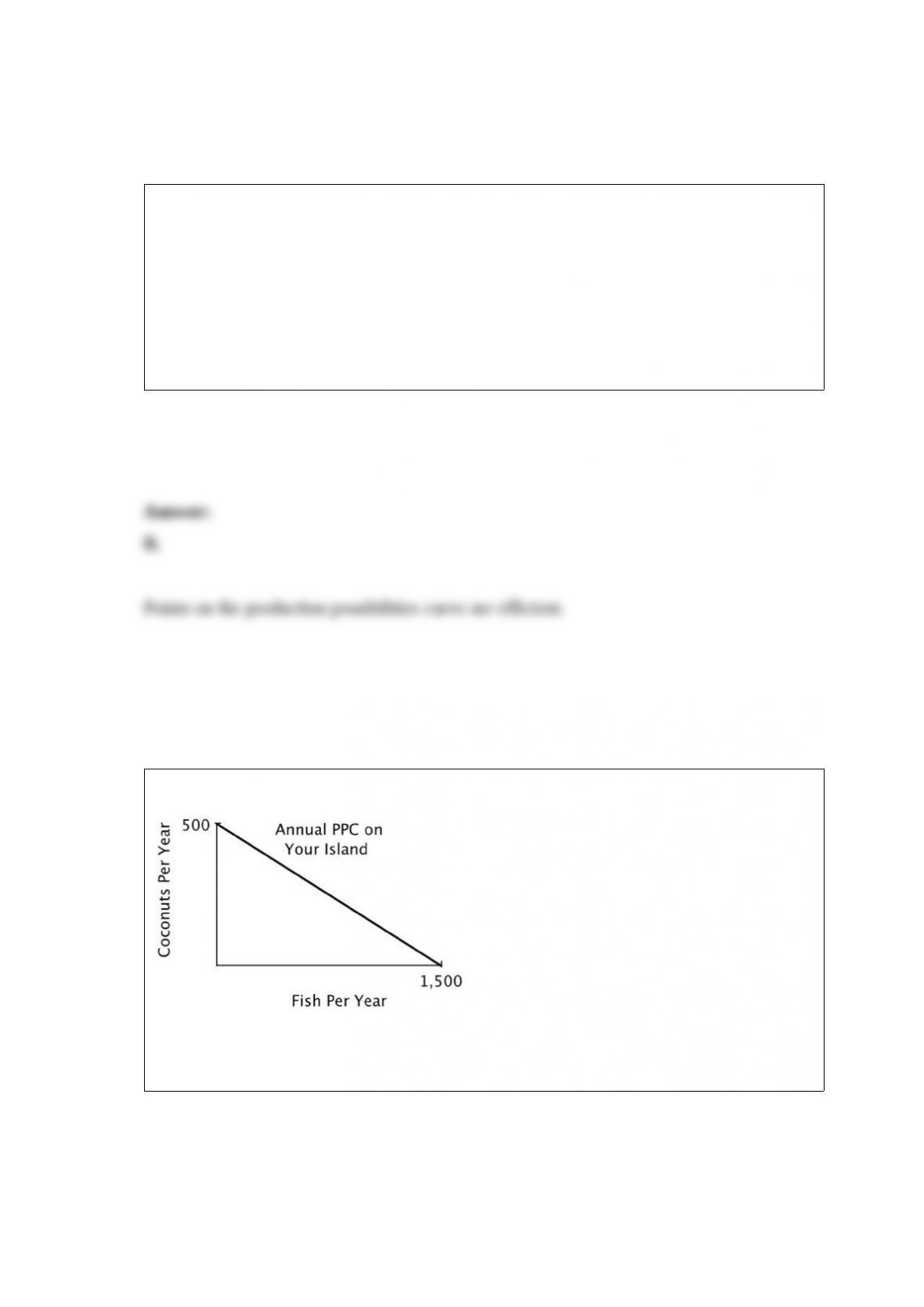
The figure below shows Avery’s weekly production possibilities curve for scarves.
For Avery, the opportunity cost of making a red scarf is:
A. decreasing.
B. increasing.

C. 1 blue scarf.
D. zero.
Refer to the figure above. If supply were to shift to the left, and demand were to also
shift to the left, in the new equilibrium:
A. both price and quantity would be lower.
B. both price and quantity would be higher.
C. price would be higher and quantity would be lower.
D. quantity would be lower, but the direction of the price change cannot be determined.
A warranty on a used car is a credible signal of quality because:
A. many used cars come with warranties.
B. sellers who offer warranties are more honest than most people.

C. it would cost the seller too much to honor a warranty on a low-quality car.
D. it indicates the car is of average quality.
An increase in the size of the working-age population:
A. increases labor demand.
B. decreases labor demand.
C. increases labor supply.
D. decreases labor supply.
Relative to a single price monopolist, a price discriminating monopolist generates:
A. less total surplus.
B. more total surplus.
C. the same amount of total surplus, but more consumer surplus and less producer
surplus.
D. the same amount of total surplus, but less consumer surplus and more producer
surplus.

Final goods and services are ______ production and ______ counted in GDP.
A. the end products of; are
B. the end products of; are not
C. used up in the process of; are
D. used up in the process of; are not
Labor unions contribute to structural unemployment by:
A. keeping wages above the market-clearing level.
B. keeping wages below the market-clearing level.
C. allowing unemployed workers to search longer or less intensively for jobs.
D. forcing unemployed workers to take the first job offered to them.

Shoe leather costs include the ______ due to the more frequent trips to the bank, the
new cash management systems and the expanded employment in banks that inflation
causes.
A. bracket creep and redistribution that occur
B. deflating and indexing that are necessary
C. substitution and price adjustment biases that arise
D. time and effort that are used up
The market interest rate in Alpha is 7%, and the market interest rate in Beta is 10%; the
inflation rate in Alpha is 3%, and inflation rate in Beta is 8%. Which of the following
statements is true?
A. The real interest rate is higher in Alpha, but the nominal interest rate is higher in
Beta.
B. The real interest rate is higher in Beta, but the nominal interest rate is higher in
Alpha.
C. Both the real and nominal interest rates are higher in Alpha.
D. Both the real and nominal interest rates are higher in Beta.
If a given production combination is efficient, then it must be:
A. above the production possibilities curve.
B. on the production possibilities curve.
C. either an attainable or unattainable point.
D. below the production possibilities curve.
You are the Minister of Trade for a small island country with the following annual PPC:
You are negotiating a trade agreement with a neighboring island with the following
annual PPC:
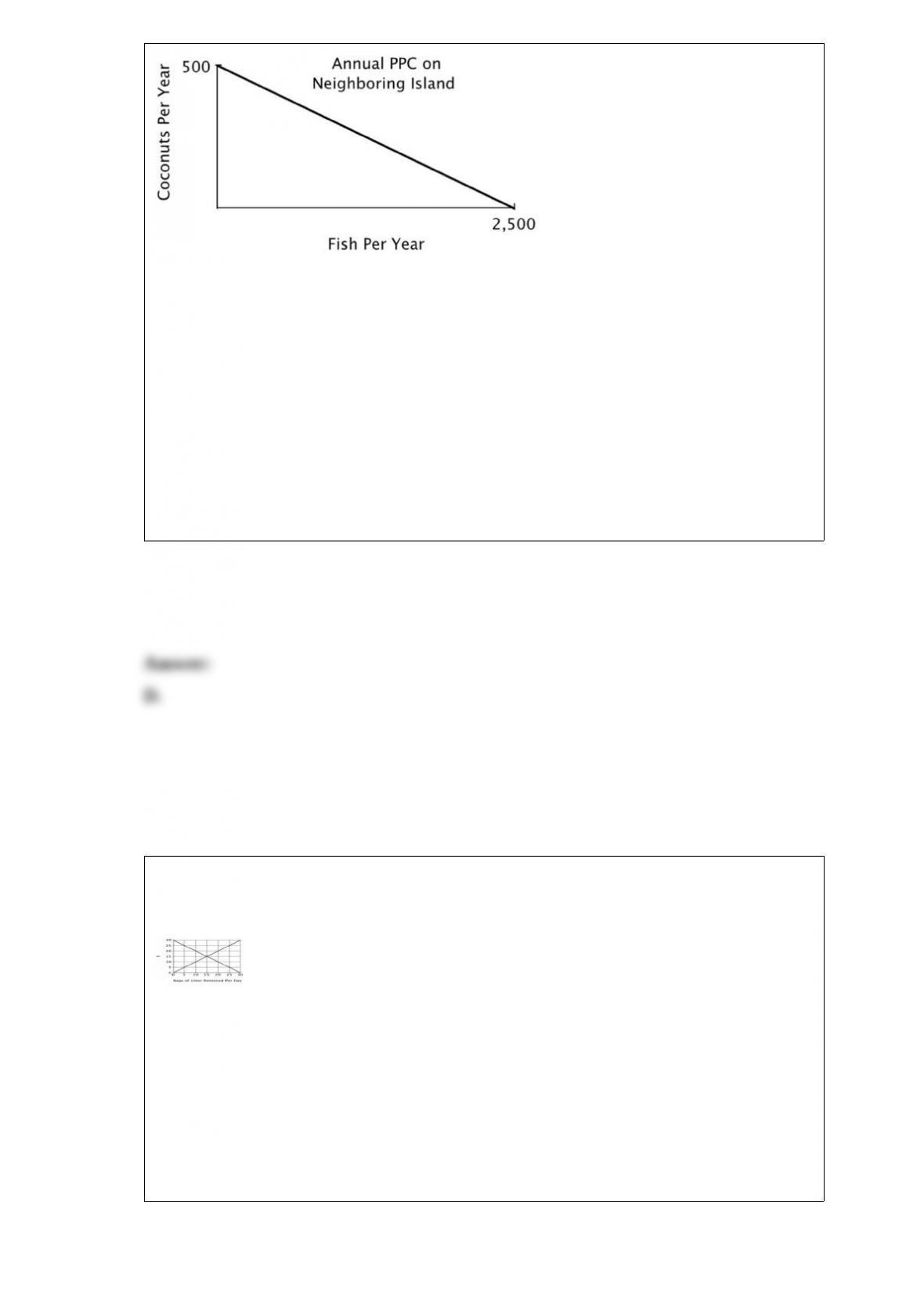
Both islands specialize exclusively in the product for which they have a comparative
advantage. You have agreed to give 350 coconuts to the other island in exchange for
1,300 fish. After the trade the other island has a total of ______ coconuts and ______
fish.
A. 850; 1,200
B. 500; 1,200
C. 350; 1,500
D. 350; 1,200
This graph shows the marginal cost and marginal benefit associated with roadside litter
clean up. Assume that the marginal benefit curve and marginal cost curve each have
their usual slope.
The socially optimal number of bags of litter removed from the roadside each day is:
A. 10.
B. 15.
C. 20.
D. 30.

In a certain economy, the components of planned spending are given by:
C = 500 + 0.8(Y – T) – 300r
Ip = 200 – 400r
G = 200
NX = 10
T = 150
Given the information about the economy above, what would be the impact on induced
expenditures of a one-percentage-point increase in the real interest rate?
A. Induced expenditures would increase by 35 units.
B. Induced expenditures would not change.
C. Induced expenditures would decrease by 35 units.
D. Induced expenditures would decrease by 7 units.
Suppose that a new drug has been approved to treat a life-threatening disease. The
demand for that drug is shown on the graph below. Prior to approval of this drug, the
only treatment for this condition was any one of several non-prescription, or
over-the-counter, pain relievers. The demand for one brand of the several
non-prescription pain relievers is also shown on the graph.
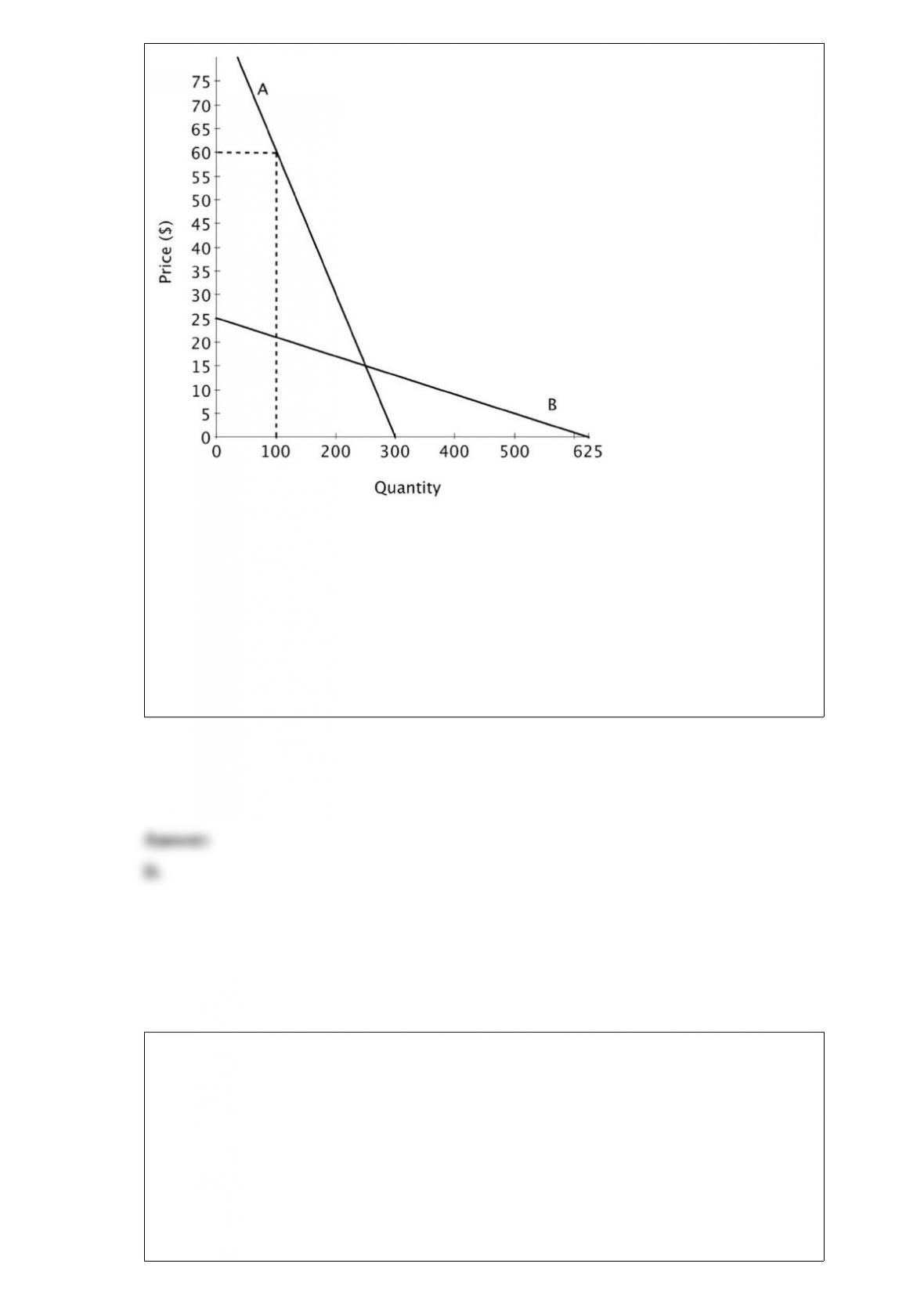
If the manufacturer of the new drug chose to increase its price from $30 to $35,
consumers would buy ______ doses, and have _____ total expenditures.
A. more; higher
B. fewer; lower
C. more; lower
D. fewer; higher
In an open economy, an increase in capital inflows ______ the equilibrium domestic
real interest rate and ______ the quantity of domestic investment.
A. increases; increases
B. increases; decreases
C. decreases; decreases
D. decreases; increases

The self-correcting tendency of the economy means that rising inflation eventually
eliminates:
A. expansionary gaps.
B. recessionary gaps.
C. exogenous spending.
D. unemployment.
In the Keynesian cross diagram, the 45-degree line represents the short-run equilibrium
condition that:
A. Y = PAE.
B. PAE = C + Ip+ G + NX.
C. I ≠ Ip.
D. Y* = Y.

Broadcast television is an example of:
A. a collective good provided by the government.
B. a private good provided by private firms.
C. a private good provided by the government.
D. a public good provided by private firms.
If the elasticity of labor demand is greater than one, then imposing a minimum wage
above the equilibrium wage will cause:
A. the firms’ total wage bill to fall.
B. employment to rise.
C. the firms’ total wage bill to rise.
D. no adverse employment effects.

If bank reserves are 200, the public holds 400 in currency, and the desired
reserve/deposit ratio is 0.25, the deposits are ______ and the money supply is _____.
A. 200; 600
B. 400; 800
C. 600; 1,000
D. 800; 1,200
Suppose Campus Books, a profit-maximizing firm, is the only supplier of the textbook
for a given class. The marginal cost of supplying each book is constant and equal to
$10, and Campus Books has no fixed costs. The table below shows the reservation
prices of the eight students enrolled in the class.
What is the socially optimal number of books?
A. 8
B. 5
C. 6
D. 7

Where Y is GDP, C is consumption, I is investment, G is government spending, T is net
taxes, and there is no international trade, private saving equals:
A. C + I + G – T.
B. Y – T – C.
C. Y –T – G.
D. Y ” C ” I.
Sven likes to water ski, but can only water ski during the one week each year when he
is on vacation. Therefore, he plans to ski every day, for eight hours a day. The first day,
Sven skied for eight hours and enjoyed every hour. The second day, Sven slept in and
then skied for seven hours, which was fun but not as much fun as the first day. The third
day, Sven skied for six hours, but was starting to get a bit bored by the end. The fourth
day, Sven skied for four hours and then took a nap. On the fifth day of Sven’s vacation,
Sven went blueberry picking all day. On the fifth day of Sven’s vacation, he had decided
that another hour of skiing would yield:
A. more utility than blueberry picking.
B. the same level of utility as the day before.
C. less utility than blueberry picking.
D. no utility at all.

Graphically, long-run equilibrium occurs at the intersection of the aggregate demand
curve and:
A. the aggregate supply curve and potential output.
B. the planned aggregate expenditure line.
C. the aggregate supply curve.
D. potential output.
Alex received a four-year scholarship to State U. that covered tuition and fees, room
and board, and books and supplies. If Alex becomes a full-time student, then:
A. attending State U. for four years is costless for Alex.
B. Alex has no incentive to study hard while at State U.
C. the opportunity cost of attending State U. includes the money Alex could have
earned working for four years.
D. the opportunity cost of attending State U. includes the sum of the benefits Alex
would had from attending each of the other schools to which he was admitted.