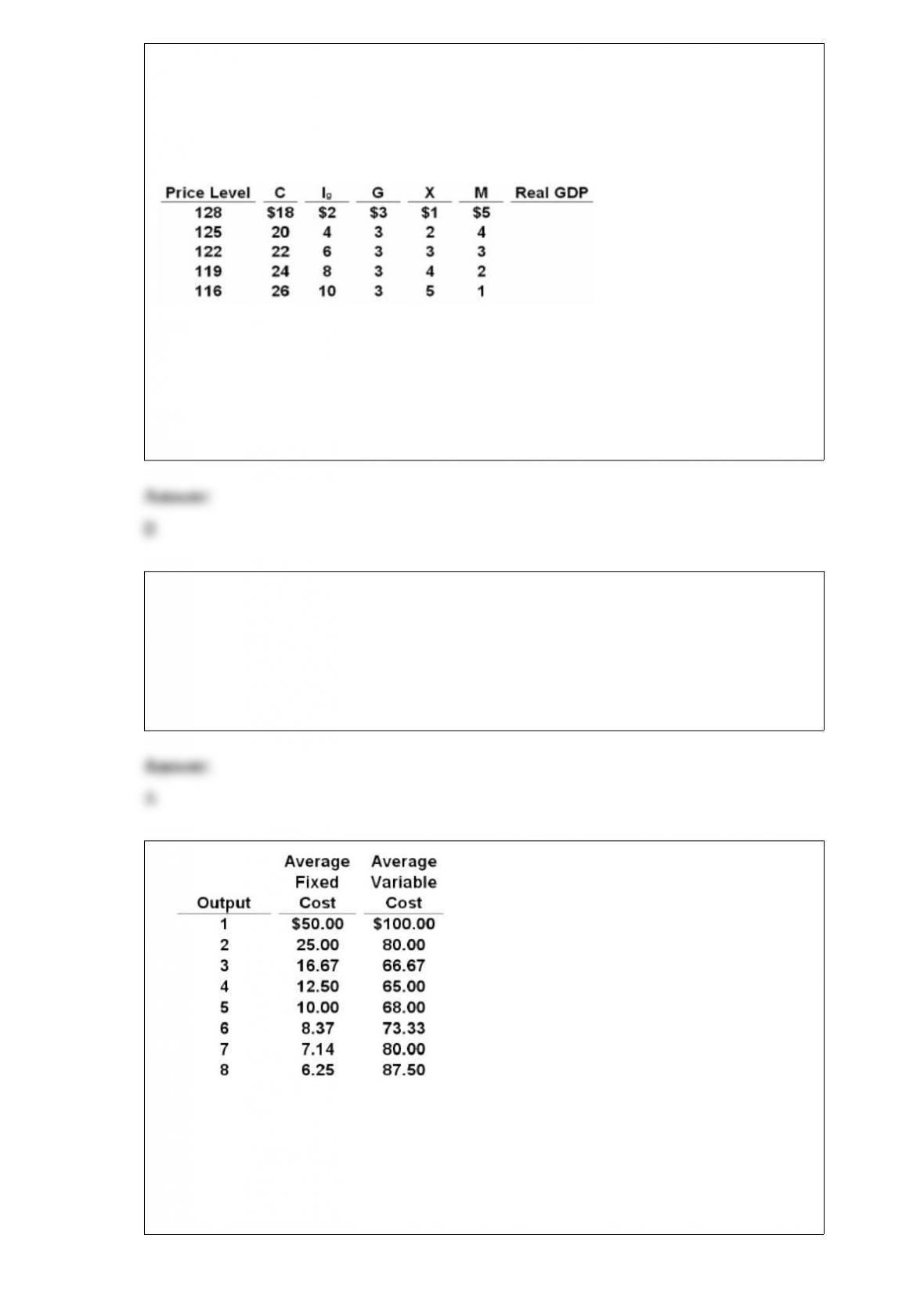
1) Answer the next question(s) on the basis of the following table for a particular
country in which C is consumption expenditures, Ig is gross investment expenditures, G
is government expenditures, X is exports, and M is imports. All figures are in billions of
dollars. Each question is independent of the other questions.
Refer to the above table. If the amounts of GDP supplied at the price levels shown (in
descending order) are $27, $25, $22, $18, and $13, the equilibrium price level will be:
A.128.
B.125.
C.122.
D.119.
2) If the demand for a product is perfectly elastic and supply is upsloping, a $1 excise
tax per unit on suppliers will:
A.not raise price at all.
B.lower price by $1.
C.raise price by more than $1.
D.raise price by $1.
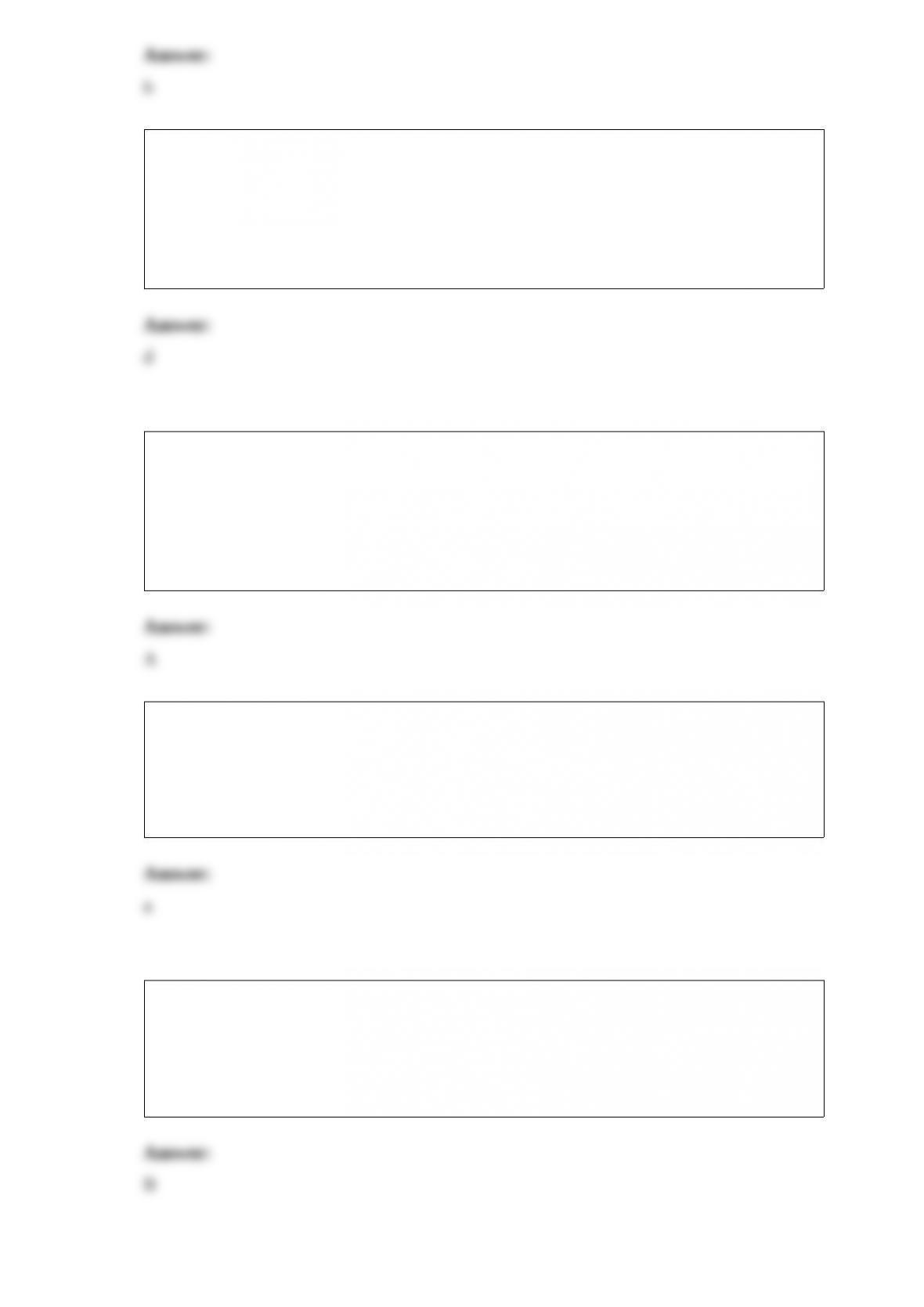
3)
refer to the above data. if the firm closed down and produced zero units of output, its
total cost would be:
a.zero.
b.$50.
c.$150.
d.$100.
4) migrant workers who face imperfect skill transferability may:
a.have to settle for a lower wage than they were expecting at the time of migration.
b.overcome this problem through greater motivation and effort.
c.return to their origin nation because the net benefits of migration were less than
expected.
d.experience all of these.
5) When current government expenditures equal current tax revenues and the economy
is achieving full employment:
A.the standardized budget has neither a deficit nor a surplus.
B.the standardized budget may have either a deficit or a surplus.
C.fiscal policy is contractionary.
D.nominal GDP and real GDP are equal.
6) the supply curve shows the relationship between:
a.price and quantity supplied.
b.production costs and the amount demanded.
c.total business revenues and quantity supplied.
d.physical inputs of resources and the resulting units of output.
7) Stock market price quotations best exemplify money serving as a:
A.store of value.
B.unit of account.
C.medium of exchange.
D.index of satisfaction.
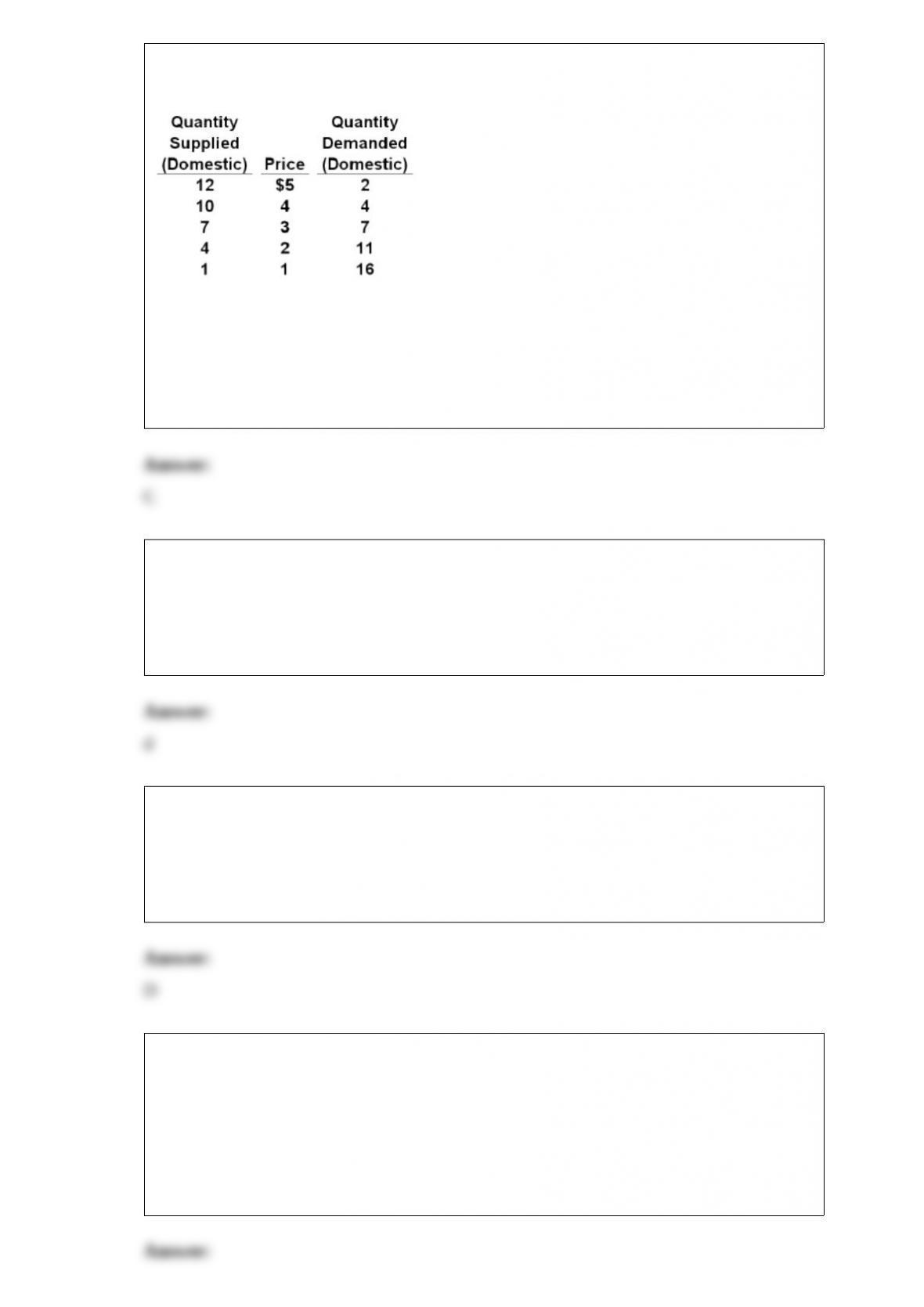
8) The following domestic supply and demand schedules for a product. Suppose that the
world price of the product is $1.
Refer to the above data. The total amount of revenue collected from a $1 per unit tariff
on this product will be:
A.$22.
B.$8.
C.$7.
D.$14.
9) if the price elasticity of demand for a product is unity, a decrease in price will:
a.have no effect upon the amount purchased.
b.increase the quantity demanded and increase total revenue.
c.increase the quantity demanded, but decrease total revenue.
d.increase the quantity demanded, but total revenue will be unchanged.
10) The demand for land is:
A.perfectly elastic.
B.perfectly inelastic.
C.upsloping.
D.downsloping.
11) assume that in year 1 your average tax rate is 20 percent on a taxable income of
$20,000. if the marginal tax rate on the next $10,000 of taxable income is 30 percent,
what will be the average tax rate if your taxable income rises to $30,000?
a.7 percent
b.30 percent
c.16 percent
d.about 23 percent
12) Describe the essential features of the kinked-demand model of oligopoly pricing.
13) Define earmarks and give an example.
14) Why is GDP a monetary measure?
15) Explain the logic behind the fact that if the Federal Reserve raises the risk-free
interest rate, return rates of other assets must rise by the same amount? Is the same true
when the risk-free interest rate is lowered?
16) How does monopoly compare with pure competition in terms of price, output, and
efficiency?
17) Why is working to increase the production of consumer goods a catch 22?
18) In the following table are five levels of taxable income and the amount that would
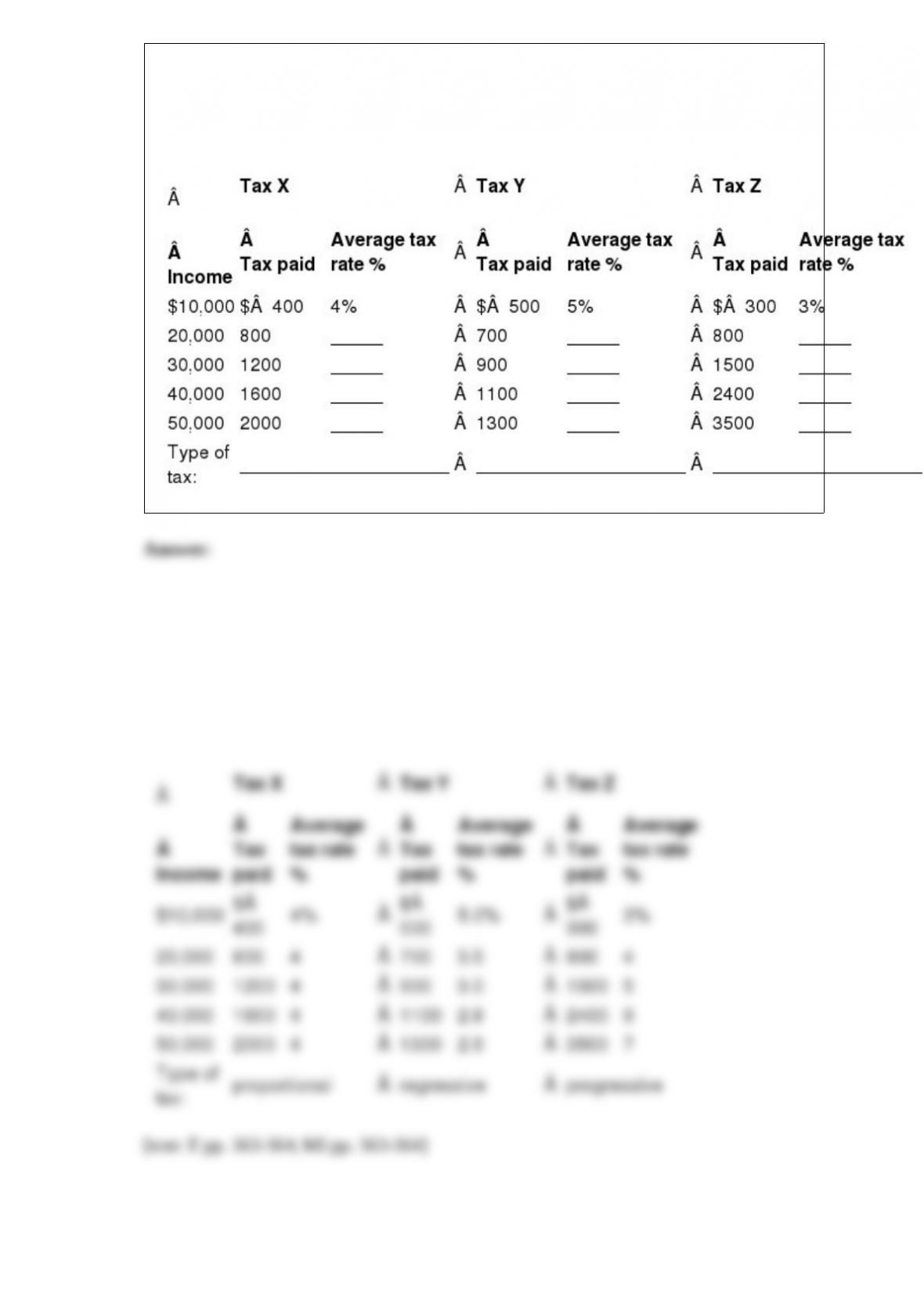
be paid at each of the five levels under three tax laws: X, Y, and Z. Compute for each of
the three tax laws the average rate of taxation at each of the four remaining income
levels and indicate whether the tax is regressive, proportional, or progressive.
19) Assume that in year 1 an economy produces 1000 units of output and they sell for
$100 a unit, on average. In year 2, the economy produces the same 1000 units of output,
and sells it for $110 a unit, on average. Use year 1 prices to calculate real GDP in Year 1
and Year 2. What happened to real GDP between years 1 and 2? Why?
20) How do government programs affect the distribution of income in the United
States?
21) Evaluate and explain: If poverty is defined as an absolute deficiency of income, the
poor are far better off today than they were four decades ago. But if poverty is viewed
as relative deprivation, of being worse off than the people to whom a poor person
compares himself or herself, then poverty today may be more painful than four decades
ago.