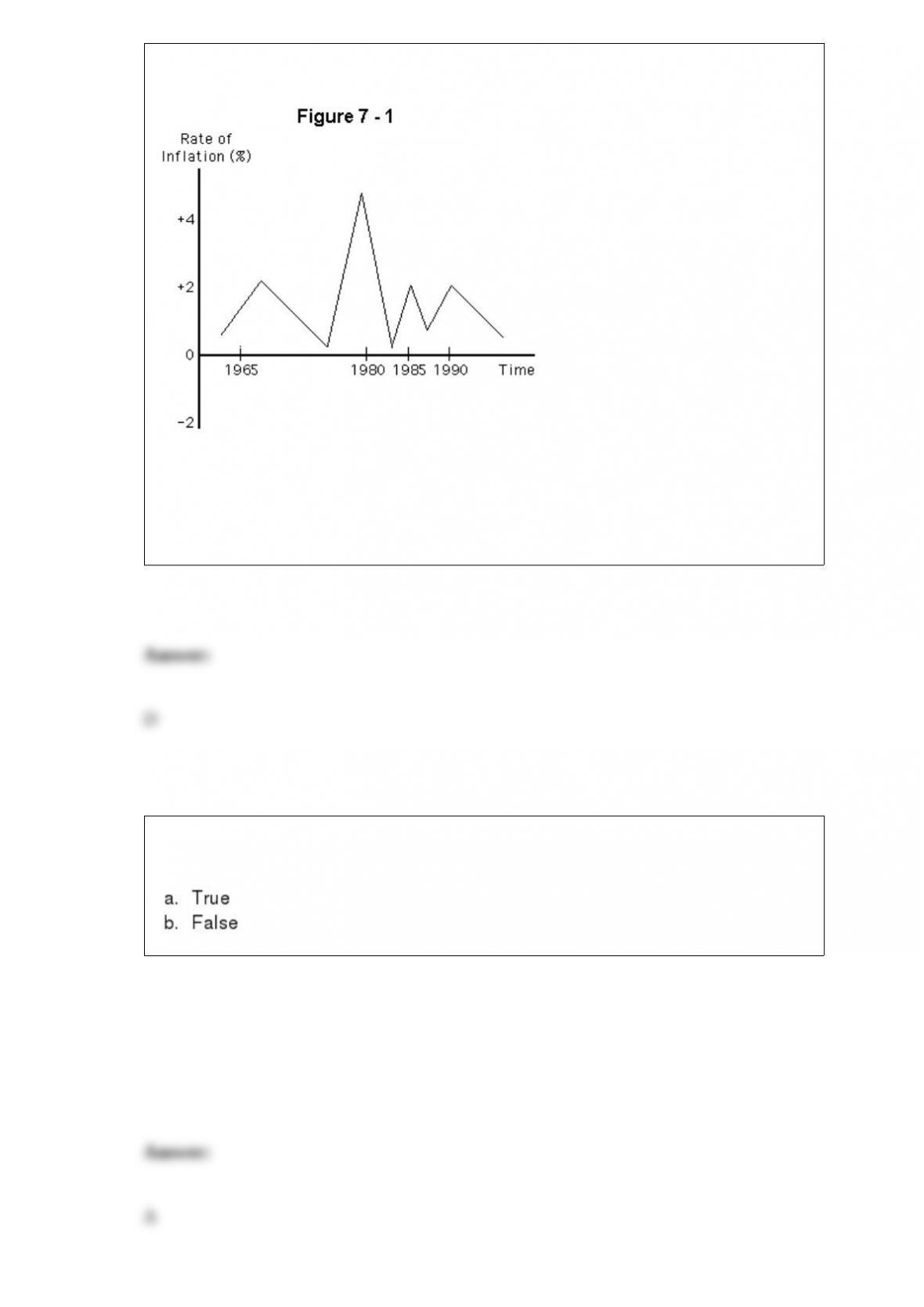
Refer to Figure 7-1. Based on the figure,
a. the price level has fallen since 1965
b. the price level in 1985 was lower than in 1980
c. the price level fell from 1980 to 1990
d. the price level has not fallen since 1965
e. the base year is 1965
Aggregate expenditure includes final spending by households, businesses, and
government on final goods and services.
If Indiana has an absolute advantage over Maine in producing both corn and ball
bearings, then
If the base year for an index is 2005 and the value of the index in 2008 is 165.1, by
what percent has the measure grown over those 3 years?
a. 165.1 percent
b. 100.0 percent
c. 6.51 percent
d. 0 percent
e. 65.1 percent
Suppose that a firm chose an output level where the total cost and total revenue curves
intersect. At this level of output,
If the Fed conducts an open market purchase of bonds, the
a. money supply decreases as reserves are injected into the banking system
b. demand for money increases as reserves are drained from the banking system
c. demand for money decreases as reserves are injected into the banking system
d. money supply increases as reserves are injected into the banking system
e. money supply increases as reserves are drained from the banking system
The AD curve shifts to the right when
a. the Fed alters its fiscal policy rules
b. any economic shock disrupts the economy
c. the AS curve does not shift
d. new trade legislation is passed
e. positive demand shocks occur
Which of the following statements about the effects of an increase in government
purchases is most accurate?
a. In the classical model, it will cause complete crowding out. In the short-run macro
model, crowding out will be incomplete.
b. In the classical model, it will cause incomplete crowding out. In the short-run macro
model, crowding out will be complete.
c. Crowding out will be complete in both the classical and short-run macro model.
d. Crowding out will be incomplete in both the classical and short-run macro model.
e. In the classical model, the increase in government spending will lead to a decrease in
investment spending and autonomous consumption. In the short-run macro model, it
will not.
A nation has a comparative advantage in producing a good if it has a lower opportunity
cost of producing that good than other countries have.
A network externality exists
If the demand for money decreases, a constant interest rate policy requires the Fed to
a. consult with leaders in the financial markets to see whether it should introduce credit
controls
b. watch to see whether the investment spending decreases
c. move quickly to prevent a recession
d. decrease the supply of money
e. decrease the interest rate
The consumption function shows the relationship between real consumption spending
and
a. real wealth
b. the interest rate
c. expectations
d. real disposable income
e. debt
A labor union anticipates a 7 percent inflation rate in each of the next three years. It
wants to obtain a 3 percent increase in real wages in each of those three years. To obtain
this goal, the requisite nominal wage hike it should negotiate is
a. 7 percent each year
b. 3 percent each year
c. 10 percent each year
d. 10 percent the first year and 3 percent each year thereafter
e. 21 percent the first year and 3 percent each year thereafter
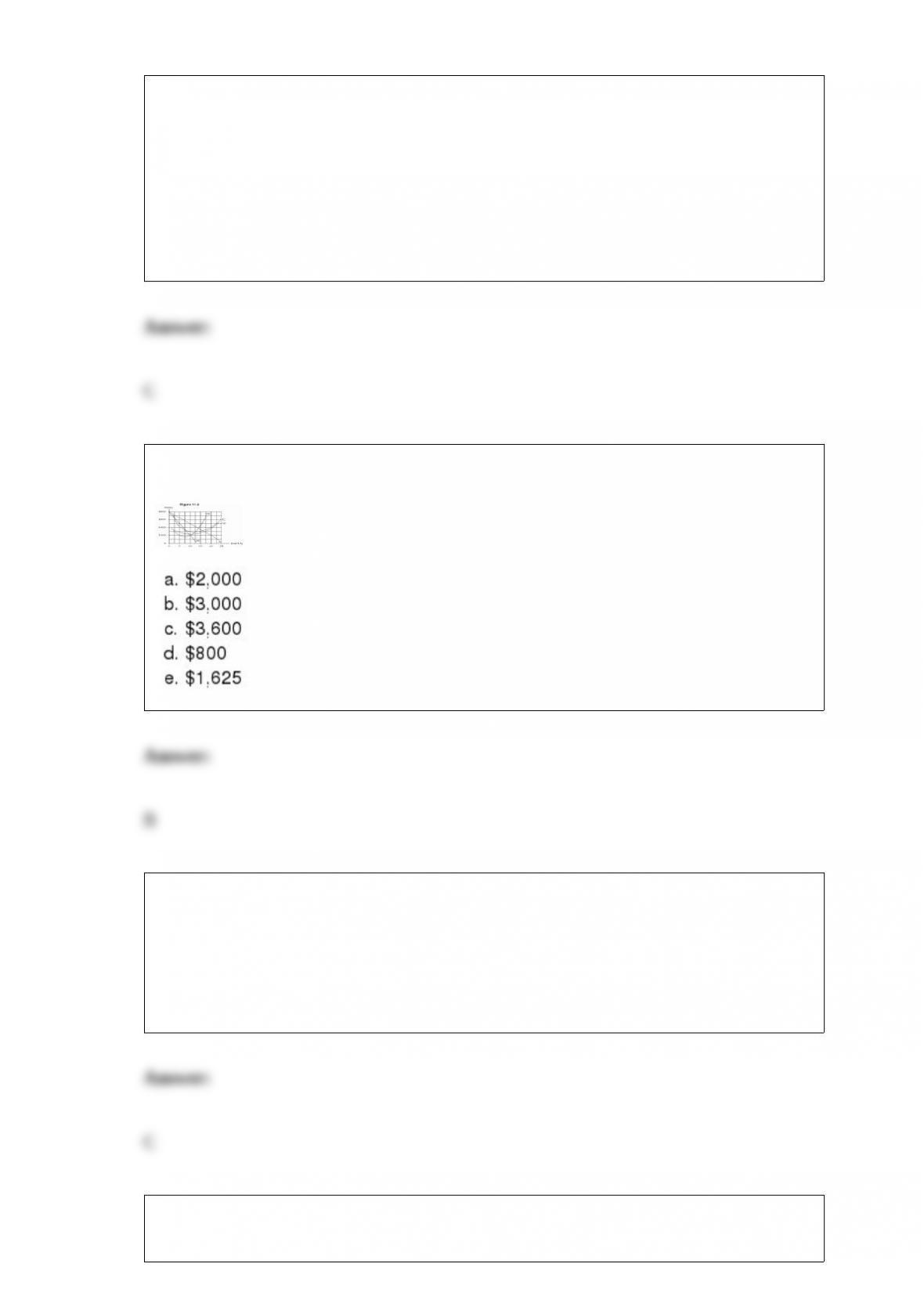
At the profit-maximizing, or loss-minimizing, output level, the firm in Figure 11-2 has
total cost approximately equal to
When a nation begins to export a good,
a. the domestic price of that good falls
b. less of that good is produced domestically
c. the domestic producers are made better off
d. the domestic consumers are made better off
e. both domestic and foreign consumers will purchase more of it
Assume that GDP growth in a particular country is 4 percent per year. How many years
it will take for GDP to double?
a. 80.0 years.
b. 17.5 years.
c. 10.0 years.
d. 20.0 years.
e. 20.5 years.
Fiscal policy is a change in either government purchases or the money supply designed
to change total spending in the economy, thereby influencing the levels of employment
and output.
The height of the market demand curve
In the short run, the impact of a $50 billion tax package on GDP will be
a. greater than $50 billion because of the multiplier effect

b. less than $50 billion because of the tax code
c. greater than $50 billion because of the tax code
d. exactly $50 billion
e. greater than $50 billion because of crowding out