
1) The contagion effect refers to the fact that
A) deposit insurance has eliminated the problem of bank failures
B) bank runs involve only sound banks
C) bank runs involve only insolvent banks
D) the failure of one bank can hasten the failure of other banks
2) A consol paying $20 annually when the interest rate is 5 percent has a price of
A) $100
B) $200
C) $400
D) $800
3) The ________ states that the nominal interest rate equals the real interest rate plus
the expected rate of inflation.
A) Fisher equation
B) Keynesian equation
C) Monetarist equation
D) Marshall equation
4) A credit market instrument that provides the borrower with an amount of funds that
must be repaid at the maturity date along with an interest payment is known as a
A) simple loan
B) fixed-payment loan
C) coupon bond
D) discount bond
5) Changes in stock prices
A) do not affect people’s wealth and their willingness to spend
B) affect firms’ decisions to sell stock to finance investment spending
C) occur in regular patterns

D) are unimportant to decision makers
6) Eurodollars are
A) dollar-dominated deposits held in banks outside the United States
B) deposits held by U.S. banks in Europe
C) deposits held by U.S. banks in foreign countries
D) dollar-dominated deposits held in U.S. banks by Europeans
7) Everything else held constant, a decrease in the value of the dollar relative to all
foreign currencies means that the price of foreign goods purchased by Americans
A) increases
B) decreases
C) remains unchanged
D) either increases, decreases, or remains unchanged
8) Keynes argued that the precautionary component of the demand for money was
primarily determined by the level of people’s ________, which he believed were
proportional to ________.
A) incomes; wealth
B) incomes; age
C) transactions; income
D) transactions; age
9) Moral hazard and adverse selection problems increased in prominence in the 1980s
A) as deregulation required savings and loans and mutual savings banks to be more
cautious
B) following a burst of financial innovation in the 1970s and early 1980s that produced
new financial instruments and markets, thereby widening the scope for risk taking
C) following a decrease in federal deposit insurance from $100,000 to $40,000
D) as interest rates were sharply decreased to bring down inflation

10) When the interest rate on a bond is above the equilibrium interest rate, in the bond
market there is excess ________ and the interest rate will ________.
A) demand; rise
B) demand; fall
C) supply; fall
D) supply; rise
11) If Second National Bank has more rate-sensitive assets than rate-sensitive liabilities,
it can reduce interest-rate risk with a swap that requires Second National to
A) pay fixed rate while receiving floating rate
B) receive fixed rate while paying floating rate
C) both receive and pay fixed rate
D) both receive and pay floating rate
12) Options are contracts that give the purchasers the
A) option to buy or sell an underlying asset
B) obligation to buy or sell an underlying asset
C) right to hold an underlying asset
D) right to switch payment streams
13) The leverage ratio is the ratio of a bank’s
A) assets divided by its liabilities
B) income divided by its assets
C) capital divided by its total assets
D) capital divided by its total liabilities
14) Since Regulation Q has been abolished, there have been doubts raised about the size
of the effect of the ________ channel.
A) balance sheet
B) bank lending

C) cash flow
D) unanticipated price level
15) Everything else held constant, an increase in the required reserve ratio on checkable
deposits causes the M1 money multiplier to ________ and the money supply to
________.
A) decrease; increase
B) increase; increase
C) decrease; decrease
D) increase; decrease
16) According to Tobin’s q theory, if q is ________, new plant and equipment capital is
________ relative to the market value of business firms, so companies can buy a lot of
new investment goods with only a ________ issue of stock.
A) high; dear; large
B) high; cheap; large
C) high; cheap; small
D) low; cheap; large
E) low; cheap; small
17) Reasons regulators chose to follow regulatory forbearance rather than to close the
insolvent S&Ls include all of the following except
A) they had insufficient funds to close all of the insolvent S&Ls
B) they were friends with the S&L owners
C) they hoped the problem would go away
D) they did not have the authority to close the insolvent S&Ls
18) An investment bank purchases securities from a corporation at a predetermined
price and then resells them in the market. This process is called
A) underwriting
B) underhanded
C) understanding
D) undertaking

19) Everything else held constant, Americans who love French wine benefit most from
A) a decrease in the dollar price of euros
B) an increase in the dollar price of euros
C) a constant dollar price for euros
D) a ban on imports from Europe
20) The Japanese banking system went through a cycle of ________ in the 1990s
similar to the one that occurred in the U.S. in the 1980s.
A) regulatory forbearance
B) policy antagonism
C) regulatory ignorance
D) policy renewal
21) Which of the following statements about the characteristics of debt and equity is
false?
A) They can both be long-term financial instruments
B) They can both be short-term financial instruments
C) They both involve a claim on the issuer’s income
D) They both enable a corporation to raise funds
22) Banks will be examined at least once a year and given a CAMELS rating by
examiners. The L stands for
A) liabilities
B) liquidity
C) loans
D) leverage
23) The ________ of the term structure states the following: the interest rate on a
long-term bond will equal an average of short-term interest rates expected to occur over

the life of the long-term bond plus a term premium that responds to supply and demand
conditions for that bond.
A) segmented markets theory
B) expectations theory
C) liquidity premium theory
D) separable markets theory
24) Thrift institutions include
A) commercial banks
B) brokerage firms
C) insurance companies
D) mutual savings banks
25) A financial panic was averted in October 1987 following “Black Monday” when the
Fed announced that
A) it was lowering the discount rate
B) it would provide discount loans to any bank that would make loans to the security
industry
C) it stood ready to purchase common stocks to prevent a further slide in stock prices
D) it was raising the discount rate
26) Collateralized debt is also know as
A) unsecured debt
B) secured debt
C) unrestricted debt
D) promissory debt
27) The efficient markets hypothesis suggests that investors
A) should purchase no-load mutual funds which have low management fees
B) can use the advice of technical analysts to outperform the market
C) let too many unexploited profit opportunities go by if they adopt a “buy and hold”
strategy
D) act on all “hot tips” they hear

28) Everything else held constant, when a country’s currency appreciates, the country’s
goods abroad become ________ expensive and foreign goods in that country become
________ expensive.
A) more; less
B) more; more
C) less; less
D) less; more
29) The World Bank is an international organization that:
A) promotes the growth of trade by setting rules for how tariffs and quotas are set by
countries
B) makes loans to countries to finance projects such as dams and roads
C) makes loans to countries with balance of payment difficulties
D) helps developing countries that have been having difficulties in repaying their loans
to come to terms with lenders in the West
30) A decrease in the liquidity of corporate bonds, other things being equal, shifts the
demand curve for corporate bonds to the ________ and the demand curve for Treasury
bonds shifts to the ________.
A) right; right
B) right; left
C) left; left
D) left; right
31) If you default on your auto loan, your car will be repossessed because it has been
pledged as ________ for the loan.
A) interest
B) collateral
C) dividend
D) commodity
32) Fluctuations in the demand for reserves cause the Fed to lose control over a
monetary aggregate if the Fed targets
A) a monetary aggregate
B) the monetary base
C) an interest rate
D) nominal GDP
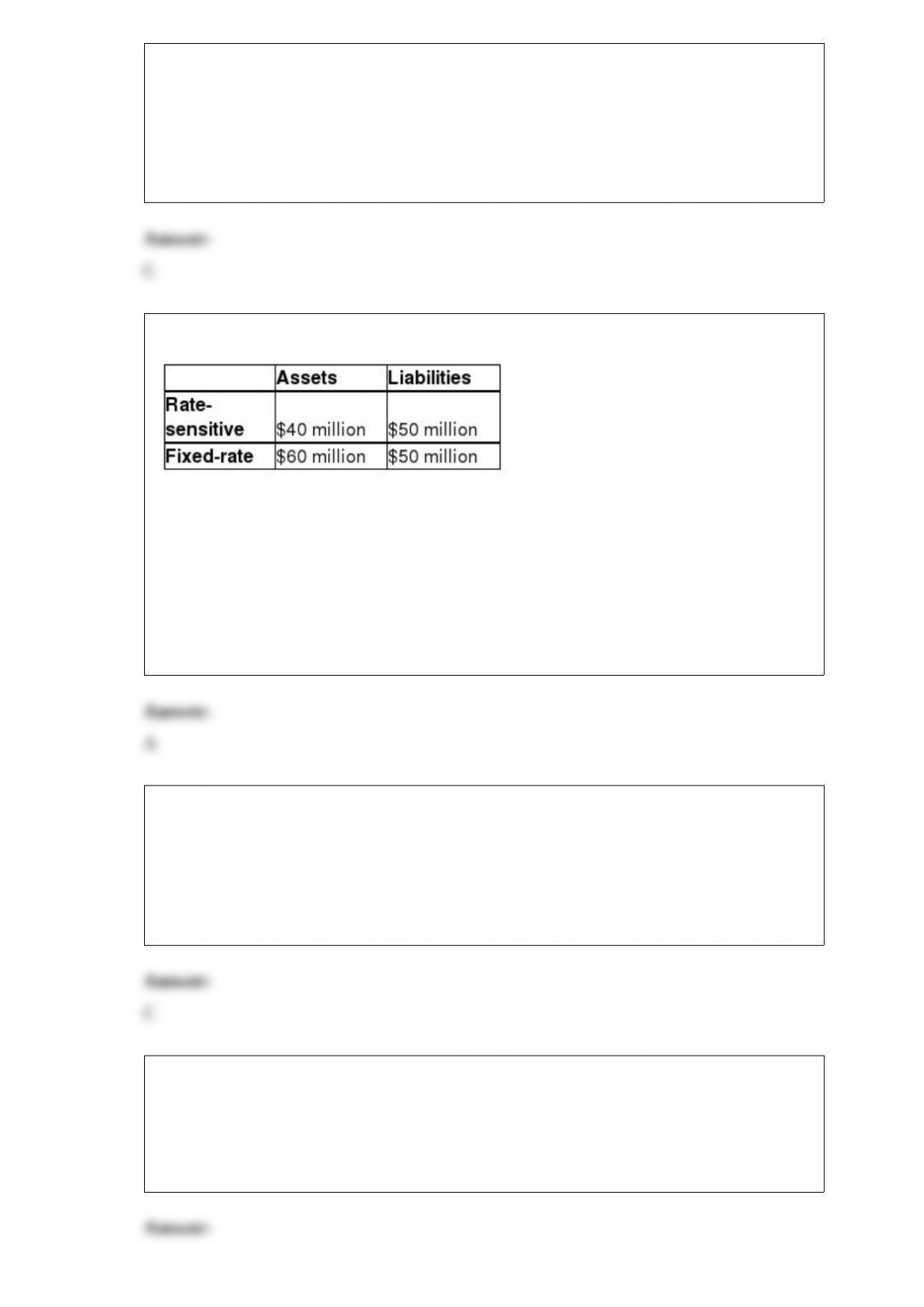
33) First National Bank
Assuming that the average duration of its assets is four years, while the average
duration of its liabilities is three years, then a 5 percentage point increase in interest
rates will cause the net worth of First National to ________ by ________ of the total
original asset value.
A) decline; 5 percent
B) decline; 10 percent
C) decline; 15 percent
D) increase; 20 percent
34) Which of the following is not an element of inflation targeting?
A) A public announcement of medium-term numerical targets for inflation
B) An institutional commitment to price stability as the primary long-run goal
C) An information-inclusive approach in which only monetary aggregates are used in
making decisions about monetary policy
D) Increased accountability of the central bank for attaining its inflation objectives
35) If the required reserve ratio is 25 percent, the simple deposit multiplier is
A) 5.0
B) 2.5
C) 4.0
D) 10.0

36) Which of the following securities has the lowest interest rate?
A) Junk bonds
B) U.S. Treasury bonds
C) Investment-grade bonds
D) Corporate Baa bonds
37) Under an exchange-rate targeting rule for monetary policy, a crawling peg
A) fixes the value of the domestic currency to a commodity such as gold
B) fixes the value of the domestic currency to that of a large, low-inflation country
C) allows the domestic currency to depreciate at a steady rate so that inflation in the
pegging country can be higher than that of the anchor country
D) allows the domestic currency to depreciate at a steady rate so that inflation in the
pegging country can be lower than that of the anchor country
38) Everything else held constant, a decline in interest rates will cause spending on
housing to
A) fall
B) remain unchanged
C) either rise, fall, or remain the same
D) rise