At macroeconomic equilibrium,
A) total investment equals total inventories.
B) total spending equals total production.
C) total consumption equals total production.
D) total taxes equal total transfers.
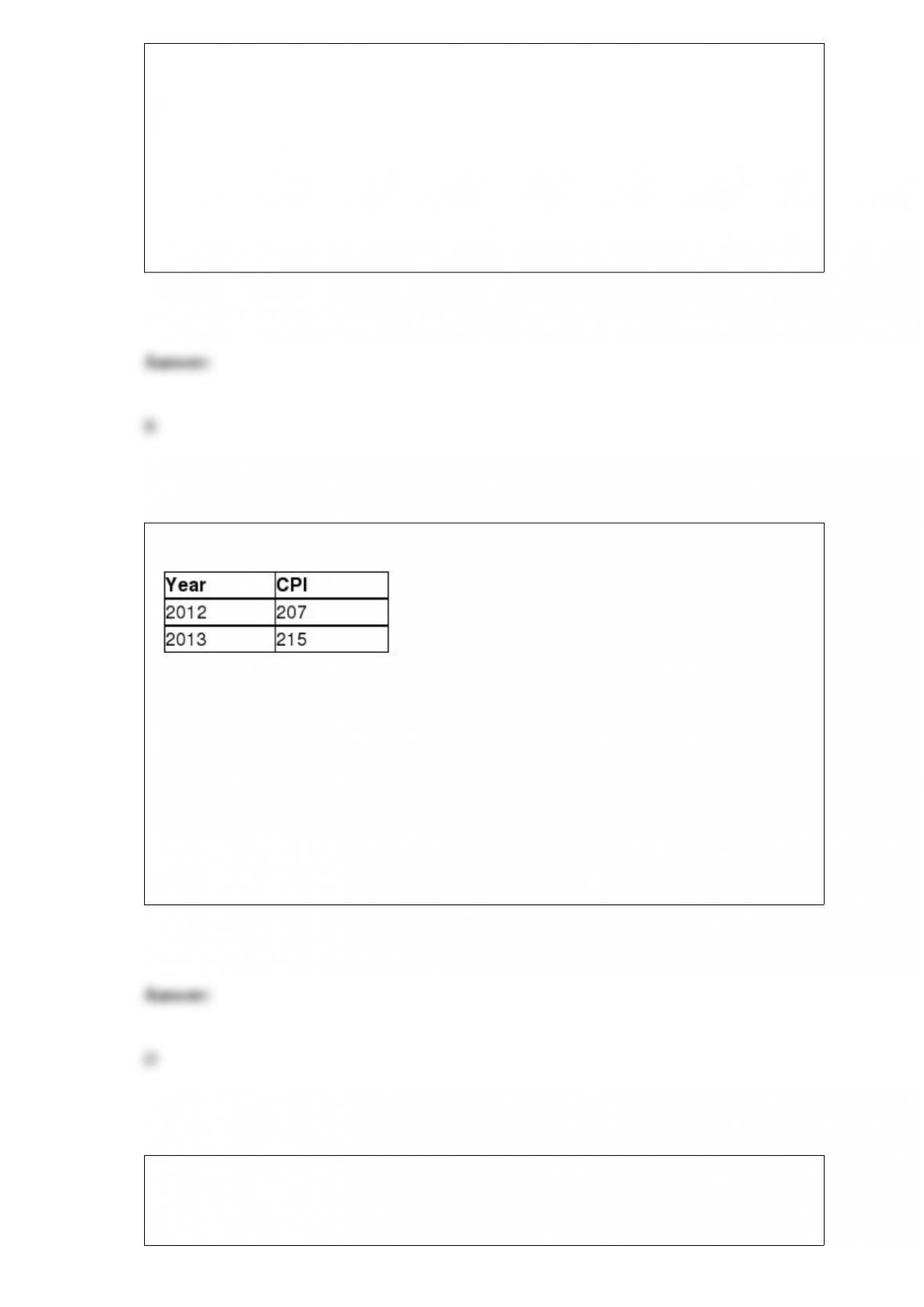
Table 9-5
Refer to Table 9-5. Consider the following values of the consumer price index for 2012
and 2013. The inflation rate for 2013 was equal to
A) 215 percent.
B) 21.5 percent.
C) 8.0 percent.
D) 3.9 percent.
The federal government debt ________ when the federal government runs a deficit and
________ when the federal government runs a surplus.

A) increases; increases
B) decreases; increases
C) increases; decreases
D) decreases; decreases
Typically, as an economy begins to emerge from a recessionary phase of the business
cycle,
A) unemployment falls immediately.
B) unemployment continues to rise.
C) inflation begins to fall.
D) investment begins to fall.
The Fed’s two main monetary policy targets are
A) the money supply and the inflation rate.
B) the money supply and the interest rate.
C) the interest rate and real GDP.
D) the inflation rate and real GDP.
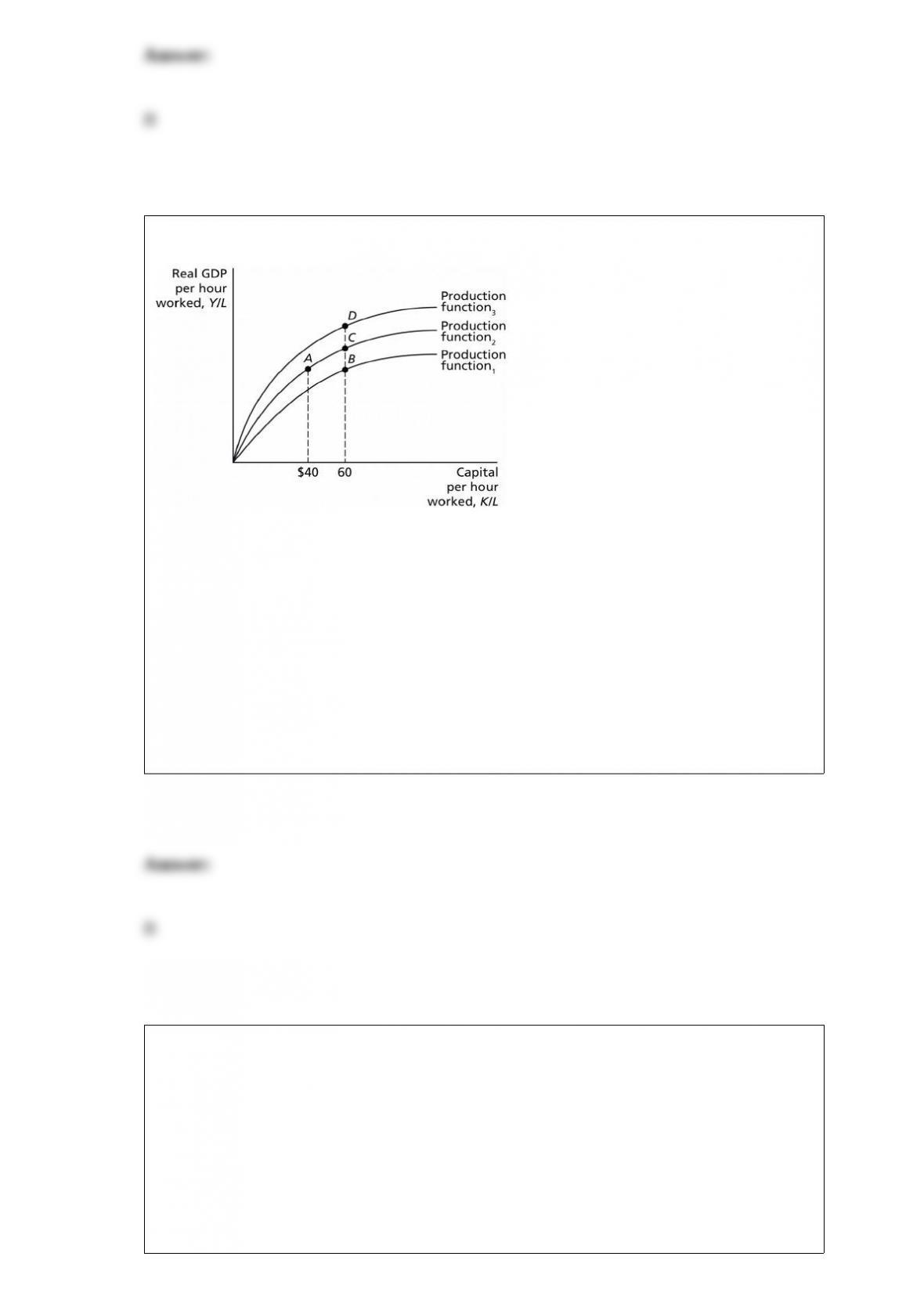
Figure 11-1
Refer to Figure 11-1. Many countries in Africa strongly discouraged and prohibited
foreign direct investment in the 1950s and 1960s. By doing so, these countries were
essentially preventing a moment from
A) A to B.
B) B to C.
C) B to A.
D) D to C.
Which of the following is the smallest portion of the market basket of goods that makes
up the CPI?
A) housing
B) food and beverages
C) transportation

D) apparel
One of the most widely followed stock indexes in the United States is the Dow Jones
Industrial Average. This index represents
A) the stock prices of 500 large U.S. firms.
B) an over-the-counter market.
C) the stock prices of more than 4,000 U.S. firms.
D) the stock prices of 30 large U.S. corporations.
Which of the following is most likely to be able to sustain economic growth in an
economy?
A) sustained increases in the labor force participation rate
B) technological change
C) increases in capital per hour worked
D) accumulations of economic resources

From 1991 until 2001, the United States was in a period of
A) expansion.
B) recession.
C) business cycle troughs.
D) business cycle peaks.
On the 45-degree line diagram, the 45-degree line shows points where
A) real income equals real GDP.
B) real aggregate expenditure equals C + I.
C) real aggregate expenditure equals real GDP.
D) real aggregate output equals the quantity produced.
If the balance on the current account is $842 billion and the balance on the financial
account is -$603 billion, what is the balance on the capital account, assuming no
statistical discrepancy?
A) $1,445 billion
B) $239 billion

C) $0
D) -$239 billion
The current account includes records of a country’s
A) net exports.
B) net investment income.
C) net transfers.
D) All of the above are included in an economy’s current account.
The individual mandate provision of the ACA requires
A) every U.S. resident to have health insurance.
B) every U.S. company to provide health insurance to its employees.
C) every employed person to pay for his or her own health insurance.
D) every private insurance company to provide free health care to its current policy
holders.
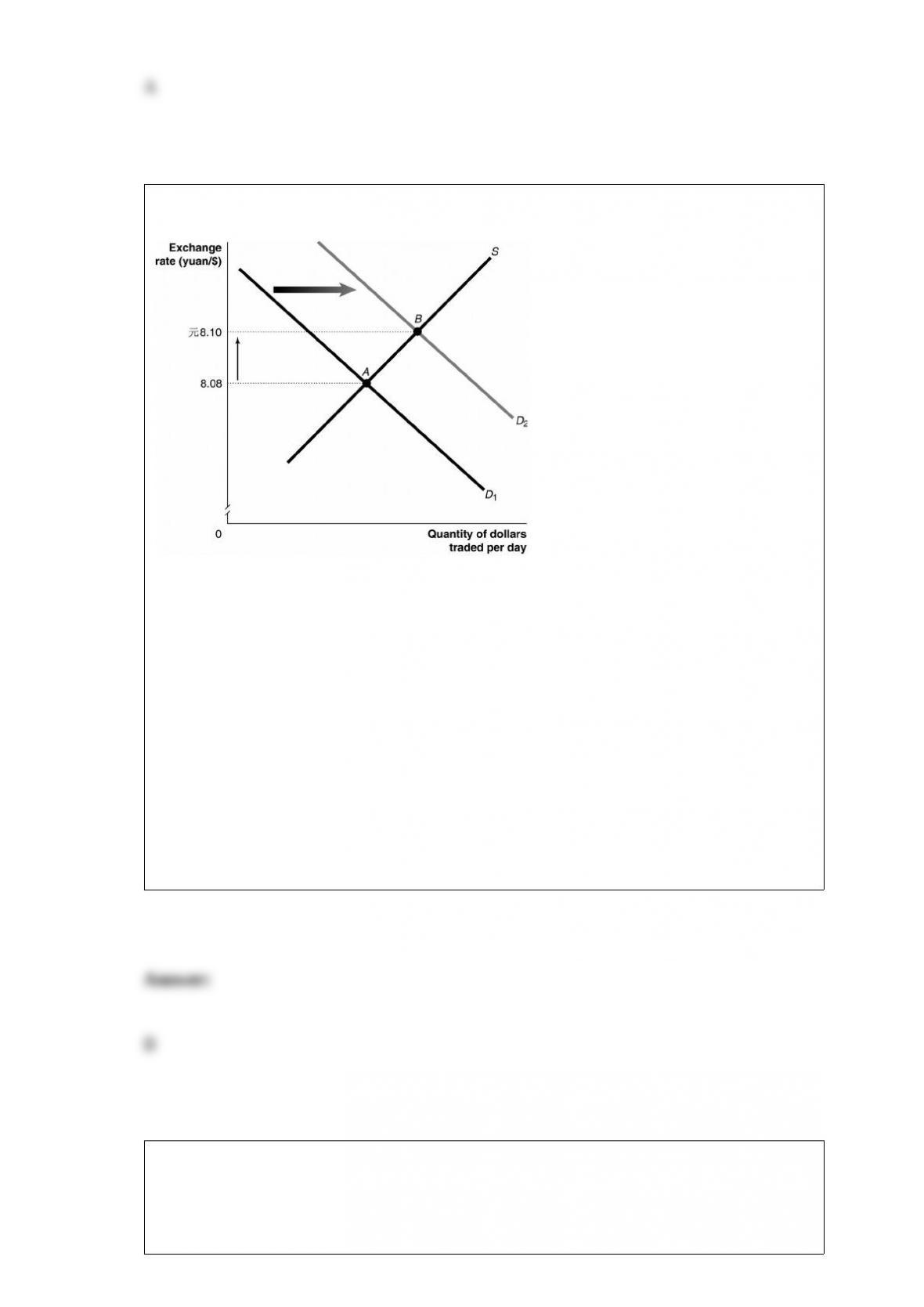
Figure 19-2
Refer to Figure 19-2. Which of the following would cause the change depicted in the
figure above?
A) Lack of investment in infrastructure causes U.S. productivity to fall relative to
Chinese productivity.
B) Tainted cat food from China causes U.S. consumers to decrease their preferences for
Chinese goods relative to U.S. goods.
C) A new trade agreement with China results in the United States removing all tariffs on
clothing imported from China.
D) An expansionary monetary policy causes an increase in the price level of U.S. goods
relative to Chinese goods.
Assume that the hourly price for the services of personal trainers has risen and sales of
these services have also risen. One can conclude that
A) the law of demand has been violated.

B) the number of personal trainers has increased.
C) the demand for personal trainers has increased.
D) personal trainers are deliberately charging high prices because they provide services
for wealthy clients.
The sum of consumer surplus and producer surplus is equal to
A) the deadweight loss.
B) the economic surplus.
C) zero.
D) total profit.
An increase in capital inflows will
A) increase net foreign investment.
B) increase capital outflows.
C) decrease capital outflows.
D) increase the equilibrium exchange rate.

“Taxes are what we pay for a civilized society.” This statement was made by
A) Adam Smith.
B) Oliver Wendell Holmes.
C) Herbert Hoover.
D) Franklin Roosevelt.