
Alexander Hamilton used the infant-industry argument to support trade restrictions.
a. True
b. False
As the price of a product rises the product will become more elastic in demand,
assuming that the demand curve for the product is a downward-sloping straight line.
a. True
b. False
Special interest group A receives a 1/10,000th slice of the economic pie (Real GDP).It is
seeking a transfer of $1,000.For group A to be indifferent between a transfer policy and
an economic growth policy, economic growth must be ________________ times larger
than the _________________.
a. 1,000; transfer
b. 10,000; transfer
c. 100; transfer
d. 10,000; transfer minus $1,000
e. 1,000; transfer; minus $10,000

If potential buyers of good X expect the price of good X will soon fall, then the current
a. demand for good X will rise.
b. demand for good X will remain unchanged.
c. demand for good X will fall.
d. quantity demanded of good X will fall.
e. quantity demanded of good X will rise.
If MRP = VMP = MFC = wages, then the firm is
a. selling its product in a perfectly competitive market and is hiring its labor in a
perfectly competitive labor market.
b. selling its product in a perfectly competitive market but is not hiring its labor in a
perfectly competitive labor market.
c. not selling its product in a perfectly competitive market but is hiring its labor in a
perfectly competitive labor market.
d. neither selling its product in a perfectly competitive market nor hiring its labor in a
perfectly competitive labor market.

One of the reasons why economies of scale exist is that the opportunity for labor
specialization tends to increase as the size of the firm grows.
a. True
b. False
Situation 27-2 A company is trying to decide whether it should produce good Y in the
U.S. or in Mexico.Suppose a U.S. worker earns $12 per hour and a worker in Mexico
earns $4 per hour.Also suppose that the marginal physical product (MPP) of the U.S.
worker is 10 units of good Y and the MPP of the Mexican worker is 5 units of good Y.
If good Y is produced in the United States, the output per $1 of cost would be
___________________ than if good Y were produced in Mexico, thus it would be best
to produce good Y in ____________________.
a. higher; Mexico.
b. lower; Mexico.
c. higher; the United States.
d. lower; the United States.
When the price of a good rises, the price is transmitting information indicating that the

good has become relatively
a. scarcer.
b. less scarce.
c. more plentiful in supply.
d. b and c
Marginal utility is
a. the extra satisfaction derived from consuming an additional unit of a good.
b. the total satisfaction derived from consuming an additional unit of a good.
c. the total satisfaction derived from consuming a good.
d. the change in total satisfaction as an additional unit of a good is consumed.
e. a and d
Situation 22-4
Joe is the owner-operator of Joe’s Haircuts Unlimited. Last year he earned $200,000 in
total revenues and paid $125,000 to his employees and suppliers. During the course of
the year, he received three offers to work for other barbers, with the highest offer being
$50,000 per year.
What are Joe’s economic profits?

a. $0
b. $25,000
c. -$25,000
d. $40,000
e. $75,000
Marginal cost is the change in
a. total cost that results from a change in output.
b. total revenue that results from a change in output.
c. fixed cost that results from a change in output.
d. a and b
e. all of the above
The profit-maximizing single-price monopolist will charge a price
a. equal to marginal revenue.
b. greater than marginal cost.
c. less than marginal revenue, but greater than marginal cost.

d. greater than marginal revenue, but equal to marginal cost.
e. a and b
The law of diminishing marginal utility helps to explain
a. why people trade.
b. the law of demand.
c. why the production possibilities frontier is typically bowed-out.
d. a and b
e. all of the above
Exhibit 31-4
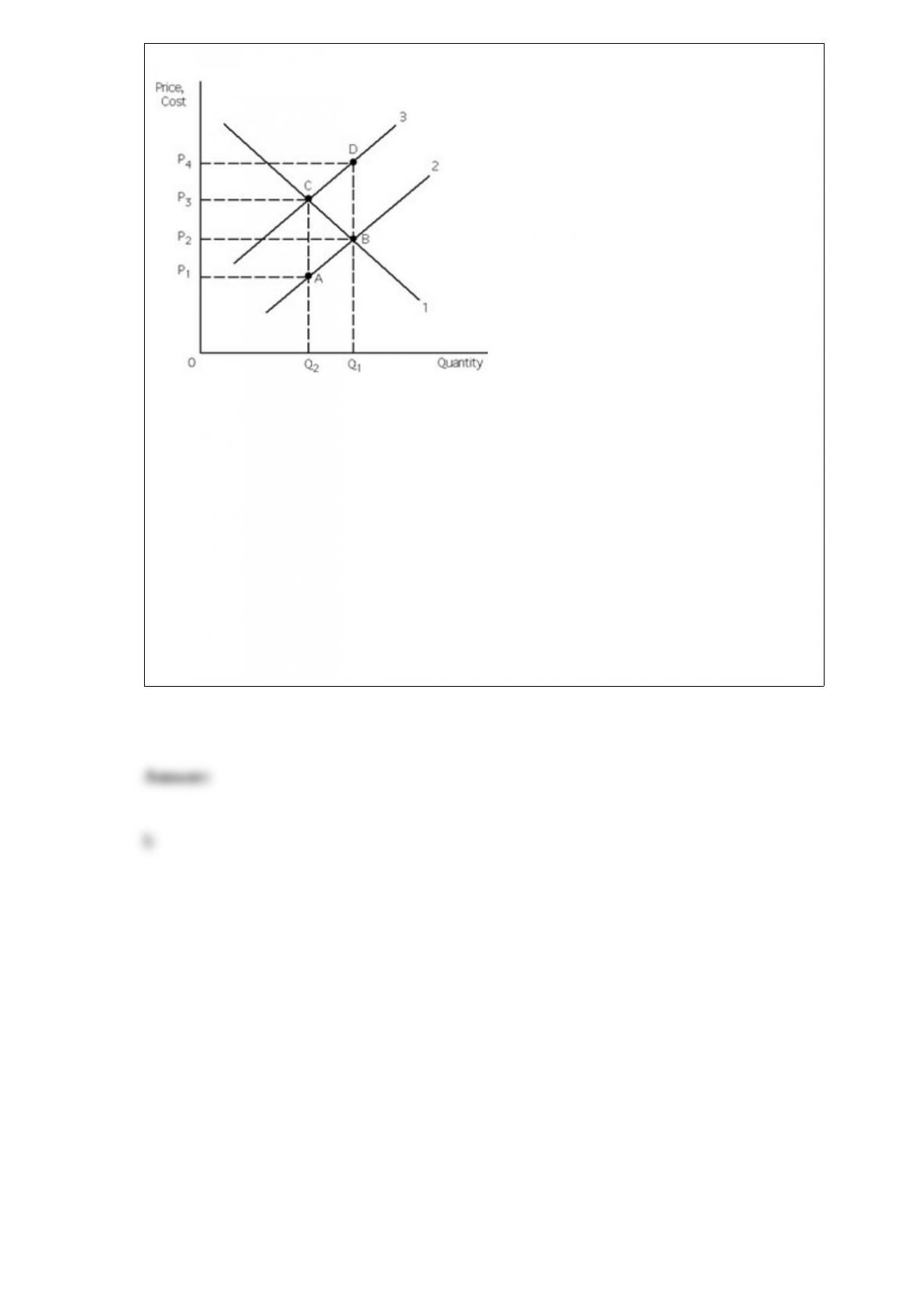
If a negative externality exists, then curve __________ represents the marginal social
cost curve and the area __________ represents the market failure.
a. 1; ACB
b. 3; BCD
c. 2; BCD
d. 3; ACB
e. 2; ACB