
Which term refers to provisions in a law or a contract whereby monetary payments are
automatically adjusted whenever a specified price index changes?
a. Contango
b. Swap
c. Averaging
d. Indexing
A price-discriminating firm will always maximize profit by following the condition that
a. MR > MC.
b. MR > P.
c. MRa = MRb = MC.
d. MR = ATC.
If the production possibilities curve is a straight line,
a. opportunity costs rise as output of either commodity is expanded.
b. resources are not equally productive in the production of both goods.
c. opportunity costs are negative.
d. resources can be moved from the production of one good to production of others with
no loss of productivity.
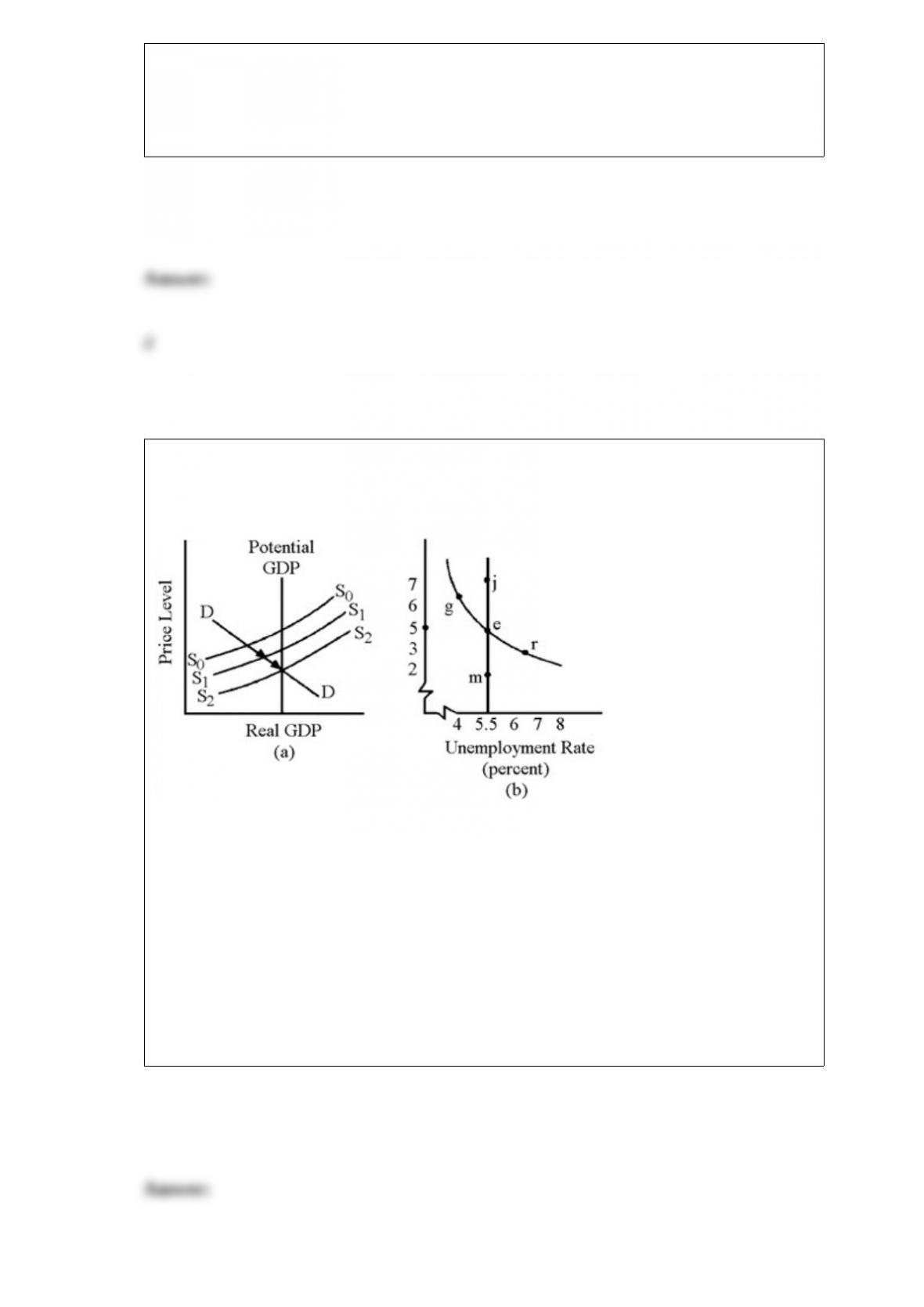
Figure 17-6
If the economy in 34-6 (b) is experiencing an inflationary gap (point g), the economy’s
self-correcting process will move unemployment to ____ and inflation to ____.
a. 4 percent; 6 percent
b. 5.5 percent; 5 percent
c. 5.5 percent; 7 percent
d. 5.5 percent; 2 percent

A partnership requires the agreement of most or all partners to any major decision.
a. True
b. False
The lower left-hand corner of a graph where the two axes meet is called the graph’s
origin.
a. True
b. False
If credit cards were suddenly ruled illegal and were no longer used, the most likely
effect would be a decrease in the
a. demand for money.
b. level of cash balances.
c. average checking account balance.

d. velocity of circulation.
Is it possible to express an economic model in words without diagrams?
a. No, models can only be stated in diagrams.
b. No, the very definition of model requires mathematical form.
c. Yes, some of the simplest models are verbal statements.
d. Yes, although the best models always use diagrams.
e. Uncertain, economic theory has not answered this question yet.
Stabilization policy may be necessary to modify or counteract volatile changes in
aggregate demand.
a. True
b. False

Consider the economic effects of the September 11, 2001 terrorist attacks. Which of the
following statements is correct?
a. Reconstruction would lead to an increase in GDP.
b. Increased government spending on relief efforts in the U.S. would decrease GDP.
c. Lost items and buildings would lead to a decrease in GDP.
d. U.S. well-being was improved, despite the loss in GDP.
If the supply of a good is perfectly inelastic, then suppliers will bear the full burden of
an excise tax
a. no matter how elastic the demand for the good is.
b. only if demand is perfectly elastic.
c. only if demand is perfectly inelastic.
d. only if the government forbids them to raise the price of the good.

Which of the following statements is correct?
a. The demand for capital is derived from the demands for outputs.
b. The demands for output are derived from the demand for capital.
c. The demand for capital is derived from the demand for rent.
d. The demand for rent is derived from the demand for capital.
A nation’s standard of living depends on its population and labor productivity.
a. True
b. False
Advertising never makes sense for an oligopolistic firm.
a. True
b. False

Governments can affect the level of aggregate demand in a direct way by changing
a. government spending.
b. exports.
c. taxes.
d. transfer payments.
Takeover of one firm by another
a. ties up the nation’s capital wastefully.
b. uses up the economy’s credit supply.
c. reduces the value of the acquired firm.
d. changes ownership of the acquired firm.
The antitrust laws are enforced by government agencies such as the Federal Trade

Commission and the Department of Justice.
a. True
b. False
An increase in the U.S. price level relative to the price level of U.S. trading partners
will cause the aggregate expenditures function in the United States to
a. shift up.
b. shift down.
c. get flatter.
d. get steeper.
Since a monopolist has a unique product, it makes no sense for the firm to advertise.
a. True
b. False

____ occur when an X percent increase in input use raises output by more than X
percent, so that the more the firm produces, the lower its per-unit costs become.
a. Economies of scope
b. Scale economies
c. Product differentiation
d. Perfect competition
An increase in the price of a particular bond implies an increase in the interest rate for
that bond.
a. True
b. False
Macroeconomists are distinguished from microeconomists because macroeconomists
are more interested in
a. inflation and unemployment than in individual markets.
b. large corporations rather than small businesses.
c. inflation in the United States rather than inflation in Costa Rica.
d. the demand for oil rather than the demand for corn.
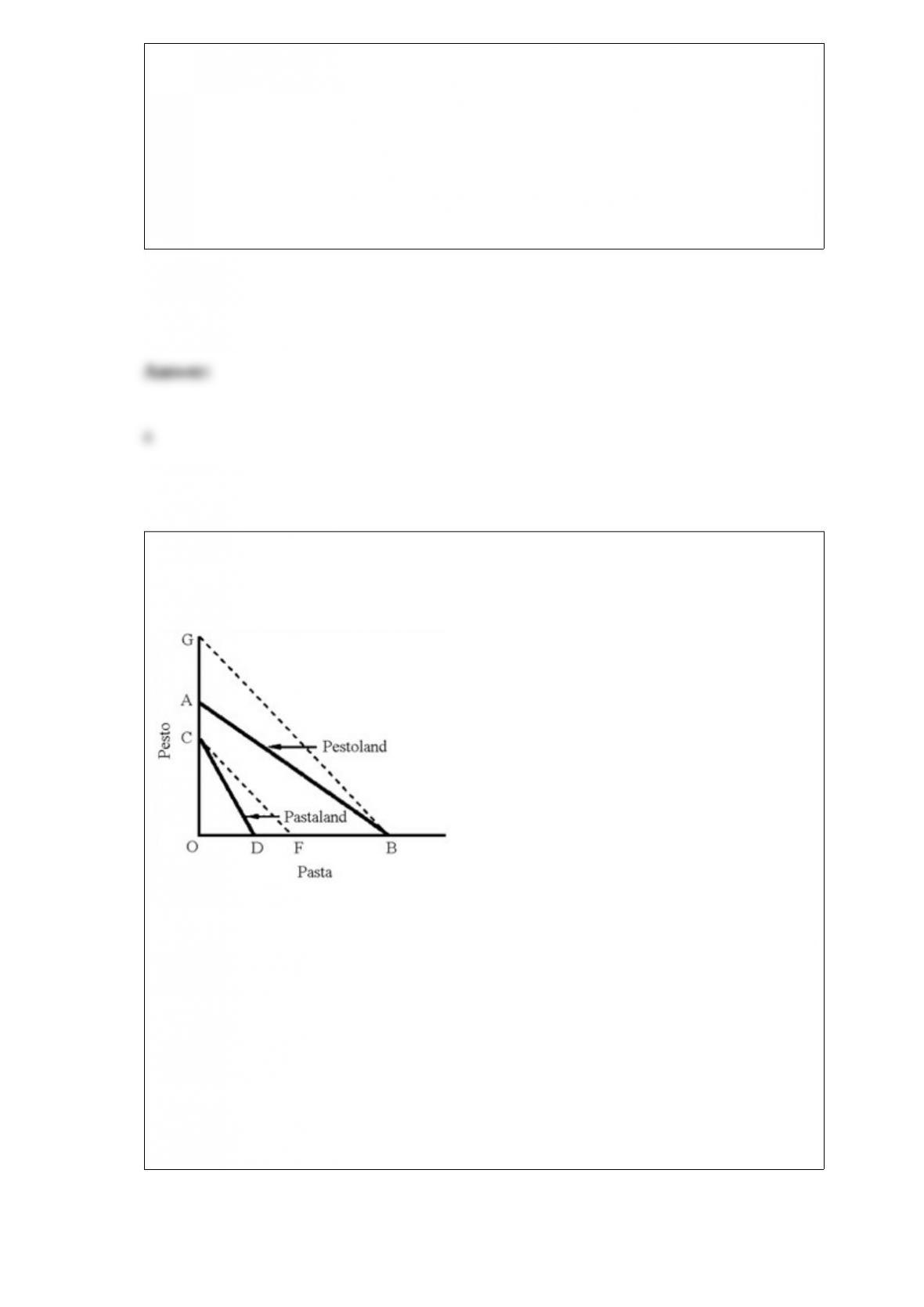
Figure 22-7
In Figure 22-7, CF has the same slope as BG. AB and CD are the production
possibilities of Pestoland and Pastaland, respectively. If both countries are given the
opportunity to trade at prices indicated by CF,
a. both will refuse trade.
b. both will agree to trade.
c. Pestoland will wish to trade, but Pastaland will not.
d. Pastaland will wish to trade, but Pestoland will not.

In 1989, Hurricane Hugo devastated Charleston, South Carolina, leaving residents with
no electricity for light or refrigeration, and completely cut off from the outside world by
fallen trees and washed-out roads. Consequently, the price of ice rose 1,000 percent and
generators 300 percent. Tree removal firms were charging $4,000 to cut up a single tree.
Outraged, the city government enacted an emergency law prohibiting price “gouging.”
This law is an example of
a. the cost disease of services.
b. a price ceiling.
c. the laissez-faire rule.
d. the indispensable necessity syndrome.
The most threatening and damaging detrimental externality at issue today is:
a. The explosion and oil spill at the Deepwater Horizon
b. the continued pollution of city air due to factory emissions
c. water shortages
d. global warming

If two countries have production possibilities curves with different slopes, there is no
possibility for gains from trade.
a. True
b. False
Most economists agree that the self-correcting mechanism works
a. very slowly.
b. very rapidly.
c. rapidly in the short run and slowly in the long run.
d. slowly in the short run and rapidly in the long run.
The U.S. economy is relatively open in terms of economic activity related to
international trade.
a. True

b. False
E. Carey Brown, an MIT economist, studied government deficits during the Great
Depression and found that even though actual deficits were large, the structural deficit
changed very little. Which of the following statements is consistent with this finding?
a. Fiscal policy did not work during the Depression.
b. Fiscal policy made the Depression worse.
c. Fiscal policy was not tried during the Depression.
d. Fiscal policy improved the economy during the Depression.
Price discrimination by a firm is
a. illegal under all circumstances.
b. legal if the firm can show that the difference in the prices charged customers is
justified by a difference in the costs of serving them.
c. legal if the firm can show that the demand for its good is relatively elastic.
d. legal under all circumstances.

Under the gold standard of a century ago, the world’s commerce
a. nearly collapsed before the beginning of World War I.
b. was at the mercy of gold discoveries.
c. grew steadily without interruption from monetary disturbances.
d. grew when the gold stock grew slowly, and shrank when gold discoveries increased.
The structural deficit or surplus
a. shows the government where to make cuts in expenditures to follow the balanced
budget requirement.
b. reveals the complicated structure underlying government spending and tax policy.
c. is the hypothetical deficit or surplus under current fiscal policies if the economy were
operating near full employment.
d. includes all government budgets-federal, state, and local.

Price floors set a legal minimum price on a product or commodity.
a. True
b. False
In 1996, if nominal GDP was about $8.5 thousand billion. The stock of money was
a. about the same as this.
b. much less than this.
c. much more than this.
d. unrelated to this number.