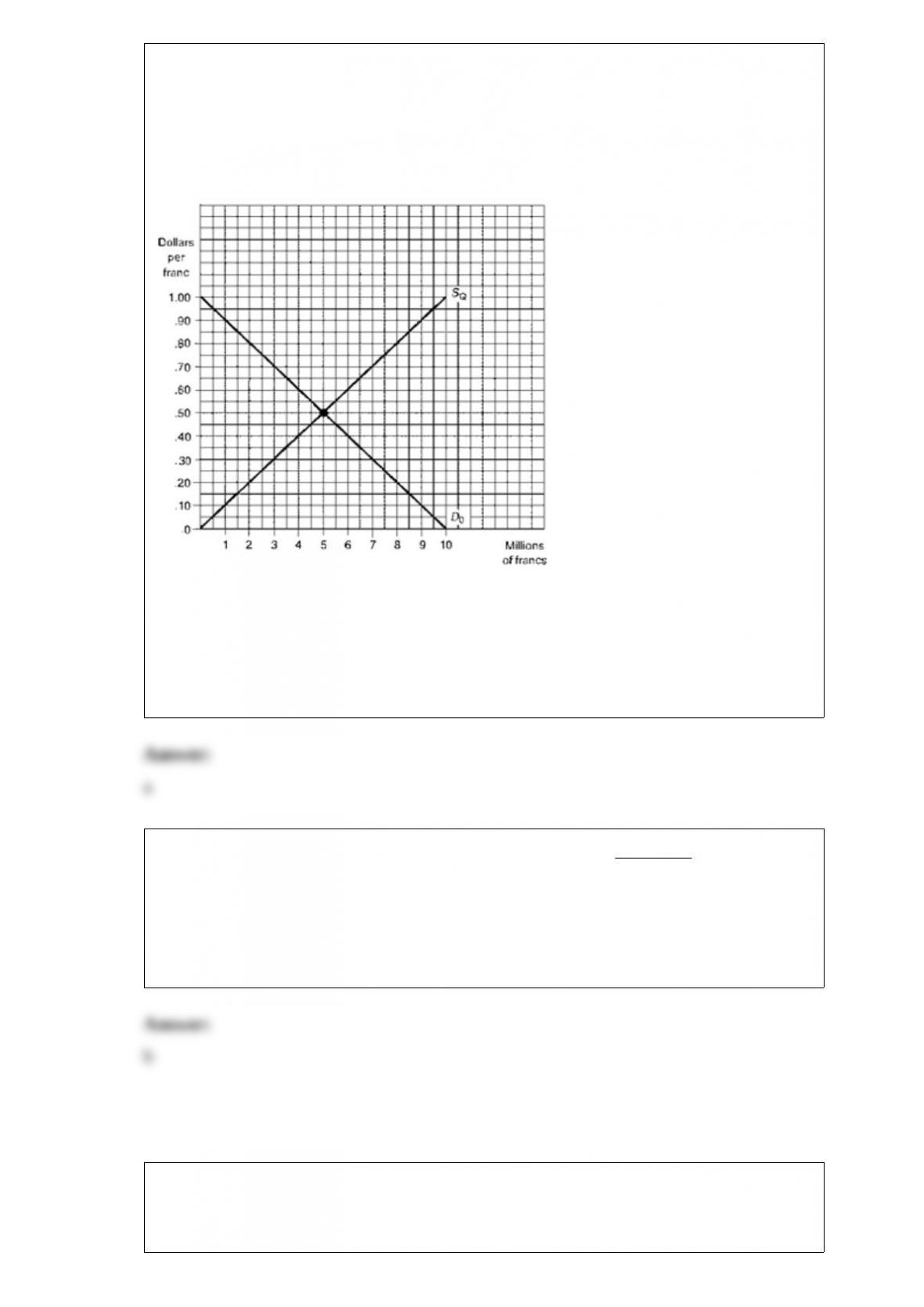
1) figure 11.1 illustrates the supply and demand schedules for the swiss franc. assume
that exchange rates are flexible.
figure 11.1. supply and demand schedules of francs
refer to figure 11.1. at the equilibrium exchange rate of ____ per franc, ____ francs will
be purchased at a total dollar cost of ____.
a.$.50, 5 million, $2.5 million
b.$.50, 5 million, $1.5 million
c.$.70, 3 million, $2.1 million
d.$.70, 7 million, $4.9 million
2) which example of market expectations causes the dollar to appreciate against the
yen–expectations that the u.s. economy will have:
a.faster economic growth than japan
b.higher future interest rates than japan
c.more rapid money supply growth than japan
d.higher inflation rates than japan
3) the bretton woods agreement of 1944 established a monetary system based on:
a.gold and managed floating exchange rates
b.gold and adjustable pegged exchange rates
c.special drawing rights and managed floating exchange rates
d.special drawing rights and adjustable pegged exchange rates
4) regarding the applicability of free trade to cigarettes, it is correct to say:
a.the rules of free trade apply to cigarettes
b.the rules of free trade should not apply to cigarettes
c.a and b are the topic of current debate
d.there are special rules applying to cigarettes world-wide
5) when the formation of a free trade area results in the reduction of trade with
nonmember nations in favor of member countries, ____ occurs.
a.trade devaluation
b.trade revaluation
c.trade creation
d.trade diversion
6) the european union protects its agricultural producers from import competition by the
use of tariff rates that vary directly with world prices.
a.true
b.false
7) concerning a country’s business cycle, rapid growth of production and employment is
commonly associated with:
a.large or growing trade deficits and current account deficits
b.large or growing trade deficits and current account surpluses
c.small or shrinking trade deficits and current account deficits
d.small or shrinking trade deficits and current account surpluses
8) empirical studies show that because voluntary export quotas are typically
administered by exporting countries, foreign exporters tend to:
a.raise their export prices, thus capturing much of the quota’s revenue effect
b.lower their export prices, thus losing much of the quota’s revenue effect
c.raise their export prices, thus selling more goods overseas
d.lower their export prices, thus selling fewer goods overseas
9) when the price of foreign currency (i.e., the exchange rate) is below the equilibrium
level:
a.an excess demand for that currency exists in the foreign exchange market
b.an excess supply of that currency exists in the foreign exchange market
c.the demand for foreign exchange shifts outward to the right
d.the demand for foreign exchange shifts backward to the left
10) figure 5.2 illustrates the revenue and cost conditions of abc inc. which sells
calculators in canada and france.
figure 5.2. international dumping
consider figure 5.2. in the absence of international dumping, abc inc. maximizes profits
by selling ____ calculators at a price of $____; the firm realizes profits totaling $____.
a.27, $5, $54
b.27, $5, $36
c.24, $4, $46
d.24, $4, $28
11) if a country’s terms of trade worsen, it must exchange fewer exports for a given
amount of imports.
a.true
b.false
12) the high foreign exchange value of the u.s. dollar in the early 1980s can best be
explained by:
a.additional investment funds made available from overseas
b.lack of investor confidence in u.s. fiscal policy
c.market expectations of rising inflation in the united states
d.american tourists overseas finding costs increasing