
Table 3-3
The table above shows the demand schedules for Kona coffee of two individuals (Luke
and Ravi) and the rest of the market. At a price of $4, the quantity demanded in the
market would be
A) 40 lb.
B) 70 lb.
C) 110 lb.
D) 150 lb.
Typically, as an economy begins to emerge from a recessionary phase of the business
cycle,
A) unemployment falls immediately.
B) unemployment continues to rise.
C) inflation begins to fall.
D) investment begins to fall.

Which of the following statements is true?
A) Exports benefit trading countries because exports create jobs. Imports do not benefit
trading countries because they result in a loss of jobs.
B) Each year China exports about 50 percent of its wheat crop and 40 percent of its rice
crop.
C) Most of the leading exporting countries are large, high-income countries.
D) All sectors of the U.S. economy are affected equally by international trade.
According to the Australian Wool Innovation, severe drought conditions in Australia
contributed to the lowest level of wool production in 50 years. This record low
production has driven up prices sharply in Australian wool markets. Meanwhile, the
price of raw cotton increased significantly for the first time in many years.
a. Illustrate this observation with one demand and supply graph for the market for
Australian wool and another demand and supply graph for raw cotton.
b. Make sure that your graphs clearly show (1) the initial equilibrium before the
decrease in the supply of Australian wool and (2) the final equilibrium.
c. Use arrows to indicate any shifts in the demand and supply curves for each market.
d. Label your graphs fully and write an explanation of your work.

If national income increases by $75 million and consumption increases by $15 million,
the marginal propensity to consume is
A) 5.
B) 0.75.
C) 0.20.
D) 0.15.
Table 6-2

Assume that an economist has estimated the price elasticity of demand values in the
table above. Use the data in the table to select the correct statement.
A) The demand for Coca-Cola is inelastic.
B) The elasticity for “All soft drinks” is less than the elasticity for Coca-Cola because
Coca-Cola is more of a luxury than a necessity; “All soft drinks” represent goods that
are more necessity than luxury.
C) The difference in elasticity values is explained by the fact that the more narrowly we
define a market the more elastic the demand will be.
D) There are fewer substitutes for “All carbonated soft drinks” than there are for “All
soft drinks.”
Which of the following is an asset for a bank?
A) deposits of its customers
B) short-term borrowing
C) shareholders’ equity
D) loans
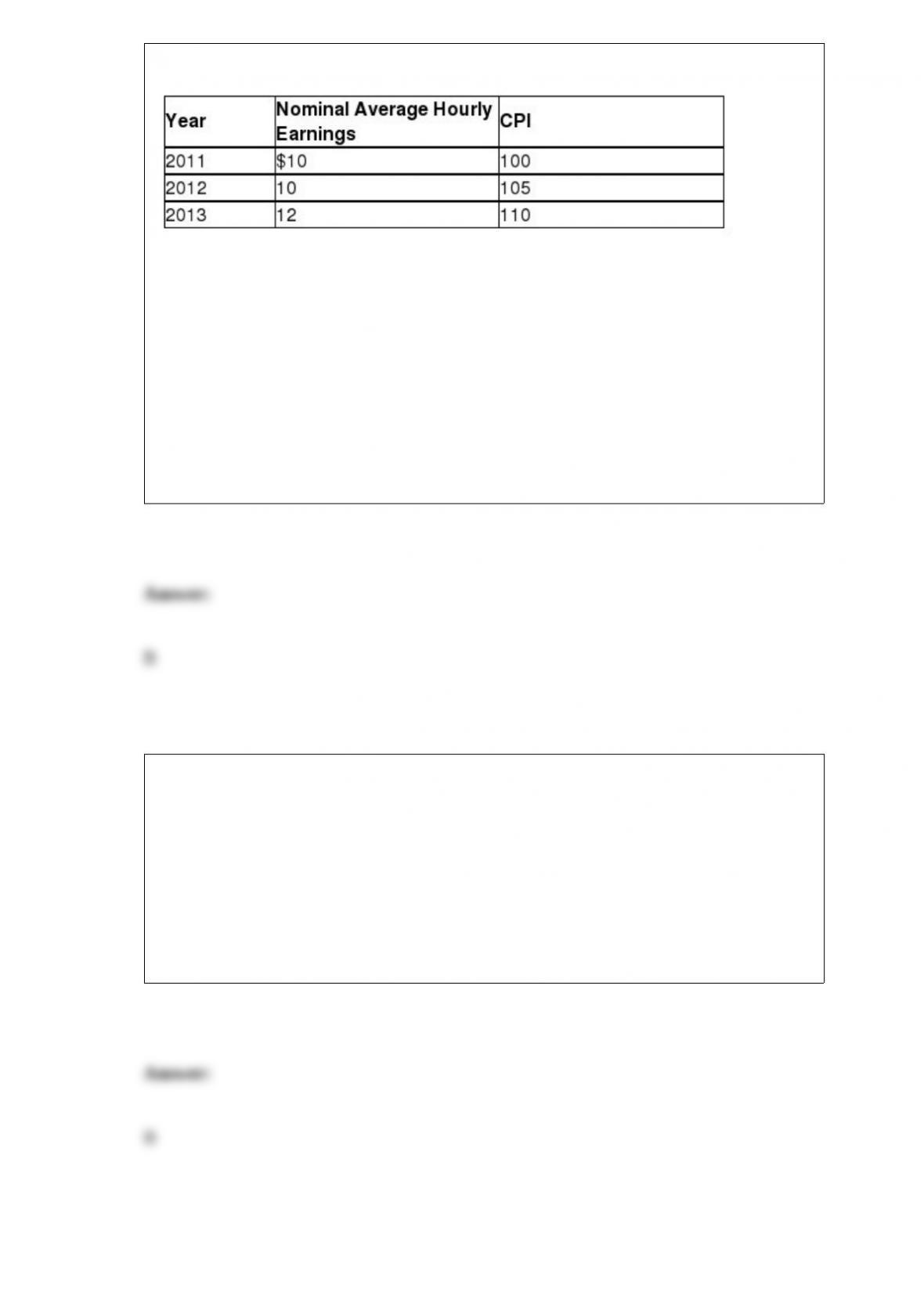
Table 9-15
Looking at the table above, real average hourly earnings were equal to ________ in
2012.
A) $9
B) $9.52
C) $10
D) $12
If expected inflation falls, the long-run Phillips curve will
A) shift to the right.
B) not be affected.
C) shift to the left.
D) become negatively sloped.

Figure 18-5
Figure 18-5 shows the Lorenz curve for a hypothetical country. The highest 20 percent
of households
A) earn 24 percent of the society’s total income.
B) earn 28 percent of the society’s total income.
C) earn 42 percent of the society’s total income.
D) earn 72 percent of the society’s total income.
If planned aggregate expenditure is less than total production,
A) actual inventories will equal planned inventories.
B) firms will experience an unplanned decrease in inventories.
C) GDP will decrease.
D) the economy is in equilibrium.
Figure 2-4

Figure 2-4 shows various points on three different production possibilities frontiers for
a nation. Consider the following events:
a. an increase in the patent protection period to 30 years
b. an increase of a nation’s capital stock
c. an improved property rights system Which of the events listed above could cause a
movement from V to W?
A) a only
B) a and b only
C) a and c only
D) b and c only
E) a, b, and c
What impact does an increase in the price level in the United States have on net exports
and why?
A) An increase in the price level decreases net exports because higher prices decrease
the value of the dollar.
B) An increase in the price level decreases net exports by increasing the relative cost of

American goods.
C) An increase in the price level increases net exports because higher prices lower the
value of the dollar.
D) An increase in the price level increases net exports because higher prices decrease
American spending on imports.
If a firm knew every consumer’s willingness to pay and could prevent arbitrage it could
charge every consumer a different price. This practice is known as
A) first-degree exploitation, or perfect price discrimination.
B) maximization of producer surplus, or perfect price discrimination.
C) first-degree price discrimination, or perfect price discrimination.
D) first-degree transfer of consumer surplus, or perfect price discrimination.
If aggregate demand just decreased, which of the following may have caused the
decrease?
A) a decrease in exports
B) a decrease in the interest rate
C) a decrease in the price level
D) a decrease in imports
Suppose the Fed decreases the money supply. In response households and firms will
________ short term assets and this will drive ________ interest rates.
A) buy; up
B) buy; down
C) sell; up
D) sell; down
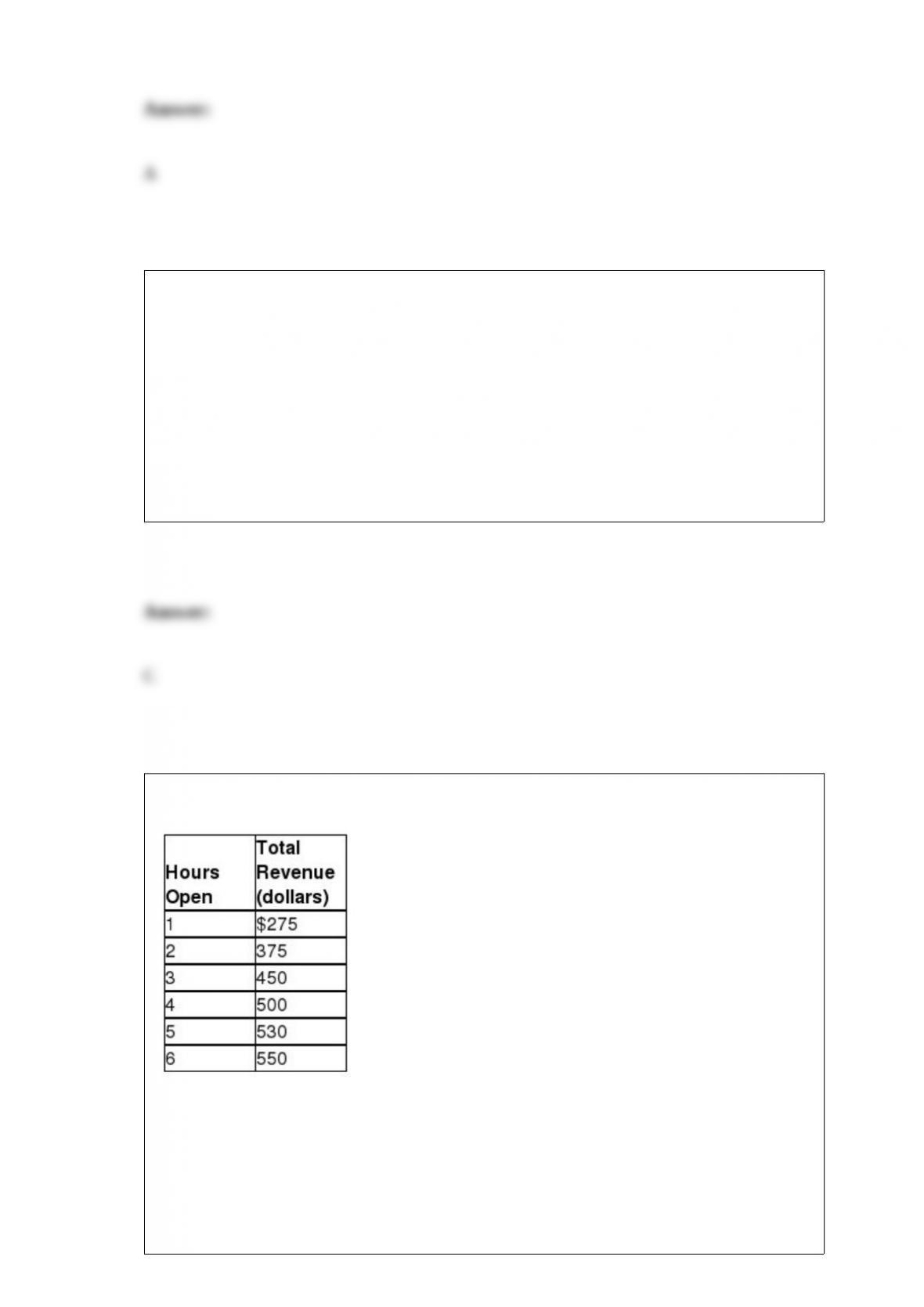
Table 1-3
Ivan runs a custom jewelry shop in Sparkle City. He is debating whether he should
extend his hours of operation. Ivan figures that his sales revenue will depend on the
number of hours the jewelry shop is open as shown in the table above. He would have
to hire a worker for those hours at a wage rate of $25 per hour. What is Ivan’s marginal
benefit if he decides to stay open for six hours instead of five hours?
A) $10

B) $20
C) $30
D) $91.67
If the CPI rises from 206.7 to 212.7 between two consecutive years, by how much has
the cost of living changed between these two years?
A) The cost of living has increased by 6%.
B) The cost of living has increased by 2.9%.
C) The cost of living has increased by 12.7%.
D) The cost of living has decreased by 6%.
Which of the following is an example of the U.S. government’s use of a “command and
control” approach to reducing pollution?
A) In 1990 Congress approved measures designed to reduce sulfur dioxide emissions to
8.5 million tons annually by 2010.
B) The U.S. government imposed a tax on electric utilities to reduce damages from acid
rain.
C) The government issued electric utilities tradable emissions allowances in other to
reduce emissions of nitrogen oxide.

D) In the 1980s the U.S. government required the installation of catalytic converters to
reduce emissions from all new automobiles.
If the demand curve for a firm is downward-sloping, its marginal revenue curve
A) will lie above the demand curve.
B) will lie below the demand curve.
C) is the same as the demand curve.
D) is horizontal.