1) Which of the following is an example of a capital-intensive commodity?
A.clothing
B.wool
C.sunflower seeds
D.chemicals
2) How many commercial banks are now operating in the United States?
A.about 140,000
B.about 7,300
C.about 11,000
D.about 6,300
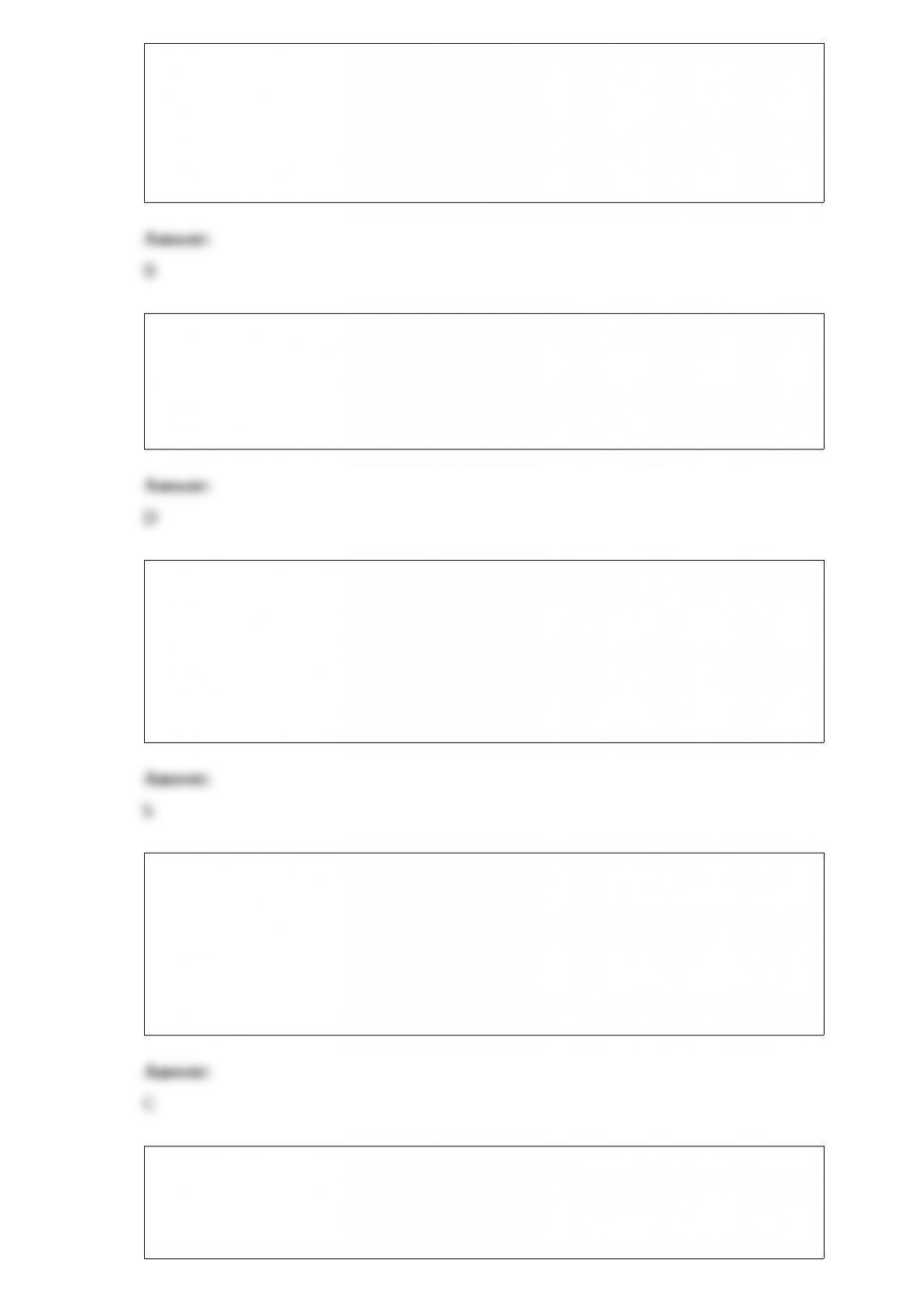
3)
Refer to the above table. If the full-employment real GDP is $70 the:
A.inflationary expenditure gap is $30.
B.recessionary and inflationary expenditure gaps are both $0.
C.inflationary expenditure gap is $10.
D.recessionary expenditure gap is $10.
4) suppose a product creates substantial negative externalities. if government adopts a
policy that forces producers to pay these costs, the:
a.output of the product will decrease.
b.initial misallocation of resources will be intensified.
c.output of the product will increase.
d.price of the product will decrease.
5) If a $10 billion decrease in lump-sum taxes increases equilibrium GDP by $40 billion
then:
A.the multiplier is 4.
B.the MPC for this economy is .8.
C.the MPC for this economy is .6.
D.the multiplier is 3.
6) Economist Milton Friedman is most closely associated with:
A.Keynesian economics.
B.the rational expectations theory.
C.supply-side economics.
D.monetarism.
7) suppose that a business incurred implicit costs of $200,000 and explicit costs of $1
million in a specific year. if the firm sold 4,000 units of its output at $300 per unit, its
accounting profits were:
a.$100,000 and its economic profits were zero.
b.$200,000 and its economic profits were zero.
c.$100,000 and its economic profits were $100,000.
d.zero and its economic loss was $200,000.
8) Which of the following statements concerning the relative distribution of income is
correct?
A.The relative distribution of before-tax incomes has become decidedly more equal
since 1970.
B.Taxes increase, but transfer payments decrease, the degree of income inequality.
C.Taxes and transfer payments both decrease the degree of income inequality.
D.Taxes and transfer payments both increase the degree of income inequality.
9) If the marginal propensity to consume is 0.9 in a private closed economy, a $20
billion decline in investment spending will decrease:
A.GDP by $20 billion.
B.GDP by $100 billion.
C.saving by $20.
D.consumption by $200 billion.
10) Suppose population A, consisting of Al, Bob, Curt, Doris, and Ellie, receive annual
incomes of $5,000, $2,500, $1,250, $750, and $500, respectively.
Refer to the above information. What percentage of total income is received by the
richest quintile?
A.50
B.5
C.25
D.20
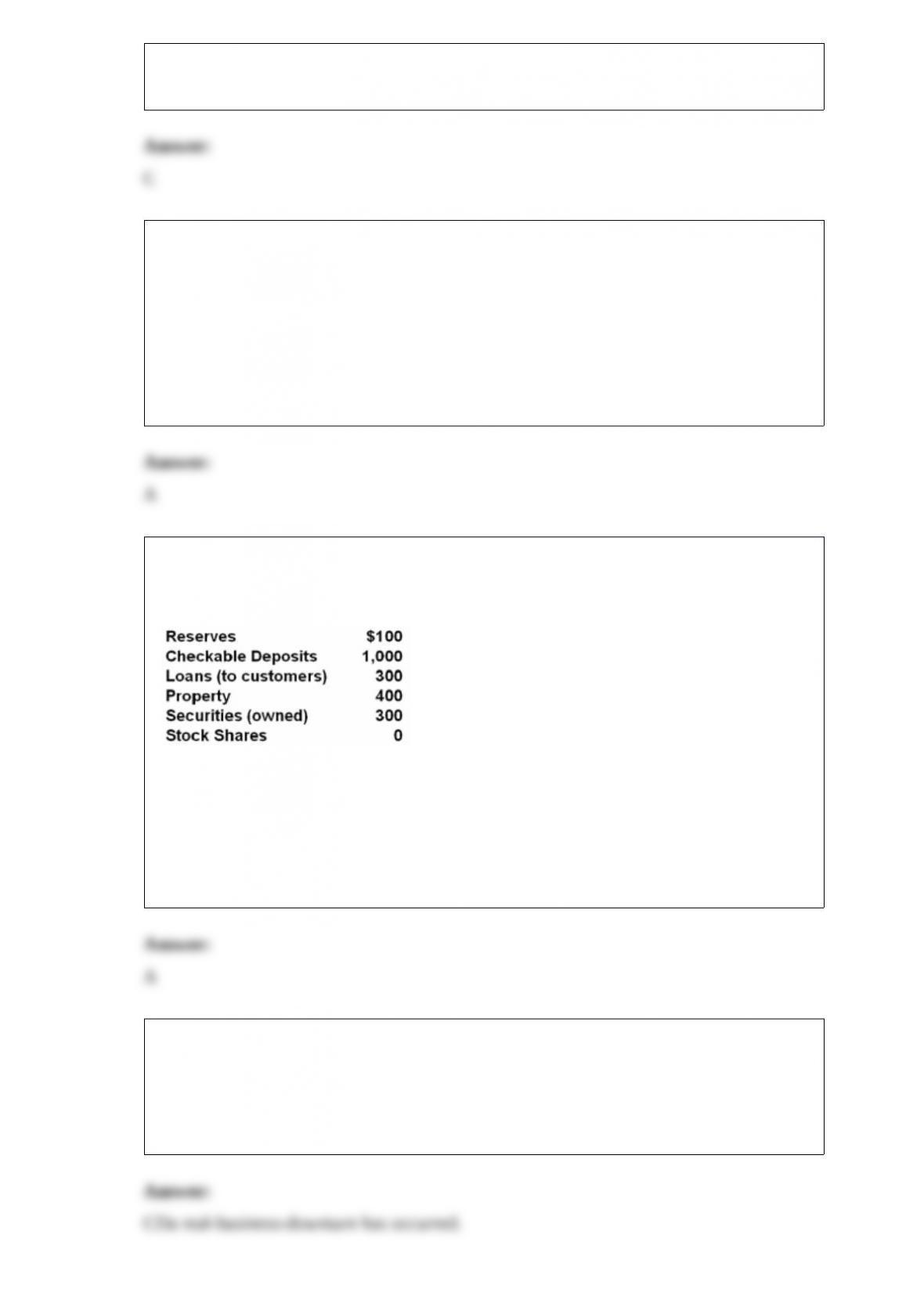
11) The following information for the Moolah Bank.
Refer to the above information. If Moolah Bank is legally “loaned up,” the reserve
requirement must be:
A.10 percent.
B.15 percent.
C.20 percent.
D.25 percent.
12) When most consumers and firms reduce spending only because they expect other
consumers and firms to reduce spending, and a recession results:
A.a self-correction has occurred.
B.an adverse aggregate supply shock has occurred.
C.a coordination failure has occurred.
13) Other things equal, trademarks and brand names:
A.increase the interest-rate cost of funds used to finance R&D expenditures.
B.decrease the interest-rate cost of funds used to finance R&D expenditures.
C.decrease the expected rate of return on R&D expenditures.
D.increase the expected rate of return on R&D expenditures.
14) the price elasticity of demand coefficient measures:
a.buyer responsiveness to price changes.
b.the extent to which a demand curve shifts as incomes change.
c.the slope of the demand curve.
d.how far business executives can stretch their fixed costs.
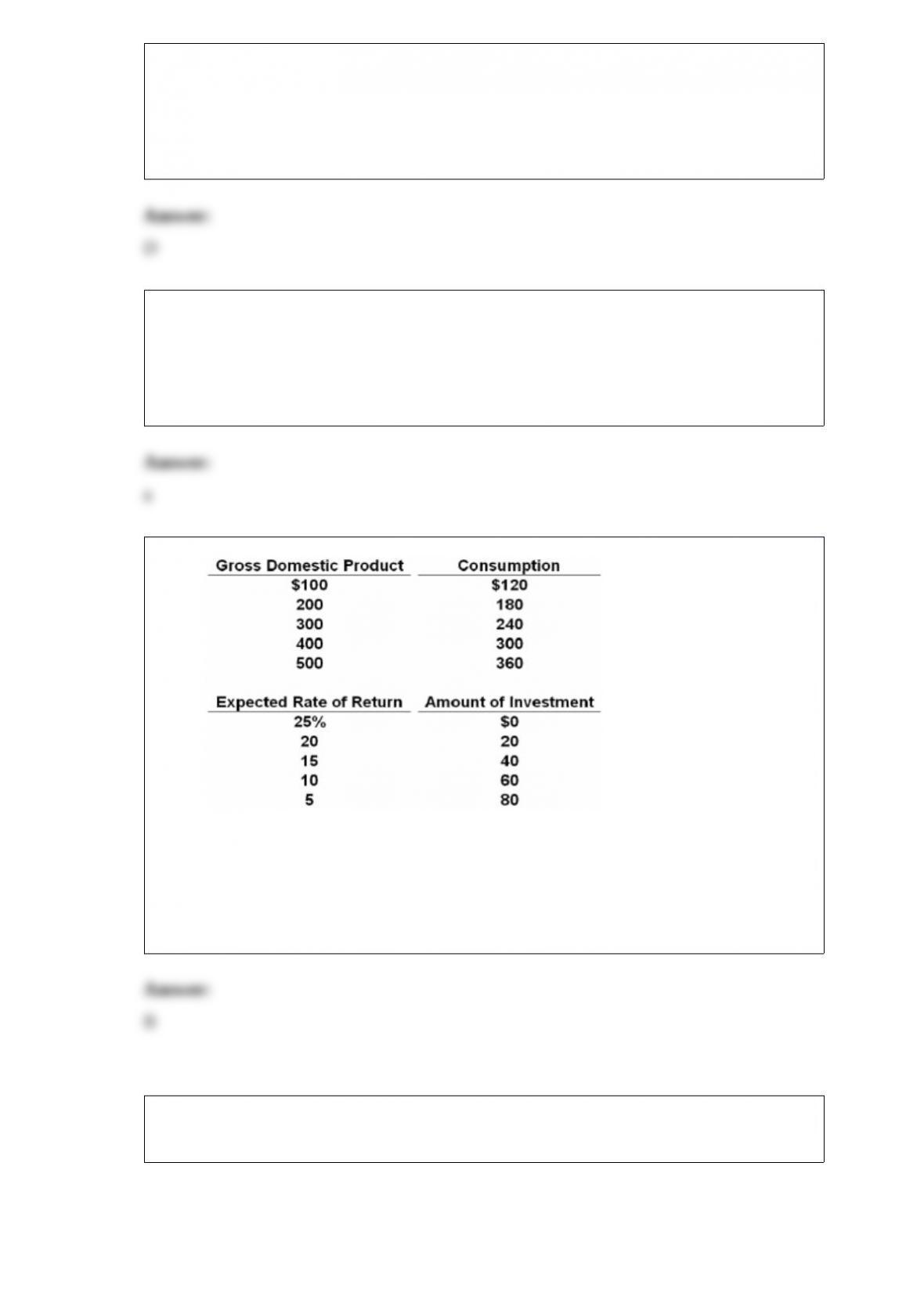
15)
Refer to the above information. The data suggest that:
A.the interest rate and the equilibrium GDP are directly related.
B.the interest rate and the equilibrium GDP are inversely related.
C.the interest rate and the equilibrium GDP are unrelated.
D. as the interest rate falls, investment also falls.
16) answer the next question(s) on the basis of the following production possibilities
tables for two countries, north cantina and south cantina:
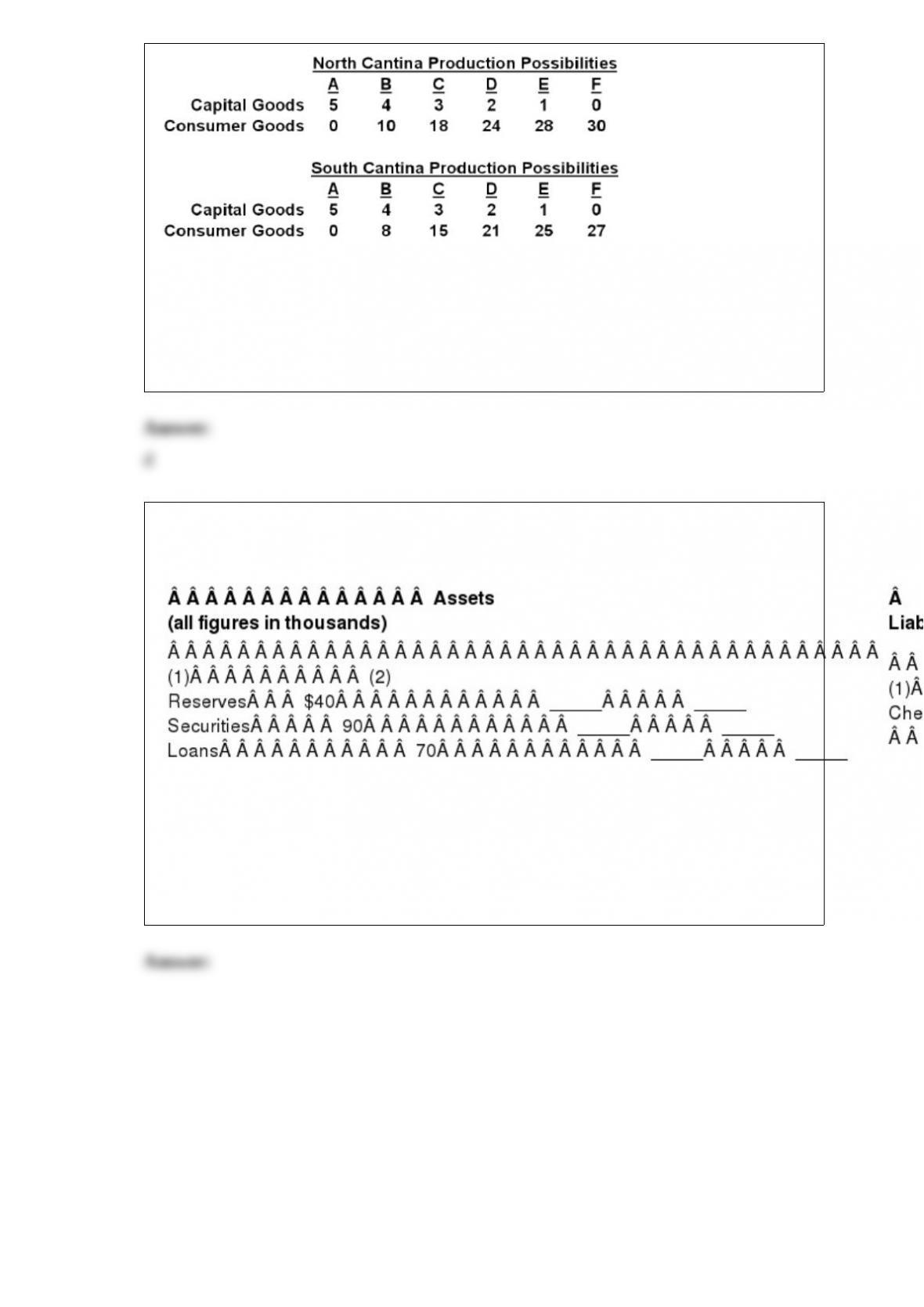
refer to the above tables. if south cantina is producing at production alternative d, the
opportunity cost of the third unit of capital goods will be:
a.3 units of consumer goods.
b.4 units of consumer goods.
c.5 units of consumer goods.
d.6 units of consumer goods.
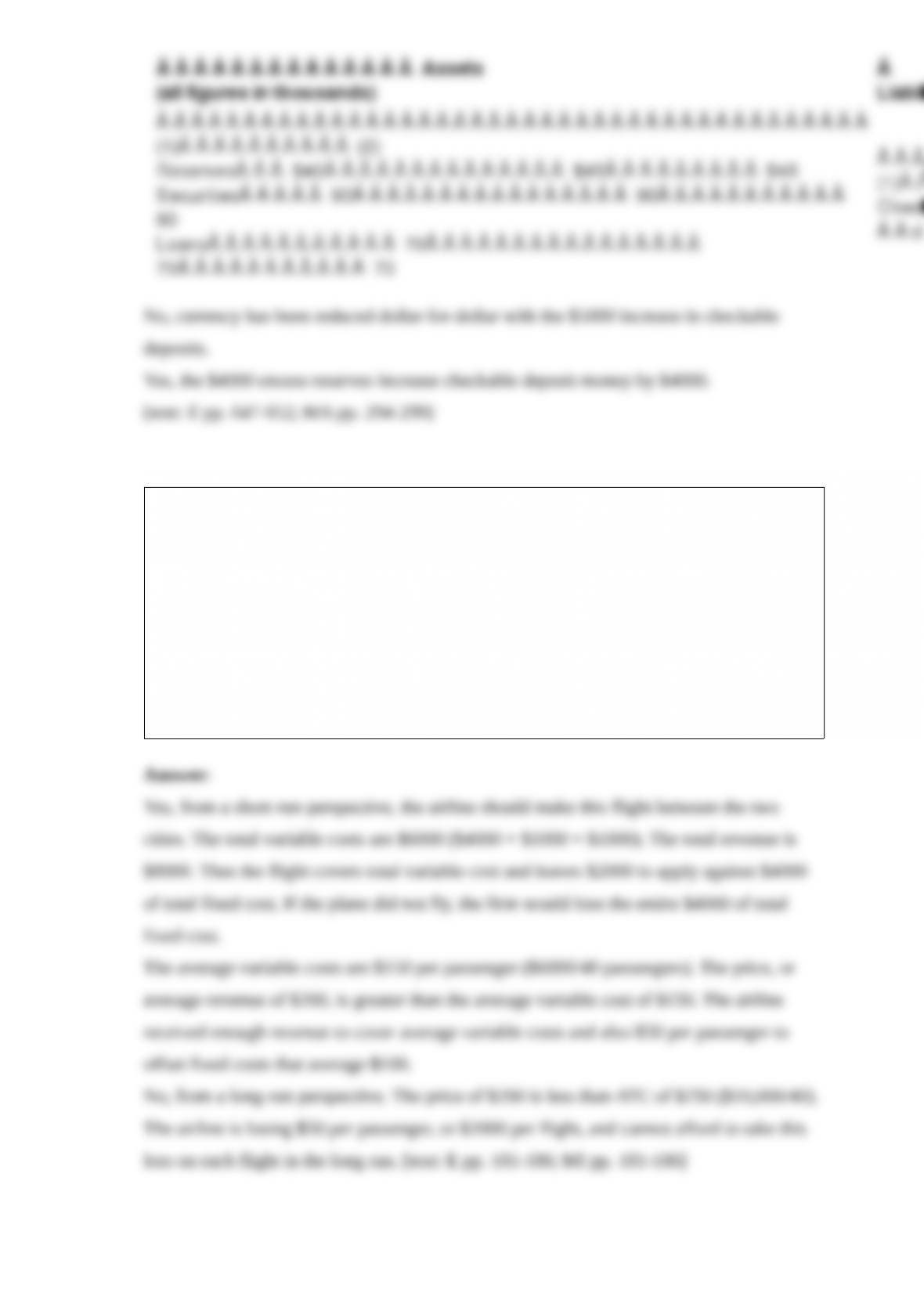
17) Suppose the First National Bank has the following simplified balance sheet. The
reserve ratio is 20%.
Assume that households and businesses deposit $5000 in this bank and that this
currency is added to the banks reserves.
In column (1) show the banks balance sheet after this occurs. Is there a change in the
money supply?
In column (2) show what would happen if the bank now loans all of its excess reserves
to a depositor. Is there a change in the money supply?
18) An airline is flying between two cities. The airline has the following costs
associated with the flight:
Crew $4000
Fuel 1000
Plane daily insurance 2000
Landing fee 1000
Plane daily depreciation $2000
The airline has an average of 40 passengers paying an average of $200 for this flight.
Do you think the airline should be flying between the two cities? Evaluate from a
short-run and long-run perspective.
19) What effects do immigrants have on tax revenues and government spending in the
United States?
20) What is the effect on the money supply when a commercial bank buys government
securities from the public?
21) What are coordination failures and why are they important for interpreting the
macro economy?